PART 1
Ricardo Salgado returned home in the Del Valle neighborhood two days earlier than planned, a bag of sweet bread in one hand and a bouquet of calla lilies in the other.
He had gone to Guadalajara for work, but the meeting ended early. He didn’t inform anyone because, after 26 years of marriage, he still loved seeing the look of surprise on Sofía's face when he appeared out of nowhere.
But that afternoon, the surprise caught in his throat.
His son Bruno's black truck was parked haphazardly in front of the gate. Valeria, his daughter-in-law's car was also there, along with the gray Versa belonging to her parents, Don Rogelio and Doña Irene.
Ricardo frowned. No one had told him there would be a family gathering.
The front door was ajar.
Inside, the smell of chlorine, lemon, and freshly brewed coffee filled the air.
But beneath it all, there was another smell.
Blood.
Ricardo dropped the bread onto the foyer and walked toward the living room.
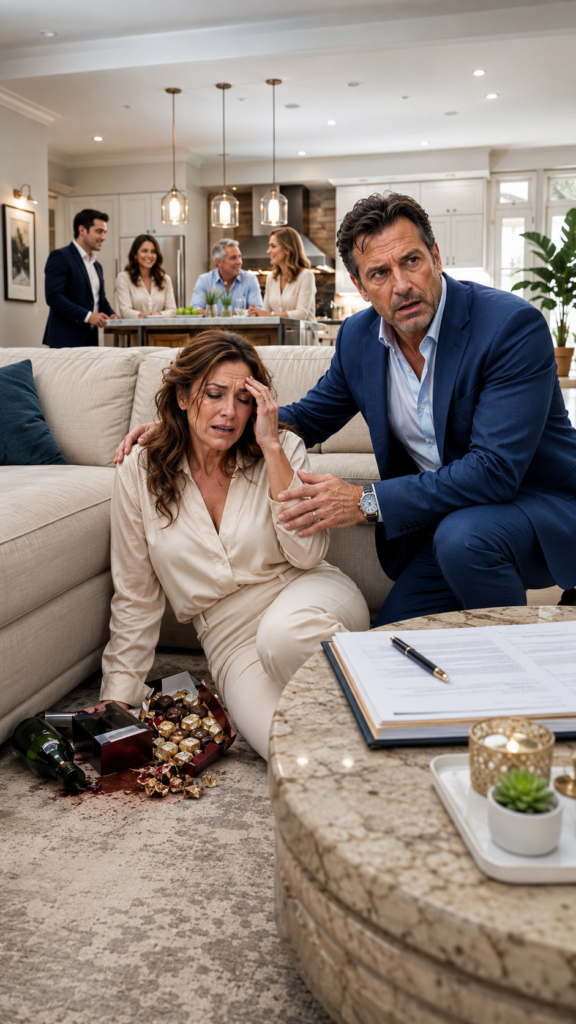
There he saw Sofía.
She was sitting on the floor, leaning against the TV stand, one hand pressed to her brow and her white blouse stained red. Her hair was a mess, her lip split, and her eyes were filled with a shame that hurt Ricardo more than the wound.
—Sofi… what happened?
He knelt before her.
Before she could respond, a laugh erupted from the kitchen.
It was Bruno.
Then Don Rogelio's voice echoed:
—Come on, man, it wasn’t that bad. Women sometimes make a drama out of nothing.
Ricardo felt his chest tighten.
His wife was bleeding less than five meters away, and his son was in the kitchen, laughing with his in-laws as if nothing had happened.
Sofía squeezed his wrist.
—I didn’t sign —she whispered—. They were trying to force me, Ricardo. I didn’t sign.
On the coffee table lay an open yellow folder. Ricardo carefully picked it up.
Inside were copies of deeds, notarized documents, and a sales contract.
The house in Progreso.
The house that Sofía’s mother had left her before dying.
The house where Sofía had learned to swim, where she still kept her mother’s clay cups, an old hammock, and the green tiles nobody had wanted to change.
Ricardo read the first page.
It wasn’t a proposal.
It was a contract ready for signature.
In the kitchen, Bruno said:
—My mom always gets intense, seriously. She’ll come out with tales of how we attacked her.
Sofía closed her eyes.
—He pulled me by the arm. He pushed me into the chair. I fell against the corner of the table.
Ricardo took out his cell phone.
He photographed the blood, the wound, the folder, the documents, and the open door.
Then he called 911.
Sofía didn’t ask him to hang up.
She simply said, her voice broken:
—Don’t let them take my mother’s house.
Ricardo stood and walked into the kitchen.
Bruno had a shot of tequila in his hand. Valeria stared at the floor. Don Rogelio smiled as if he were closing a business deal. Doña Irene was folding napkins with a sickening calmness.
—No one moves —Ricardo said, leaving the phone on the bar with the call still active.
Bruno stood up.
—Dad, calm down. This is a family matter.
Ricardo looked at the blood on his own hands.
—My wife is hurt in the living room. You’re here toasting. This is no longer family, Bruno. This is disgusting.
Don Rogelio raised his hands.
—Don Ricardo, please don’t get upset. We just wanted to help you resolve a property issue.
From the living room, Sofía shouted:
—Check the second page!
Ricardo returned to the folder.
Then he saw what they really wanted to hide.
The money from the sale wouldn’t go into Sofía’s account.
It would go straight to a business account called Grupo BVR, registered under Bruno, Valeria, and Rogelio’s names.
Bruno rushed to snatch the paper away.
—You weren’t supposed to see that!
In that moment, sirens began to wail outside.
But Ricardo no longer looked at the police.
He stared at the second page because he had just realized that the worst was yet to come.
PART 2
Bruno clutched the papers to his chest as if he could still hide them.
Valeria stood up from the table, pale.
—I didn’t know the account was like that —she said almost in a whisper—. I was told it was a temporary loan.
Bruno turned to her with a cold stare.
—Shut up, Valeria.
That “shut up” said more than any explanation.
Ricardo then noticed something he hadn’t seen in his anger. Valeria had swollen eyes, trembling hands, and an old bruise on her right wrist.
Doña Irene pulled her by the arm.
—Don’t start with your nonsense, daughter. Remember everything Bruno has done for you.
The police arrived minutes later. Paramedics treated Sofía in the living room. Bruno spoke first, quickly, far too confidently.
—My mom tripped. We came to discuss a sale she had already agreed to. My dad arrived upset and is exaggerating everything.
Ricardo raised his cell phone.
—The call is recorded. And I took photos before they touched anything.
Bruno turned pale.
Don Rogelio tried to smile.
—Officer, really, this can be resolved within the family. No need for a scene.
Sofía, with a bandage on her brow, spoke from the couch.
—I never agreed to sell.
The officer asked everyone to separate.
When the paramedics lifted her into the ambulance, Sofía took Ricardo's hand.
—In my sewing box —she murmured—. There’s a blue memory stick. Don’t let Bruno find it.
Ricardo returned to the living room. Inside a box of threads, buttons, and needles, he found a small, blue USB drive wrapped in a handkerchief.
Bruno saw him from the kitchen.
—Dad, give me that.
Ricardo tucked it into his pocket.
—Now you’re scared, huh?
In the emergency room, Sofía received six stitches. The wound wasn’t severe, but the blow she had inside was something no doctor could heal.
—He told me that a good mother doesn’t let her son die —she recounted, staring at the ceiling—. He said that if I didn’t sign, his restaurant would go bankrupt because of me. That I was selfish for clinging to an old house.
Ricardo didn’t interrupt her.
He simply held her hand.
That night, when they returned home, they connected the memory stick to the computer.
There were audio files.
Not from that day.
From weeks before.
Sofía had started recording when Bruno began visiting her unannounced, always with the same phrase: “Mom, it’s for the future of the family.”
In the first audio, Bruno said:
—Don’t be ridiculous. A beach house isn’t worth more than your son.
In another, Don Rogelio explained:
—If she signs the first page, the rest will be added later. She won’t even notice.
Ricardo felt nauseated.
Then they heard Doña Irene’s voice:
—Mothers are moved by guilt. Tell her you’ll be left on the street, and she’ll sign.
Sofía covered her mouth.
But the final audio was the one that broke her.
Bruno was talking to Julián, his restaurant partner.
—My dad is out. My mom doesn’t check anything. If we pressure her, she’ll sign. If she cries, let her cry. Later we’ll tell her it was for her own good.
Then Valeria’s voice appeared.
—Bruno, that’s already fraud. And your mom isn’t well. You’re scaring her.
Bruno responded:
—Fraud is when an old woman clings to memories while we lose everything, man.
Sofía didn’t scream.
She didn’t curse.
She just stared at the screen as if she had lost her son a second time: first the child she raised, then the man he had become.
The next day, Ricardo and Sofía went to see a lawyer in Coyoacán, Licenciada Elena Vargas.
The lawyer calmly reviewed each document.
—The good news is that your signature isn’t on any of them yet. Nothing has been registered. The house is still yours.
Sofía breathed for the first time in hours.
But Elena didn’t stop there.
—The bad news is that your son already promised that property as a verbal guarantee with a private lender. If he doesn’t deliver the documents in 48 hours, his debt becomes enforceable.
Ricardo clenched his jaw.
—How much?
The lawyer looked at Sofía carefully.
—3,800,000 pesos.
Sofía closed her eyes.
Bruno’s restaurant, “La Mesa Brava,” had been losing money for months. He had never mentioned it. He bragged online, posting pictures of fine cuts, expensive wines, and success quotes. But inside, he was broke.
And he had decided to pay for his failure with his mother’s inheritance.
That afternoon, Bruno came again.
But this time he wasn’t alone.
He came with Don Rogelio, Julián, and a man in a gray suit who didn’t greet anyone. He looked around the living room as if appraising furniture.
—Mrs. Sofía —the man said—, your son assured us you were on board.
Ricardo stood in front of her.
—This conversation is over.
Bruno’s eyes were sunken.
—Mom, sign. Please. If you don’t, I’m going to lose everything.
Sofía looked at him.
—And that’s why you left me bleeding on the floor?
Bruno swallowed hard.
—It was an accident.
—No —Valeria said from the doorway.
Everyone turned.
Valeria had arrived silently. She held a purple folder against her chest, her face set in determination.
Bruno took a step toward her.
—What are you doing here?
Valeria raised the folder.
—What I should have done from the start.
She pulled out copies of messages, bank statements, and a printed conversation.
The truth was worse than Sofía had imagined.
Grupo BVR wasn’t just an account to receive the money from the house. It was a company created three months earlier by Bruno and Rogelio. Valeria was listed as a partner, yes, but her signature had been digitally forged without permission.
Don Rogelio wasn’t “helping.”
He had planned to keep part of the money.
And Julián was already preparing a contract to sell the restaurant after receiving the transfer, leaving Bruno with debts and Sofía without a home.
Bruno looked at his father-in-law.
—What is this?
Don Rogelio lost his smile.
—Business, kid. You wanted to use your mother too.
That phrase shattered what little remained of the family scene.
The lender quickly understood.
—Did you offer me a guarantee that wasn’t yours?
No one answered.
Licenciada Elena, whom Sofía had called on speaker since she saw Bruno arrive, listened to everything.
—Mrs. Sofía —she said from the phone—, don’t sign anything. We’ve already filed a preventive notice regarding the property. And with what has just been heard, we will expand the complaint for attempted fraud, forgery, and assault.
Bruno sank into a chair.
—Mom… I didn’t want it to come to this.
Sofía looked at him with a calm that hurt.
—No, Bruno. You wanted it to come to my signature. The rest didn’t matter to you.
The following days were hell.
Bruno called 31 times.
First, he apologized.
Then he cried.
Later he insulted.
Soon after, he left messages saying that Sofía was a cruel mother, that no child deserved to be treated like a criminal, that a house wasn’t worth more than blood.
Sofía listened to every message.
Ricardo wanted to block him, but she shook her head.
—I need to hear if he ever truly regrets it.
The regret didn’t come quickly.
Guilt dressed as love arrived.
An audio came where Bruno said:
—If I lose my life, remember that you could have saved me.
Sofía responded only once.
She wrote:
—I can’t save you by surrendering myself again.
Then she turned off her phone.
The legal process moved slowly, like everything that mixes papers, blood, and last names. The notary denied having issued the documents. The seal was fake. The business account did exist. The audio files were submitted. Valeria testified that Bruno had grabbed Sofía by the arm and that Don Rogelio pressured her not to intervene.
—I stayed silent out of fear —Valeria said before the Prosecutor’s Office—. But seeing her bleeding while they laughed was too much. Honestly, it disgusted me.
Weeks later, “La Mesa Brava” closed.
Julián disappeared with supplier money.
Don Rogelio tried to blame Bruno, but the messages sank him. Doña Irene stopped calling Sofía “dramatic” when she realized she could also be investigated.
Bruno sold his truck.
Valeria moved in with a cousin in Querétaro and filed for divorce.
Sofía didn’t celebrate anything.
There was no victory when the one falling was the son she once patched up scraped knees for, made sandwiches for school, and saved birthday cake for even if she arrived late.
One night, Ricardo changed the locks of the house.
When he removed the copy Bruno had had since he was 18 from the keychain, Sofía broke down.
—This is where he learned to walk —she said, looking at the door—. This is where he got chickenpox. Here he told me that when he got rich, he would buy me a mansion.
Ricardo hugged her.
—He can still be your son without having permission to hurt you.
That phrase lingered in the house like an uncomfortable truth.
In January, Sofía traveled to Progreso.
She went alone.
The beach house was dusty. The hammock smelled musty. The patio plants were dry. In the kitchen still hung her mother’s blue cup, the one no one could touch.
Sofía opened the windows.
The salty air entered as if the house had also been waiting for justice.
She walked through each room. Touched the walls. Remembered her mother making coffee, cutting papaya, singing softly while sweeping the sand at the entrance.
For years she thought that house was an inheritance.
That day she understood it was also a limit.
A border.
Something that no one, not even a son, had the right to cross.
Months later, Bruno sent a handwritten letter.
He didn’t ask for money.
He didn’t ask for the house.
For the first time, he didn’t blame Rogelio, or Julián, or bad luck, or the crisis.
He wrote that he had confused need with right. That he had used the word “mother” as if it were a key. That seeing her bleed and not getting up was the greatest shame of his life.
Sofía read the letter three times.
Then she put it away in a drawer.
She didn’t run to forgive him.
Nor did she hate him.
She just understood that forgiveness, if it ever came, wouldn’t be a signature, or an open door, or a new copy of the key.
One night, free from bandages and fear, Sofía sat with Ricardo in the patio of their home in Del Valle. The smell of coffee wafted from the kitchen. The street was quiet.
She took a deep breath.
—I won’t sign anything out of guilt again —she said—. Not out of fear. Not to please anyone. Not even to be a mother.
Ricardo took her hand.
Sofía looked at the closed door.
—A mother can love deeply… but she also has the right to protect herself.
And that was the phrase that remained in Ricardo's memory.
Not the laughter in the kitchen.
Not the sirens.
Not the broken glass.
But the voice of Sofía, serene and firm, finally understanding that sometimes justice doesn’t begin in a courtroom.
It begins the day a woman stops asking for forgiveness for defending what is hers.





