PART 1
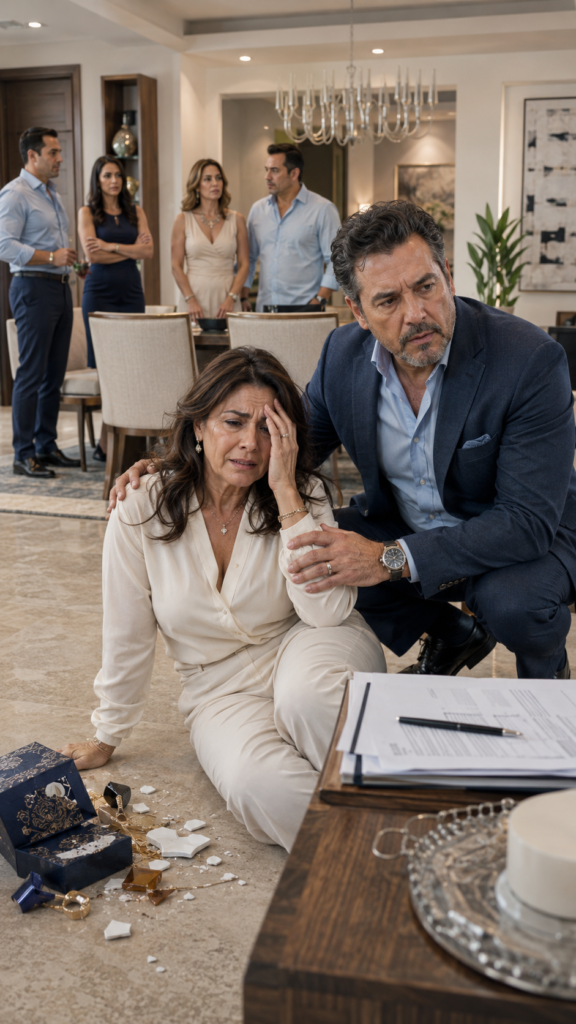
When Ramón Castañeda opened the door to his house in the Del Valle neighborhood, two days ahead of schedule, the first thing he heard wasn’t a greeting.
It was a cold phrase, spat with rage from the kitchen.
—If you don’t sign today, Mom, don’t come crying to me when my business goes under because of you.
Ramón froze, hand on the doorknob.
He had just returned from Guadalajara. The meeting with some distributors had been canceled early, and he decided to come back unannounced to surprise his wife, Inés. He had a bag of cream bread from a bakery she loved and a small bouquet of simple flowers, the kind he bought at the stalls near the metro.
After 28 years of marriage, he still loved to see her smile over little things.
But as he entered, the smile froze on his lips.
The living room smelled of bleach.
And beneath that, of blood.
Ramón moved slowly, then he saw her.
Inés was sitting on the floor, leaning against the bookshelf, one hand pressed to her forehead. A trickle of blood flowed down from her brow, crossed her cheek, and stained the collar of her blue blouse.
Her eyes were wide, filled with shame and fear, as if she didn’t want her husband to see her like this.
The bag of bread slipped from Ramón’s hand.
—Inés… who did this to you?
She tried to speak, but a laugh erupted from the kitchen.
It was Bruno, their only son.
Then Paulina, his wife, chimed in:
—Come on, honey, your mom always makes a drama out of everything.
Mauricio, Bruno’s partner, also sat there as if this were a business meeting and not a scene from a nightmare.
Ramón felt something inside him shatter.
His wife was bleeding just five steps away.
And they were having coffee.
Inés squeezed his wrist.
—I didn’t sign —she whispered—. They wanted me to sign the sale of the house in Cuernavaca.
Ramón turned his head and saw a red folder on the table.
Inside were copies of deeds, a sales contract, and sheets with the letterhead of a notary.
The house in Cuernavaca.
The house Inés’s mother had left her before she died.
The place where Inés kept the clay pots, the embroidered sheets, and her mother’s old letters.
Ramón took out a sheet.
It wasn’t a proposal.
It was a prepared sale.
And the money wouldn’t go into Inés’s account.
It went straight to Bruno and Mauricio’s fast-food business.
Ramón pulled out his cell phone, photographed the blood, the wound, the folder, and the documents.
Then he dialed 911.
Bruno appeared in the kitchen doorway with a cup in hand.
He didn’t look at his mother.
He looked at his father’s phone.
—Dad, seriously don’t get involved. This is family business.
Ramón lifted his gaze.
—Since your mother is bleeding on the floor, this is no longer family. It’s a crime.
At that moment, Inés pointed to the folder with her trembling hand.
—Check the yellow envelope.
Ramón opened it.
Inside was a copy of Inés’s identification, a scanned signature, and a sheet that authorized using the property as collateral.
Bruno paled.
—You weren’t supposed to see that.
In the distance, sirens began to wail.
But the worst part wasn’t the police approaching.
The worst part was that Inés looked at her son with tears in her eyes and asked:
—Bruno… since when were you planning to rob your own mother?
And no one in that house could imagine what was about to explode when the red folder opened.
PART 2
Bruno didn’t answer.
He only gripped the cup so tightly it looked like he might shatter it.
Paulina set her phone down on the table and stood up nervously. Mauricio, on the other hand, tried to smile with that false calm of those who believe everything can be fixed with money or threats.
—Mr. Ramón, please calm down a bit —he said—. No one stole anything here. Your wife had already given her word.
Inés, still on the floor, raised her voice with effort.
—I never agreed to sell.
Ramón walked towards the kitchen without stopping the recording on his phone.
Bruno stepped forward.
—Dad, understand. The restaurant is about to close. We owe rent, suppliers, payroll. If Mom doesn’t help, I’m going to lose everything.
Ramón looked at him with dry sadness.
—And that’s why you grabbed her by the arm and threw her?
—I didn’t throw her! —Bruno shouted—. She pulled away on her own.
Inés closed her eyes.
That gesture hurt Ramón more than the blood.
Because it wasn’t the first time his son twisted his violence into someone else’s guilt.
The police arrived minutes later. Paramedics also entered. They attended to Inés in the living room while an officer asked what had happened.
Bruno spoke first, quickly, as if he had rehearsed.
—My mom hurt herself. We just came to ask for support. My dad arrived upset and is exaggerating everything.
Ramón showed the photos.
Then he showed the active call.
—Since I walked in, this has been recorded.
Bruno’s face changed.
Mauricio cleared his throat.
—Officer, these are property matters. No need to make a scene.
Inés, with a gauze on her eyebrow, said something that left everyone silent.
—In my knitting bag, there’s a USB drive.
Bruno turned sharply.
—Mom, no.
Ramón understood immediately.
He went to the couch, grabbed the fabric bag where Inés kept yarn and needles, and found a small black USB drive.
Bruno lunged.
—Give me that!
A police officer stopped him.
—Hold it right there, kid.
For the first time that afternoon, Bruno looked scared.
Not for his mother.
Not for the blood.
But for the memory.
Inés was taken to the hospital. They stitched her up with six stitches. The doctor said the wound wasn’t serious but recommended filing a report for injuries.
Ramón stayed by her side the whole time.
She stared at the ceiling of the emergency room without crying.
—He told me that if I didn’t sign, I was a bad mother —she murmured—. That all mothers give everything for their children. That house was only good for keeping old memories.
Ramón took her hand.
—That house is yours.
—It was my mom’s —Inés said—. And I left it abandoned because I thought that the less I asked for, the fewer problems there would be.
Ramón didn’t know what to say.
That night, back at home, they connected the USB drive to the computer.
There were audio files.
Not from that day.
From several weeks.
Inés had started recording since Bruno began pressuring her.
In one, Bruno said:
—Don’t be selfish. An empty house isn’t worth more than your son’s future.
In another, Mauricio spoke with a mocking tone:
—If the lady doesn’t want to sign, we can show her the first page and slip the others in later. Grown-ups don’t even check.
Ramón felt a punch in the stomach.
But the final audio was worse.
It was Bruno talking on the phone.
—My mom trusts me. If she sees my desperate face, she’ll sign. My dad’s out of town and won’t even know.
Then Paulina’s voice sounded.
—Bruno, that’s already fraud. And if your mom finds out, she’ll report you.
Bruno replied without hesitation:
—My mom would never report me. She’s my mom. That’s what mothers are for, to endure.
Inés covered her mouth.
She didn’t cry loudly.
She just broke down in silence.
The next day, Ramón took everything to a trusted lawyer in Coyoacán. They reviewed documents, audios, photos, and messages.
Inés’s signature had been scanned from an old medical request.
The notary on the letterhead did exist, but had never authorized those papers.
And the account where the money would go belonged to Bruno and Mauricio’s company.
But the lawyer found something even more delicate.
Bruno had already offered the house in Cuernavaca as collateral to a private lender in Puebla.
If Inés didn’t sign within 48 hours, Bruno would not only lose the restaurant. He would also be in debt to people who didn’t negotiate kindly.
That afternoon, Bruno returned.
He didn’t come alone.
He brought a man in a gray suit, expensive shoes, and a cold gaze.
Paulina walked behind, pale, with swollen eyes.
The man looked at Inés as if she were a mere formality.
—Mrs. Castañeda, your son assured us you had already accepted. We just need to formalize it.
Ramón stepped in front of his wife.
—Nothing gets signed here.
Bruno lost control.
—Mom, please! If you don’t sign, you’ll destroy me!
Inés looked at him.
For years, that phrase would have bent her.
For years, she would have yielded to not see him suffer.
She paid his credit cards. Lent him money. Bought refrigerators for his business. Gave him the keys to her house. Forgave his shouting, tantrums, and lies.
But that day, with her eyebrow still swollen and her heart shattered, she understood something terrible.
Her son wasn’t asking for help.
He was demanding obedience.
Inés pulled out her cell phone and called the lawyer on speaker.
—Counselor, Bruno is here with the lender. He wants me to sign again.
The lawyer’s voice sounded clear.
—Do not sign anything. This morning we filed a preventive notice. Any attempt at sale, transfer, or collateralization is halted while we investigate the use of your data and the possible forgery.
The man in the suit looked at Bruno.
—Did you offer a property that wasn’t yours?
Bruno swallowed hard.
Mauricio wasn’t there.
Like a coward, he had let others take the fall.
But this time, it didn’t work.
With the audios, the photos, Inés’s statement, and Paulina’s testimony, the complaint advanced. The notary denied the documents. The scanned signature was sent for forensic examination. The lender declared that Bruno and Mauricio had presented the house as if it were already authorized.
Paulina broke down.
In her statement, she revealed that Bruno had been pressuring their mother for months. She said that the afternoon of the assault, he grabbed her by the arm to sit her in front of the papers, that Inés had tried to pull away and fell against the corner of the bookshelf.
—I told him to stop —she confessed—. But he said his mom would never get him in trouble.
Bruno called 31 times in a week.
First, he apologized.
Then he cried.
Later, he insulted.
Then he sent messages saying that Inés was a cruel mother, that she was letting her only son die, that no mistake justified destroying a family.
Inés read every message sitting at the dining table.
Ramón wanted to block him.
She shook her head.
—I want to see if he ever apologizes for me, not for what he lost.
That apology never came.
An audio arrived where Bruno said:
—If something happens to me, remember that you could have prevented it.
Inés replied just once:
—I can’t call love a blackmail that started with my blood on the floor.
Then she turned off her phone.
That night, she cried like she hadn’t cried in the hospital.
She cried for the child who ran barefoot in the yard. For the teenager who asked her for chilaquiles after school. For the young man she defended when everyone said he was irresponsible.
And she cried because that same son had believed that being a mother meant not having the right to defend herself.
The process was slow.
Nothing gets resolved quickly when surnames, debts, shame, and blood are involved.
Bruno’s business closed. Mauricio disappeared with part of the money. Paulina left with her sister to Toluca and filed for divorce. Bruno sold his truck and, for the first time in years, stopped entering his parents’ house as if everything belonged to him.
On a Thursday afternoon, Ramón changed the locks.
When he took Bruno’s copy off the keychain, Inés broke down.
—He learned to walk here —she said, looking at the door—. He got sick here, here I made his cakes, here I waited for him on so many nights.
Ramón hugged her.
—He can still be your son without having permission to harm you.
That phrase lingered in the house.
Months later, Inés traveled to Cuernavaca.
She went alone.
The house was dusty. The bougainvilleas hung dry over the entrance. In the kitchen, there was still a yellow cup her mother used for coffee.
Inés opened the windows.
The warm air entered as if the house had been waiting.
She walked through each room, touching the walls, recalling her mother’s voice, the rainy afternoons, the beans in the pot, the old laughter.
For years she believed that house was an inheritance.
That day she understood it was also a border.
A line that not even a son had the right to cross.
Some time later, Bruno sent a handwritten letter.
He didn’t ask for money.
He didn’t ask for the house.
For the first time, he didn’t blame Mauricio, or the business, or desperation.
He wrote that he had confused his mother’s love with permission to use her.
Inés read the letter twice.
She put it away in a drawer.
She didn’t rush to forgive him.
Nor did she hate him.
She just decided not to confuse herself again.
Because forgiveness, if it ever came, wouldn’t be a key.
It wouldn’t be a signature.
It wouldn’t be opening the door to get hurt again.
One night, already without gauzes, without bruises, and without fear, Inés sat next to Ramón in the living room. The red folder remained stored as evidence, but it no longer ruled over her.
She looked at the closed door and said softly:
—I’m not signing anything out of guilt. Nor out of fear. Nor for being a mother.
Ramón took her hand.
Inés breathed deeply.
And in that house, where laughter once echoed while she bled, another voice remained.
Hers.
Clear.
Firm.
Final.
Because sometimes justice doesn’t start when the police arrive.
It starts when a mother stops apologizing for protecting herself.





