PART 1
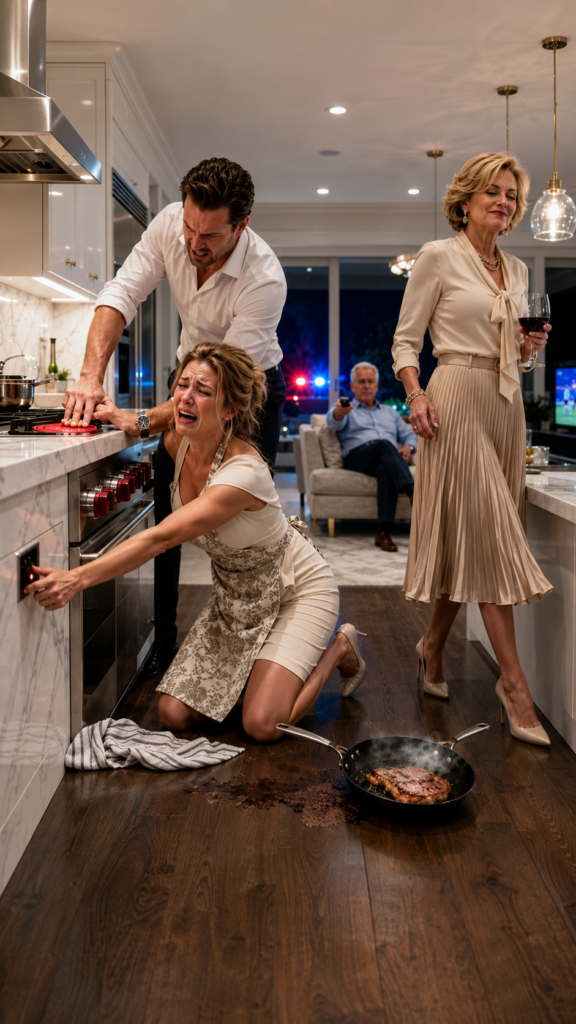
"You’re going to learn not to serve me meat like it’s charcoal," Ivan said, before smashing her hand against the hot grill.
Mariana's scream ricocheted in the kitchen like a plate shattering against the floor.
The meat fell to the side, grease splattering across the tiles, and the smell of burning mingled with something worse: skin, fear, and three years of swallowed silence.
Ivan didn’t let go right away.
He held her wrist against the hot metal with a sickening calm, as if he was correcting a clumsy employee rather than destroying his wife’s hand.
When he finally shoved her away, Mariana fell to her knees.
She clutched her hand against her chest, shaking, her breath ragged.
Her mother-in-law, Doña Elvira, walked past her without bending down.
She didn’t ask if Mariana needed help.
She didn’t look for ice.
She didn’t call an ambulance.
She simply grabbed a bottle of wine from the bar, poured herself a large glass, and let out a dry laugh.
“It was about time she learned her place.”
From the living room, Don Ramiro, her father-in-law, barely turned his head.
He saw Mariana on the floor, saw his son wiping his hands with a napkin, and turned the volume up on the Chivas game.
As if a woman’s scream was worth less than a missed goal.
In that moment, something within Mariana stopped asking for permission to survive.
For three years, that house in Zapopan had been a cage disguised as luxury.
First came the comments in front of her friends.
Then the blocked cards.
Next, the “borrowed” car only when Ivan wanted.
And later, the bruises explained away with phrases like “she hit her hand on the door” or “she’s just being sensitive.”
Doña Elvira said Mariana was exaggerating.
Don Ramiro repeated that decent marriages didn’t air their problems.
Every time Mariana talked about leaving, Ivan reminded her:
“This house is in my name. The business is in my name. You’re nothing without me.”
What Ivan never understood was that a last name on a deed doesn’t erase a truth.
Mariana had paid the down payment for that house with the trust her grandmother left her.
She had designed the administrative system for Ivan’s company.
And when he locked her in the laundry room one night for “talking back,” Mariana stopped thinking about running away.
She began preparing her exit patiently.
Like someone assembling a file before a hearing.
With evidence.
With copies.
With backup.
Two weeks prior, a lawyer from a women’s justice center recommended she install a tiny camera under the granite island.
It looked like a black charger stuck to the wall.
No one noticed it because Ivan never cleaned the kitchen, and Doña Elvira only came in to criticize.
Mariana, her fingers trembling, reached for the lower part of the bar with her good hand.
Ivan thought she was looking for the first-aid kit.
It wasn’t that.
She pressed the small hidden button.
Once activated the camera.
Twice uploaded the file to the cloud.
Three times sent location, live video, and a direct alert to Agent Claudia Mendoza.
Mariana pressed three times.
A blue light flickered.
Small.
Almost invisible.
Ivan grabbed her by the hair and lifted her face.
“Now you’re going to clean this mess, you’re going to prepare another steak, and you’re going to apologize to my mom.”
Mariana let her voice come out broken.
“My hand… please…”
“Enough of the theater,” Doña Elvira said, sipping her wine.
Don Ramiro turned the television up even louder.
Then, from the private street, a siren began to sound.
Distant at first.
Then louder.
And Ivan still didn’t know that tonight, it wouldn’t be just any patrol car.
It was the beginning of his ruin.
PART 2
Ivan froze when the siren stopped in front of the house.
For one second, his face lost all arrogance.
Then he regained it abruptly, transformed into fury.
“What did you do, Mariana?”
Doña Elvira set her glass down on the bar.
“Tell me you weren’t stupid enough to call the police.”
Ivan saw Mariana’s phone on a shelf, grabbed it, and smashed it against the wall.
The screen shattered.
“Your little act is over.”
Don Ramiro reluctantly got up.
“Just say she burned herself. She spends all her time in the kitchen.”
Ivan understood immediately.
He tossed the steak in the trash, quickly wiped the grill with a cloth, and kicked the remnants of the phone under the furniture.
Then he took his mother’s glass and spilled wine near Mariana.
Doña Elvira fixed her hair.
“She was drunk,” she said. “She got aggressive. My son just wanted to control her.”
“And you wanted to defend your mom,” added Don Ramiro.
Ivan knelt in front of Mariana.
His voice came out low, filled with venom.
“You’re going to repeat that. If you say anything else, I swear you hit my mother. It’s three against a crazy woman. Who do you think is going to win?”
They knocked on the door.
“Municipal police! Open up!”
Ivan took a deep breath, straightened his shirt, and smiled as if he were receiving guests.
When he opened the door, four officers with activated body cameras stepped inside.
Behind them was Agent Claudia Mendoza, in a dark jacket, hair tied back, and a look that didn’t come to ask for permission.
Her eyes went straight to Mariana’s hand.
The skin was red, raised, with dark patches where the heat had bitten harder.
Claudia clenched her jaw.
Ivan opened his arms.
“Thank God you showed up. My wife had another crisis. She burned herself, broke things, and then started making up stories.”
Doña Elvira put a hand to her chest.
“She tried to attack me. My son was just defending me.”
Don Ramiro pointed to the wine on the floor.
“She drank too much. You know how some women get.”
Claudia didn’t respond.
She walked toward Mariana and knelt down.
They had agreed on one phrase.
Just one.
If she was still in danger, she had to say it regardless of who was watching.
Mariana swallowed hard.
“The dinner didn’t turn out the way Ivan wanted.”
Claudia barely closed her eyes.
When she opened them, her expression changed.
She was no longer listening to versions.
She was closing a trap.
One officer positioned himself between Ivan and Mariana.
Another separated Doña Elvira from Don Ramiro.
Ivan raised his voice.
“What’s wrong with you guys? Ask my parents. She’s crazy.”
Claudia took out her phone.
“Good idea. Let’s hear what happened.”
The video started playing.
First, Ivan’s voice:
“You’re going to learn not to serve me meat like it’s charcoal.”
Then Mariana's scream.
After that, Doña Elvira’s laugh:
“It was about time she learned her place.”
And in the background, the television volume rising to drown out the crying.
The color drained from Doña Elvira’s face.
Don Ramiro opened his mouth, but nothing came out.
Ivan tried to lunge for Claudia’s phone.
He didn’t reach it.
Two officers held him against the refrigerator and put handcuffs on him.
“That recording is illegal!” Doña Elvira screeched.
“Not when the victim documents an assault inside her own home,” Claudia replied.
Ivan struggled.
“This house is mine! Everything here is mine!”
Mariana lifted her gaze.
She was pale, sweating, her destroyed hand pressed against her chest.
“No, Ivan,” she said. “It was never yours.”
And for the first time, he truly felt fear.
Because the camera hadn’t just recorded the burn.
It had recorded much more.
The ambulance arrived five minutes later.
As the paramedics wrapped her hand in special gauze, Mariana didn’t look at Ivan, who was screaming from the doorway.
She didn’t look at Doña Elvira, who was calling a “well-connected lawyer.”
She didn’t look at Don Ramiro, who was repeating that it was all a misunderstanding.
She looked at the blue light under the bar.
That little light Ivan never imagined was important because, for him, everything small was easy to trample.
At the civil hospital, doctors confirmed deep burns on her palm and three fingers.
She would need minor surgery, physical therapy, and months to regain mobility.
Mariana didn’t cry when she heard that.
She cried when Claudia sat beside her bed and said,
“You’re not going back to that house.”
By dawn, the Prosecutor’s Office already had the complete video.
But the recording didn’t just show the assault.
It also showed Ivan cleaning the grill, destroying the phone, and fabricating a lie.
It showed Doña Elvira pouring wine to make her seem drunk.
It showed Don Ramiro suggesting a false version.
Cover-up.
Threats.
Manipulation of evidence.
And the worst was still to come.
Claudia opened a folder on a laptop.
“Mariana, the camera had motion activation. It recorded conversations from previous days. Did you know Ivan and his dad were moving money from the company?”
Mariana breathed slowly.
“I suspected.”
Claudia lowered her voice.
“They also mentioned a loan on the house. They talked about a signature of yours.”
Mariana felt a horrible chill.
They didn’t just want to control her.
They wanted to rob her of her roof.
That same day her lawyer, Renata Salcedo, arrived with a blue folder.
She brought the deeds, her grandmother’s trust, the down payment transfers, and copies of the system Mariana had designed for the company.
“If Ivan insists on saying everything is his,” Renata said, “he’s going to open a door that won’t benefit him.”
He opened it.
At the first hearing, Ivan appeared in a white shirt, perfectly styled hair, and that face of a man used to being believed for speaking loudly.
His lawyer tried to present Mariana as unstable.
He said she was resentful.
He said the burn was a domestic accident.
He said the marriage had normal problems.
Then the prosecutor played the video.
The courtroom fell silent.
Ivan’s voice sounded cold, clear, impossible to disguise.
Doña Elvira’s laugh was worse than a slap.
The noise from Don Ramiro’s television made several people turn to look at him with disgust.
When the judge issued justified preventive detention for Ivan, he lost his mask.
He looked at Mariana and moved his lips soundlessly.
“You’re going to regret this.”
Renata saw him.
She stood up and handed over a USB flash drive.
“Your Honor, we request to include elements for possible fraud, forgery of documents, and embezzlement.”
Ivan turned pale.
In that moment, Mariana understood everything.
He wasn’t just afraid of having burned her hand.
He was afraid they would investigate the company he bragged about at dinners.
The house he claimed was his.
The money he used to humiliate her.
The system Mariana created kept records Ivan was unaware of: altered invoices, payments to ghost suppliers, duplicated contracts, and files uploaded from Don Ramiro’s computer.
For months, Ivan had embezzled money to shell companies.
Don Ramiro, a former municipal official, had moved favors to secure contracts.
Doña Elvira had forged a signature to request a loan using the house as collateral.
The fall wasn’t swift.
It was public.
First, they froze the accounts.
Then four clients reported missing advances.
After that, the bank pressed charges for the fraudulent loan.
Finally, the authorities opened an investigation against Don Ramiro.
The family that had called Mariana exaggerated for years began to devour itself.
Don Ramiro blamed Ivan.
Ivan blamed his mother for saying too much in front of the camera.
Doña Elvira blamed Mariana for "destroying a respectable family."
At the final hearing, Ivan no longer wore an expensive watch.
He was dressed in gray uniform and had sunken eyes.
He asked to speak.
“I made a mistake,” he said. “I lost control one night. She’s destroying my life over a steak.”
Mariana stood up.
Her hand throbbed with every heartbeat, but her voice came out strong.
“It wasn’t over a steak. It was for every time you thought my pain was obedience. For every lie your parents helped construct. For every day you thought having my money, my house, and my fear was the same as having me.”
No one spoke.
Not Ivan.
Not Doña Elvira.
Not Don Ramiro.
The judge sentenced Ivan for aggravated injuries, domestic violence, threats, evidence manipulation, and fraud.
He received nine years in prison.
Don Ramiro was sentenced for forgery, cover-up, and involvement in embezzlement.
Doña Elvira received a sentence for cover-up, forgery, and restitution of the fraudulent loan.
The house was recognized as Mariana’s property.
She also obtained a protection order for ten years.
But Mariana didn’t want to stop there.
She sold the house.
She didn’t want that granite kitchen.
She didn’t want that shiny grill.
She didn’t want walls that knew how to keep screams.
With part of the recovered money, she rented a small apartment in Tlaquepaque.
It had a simple kitchen, a window with bougainvillea pots, and a wooden table where no one banged utensils to demand anything from her.
Physical therapy was slow.
Some days she moved her fingers.
Others, the pain returned like a switched-on memory.
She also underwent psychological therapy because she understood she had to heal not just her hand.
She had to teach her body that she no longer lived waiting for the next blow.
One year later, Mariana opened an association called Luz Azul.
She helped women victims of domestic and economic violence secure documents, messages, recordings allowed by law, bank statements, and deeds.
She didn’t promise perfect endings.
She promised something more real: a plan.
A route.
An exit.
On the day of the inauguration, Claudia arrived with white flowers.
Renata placed on the wall a small framed piece: the fake black charger that had been under the bar.
Some women looked at it as if it were a miracle.
Mariana always corrected that.
"That didn’t save me," she would say. "It only showed who they were when they thought no one was watching."
Months later, Mariana cooked a steak in her new apartment.
She overcooked it a bit.
One edge was burned.
For a moment, the smell left her frozen.
Then she opened the window, took a deep breath, and sat down to dinner.
There was no one laughing behind her.
No one turning up the television.
No one telling her what her place was.
And as she cut the first piece with a hand that still hurt but no longer obeyed, Mariana understood something that many people debate and few accept:
Sometimes a woman doesn’t destroy a family when she speaks.
Sometimes she just stops protecting those who had already destroyed her in silence.





