PART 1
—Are you really living like this, Mom, with the 50,000 pesos I send you every month?
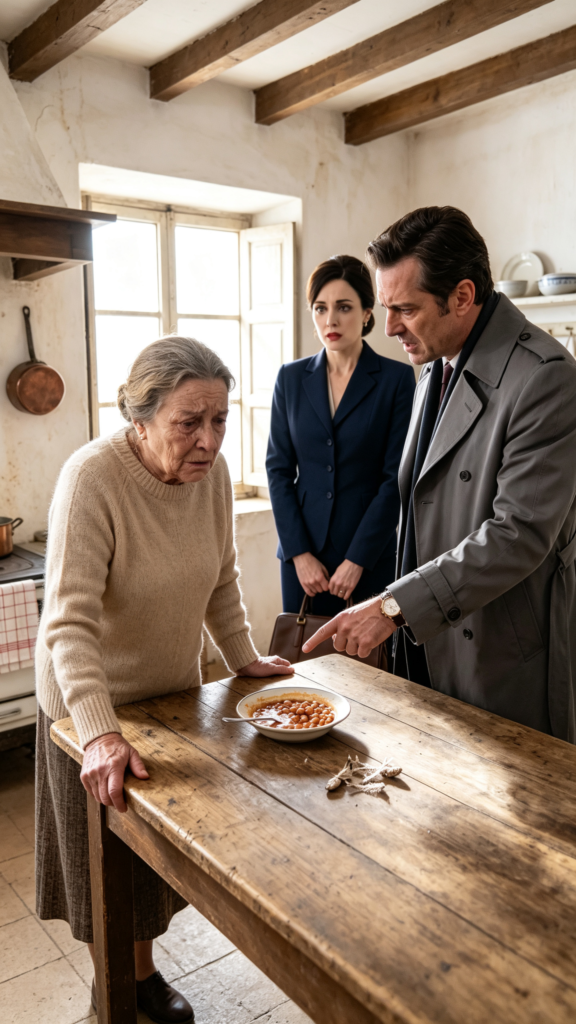
Doña Consuelo Medina let her spoon slip into the pot. The bean broth splashed on the old stove, but she didn’t even feel the heat on her hand.
It was Christmas Eve in Tepatitlán, Jalisco.
Outside, the wind slipped through a window covered with cardboard. Inside, the house smelled of dampness, cheap medicine, and reheated beans. In one corner stood a small, crooked Christmas tree adorned with ornaments from years past and a string of lights that only flickered occasionally.
Doña Consuelo was 68, her hands twisted with arthritis. That morning, she had scrubbed the concrete floor twice, dusted the old furniture, and put on her beige floral dress, the one she wore to mass.
Her son, Santiago Robles Medina, was coming to visit.
Santiago was not just any son. He owned a construction company in Monterrey, appeared in business magazines, and drove trucks worth more than the entire block. Doña Consuelo kept every photo of him as if he were a saint.
But it had been almost a year since she last saw him.
He always said he was busy. Meetings, trips, commitments. His wife, Patricia, often answered for him and echoed the same:
—Your mom is fine, honey. She prefers to be at peace. You know she doesn’t want to be a bother.
Doña Consuelo never contradicted anything.
She was embarrassed to admit that sometimes she ate stale bread with coffee. She felt ashamed to say that Father Ramón brought her groceries from the parish. It hurt her to mention that she split her pills in half to make them last longer.
A humble mother learns to hide hunger with a smile.
That Christmas, when the black truck stopped in front of her door, doña Consuelo felt her chest fill with life. Santiago got out first, elegant, wearing an expensive jacket and a shiny watch. Then came his kids, Camila, 9, and Leo, 6, running towards her.
—Grandma!
Doña Consuelo hugged them so tightly that she almost cried.
Patricia got out last. She wore a white coat, dark sunglasses, and a designer bag hanging from her arm. She looked at the peeling facade, the rusty door, and the dirt floor by the entrance.
—Oh, mother-in-law… this house is getting sadder every day —she said, smiling as if it were a joke.
Santiago pretended not to hear.
They entered the kitchen because it was the only place where the stove provided a bit of warmth. The kids asked about dinner. Doña Consuelo swallowed hard.
—I made little beans, my children. With chili and fresh cheese.
Santiago lifted the lid of the pot. His smile vanished.
—Beans? On Christmas?
Doña Consuelo lowered her gaze.
He then took in the cardboard-covered window, the stained walls, the nearly empty refrigerator, his mother’s red hands, and a bag of generic medicines on the table.
His voice came out broken.
—Mom… what’s going on?
She wanted to lie. To say that the pozole was coming next. To say everything was fine. To say the same old things.
But Santiago spoke those words about the 50,000 pesos.
Doña Consuelo raised her eyes, confused.
—What 50,000, son?
Santiago froze.
—The ones I send you every month with Patricia. For food, medicine, house repairs… so you wouldn’t lack anything.
The old woman shook her head slowly.
—I haven’t received a single peso.
In that instant, Patricia appeared at the kitchen entrance. She looked pale, clutching her phone tightly against her chest.
And Santiago understood that his wife had heard everything.
PART 2
The silence grew so heavy that even the kids stopped laughing in the living room.
Santiago looked first at his mother and then at Patricia. His face shifted from confusion to a seething rage, the kind that doesn’t scream because it hasn’t yet found a place to break free.
—Patricia —he said slowly—, tell me this has an explanation.
She let out a nervous laugh.
—You’re not going to make a scene here, right? It’s Christmas.
—I asked you something.
Patricia adjusted her coat as if she could still control the scene with elegance.
—Your mom is playing the victim. She’s always been like this. All suffering, all quiet, so you feel guilty.
Doña Consuelo opened her mouth, but nothing came out.
Santiago clenched his fists.
—My mom just said she hasn’t received any money.
—Well, I did what you asked —Patricia replied—. If she doesn’t know how to manage, that’s not my fault.
—Manage what? —asked doña Consuelo, her voice trembling—. I only get my pension, dear. 3,200 pesos every two months. With that, I buy what I can.
—Don’t call me dear —Patricia snapped—. You never liked me.
The phrase hit like a slap.
Doña Consuelo looked at her son. For a moment, she saw doubt in his eyes, and that doubt hurt more than the cold of all those months.
Because she had remained silent for too long.
She had been silent when she sold her sewing machine to help Santiago with his first business. She had been silent when she pawned her late husband’s gold medal to pay for his college debt. She had remained quiet when Patricia began answering calls and saying that Santiago was busy.
She had been silent because she believed a mother should not be a burden.
But that night, in front of the pot of beans, she understood that her silence had been used against her.
—Wait for me a moment, son —she said.
She walked slowly to her room. She opened an old wardrobe, pulled out a blue plastic folder, and returned with several folded papers. She placed them on the table.
—Here’s my bank book. Check it.
Santiago took it.
He flipped through the pages with tense hands. Small deposits. Withdrawals of 200, 500, 1,000 pesos. Pharmacy payments. Nothing more.
Final balance: 96 pesos and 40 cents.
Santiago’s face hardened.
—Patricia, show me the transfers.
—I don’t have to show you anything.
—Of course you do.
—Santiago, seriously, you’re exaggerating.
He pulled out his cell phone and logged into his banking app. Patricia tried to move closer.
—Don’t do this in front of your mom.
—My mom has been hungry for months. I’m absolutely doing this in front of her.
Doña Consuelo clung to the chair.
Santiago checked the transactions. Month after month, the same amount appeared: 50,000 pesos. Concept: “mom expenses.” But the destination account wasn’t under Consuelo Medina’s name.
It was under Patricia Cárdenas Luján’s name.
The air shattered.
Santiago looked up.
—The account is yours.
Patricia lost her color.
—I… I opened it to manage things better.
—Manage what things?
He kept checking. In that same account, there were payments to boutiques, jewelry stores, restaurants, an advance for a new truck, and even plane tickets to Cancun.
Doña Consuelo felt her body slacken.
—Oh my God...
Santiago showed his wife the phone.
—You kept 500,000 pesos.
Patricia crossed her arms, but her voice no longer sounded confident.
—It wasn’t robbery. We’re family. That money was still within the family.
—My mother hasn’t eaten well in 10 months.
—Your mother lives in a town, Santiago. Why would she need 50,000 a month? Come on. A little is enough.
Santiago looked at her as if he were seeing a stranger.
—A little? Did you see her window? Did you see her hands? Did you see her refrigerator?
—She exaggerates everything.
—She has 96 pesos in her account.
Patricia swallowed hard.
—I’ll pay you back and that’s it.
—and that’s it?
—Yes. Don’t destroy our marriage over money.
Santiago let out a bitter laugh.
—It’s not about money. It’s about what you did while my mom was dying of embarrassment.
In the living room, Camila appeared hugging her teddy bear. Leo came behind, scared.
—Dad, why are you yelling?
Doña Consuelo quickly wiped her eyes.
—Nothing, sweetheart. Go to Grandma’s room. There are blankets on the bed.
The kids obeyed, but Camila looked at her mom with fear before closing the door.
That gesture hit Patricia harder than any accusation.
—Don’t involve the kids in this —she said.
—You involved them when you kept them away from their grandmother —Santiago replied.
Patricia tensed.
Doña Consuelo raised her gaze.
—Away from them?
Santiago turned back to her with a destroyed face.
—Mom… Patricia told me you didn’t want visits. That the kids tired you. That you got nervous when we came. I thought I was respecting your space.
The old woman put a hand to her chest.
—I was waiting for them every Sunday.
Santiago closed his eyes.
—She also told me you didn’t answer because you were embarrassed to talk to me.
—I called, son. Many times. I was sent to voicemail.
Patricia immediately defended herself.
—Because you were working. I wasn’t going to interrupt you with your mom’s complaints.
—Complaints? —Santiago said.
—Yes, complaints. The same thing all the time: that something hurts, that the house is cold, that she misses the kids. You had important meetings, Santiago. A company to take care of.
Doña Consuelo lowered her head.
That truth hurt differently. Money was one thing. But filtered calls, cut visits, stolen Sundays… that couldn’t be repaid with a transfer.
Santiago continued checking Patricia’s phone, which she had left on the table in the midst of tension. The screen lit up with a new message from his sister.
“Did the old lady swallow the story again?”
Patricia lunged to grab it, but Santiago was faster.
—Give me that.
—It’s private.
—Stealing from my mother was also private, wasn’t it?
He opened the conversation. He read messages from months back.
“As long as Consuelo doesn’t say anything, you’re fine.”
“With 5,000, she’ll have enough and more.”
“Don’t be stupid, that money is better used for your truck.”
And one that left everyone frozen:
“Besides, Santiago never believes his mom when you cry.”
Doña Consuelo felt the chair shift beneath her.
Patricia began to cry.
—I was fed up, okay? Fed up with you always putting her first.
—First? —Santiago could hardly speak—. I haven’t seen her in a year.
—But she’s always there. In your guilt. In your stories of sacrifice. In that way you say “my mom gave everything for me.” And what about me? Don’t I matter?
—I gave you a house, trips, cards, everything.
—Because that was the least. I helped you enter circles where you didn’t belong.
That phrase left him motionless.
Doña Consuelo looked up. She saw her son as a child, with broken shoes, eating eggs with tortillas before going to school. She saw the boy studying under a dim light. She saw the man who had managed to get ahead and who, even so, still carried shame for his roots.
Patricia had struck right there.
—I didn’t belong —Santiago repeated.
Patricia realized too late that she had said too much.
—I didn’t mean that.
—Yes, you did.
He took a breath, dialed a number, and put the phone on speaker.
—Attorney Ortega, sorry for the hour. I need to freeze an account linked to family transfers and prepare a review of transactions. I also want to initiate a separation of assets as soon as possible.
Patricia screamed:
—You’re crazy!
—No. I’m just starting to see clearly.
—Are you going to divorce over 500,000 pesos?
Santiago looked at her with terrible calm.
—I’m going to divorce you because you left my mother hungry and still had the nerve to call her manipulative.
Doña Consuelo didn’t celebrate.
She didn’t want to see her family destroyed. She didn’t want her grandchildren to remember that Christmas as the night everything broke. But she also couldn’t keep protecting Patricia with her silence.
Santiago approached his mother and knelt before her.
—Forgive me, Mom.
She touched his hair.
—Get up, son. Don’t ask for forgiveness on your knees.
—I failed you.
—Yes —she said, and that word trembled on her lips—. But you can still stop failing me.
Santiago cried then. Not with screams. He cried like men who realize too late.
Patricia grabbed her bag.
—I’m taking my kids.
Santiago stood up.
—They’re staying with me tonight. I’m not letting them go out in the middle of this.
—They’re my kids too.
—And precisely for them, tomorrow we’ll talk to lawyers.
Patricia looked towards the room, but Camila came out just then. The girl had heard more than everyone thought.
—Mom, why did you take money from Grandma?
Patricia fell silent.
Leo appeared behind his sister, tears in his eyes.
—Grandma was cold.
No one knew what to say.
Patricia took a step towards them, but Camila hid behind Santiago. That small movement shattered the last mask of the night.
Patricia slammed the door as she left.
Her heels echoed on the pavement. Then the truck started, but Santiago didn’t follow. He stayed there, standing in his mother’s poor kitchen, surrounded by cold beans, bank papers, and truths that could no longer be hidden.
That night, Santiago took the kids to a nearby hotel. Before leaving, he wrapped doña Consuelo in a thick blanket he took from the truck.
—I’ll be back early tomorrow.
—Take care of my grandchildren.
—And you too, Mom. I’m not going to let anyone speak for you anymore.
She didn’t respond. She just nodded.
When she was alone, she turned off the stove. The pot of beans remained untouched. She wasn’t hungry. She felt an ancient sadness pouring out of her bones.
The next day, Santiago returned with dark circles under his eyes, a folder of documents, and a heart shattered into pieces. Two workers also arrived to measure the windows, a technician to check the heater, and a nurse to assess doña Consuelo’s medicines.
He showed her a transfer.
500,000 pesos complete.
Then another one, for repairs, food, medical care, and household expenses.
Doña Consuelo looked at the screen but didn’t smile.
—Son, money helps. But it doesn’t cure everything.
Santiago lowered his head.
—I know.
—I didn’t need luxuries. I needed you to ask me how I was doing for real.
He pressed his lips together.
—I’ll never assume again.
—And I’ll never remain silent again to avoid discomfort.
That phrase changed something between them.
The following weeks were hard. Patricia tried to tell another version. She said doña Consuelo had exaggerated, that Santiago had let himself be manipulated, that the money wasn’t lost because “it was for the family.” But the messages, the account statements, and the purchases left her defenseless.
Her own sister ended up confessing that Patricia mocked the old woman in audio messages.
She said that “a town lady wouldn’t know what to do with so much money.”
Santiago initiated the divorce.
It wasn’t quick or pretty. There were claims, tears, lawyers, and uncomfortable calls. But for the first time in years, doña Consuelo didn’t ask for anything to be softened. She didn’t say “leave it like that.” She didn’t say “poor thing, she’s the mother of my grandchildren.”
She understood that forgiving didn’t mean covering up what hurt.
Camila and Leo started visiting her every weekend. At first, they came quietly, as if they were afraid of touching a wound. Then Leo asked her to teach him how to shell corn. Camila wanted to help paint the living room wall a light yellow.
Santiago called her every Wednesday and Sunday.
Sometimes he arrived with groceries. Sometimes with nothing. He would just sit to have coffee with her, and that was worth more than any deposit.
A month later, doña Consuelo made red pozole.
She bought good corn, good meat, guajillo chili, radishes, lettuce, and tostadas. The house was warm. The new windows closed well. On the shelf, she placed a different photo: her with her grandchildren, all three laughing, without elegant poses or costly lies.
When Santiago tasted the first bowl, his eyes welled up.
—It tastes like when I was a kid.
Doña Consuelo shook her head with a tired smile.
—No, son. It tastes different.
—Why?
She looked at her kitchen, her hands, her grandchildren, and the empty chair where shame no longer sat.
—Because this one I made without fear.
Santiago didn’t answer. He just continued eating.
Doña Consuelo never hated Patricia again. To hate her was to keep carrying her. What she did had consequences, and for the first time, no one asked the old woman to make them smaller to make others comfortable.
That Christmas didn’t reclaim the perfect family that appeared in the photos.
It reclaimed something more important.
Her voice.
And in Mexico, where so many mothers swallow their pain to avoid bothering their children, doña Consuelo’s story left an uncomfortable question in many homes:
How many moms say “I’m fine” while someone else takes advantage of their silence?





