PART 1
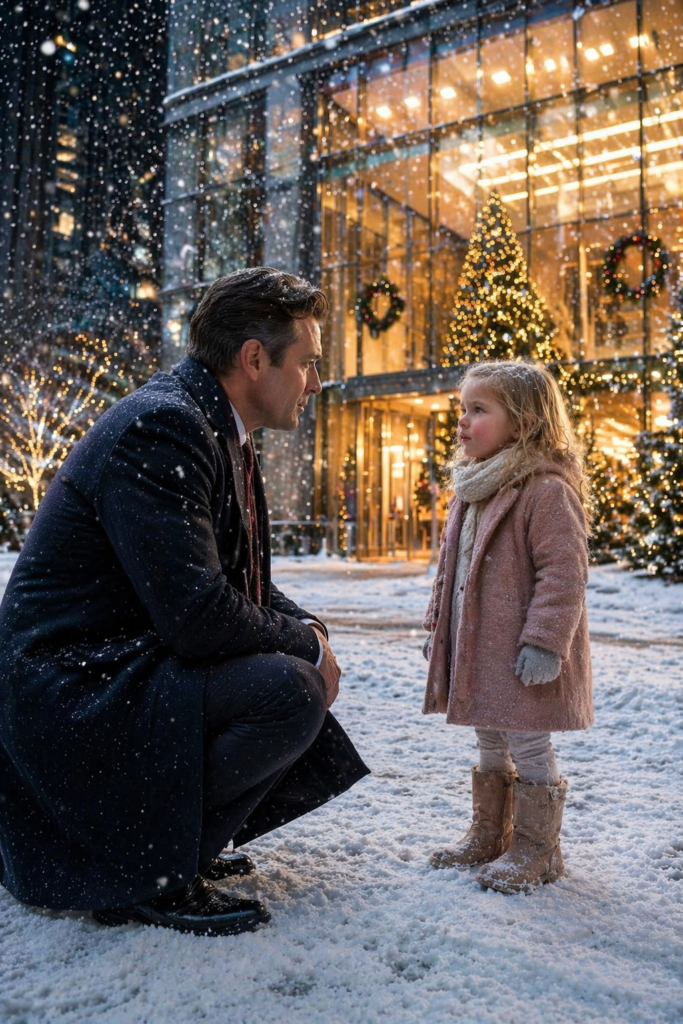
The girl was only 6 years old, standing outside a glass tower in Santa Fe, her school uniform soaked and a pink backpack clutched to her chest.
It was December in Mexico City, but that afternoon the cold had settled in like a weight. It rained and hailed, the wind slapped against her face, and people rushed out of their offices toward their cars, their Ubers, or the subway.
No one stopped.
Everyone glanced at her for a second before continuing on, as if a little girl alone in the rain was someone else’s problem.
Arturo Salgado stepped out of the tower at 7:15 PM, irritated that his driver hadn’t arrived. He was 42, wearing an expensive suit, a shiny watch, and the kind of exhaustion that comes from having money, but no one waiting for you at home.
He owned Grupo Salgado, a company of private hospitals, offices, and real estate developments. In magazines, they called him “the Mexican businessman who never loses.”
But that night, when he saw the girl shivering by the planter, something compelled him to stop.
He approached cautiously and knelt in front of her.
“Hey, little one… Are you lost? Are you waiting for someone?”
The girl lifted her face. Her eyes were red from crying, her lips purple from the cold, and she had a bravery far too big for her age.
“Sir… my mom didn’t come home last night.”
Arturo felt the words hit him in the chest.
She didn’t say, “I’m lost.”
She didn’t say, “My mom is late.”
She said she hadn’t arrived since last night.
“What’s your name?”
“Camila Hernández.”
“Camila, where does your mom live?”
“In the Doctores neighborhood. In a yellow building, with a blue door. She always arrives before I sleep. She always calls me. But yesterday she didn’t call. My aunt said she was probably with some man and that I should stop bothering.”
Arturo frowned.
“Did your aunt let you come here alone?”
Camila shook her head quickly.
“I left school. I came because my mom works nearby… or I thought she did. She’s a nurse. Sometimes she takes the bus here.”
Arturo looked at the street filled with cars, rain, honking, and hurried people. A 6-year-old girl had crossed half the city looking for her mother because no adult wanted to believe her.
“Camila, you’re not walking alone. I’m going to help you find her.”
She watched him with distrust.
“My mom says not to go with strangers.”
“Your mom is right. So we’ll do it the right way. I’ll ask the cop at the entrance to write down my name, my phone number, and my ID. And you’re going to tell me if something doesn’t feel right, okay?”
Camila hesitated.
Then she whispered:
“You have sad eyes, but not bad ones.”
Arturo didn’t know how to respond.
He asked security to register everything and called a nearby patrol to inform them of the situation. Then, with a guard accompanying them in the car, he took Camila to the Doctores neighborhood.
The building was old, with peeling walls and damp stairs. Camila pulled out a key hanging from her neck.
“My mom told me to only use it in emergencies.”
“This is an emergency,” Arturo said.
They entered the apartment.
It was small, but clean. There were drawings stuck to the fridge, a pot of dry rice on the stove, and a photo of Camila hugging a young woman in a white uniform.
“Mommy?”
Silence answered first.
Camila began to cry.
Arturo called public hospitals, clinics, and delegations. After 20 minutes, at the General Hospital, a social worker confirmed something that froze his blood.
Mariana Hernández, an emergency nurse, had collapsed during her shift due to pneumonia, high fever, and dehydration. She was hospitalized, conscious, desperate to know where her daughter was.
But before hanging up, the social worker added:
“There’s a problem, sir. The child’s paternal grandmother just arrived with a lawyer. She says the mother abandoned the girl and wants to take her today.”
Camila pressed the backpack against her chest.
Arturo then understood they not only had to find Mariana.
They had to get there before someone took her daughter away.
PART 2
The car moved through rain-soaked streets, booths closing halfway, and lights blurred by the rain. Camila sat in the back seat, wrapped in Arturo’s coat, her school shoes dripping water onto the mat.
She didn’t ask anything.
That hurt Arturo the most.
A 6-year-old girl should be asking about candy, cartoons, or if there would be school the next day. Camila, however, looked out the window as if she already knew that adults could fail in horrible ways.
“Is Miss Patricia mad at my mommy?” she finally asked.
Arturo glanced at her through the rearview mirror.
“Who’s Patricia?”
“My grandmother. My dad’s mom.”
“And why would she be mad?”
Camila lowered her voice.
“Because she says my mom took her son away.”
Arturo didn’t respond immediately.
Camila kept talking, with that brutal honesty that kids have when they repeat phrases they should never have heard.
“My dad died when I was a baby. He was a paramedic. My grandma says if my mom hadn’t worked so much, he wouldn’t have gone out that night to cover another shift. But my mom says no one was to blame.”
Arturo felt a knot in his throat.
The hospital was crowded. The emergency room smelled of bleach, burnt coffee, and fear. People slept sitting with thin blankets. A woman prayed quietly by a stretcher. A child cried in his father’s arms.
When Arturo walked down with Camila, a nurse recognized them immediately.
“Is she Mariana’s daughter?”
“Yes.”
The nurse put a hand to her chest.
“Oh, thank God. Mariana wouldn’t stop asking for her. She tried to get up three times with a fever of 104.”
Camila let go of Arturo’s hand.
“Can I see my mom?”
The nurse was about to respond when a harsh voice sliced through the hallway.
“That girl is coming with me.”
Doña Patricia appeared dressed in black, with a stylish bag, tight lips, and a young lawyer by her side. She didn’t look like a worried grandmother. She looked like a woman ready to win a war.
Camila hid behind Arturo.
“Grandma…”
“Don’t call me grandma with that scared face,” Patricia said. “If your mother had been decent, you wouldn’t be lost like a street dog.”
Arturo straightened up.
“Watch how you speak to her.”
Patricia sized him up.
“And who are you?”
“The person who found Camila alone in the rain because no family responded.”
The lawyer intervened with rehearsed tone.
“Ms. Patricia is a direct relative. The child’s mother was missing all night. We are requesting temporary custody due to abandonment.”
Camila started to tremble.
“My mom didn’t abandon me.”
Patricia looked at her with disdain disguised as pain.
“That’s what all of them say, my child. Your mother always preferred the hospital over family.”
Arturo clenched his jaw. He had seen dirty negotiations, lying partners, cynical politicians. But seeing a woman use a child’s fear to punish her daughter-in-law twisted his stomach.
The social worker arrived with a folder.
“We need calm. First, the child must see her mother.”
“No,” said Patricia. “That woman is not in condition.”
Camila then shouted:
“I want my mommy!”
The entire hallway turned.
The social worker made the decision.
“The girl gets five minutes. Then we’ll all talk.”
Arturo accompanied Camila to the door of the room. Mariana Hernández was in a bed, pale, with oxygen in her nose and an IV in her arm. Her hair was pulled back in any way, and her eyes were sunken, but when she saw her daughter, her face changed completely.
“Cami…”
The girl ran toward the bed.
“Mommy!”
Arturo managed to stop her before she yanked the cables. He carefully lifted her and sat her beside Mariana.
Mother and daughter hugged as if the world had been on the verge of breaking.
“Forgive me, my love,” Mariana whispered, crying. “Forgive me. I tried to call. I swear I tried.”
“I knew you didn’t leave me,” sobbed Camila. “I knew it, mommy.”
Mariana kissed her forehead, her hair, her hands.
“Never. Listen to me. Never.”
Arturo looked out the window to give them privacy, but also to hide the moisture in his own eyes.
He had money, a driver, a penthouse, black cards, and dinners where everyone laughed even when no one felt like it. But he had never seen anything as clear as that girl clinging to her sick mother.
After a few minutes, Mariana looked at Arturo.
“Did you find her?”
“Yes. She was outside my building.”
Mariana closed her eyes, devastated.
“Oh my God…”
“She was very brave,” he said.
“She shouldn’t have had to be.”
The phrase hung in the air.
At that moment, Patricia entered without permission.
“What a lovely scene,” she said coldly. “But it doesn’t erase the fact that your daughter spent a night without you.”
Mariana tensed.
“Patricia, please…”
“No. Enough. My son died trying to support your martyr nurse dreams. And now you almost lost the girl.”
Camila hugged Mariana’s chest.
“Don’t yell at my mommy.”
Patricia pointed at the bed.
“Look at her. She can’t even take care of herself. I have a house, money, contacts. You’d be better off with me.”
Arturo watched Mariana turn paler.
It wasn’t just fear. It was old exhaustion.
As if that threat had already been repeated for years.
The social worker asked everyone to step out, but Patricia insisted on showing papers: messages where Mariana asked for help, unanswered calls, incomplete screenshots, photos of the humble apartment, overdue receipts.
“This shows negligence,” said the lawyer.
Arturo asked to see the folder.
The lawyer laughed.
“Excuse me? What do you have to do with this?”
“I’m a witness to how I found the girl. And I can also call a real lawyer if you want to play this game.”
Patricia then recognized the last name.
“Salgado? From Grupo Salgado?”
Arturo didn’t respond.
The woman barely changed her expression. She didn’t become friendly, but she did become cautious.
The social worker reviewed the hospital records. Then the first crack appeared in Patricia’s version.
Mariana had provided three emergency contacts: Patricia, her neighbor Doña Elvira, and the home phone number of the apartment. The hospital had called Patricia seven times since the night before.
Patricia said she never received anything.
But her phone rang at that moment.
On the screen appeared: “General Hospital.”
Everyone looked.
The social worker asked her to answer on speaker.
Patricia refused.
Arturo understood before the others.
“You knew.”
Mariana froze.
“What?”
Patricia pressed the bag against her body.
“Don’t say nonsense.”
The social worker went for hospital security. The lawyer asked not to make a circus. Camila cried silently against Mariana.
Then Doña Elvira, the neighbor, hurried into the hallway with a bag of clothes for the girl.
“Camilita! Mariana!”
The woman, 68 years old, was soaked, wearing plastic flip-flops and an old sweater. Seeing Patricia, her face hardened.
“How heartless you are.”
Patricia was indignant.
“Respect, ma’am.”
“You showed no respect when you hung up on me last night.”
The hallway fell silent.
Doña Elvira pulled out her cell phone. She had recorded a call from the night before. She had done it after Camila had fallen asleep in her living room, crying for Mariana.
Patricia’s voice sounded clear.
“Don’t get me involved in your problems. Mariana always wanted to be strong, so let her endure. If the girl gets scared, good. That way she learns her mother is worthless.”
Mariana covered her mouth.
Camila didn’t understand all the words, but she understood the tone.
“Grandma… did you know my mom was sick?”
Patricia couldn’t hold her gaze.
That’s when everything broke.
The social worker took Doña Elvira’s phone as evidence. Security asked the lawyer to leave the area. A doctor ordered that Mariana not be subjected to more stress.
But Patricia, cornered, exploded.
“My son would be alive if it weren’t for her!”
Mariana lifted her face with a strength no one expected.
“Your son died saving people in a multi-car crash. He died doing his job. You know that.”
“He died because he worked himself to death to pay rent, diapers, and your shifts.”
“He died because he was good,” Mariana said, tears falling. “And if he were here, he’d be ashamed to see you using his death to take my daughter away.”
Patricia stood frozen.
Camila hugged her mother tighter.
Arturo felt that phrase pierce something deep within him.
Because he too had used work as an excuse. Efficiency as a shield. Success as a permission not to look.
And that night, in a public hospital filled with invisible people to men like him, he understood that indifference also destroys families.
Patricia’s complaint did not progress.
With the recording, the call logs, and Arturo’s testimony, the social worker made it clear that Mariana had not abandoned Camila. She had collapsed working. She had tried to communicate. And the person who was supposed to help decided to punish her.
Patricia left the hospital escorted, still saying it was all an exaggeration. But no one believed her anymore.
Camila stayed with Mariana that night in an adapted bed. Arturo arranged, with Mariana’s permission and without trampling on her dignity, for the hospital to allow a cot next to the bed.
Before leaving, Camila called him.
“Mr. Arturo.”
He approached.
“Yes?”
“Are you rich?”
Mariana, weak, opened her eyes.
“Camila…”
“It’s okay,” Arturo said, barely smiling. “Yes, I suppose I am.”
The girl looked at him very seriously.
“Then buy a phone that answers when a mom gets sick.”
Arturo didn’t laugh.
Because the girl was right.
The next day, he canceled four meetings, two lunches, and an interview with a business magazine. He gathered Human Resources, legal, operations, and the directors of his private clinics.
He entered the room wearing the same clothes from the day before and a face no one recognized.
“Yesterday a nurse collapsed for working sick, and her daughter ended up alone in the rain looking for help. Her emergency contact ignored her out of family resentment. The system failed everywhere. And we are part of that system too.”
A director tried to talk about costs.
Arturo cut him off.
“I don’t want speeches. I want solutions.”
That same month, the Open Door Program was born: emergency support for single mothers and fathers, safe transportation, voluntary contact reviews, a 24-hour hotline, paid leave for family crises, and temporary daycare for employees in clinics, cleaning, security, and administration.
It wasn’t perfect.
At first, there were absurd procedures, bosses who were suspicious, and employees who didn’t believe it was real. Arturo had to fire two managers who punished workers for asking for help.
But he persisted.
Not to look good.
He persisted because every time he doubted, he remembered Camila shivering outside the tower.
Mariana took weeks to recover. She didn’t accept easy charity. When Arturo offered to pay for everything, she looked at him with fever, pride, and exhaustion.
“I don’t want my daughter to learn that help always comes with strings attached.”
He looked down.
“Then tell me how to help without taking anything.”
Mariana studied him.
“By asking first.”
And Arturo learned.
He learned not to solve someone’s life as if it were an acquisition. He learned to ask for permission. He learned that a food basket could humiliate if it was handed down from above but could accompany if offered with respect.
Doña Elvira took care of Camila when Mariana gradually returned to work. Arturo fixed the elevator in the building through the administration, not as a personal favor, but because it had been broken for eight months and the neighbors had already paid maintenance.
Camila drew him a picture.
On the paper was a huge building, rain, a girl with a pink backpack, and a tall man in a black suit.
Above it, she wrote in crooked letters:
“My mommy came back.”
Arturo put that drawing on the refrigerator in his office.
His partners saw it.
No one laughed.
Maybe because he was no longer the same man.
Months later, Patricia tried to approach Camila at the school exit. She was carrying expensive gifts and a rehearsed smile.
Camila didn’t run to her.
She stayed next to Mariana and said:
“My mom taught me that forgiving doesn’t mean letting someone hurt you again.”
The phrase became a topic throughout the building.
Some neighbors said Patricia deserved another chance for being a grandmother. Others said some wounds don’t heal with dolls or chocolates.
Mariana didn’t shout.
She just laid down a condition: family therapy, a real apology, and absolute respect for boundaries. Patricia, proud, refused.
Then the door was shut.
And for the first time, Mariana didn’t feel guilty.
A year later, another cold afternoon fell over Santa Fe.
The glass tower remained the same. Executives still rushed out. Cars still honked as if the world would end at every traffic light.
But Arturo no longer walked with his eyes glued to his phone.
That afternoon, as he left, he saw Camila waiting for him next to Mariana. The girl wore a red jacket, new boots, and a lunchbox with tamales that Doña Elvira had sent “for the rich man who no longer seems so foolish.”
Arturo laughed out loud when he read the note.
Mariana blushed.
“Doña Elvira has no filter.”
“She’s right about several things,” he said.
Camila took his hand.
“Do you remember where I was?”
Arturo looked at the planter by the entrance.
“There.”
“And do you remember what I said?”
He nodded.
“That your mom hadn’t arrived.”
Camila squeezed his hand.
“But she did.”
Mariana came closer and adjusted her daughter’s scarf.
“Yes, my love. I arrived because someone believed you.”
People passed by without knowing the complete story.
Some would think a millionaire saved a poor girl.
But that was too simple.
The money helped, of course. It opened doors, paid transfers, moved procedures, and forced several to listen.
But what saved Camila that night wasn’t the money.
It was that someone stopped.
It was that an adult believed in the voice of a little girl.
It was that a sick mother didn’t have to prove her love by dying on her feet.
It was that a neighbor kept proof when everyone wanted to call her a gossip.
It was that a family learned that blood does not give the right to destroy.
And it was that a man who thought he had it all discovered, in the rain, that success means nothing if one walks past another’s pain pretending not to see it.
Camila pulled Arturo toward the street.
“Hurry up. The tamales are getting cold.”
Arturo looked at Mariana.
She smiled faintly, still tired from life, but no longer alone.
And as they walked together through the cold and the city lights, Arturo understood that sometimes a lost girl doesn’t show up to be rescued.
Sometimes she shows up to rescue the humanity that others had already given up for dead.





