PART 1
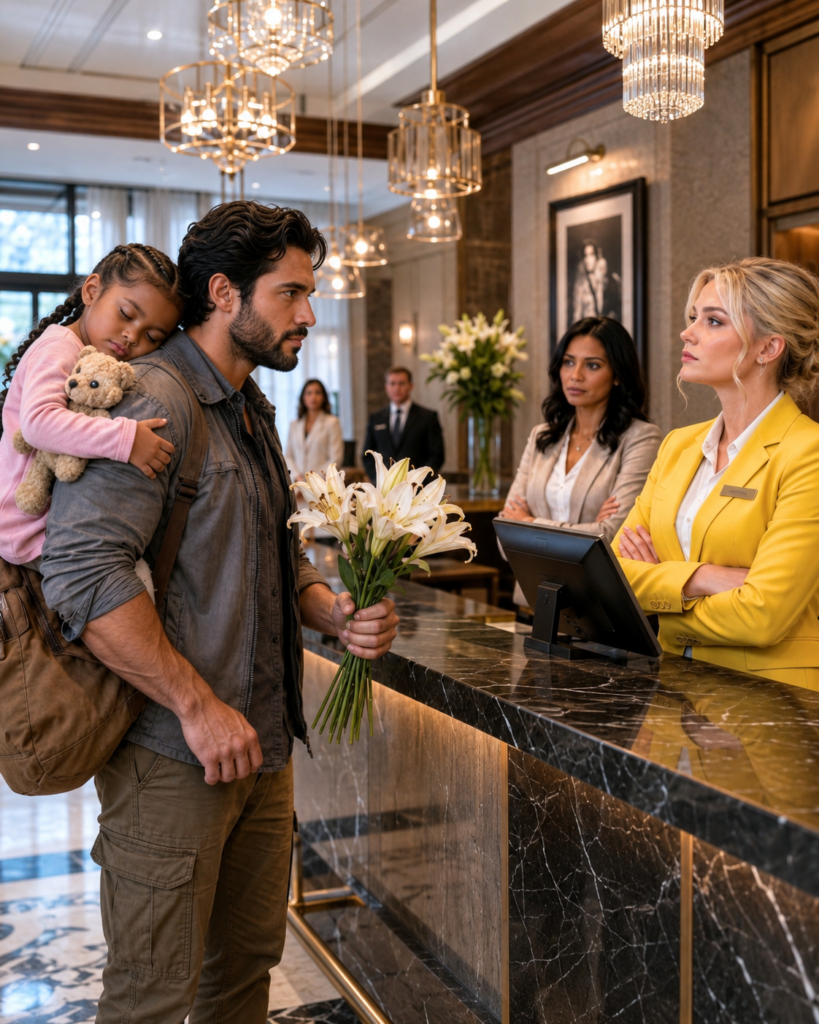
The girl was sleeping on his shoulder when Santiago Arriaga entered the Gran Reforma Hotel, right in the heart of Mexico City.
It was almost midnight. Outside, it was raining so hard that the cars looked like shadows behind the windows. Santiago wore a simple jacket, jeans, worn-out sneakers, and a black backpack hanging from one arm.
In his arms was Valentina, his 8-year-old daughter, hugging a teddy bear with a broken ear.
They were coming from Torreón. The flight had been delayed by 5 hours due to a storm, the girl hadn’t had a proper dinner, and Santiago could only think about a clean bed, a hot shower, and silence.
He could have called ahead.
He could have notified them that the owner was arriving.
He could have asked for the most expensive suite on the 18th floor.
But he didn’t.
Santiago liked to visit his hotels unannounced. He said that a business is not known when everyone smiles because they know who you are, but when no one believes you matter.
That phrase had been taught to him by his mother, Doña Amparo, a woman who cleaned rooms for 30 years in hotels where guests left trash behind and didn’t even say thank you.
That’s why, when Santiago founded the Arriaga Group, he had a plaque placed behind every reception desk:
“No one should have to demonstrate wealth to receive respect.”
That same plaque shone behind the counter that night.
And right below it was Bruno Salcedo, the receptionist on duty.
He wore a pristine uniform, his hair styled with gel, and a smile that vanished as soon as he saw Santiago’s wet sneakers, his cheap jacket, and the girl sleeping on his shoulder.
“Good evening,” Santiago said softly. “I need a room for me and my daughter. Just for tonight.”
Bruno looked him up and down.
“Do you have a reservation?”
“No. The flight was delayed. I can pay right now.”
Bruno pretended to check the computer. He didn’t even type correctly.
“I’m sorry, sir. We’re fully booked.”
Santiago looked around the almost empty lobby.
“Isn’t there a single room available?”
Bruno pressed his lips together.
“This hotel doesn’t handle ‘single’ rooms just like that. There are other, more economical places around. Maybe you can find something on Bucareli.”
Valentina stirred a little.
“Daddy… are we there yet?”
Santiago stroked her hair.
“We’re almost there, my love.”
At that moment, an elegant couple entered, also drenched, but in designer clothes and carrying expensive luggage. The man approached the counter laughing.
“We don’t have a reservation, young man. Do you have anything available?”
Bruno’s smile appeared as if by magic.
“Of course, sir. Just give me a moment. We have an executive room with a view of Reforma.”
Santiago stood frozen.
In less than 2 minutes, Bruno found a room, offered breakfast included, access to the gym, and even late check-out.
When the couple went to the elevator, Santiago returned to the counter.
“I want to speak to the manager.”
Bruno became serious.
“Sir, I’ve already explained.”
“Call the manager.”
Minutes later, Ramiro Castañeda, the night manager, appeared. He wore a dark suit, a shiny watch, and had that look of someone who believes authority is meant to crush.
Bruno whispered something in his ear.
Ramiro didn’t even listen to Santiago before deciding.
“Sir, we don’t have availability. My staff has already given you an answer.”
“That couple just got a room without a reservation.”
Ramiro smiled with disdain.
“My team knows how to distinguish which requests we can accommodate.”
Santiago felt Valentina clutching her teddy bear against her chest.
“Distinguish?”
“Yes. And I’m going to ask you not to insist. You’re making our guests uncomfortable.”
Santiago took a deep breath.
“I’m just asking for a room for my daughter.”
Ramiro looked at the sleeping girl, then at the backpack, then at Santiago’s wet shoes.
“Then I suggest you look for a hotel suitable for your situation.”
The phrase fell like a slap.
Santiago didn’t shout. He didn’t insult. He only pulled out his phone and noted the manager’s name.
Then he walked over to a couch in the lobby and sat down with Valentina in his arms.
He didn’t leave.
Ramiro approached angrily.
“Sir, this is a private establishment. If you don’t leave, I’ll call security.”
Valentina opened her eyes just as 2 guards appeared beside them.
She looked at the uniforms, then at her dad.
“Are they going to kick us out because we don’t look rich?”
No one answered.
And then Santiago raised the phone, dialed a number, and said with a calm that chilled the lobby:
“Come down now. Bring legal and human resources. Yes… it’s me.”
PART 2
Ramiro let out a dry laugh, as if he had just heard a bad joke.
“Sir, I don’t know who you think you’re impressing, but here the decisions are made by me.”
Santiago put his phone away and stood up with Valentina pressed against his side. The girl was no longer sleeping. She had her eyes wide open, confused, as if she had just learned something ugly about the world.
“I don’t want to impress anyone,” Santiago said. “I just want my daughter to see how to respond when someone uses a uniform to humiliate.”
Bruno swallowed hard. The younger guard looked down. A waitress at the bar stopped cleaning a glass. In the lobby, everyone pretended not to look, but they were all listening.
Ramiro hardened his voice.
“Escort the man and the child out of the hotel.”
The young guard hesitated.
“Sir, maybe we should…”
“Now,” Ramiro ordered.
Valentina clung to her father’s leg.
“Daddy, let’s go. I don’t want to sleep here.”
That sentence hurt Santiago more than any insult.
Because that hotel was born from a family dream.
His mother, Doña Amparo, had worked for years cleaning rooms in luxury hotels. When Santiago was a child, he waited for her outside because they wouldn’t let her sit in the lobby “to avoid giving a bad image.” She would come out tired, her hands cracked from the bleach, but she would always say:
“Son, promise me that if one day you have something of your own, you’ll never make anyone feel small.”
Santiago built his company on that promise.
And now his own daughter was feeling shame inside the place that was meant to protect that memory.
The elevator dinged.
The doors opened.
Out came Mauricio Beltrán, CEO of the Arriaga Group, with his shirt misbuttoned and a pale face. Behind him were a lawyer, the human resources director, and the operations manager.
Mauricio crossed the lobby almost running.
He didn’t greet Ramiro.
He didn’t look at Bruno.
He stopped in front of Santiago and lowered his head.
“Mr. Arriaga, I’m sorry for the delay.”
The silence was brutal.
Bruno turned white.
Ramiro took a step back.
Valentina looked at Mauricio and then at her dad.
“Does he work with you?”
Santiago squeezed her hand.
“Yes, my love.”
Mauricio turned to all the staff.
“To make it clear: he is Santiago Arriaga, founder and owner of the Arriaga Group. This hotel, this brand, these rooms, and every contract in this building exist because he built them.”
A woman in the lobby covered her mouth with her hand.
The young guard opened his eyes wide.
Bruno looked like he was about to faint.
Ramiro tried to smile.
“Mr. Arriaga… if we had known you were the owner, we would never…”
“Therein lies the problem,” Santiago interrupted. “You didn’t know who I was. So you treated me as you think you can treat someone without a last name, without a suit, and without power.”
Ramiro wanted to speak, but the lawyer stepped forward.
“Mr. Castañeda, everything has been recorded on cameras with audio from the lobby.”
Ramiro froze.
Bruno did too.
Santiago looked at him intently.
“I was denied a room saying the hotel was full. Then they accommodated 2 people without a reservation because they were better dressed. After that, you tried to have me escorted out by security in front of my daughter. Which part was a misunderstanding?”
Ramiro looked down.
“It was a judgment error.”
“No,” Santiago said. “It was classism. And what’s worse is that you did it under a plaque that says exactly the opposite.”
Valentina gently tugged at her dad’s sleeve.
“Did Grandma Amparo write that?”
Santiago felt a lump in his throat.
“Yes, my love. That phrase was from her.”
The girl looked at the plaque.
“Then they also disrespected my grandmother.”
No one dared to move.
That sentence, spoken by an 8-year-old girl holding a broken teddy bear, finally sunk Ramiro.
Santiago took a deep breath.
“Ramiro Castañeda, you are fired immediately. Human resources will formalize your departure this very night.”
Ramiro opened his mouth.
“I’ve worked here for 12 years.”
“And in 12 years, you didn’t learn the most basic thing: a guest is not valued by their shoes.”
Ramiro took off his name tag with trembling hands. He walked toward the side office without looking at anyone. The door closed behind him.
Then Santiago approached Bruno.
The receptionist no longer looked elegant. He looked like a scared boy in an oversized uniform.
“Sir, I’m sorry. I really am. I thought that…”
“You thought we didn’t belong here,” Santiago said.
Bruno lowered his head.
“Yes.”
The sincerity surprised everyone.
“I’m not going to fire you today,” Santiago continued, “but starting tomorrow, you won’t be at the front desk. You will undergo complete training, work for 3 weeks in housekeeping, kitchen, and maintenance. You will see the hotel from a perspective you’ve never looked at it. After that, we’ll decide if you can return to serving guests.”
Bruno cried silently.
“Yes, sir. Thank you.”
“Don’t thank me. Change.”
Then Santiago looked at a young concierge named Mariela, who had been watching everything from the beginning. Her eyes were red.
“You wanted to intervene, didn’t you?”
Mariela stiffened.
“Yes, sir. But I was scared. Ramiro always said that anyone who contradicted a management decision would be out.”
The human resources director looked down, embarrassed.
Santiago nodded.
“Then the problem wasn’t just Ramiro. It was a culture of fear.”
The lobby remained silent.
“Starting tomorrow, Mariela will be the supervisor of guest experience. And all hotels in the group will have a direct line to report undignified treatment without retaliation.”
Mariela covered her mouth.
“I don’t know what to say.”
“Speak the truth when something is wrong. That’s all it takes.”
Mauricio approached.
“Sir, they’ve prepared the presidential suite.”
Santiago shook his head.
“No. I want a standard room. The same one I would have been given if I had been treated like any other person.”
Valentina lifted her face.
“But is there a bed?”
For the first time, some chuckled softly, with relief and mixed embarrassment.
Santiago smiled tiredly.
“Yes, my life. There is a bed.”
They went up to the 7th floor. The room was simple, clean, with 2 white pillows and a window from which they could see the rain falling over Reforma.
Santiago laid Valentina down, took off her wet sneakers, and placed the teddy bear next to her pillow.
The girl, half asleep, murmured:
“Dad, when I grow up, I want to make a hotel where no one asks if you look rich.”
Santiago felt his chest break and heal at the same time.
“That was the hotel your grandmother wanted.”
Valentina closed her eyes.
“Then do it right, dad.”
And that sentence kept him awake.
The next day, Santiago ordered a complete review. Not just at the Gran Reforma, but at the 19 hotels in the group. Cameras, archived complaints, ignored emails, deleted reviews, employee testimonies.
What they found was more serious than expected.
Ramiro was not an isolated case.
For months, several guests in simple clothing had been sent to “cheaper” hotels. Indigenous families had been asked for higher deposits. Construction workers were denied access to the restaurant even if they paid. Single mothers were spoken to with distrust if they arrived without a gold card or designer suitcase.
The elegant company had a rotting wound beneath the marble.
Santiago didn’t hide it.
He called all group staff to an internal broadcast and told them what happened, without glossing over anything. He also talked about Doña Amparo.
He showed a photo of her in a cleaning uniform, smiling tiredly, with hands marked by years of work.
“My mother cleaned rooms so that I could study,” Santiago said. “If someone like her enters one of my hotels and doesn’t feel welcome, then we are not a hospitality company. We are an expensive facade.”
Many employees cried.
Others felt uncomfortable.
But no one could say it wasn’t true.
Three months later, the Gran Reforma no longer felt the same.
Mariela walked through the lobby with firm calm. Bruno, after working with housekeepers and cooks, returned changed. He no longer looked at shoes first. He looked at faces.
One Sunday afternoon, a family from Chiapas entered the hotel. They came with plastic bags, clothes wet from the rain, and 2 tired children. The father asked nervously if there was an affordable room.
Bruno stepped out from behind the counter.
“Welcome. First, we’re going to give you towels and something warm for the kids. Then we’ll look at the room, okay?”
The mother of the family stood still, as if she didn’t know whether to believe him.
“We don’t want to be a bother.”
“You’re not bothering,” Bruno replied. “That’s what we’re here for.”
From a corner of the lobby, Santiago watched with Valentina.
The girl carried her repaired teddy bear, with the ear neatly sewn by a housekeeper who had grown fond of her.
Valentina saw how Bruno offered hot chocolate to the children. She saw how Mariela spoke with the family without making them feel less. She saw how the father, who had entered hunched over, gradually lifted his head.
“Dad,” the girl said, “now it really looks like Grandma Amparo’s hotel.”
Santiago smiled with moist eyes.
“Yes, my love. Now it does.”
The plaque was still in the same place.
The marble still shone.
The lamps were still expensive.
But something had truly changed.
Because a hotel doesn’t become great because of its suites, imported wines, or beautiful views. It becomes great when a tired person crosses the door and doesn’t have to beg to be treated like a human being.
And that night, Santiago understood that he hadn’t built hotels to prove that he belonged to the world of luxury.
He had built them so that no one, ever again, would have to prove that they deserved respect.