PART 1
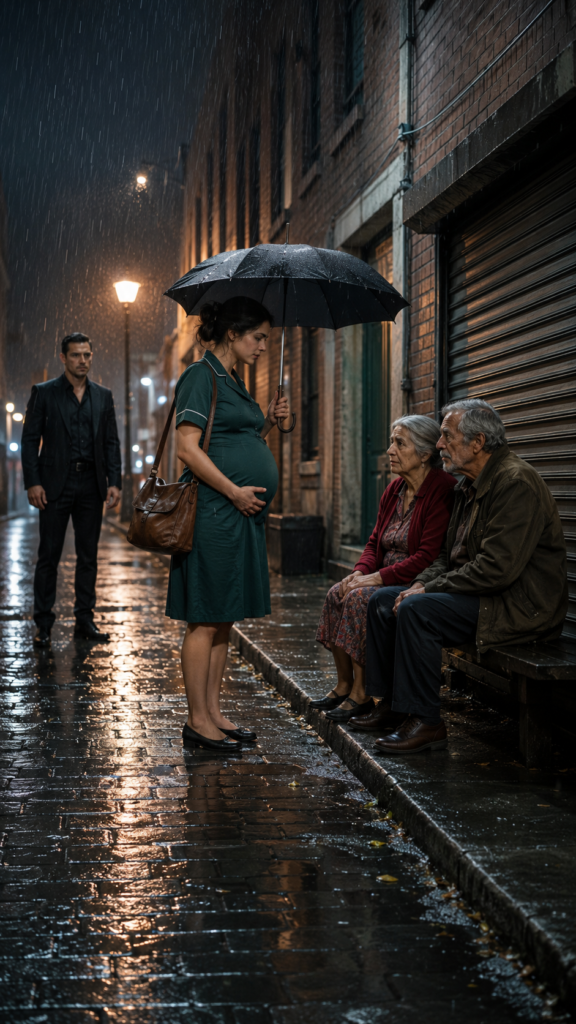
The night Lucía Navarro found two elderly strangers beneath the roof of a closed pharmacy, she carried 1,180 pesos in her bag, two stale rolls, and a seven-month-old baby growing inside her.
Rain poured heavily over the Guerrero neighborhood. Water ran down the sidewalks, sweeping away foam cups, leaves, and trash. Lucía walked slowly, careful not to slip, one hand resting on her belly and the other clutching a bag filled with beans, rice, and a can of milk she might have to return.
She was 29 years old and had been a widow for four months.
Her husband, Mateo, had died at a construction site in Santa Fe when an unsecured platform fell from several stories. The company spoke of "human error." The lawyers promised compensation. But rent, medical bills, and hunger did not accept promises.
Lucía cleaned offices at night on Paseo de la Reforma. She slept little, ate even less, and lived in a rooftop room with no hot water, a broken window covered with cardboard.
As she passed the pharmacy, she saw the couple.
The older woman trembled in a soaked sweater. The man, hunched over with a hardened gaze, held a fabric bag to his chest as if it contained the last of what he had left.
"Are you waiting for someone?" Lucía asked.
The elderly woman looked down.
"Our son. He said he was getting a taxi... but it's been six hours."
The man clenched his jaw.
"He left us with 800 pesos and turned off his phone."
Lucía thought of her tiny room. Of the broken extra mattress. Of the 1,180 pesos that needed to last until Friday. Of the baby who kicked at that moment, as if he too were listening.
"Come with me."
"We are not your problem," the old man replied.
Lucía let out a sad laugh.
"Sir, I’m nobody’s problem either. And look at how things are going."
They climbed five flights. The elderly woman, named Teresa, had to stop four times. Her husband, Don Ezequiel, asked for help not once.
The room was poor: a bed, a small stove, two mismatched chairs, and water stains on the ceiling. But it was dry.
Lucía prepared thin soup with the last egg from the fridge. She divided it among the elderly couple and insisted that she had already eaten.
It was a lie.
That night, while Teresa slept, Don Ezequiel remained seated by the window, watching the street like someone accustomed to waiting for danger.
Lucía did not know that fifty years ago he was called El Silencio.
She did not know he had been one of the most wanted men in the country.
And she also did not know that Gael Montenegro, owner of respectable businesses and enterprises no one dared to name, had just received a photograph of her entering the building with the two elderly strangers.
Gael stared at the image for several seconds.
Then he recognized Don Ezequiel’s face.
He stood up so quickly he knocked over his whiskey glass.
"Shut down all exits in the neighborhood," he ordered. "No one approaches that woman."
His right hand turned pale.
"Why? Who is that old man?"
Gael gripped the photograph between his fingers.
"The man my father hunted for thirty years."
And as Lucía turned off the only lamp in the room, three unmarked trucks parked at the end of her street.
PART 2
The next morning, Lucía woke to the smell of coffee.
Doña Teresa was pouring three small cups. Don Ezequiel was kneeling under the sink with an old wrench.
"The leak was due to a worn-out washer. It's fixed now."
Lucía turned on the faucet. For the first time in months, not a single drop fell after she turned it off.
It seemed trivial, but no one had fixed anything for her since the funeral. No one asked if she slept well, if she was cold, or if she could climb the stairs alone.
In the following days, the room changed.
Ezequiel adjusted the lock, covered the window better, and fixed an outlet that was sparking. Teresa cooked lentils and turned a wooden box into a small crib.
Every night, when Lucía returned, she found the light on.
One early morning, Teresa handed her a knitted green cap.
"For when the baby is born, whether it's a boy or a girl."
Lucía crumbled. She cried for Mateo, for the fear of childbirth, and for all the times she pretended to be strong when she was really falling apart.
Teresa embraced her.
"You're not alone anymore, daughter."
From an office in Polanco, Gael Montenegro watched the building.
He was 36 years old, impeccably dressed, and had a reputation that could silence mouths. But watching Lucía share her food with two strangers brought back the shame he had carried since childhood.
At eleven, he saw his father throw his grandmother out of the house. The old woman died alone months later. Gael was small but never forgave himself for not defending her.
"I want to know everything about her," he ordered.
His assistant, Iván, returned with a file.
"Lucía Navarro, 29 years old, widow, seven months pregnant. She owes three months' rent. The construction company responsible for her husband's death is delaying the trial."
"And the elderly couple?"
"She picked them up off the street. Their son sold their house. But the old man is not just any old man."
Gael already knew.
That afternoon, he appeared at a nearby store. Lucía was short 73 pesos for her prenatal vitamins.
"Take the vitamins away," she said.
Gael left a bill on the counter.
"Cover everything."
"I don't accept charity."
"Then consider it a debt from those of us who have much and never did anything."
Lucía accepted the vitamins but returned the change.
"Thank you. And don’t follow me, Mr. Fancy."
"I’m not following you. I’m watching the same street."
The phrase unsettled her.
Meanwhile, Ernesto Salgado, son of Ezequiel and Teresa, was drinking cheap tequila in a Tepito bar.
He had sold his parents' house, lost the money in bets, and was in debt for 2.4 million pesos. Looking for something else to sell, he found old photographs, codes, and a silver watch.
In one image, his father appeared young, dressed in black, next to men whose names still evoked fear.
Ernesto recalled the stories about El Silencio, the man who entered unseen and left without witnesses.
Desperate, he sold the information.
"He’s still alive. He’s with a pregnant woman in Guerrero."
With those words, he put a price on his parents' lives.
The storm arrived two nights later.
At 2:47 AM, the power went out. Lucía woke to thunder. Teresa took her hand, and Ezequiel lit three candles.
"On a night like this, I stopped being a monster," he said.
He recounted how fifty years ago, he worked for a criminal organization. He collected debts and made people disappear.
Until he was ordered to kill a man in front of his house.
When he arrived, he saw the target hugging his small son. The boy looked at him, not understanding why this stranger was holding a gun.
Ezequiel did not shoot.
"I thought of Ernesto, who was two. I realized I couldn’t ask others to respect my child while I destroyed others’ children."
He forgave the man, abandoned everything, and spent fifty years working as a carpenter. However, the son who inspired his change ended up robbing them of their home.
"Maybe this is what I deserve."
Lucía held his hand.
"You chose to change. Your son chose to betray you. Each one carries what they decide."
The old man cried silently.
The next day, Gael arrived with a wooden box.
Ezequiel opened the door and recognized him by his eyes. Gael pulled out a pocket watch.
"My father asked me to return this to you."
The inscription on the lid read: "Time does not erase debts. It turns them into decisions."
"I gave it to him the night I spared his life," Ezequiel murmured.
Gael knelt.
"My father said you gifted him 40 years. Thanks to those years, I was born. And you ended up sleeping on the street while I watched the city from a tower."
"Get up, boy."
"No. My family exists because you had mercy."
Lucía then saw that the feared man was still just a son trying to repay an inherited debt.
Gael wanted to take them to a safe house. Ezequiel refused.
"I won’t spend the rest of my life hiding."
Lucía wouldn’t either.
"I’m not leaving my home because some guys think they can decide who lives here."
"This isn’t bravery," Gael replied. "It’s being foolish."
"And living in fear is life?"
That same early morning, the men came.
Three trucks entered with their lights off. Ezequiel counted at least eleven men and called Gael.
"They’ve arrived."
"I’m twelve minutes away."
"You have eight."
Ezequiel moved the table in front of the door. Lucía stood behind him.
"Get into the bathroom."
"No way."
"You’re pregnant."
"And you’re 82. Don’t play the hero."
The door fell on the third blow.
"El Silencio ended up changing diapers," one attacker mocked.
"And you need eleven men to scare a widow. What a pathetic sight."
Ezequiel knocked one down with his cane, but another threw him against the wall. Lucía threw a pot of boiling water over an invader's arm.
Then engines roared below.
Gael appeared with Iván and over twenty men.
"You’ve entered the wrong house."
The attackers lowered their weapons. One threatened to return.
"For you, this ends today," Gael replied.
Hours later, they discovered who sold their location.
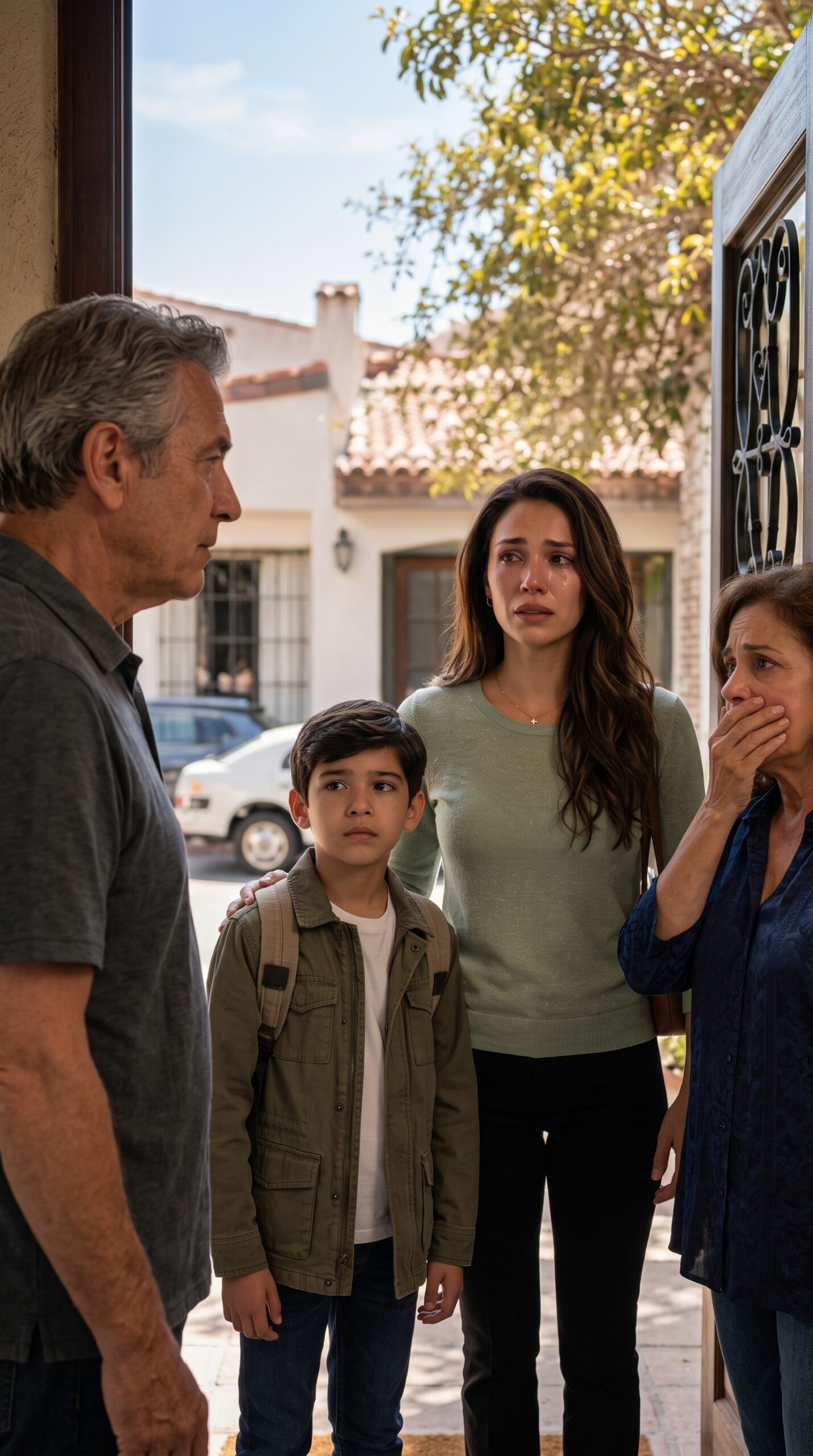
Ernesto was brought before his parents, pale and defeated. He fell to his knees.
"I sold you out. I thought I’d pay my debts and then get you back."
Teresa let out a moan.
"You took our house, left us in the rain, and then sold our lives," Ezequiel said.
"Forgive me, Dad."
"I don’t know if I can."
Gael expected cries for revenge. Ezequiel surprised everyone.
"Hand him over to justice and take him to rehab."
"He could have killed you," Gael said.
"If he dies, it all ends. If he lives, he’ll have to wake up every day knowing what he did and trying to make amends."
Ernesto lifted his head.
"I’m not going to abandon you like you abandoned us," Ezequiel added. "But I’m not going to save you from the consequences either."
Ernesto was prosecuted for fraud, dispossession, and criminal collaboration. From prison, he began treatment for his gambling addiction.
Lucía, Teresa, and Ezequiel moved to a house in Coyoacán. Gael paid the expenses, but she set a condition.
"I don’t want handouts or to owe you obedience."
"Then help me build something that doesn’t depend on my guilt."
Two months later, Lucía gave birth to a boy.
Gael waited all night in the hallway. When the nurse came out with the baby, the man who faced threats without flinching covered his face and cried.
"His name will be Mateo Ezequiel Navarro," Lucía said. "Mateo for his father. Ezequiel for the man who taught me that the past explains a person but doesn’t have the right to condemn them."
Four months later, she opened the House of the Second Door in Iztapalapa.
It had fourteen rooms, a kitchen, a consultation room, legal advice, and a carpentry workshop. It welcomed pregnant women without support and abandoned elderly adults.
Teresa knitted caps. Ezequiel repaired furniture. Lucía resumed nursing and directed the shelter.
Gael closed down businesses that should never have existed and turned others into legitimate companies. He didn’t become a saint overnight, but he began to pay his debts without fear or violence.
One afternoon, Lucía found him in the garden carrying the baby.
"That night, I thought I had nothing to give."
Gael looked at Mateo Ezequiel.
"You had the only thing none of us had when we needed it most."
"What thing?"
"The courage to open a door."
Lucía’s door had been poor, old, and hard to close.
But it changed everyone’s lives.
Because sometimes justice does not start in a courtroom, nor does redemption arise from a powerful man.
Sometimes it begins with a soup shared among three, a mattress on the floor, and a pregnant widow who decides to help, even when the world never helped her.