PART 1
The first card was declined in front of everyone.
Then the second.
Next was the black American Express, the one that Nora Salvatierra had never seen fail in 28 years of marriage or in the 5 years since Armando, her husband, had died.
She stood in the City Market checkout line in Polanco, with a cart full of simple things: chicken, tomatoes, artisan bread, olive oil, and some strawberries for her grandchildren.
The cashier looked at her with that uncomfortable smile people wear when they’ve just witnessed someone else’s humiliation.
— Do you have another form of payment, ma’am?
Behind Nora, someone sighed. A woman murmured something. A man shifted his cart impatiently.
Nora felt all the gazes piercing her back.
— Try the debit card again, please — she said, trying to keep her voice steady.
The cashier complied.
Declined.
Nora left the cart there, whole, as if abandoning those groceries was less painful than accepting the humiliation. She walked out of the supermarket with her head held high, though her hands trembled so much she almost dropped the bag.
Once in her truck, she opened her wallet.
She didn’t have a single peso.
Only an old photo of Armando, smiling beside her in front of the first shop they opened in Naucalpan.
He started as a mechanic, grease under his nails.
She kept the accounts in a school notebook, attended to customers, negotiated credits, and brewed coffee for the employees.
From that small shop came 12 agencies.
3 states.
An automotive group valued at 42 million dollars.
And that morning, Nora couldn’t even pay for food.
She called the bank. She endured the awful hold music, the automated menus, and the security questions until finally, a representative answered.
— Mrs. Salvatierra, all your accounts are showing as frozen.
Nora closed her eyes.
— Frozen by whom?
— I can’t give you more information over the phone. You need to visit a branch.
But Nora didn’t need more.
She knew exactly who had done it.
Her son.
Daniel.
The child she had after 3 miscarriages. The baby she prayed for in the Basilica. The boy she had employed since he was 18. The man she appointed as her power of attorney because he was her only son and because, in her naivety, she believed that blood still meant something.
She drove straight to Daniel’s house in Lomas Verdes, that huge house she helped buy.
In the driveway was his Range Rover and Karla’s Mercedes, both financed by Nora’s agencies at a favorable rate.
Karla opened the door dressed in tennis shoes, perfectly manicured nails, and a smile sharper than friendly.
— Oh, Nora. What a surprise. You should have called.
— My cards aren’t working. The bank says my accounts are frozen. Where is my son?
Karla inspected her nails.
— Daniel blocked your number this morning. He said it was time to set boundaries.
Boundaries.
For the woman who paid her mortgage, her cars, and her children’s tuition.
Daniel appeared behind her.
He had Armando’s jaw, Armando’s shoulders, but none of his nobility.
— Yes, Mom. I froze the accounts.
Nora felt the air leave her.
— You?
— Someone has to protect the family’s assets. Your spending is no longer reasonable.
— My spending? Daniel, your father and I built all this. Every peso came from our hard work.
Karla let out a dry laugh.
— Here we go again with the sacrifice speech. Seriously, Nora, it’s getting old.
Then they explained the plan as if it were already decided.
They were going to sell the Salvatierra Group.
38 million dollars in cash.
Daniel insisted that Nora had signed documents after a hip surgery when she was still sedated. Notarized powers of attorney, authorizations, resignations from directorial positions.
All of it.
Without access.
Without salary.
Without a voice.
Daniel pulled out 2 bills of 500 pesos from his wallet and handed them to her.
— Here, Mom. For groceries. Since your cards aren’t working.
Nora looked at that 1000 pesos as if it were a slap in the face.
— I’d rather go hungry than ask you for money from a fortune that exists because of me.
Karla smiled.
— You’ll come back. Hunger makes people more compliant. When you apologize, we’ll talk about a reasonable monthly allowance for your age.
Then they mentioned a nursing home.
Talked about removing her from her own house.
Keeping her away while they closed the sale.
And when Nora stood there, Daniel used the cruelest blow.
— If you fight, Mom, you’ll never see my kids again.
Nora left with weak legs. She closed the door of her truck and stared at the house she had paid for.
Then her phone rang.
Unknown number.
— Mrs. Salvatierra? This is Federico Petón, Vice President of Wealth Management at Banco Nacional. We’re trying to contact you regarding unusual movements in your accounts.
Nora gripped the steering wheel.
— What movements?
— There was an attempt to transfer approximately 23 million dollars this morning using your credentials.
The world seemed to stop.
— Your son managed to freeze some accounts, but several are protected by locks you activated years ago. No one can touch them. Only you.
And sitting outside her son’s house, with the humiliation still burning on her face, Nora understood something terrible.
Daniel thought he had taken everything from her.
He had no idea what she had kept hidden.
PART 2
Nora didn’t cry.
Not at that moment.
She put her phone away, took a deep breath, and drove aimlessly for 10 minutes until she parked in front of a small café. She didn’t have money to go in, but she needed to remember how to think.
Federico Petón called her again.
— Mrs. Salvatierra, I suggest you come in immediately. There are recent documents we need to review with you.
— Can my son know I’m coming?
— No, ma’am. In fact, that’s why I’m calling you on this number. Your main line was reported as “unreliable” by the power of attorney.
Nora smiled without joy.
Even her phone wanted to take something from her.
In the private branch, Federico greeted her with an in-house lawyer and a thick folder. They showed her rejected transfers, change of beneficiary requests, and a petition to liquidate protected investments.
All digitally signed by Daniel.
But then came the first stroke of luck, or perhaps justice.
Years ago, when Armando fell ill, Nora had created a secret trust. Not out of distrust towards Daniel, but out of fear of abusive partners, tax fraud, and corporate vultures.
That trust controlled 51% of the actual shares of the group.
Daniel had papers, offices, cars, and airs of ownership.
But he didn’t have control.
Armando had left it that way in a private letter:
“If our son ever forgets who built this business, let Nora have the final say.”
Nora read that phrase and finally broke down.
She didn’t cry for the money.
She cried because Armando, even in death, had protected her from the son they both loved.
— What can I do? — she asked.
Federico adjusted his glasses.
— A lot. But you must act today.
The first call was to Lucía Mendoza, a corporate attorney and Nora’s friend for 20 years.
The second was to a trusted notary.
The third was to the CEO of the group, a man named Ramiro who had started washing cars at the Toluca agency.
When Nora explained everything to him, Ramiro fell silent for a few seconds.
— Mrs. Nora, here people still know who gave us work. Tell me what you need.
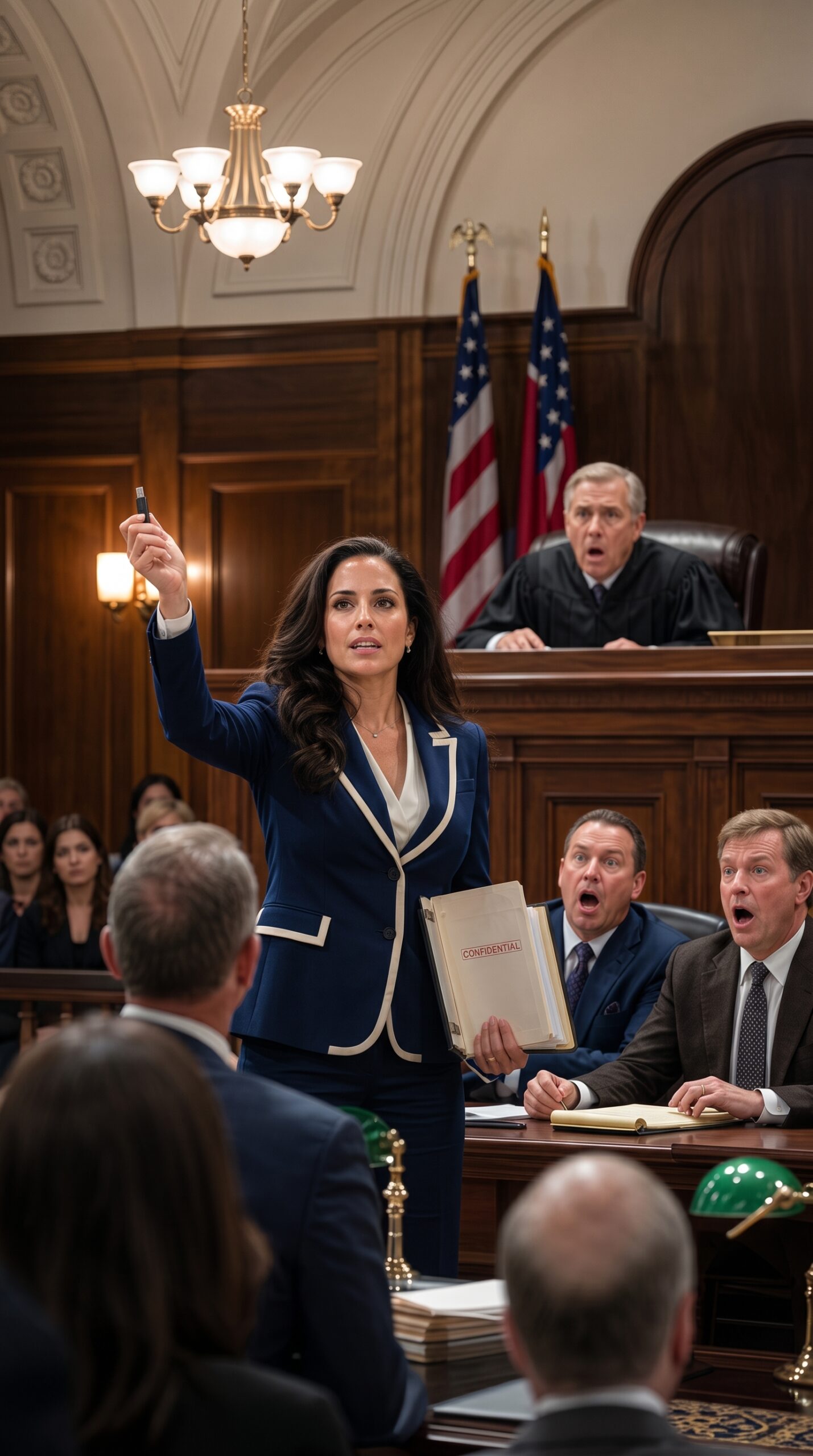
By 7 PM, Daniel entered the boardroom of the corporate office in Santa Fe, believing he was closing the sale.
Karla arrived with him, perfumed, dressed in white, smiling as if she were already picking out a house in Miami.
The buyers were also there, 2 lawyers and 4 nervous executives.
Daniel sat at the head of the table.
— Let’s get started. My mother no longer participates in decisions of the group.
The door opened.
Nora entered wearing a dark blue dress, her hair up, and a folder in hand.
Behind her came Lucía, the notary, and Federico.
Daniel stood up.
— What are you doing here?
— I came to my company.
Karla let out a laugh.
— Nora, please. Don’t make a scene. This is already signed.
Nora placed the folder on the table.
— That’s what you thought.
Lucía spoke first. She explained that the signatures obtained after the surgery could be contested due to temporary incapacity. She showed medical records, anesthesia schedules, videos from the hospital, and messages where Karla pressured a nurse to leave Nora alone with Daniel.
Daniel paled.
— That doesn’t prove anything.
Then Federico projected the attempts at transfer on the screen.
23 million dollars.
Blocked accounts.
Beneficiary changes.
Urgent liquidations.
The buyers looked at each other.
One closed his laptop.
— We can’t proceed with this operation.
Daniel slammed the table.
— I am her son! She doesn’t understand what she’s doing anymore!
Nora looked at him with a calm that hurt.
— I understand perfectly. I understood when you left me unable to pay for food. I understood when you offered me 1000 pesos as charity. I understood when you threatened to take my grandchildren away.
Karla stood up.
— Oh, enough with the drama. You lived like a queen thanks to Armando.
Nora turned to her.
— No, Karla. Armando and I lived working. You lived off us.
The room fell silent.
Then came the twist that Daniel never saw coming.
Ramiro entered with a box of files.
— Mrs. Nora, we found this in Mr. Daniel’s office. His secretary delivered it.
Inside were copies of contracts with a phantom company.
The company belonged to Karla’s brother.
For 3 years, Daniel had diverted commissions from parts, fleets, and inflated warranties. He didn’t just want to sell the group.
He had been plundering it all along.
Nora felt something break inside her.
— Did you also steal while I was paying your children’s school?
Daniel looked down.
Karla exploded.
— We didn’t steal! We just took what was ours. After years of hearing that everything belonged to you and Armando, what did you expect? Daniel is the heir.
— Heir doesn’t mean owner of his mother’s life — replied Nora.
Lucía placed another document on the table.
It was the immediate revocation of the power of attorney.
Daniel’s suspension as an executive.
The activation of the trust.
And a complaint for breach of trust, attempted fraud, and economic violence against an elderly person.
Daniel lost all color.
— Mom, you can’t do this to me.
For the first time, his voice sounded like it did when he was a child.
But Nora was no longer the mother who rushed to catch him before he hit the ground.
— No, Daniel. You did this to me. I’m just letting the truth collect its dues.
Karla grabbed her bag.
— Let’s go, love. This old woman won’t leave you anything.
Nora stopped her with a phrase.
— Neither the trucks. Nor the house. Everything is under the trust until the payments are audited.
Karla froze.
Daniel looked at her, terrified.
Within 24 hours, Nora’s accounts were released. Daniel’s were under investigation. The buyers withdrew their offer. Employees received a memo signed by Nora: the Salvatierra Group was not for sale.
But the hardest part wasn’t the business.
It was the family.
That same night, Daniel sent her a message from another number:
“If you continue, you’ll never see the kids again.”
Nora replied with a single line:
“I’ve already notified the family court judge.”
Because Lucía had also prepared a visitation request for grandparents. Daniel could use his children as a weapon, but not as an eternal shield.
Days later, Nora saw her grandchildren in a supervised visitation center.
Emilia, 8 years old, ran towards her.
— Grandma, my mom said you didn’t have money anymore and that’s why we couldn’t see you.
Nora knelt down and hugged her tight.
— My love, there are people who confuse money with love. But love doesn’t freeze in a bank.
The youngest boy, Mateo, handed her a drawing.
It was a car agency, a man in overalls, a woman with glasses, and 2 children holding hands.
— Dad said you wanted to take everything from us — he whispered.
Nora felt like screaming, but she only kissed his forehead.
— I just want you to know the truth when you grow up.
Months later, Daniel accepted a settlement. He returned part of the money, lost his position, and was required to attend family therapy if he wanted to regain unsupervised visits.
Karla filed for divorce when she realized the fortune was no longer in her hands.
Nora returned to the first agency in Naucalpan, the old rusty sign that Armando never wanted to take down.
There she gathered the employees.
— This business is not for sale — she said —. It will be cleaned, protected, and inherited only by those who know how to respect it.
No one applauded at first.
Then Ramiro started.
Then everyone.
Nora looked at the picture of Armando hanging on the wall and felt that, for the first time in a long time, she could breathe.
She hadn’t won without pain.
She had lost the image of the perfect son.
She had understood that family can also become a threat when it believes that love is permission to abuse.
But that morning, as she left, she entered a small store on the corner.
She bought sweet bread, milk, and strawberries.
She paid with her card.
The terminal approved the purchase.
Nora smiled just a little.
Not because she had recovered her money.
But because she had recovered her name.
And in Mexico, where many remain silent "for the family," her story left an uncomfortable question:
How far should a mother forgive when her own son tries to leave her with nothing?