PART 1
Mariana Alcázar chose a red bead first.
Then she took a golden one.
After that, she placed three purple beads on the bedside table with a seriousness that belied her six years.
"Three wishes," said Inés, the new nurse. "Then this bracelet will have more power than all the doctors combined."
Mariana didn’t smile.
But she lifted her gaze.
And in that house in San Pedro Garza García, where silence had become heavier than the walls, that gesture felt almost miraculous.
From his office, Emiliano Alcázar watched everything through the cameras.
He wasn't just any man.
In Monterrey, his last name was spoken with caution. He owned construction companies, warehouses, transport fleets, gas stations, and businesses that raised too many questions. To some, he was Don Emiliano. To others, a man best left unowed even a peso.
But inside that fortified mansion, with black SUVs and guards at every entrance, Emiliano held no power.
He was just a father watching his daughter fade away.
Mariana had leukemia.
She had lost her hair, her appetite, and, since her mother died in a strange accident on the way to Saltillo, she had also lost her voice.
The doctors spoke of trauma.
Emiliano spoke of guilt.
That’s why he filled the house with cameras. In the hallway. In the kitchen. In the garden. In the playroom. Even in front of the private infirmary.
He trusted no one.
Until Inés Robledo arrived.
She was thirty years old, with a Chilango accent, steady hands, and a patience seemingly built to weather storms. She asked no questions about guards. She wasn't impressed by luxury. She didn't look at Emiliano with fear or interest.
She simply entered Mariana's room, washed her hands, and turned each medicine into a story.
One afternoon, while arranging the blankets, Inés hummed a quiet tune.
Emiliano froze in front of the monitor.
It was the song Clara, his dead wife, used to sing to Mariana when she had a fever.
No one else knew it.
No one.
Not the nannies. Not the doctors. Not his trusted men.
Emiliano called Rengo, his right-hand man.
"Investigate her. Everything. Family, school, hospitals, ex-partners, accounts, debts. That woman didn’t just show up here by chance."
The report appeared before dawn.
Inés Robledo existed.
Born in Iztapalapa. Mother missing. Father unknown. She had gone through a group home in Querétaro. Studied nursing, worked in private clinics, and entered the mansion through a pediatric care agency.
But there were gaps.
Years without records. References too perfect. Documents cleaner than they should be, as if someone had pressed them with care.
"There’s one more thing," Rengo said.
Emiliano looked up.
"Aurelio Castañeda is asking about the girl."
The air shifted.
Aurelio was his most venomous rival. He didn’t just attack routes or contracts. He struck where it hurt.
"What did he ask?"
"Who is taking care of her. How serious it is. And whether the new nurse sleeps in the house."
Emiliano clenched his teeth.
"Double the security. No one gets near Mariana."
Rengo nodded.
"And the nurse?"
Emiliano looked back at the screen.
Inés was asleep in a chair, holding Mariana’s hand.
"No one gets near her either."
That night, the impossible happened.
Mariana opened her eyes and whispered:
"Dad…"
Emiliano ran to the room as if the house were burning.
When he entered, Mariana spoke again.
"Inés didn’t leave."
Emiliano fell to his knees beside the bed.
"My little girl… you spoke."
Inés woke up startled.
Mariana closed her eyes, exhausted.
"I’m tired."
"Being tired counts as still fighting too," Inés murmured, her voice raw.
Emiliano looked at her as if this woman had just returned air to a dying house.
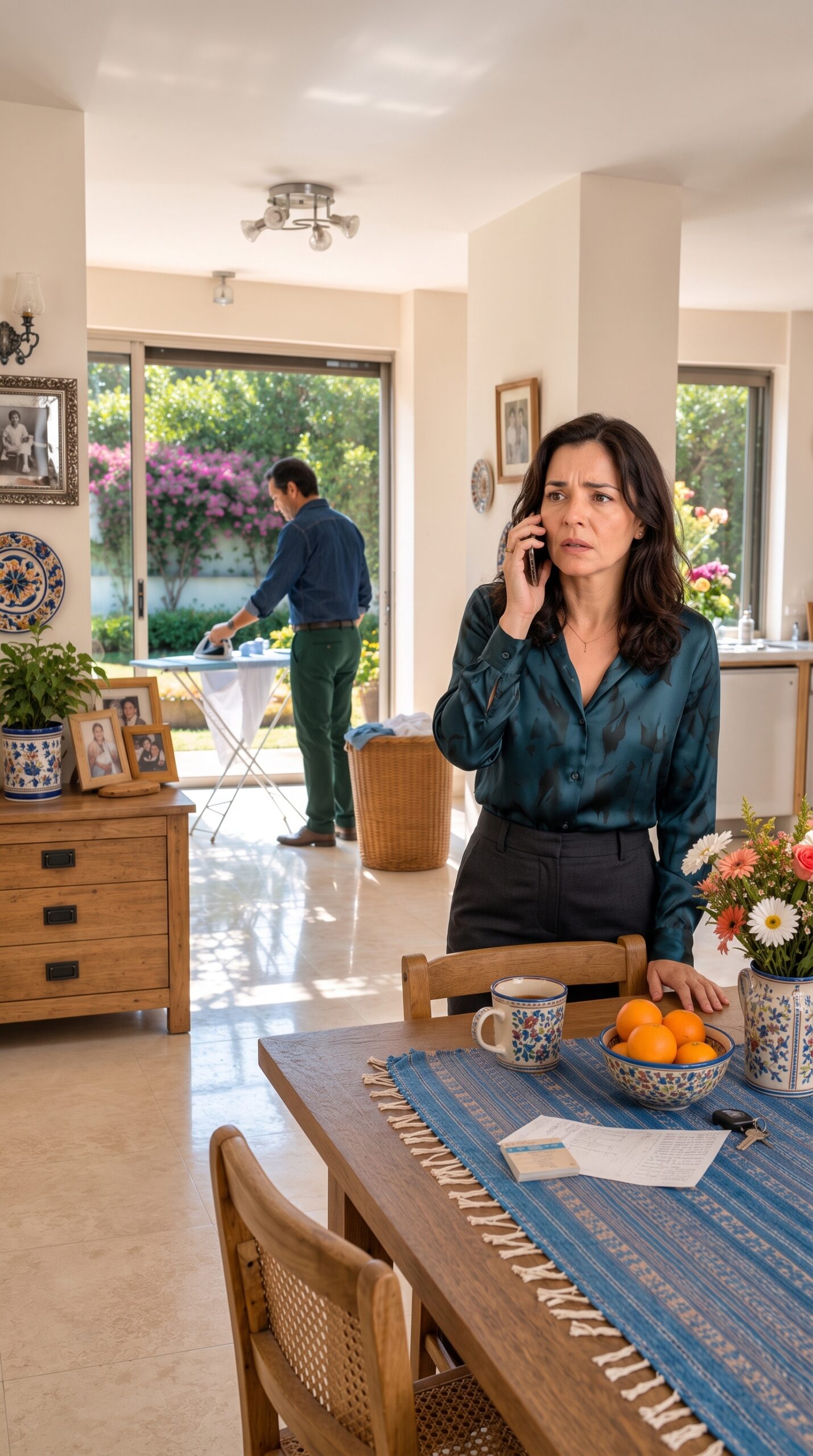
But later, in the kitchen, Inés prepared chicken broth with rice, mint, and lemon.
Emiliano took a spoonful.
Color drained from his face.
"Clara used to make this broth the same way."
Inés lowered her eyes.
"Many moms cook like that."
"No," he said. "Not with that song. Not with that phrase before bed. Not with that way of blowing on the soup."
She fell silent.
Emiliano approached slowly.
"Tell me who you are before I find out my way."
Inés barely breathed.
"I’m the woman trying to make your daughter live."
He was about to respond, but the medical alarm began to scream from Mariana's room.
They ran.
And when they entered, they saw the girl convulsing on the bed, while Inés opened a blue suitcase that no one knew existed.
PART 2
"Call an ambulance," Inés ordered. "Say pediatric oncology patient, prolonged seizure, possible reaction to the new medication."
Rengo dashed out.
Emiliano froze for one second, fear lodged in his throat.
Mariana writhed between the sheets. Her little mouth gasped for air. Her small hands curled as if trying to grasp hold of life.
Inés didn’t lose control.
She turned her body to the side, protected her head, and checked her breathing. Then she pulled a syringe from the suitcase.
Emiliano grabbed her wrist.
"What the hell are you going to give her?"
Inés looked at him furiously.
"Rescue medication. If I don’t administer it now, she could be damaged."
"Your papers are unclear."
"My care for her isn’t."
The alarm continued blaring.
Emiliano released her wrist.
Inés administered the dose.
Eternity stretched in seconds.
Then Mariana's body began to calm. Her eyelids stopped trembling. Air slowly flowed back into her.
When the paramedics arrived, Inés already had recorded times, symptoms, medications, and vital signs.
One of them looked at her in surprise.
"Are you a nurse?"
Inés didn’t respond.
Emiliano did.
"She’s coming with us."
In the private hospital, under white lights and the smell of disinfectant, Emiliano waited like any father: sitting, defeated, unable to buy a good piece of news.
When the doctor said Mariana was stable, he found Inés in an empty waiting room.
"Now you’re going to tell me the truth."
She clenched her hands.
"To fire me or to listen?"
"To understand why you know things only my wife knew."
Inés took a deep breath.
She recounted that at eleven, she lived among tenements in eastern Mexico City. Her mother would disappear for days. She ate when she could. Slept where she wasn’t kicked out.
One night, she fainted outside a clinic.
People passed by.
No one stopped.
Until a woman stepped down from an SUV.
"She smelled of orange blossoms," Inés said. "She wore dark glasses but spoke beautifully. As if she still believed one deserved to be treated with tenderness."
That woman paid for her medical attention.
Afterward, she took her to some nuns in Querétaro. She didn’t adopt her, but she never let go. She visited every month. Brought her books, clothes, handwritten recipes, and lullabies for when fear wouldn’t let her close her eyes.
Emiliano stopped breathing.
"What was her name?"
Inés swallowed.
"Clara."
He shut his eyes.
"It can’t be."
"I didn’t know who she really was until years later," she continued. "I saw her photo in an article about her accident. Clara Méndez de Alcázar. Your wife. Mariana’s mother."
Emiliano covered his face.
His entire life, he believed Clara had hidden something dangerous from him.
He never imagined that her great secret was an abandoned girl she had saved without asking for permission or applause.
"When I found out Mariana was ill, I came," Inés said. "Clara rescued me when no one looked at me. I thought maybe I could return something by caring for her daughter."
"And your documents?"
"I studied. I worked. I trained. But there are papers I couldn’t get. In this country, if you come from a group home and have no family, you always lack a signature, a last name, proof. Someone helped me get in."
"You falsified part of your records."
"Yes. But I never pretended to want to save her."
Emiliano didn’t know what to say.
Behind the glass, Mariana slept with the purple bracelet in her hand.
When she woke up, she asked to see both of them.
"Dad… Inés…"
Emiliano leaned down.
"You scared us, little one."
Mariana looked at Inés.
"Did you know my mom?"
Inés carefully took her hand.
"She helped me a long time ago. She taught me that when someone suffers, one doesn’t ask if it’s convenient to help. One helps and that’s it."
Mariana thought for a few seconds.
Then she smiled softly.
"Then my mom sent you."
Inés looked at Emiliano, expecting anger.
But he had tears in his eyes.
"Maybe she did," he murmured. "Maybe she sent us an opportunity."
The calm lasted two days.
On the third day, a bouquet of white calla lilies arrived at the mansion.
Clara’s favorite flowers.
Rengo checked everything before bringing it to the office. Among the stems, he found a photo taken from afar: Inés walking with Mariana down the hospital hallway.
In the back, in black marker, it read:
"You can’t take care of your two treasures forever."
Emiliano crumpled the photo in his fist.
Inés entered because she saw the guards move.
"What happened?"
He tried to hide it.
Too late.
She caught a glimpse.
"Castañeda already knows about me."
"He won’t touch you."
"What are you going to do?"
Emiliano stood up.
"What I know how to do."
Inés confronted him.
"That’s not an answer."
"In my world, it is."
She looked at him sadly.
"Clara once told me that there are men who confuse protecting with imprisoning. They build walls so high that even love can’t enter."
Emiliano didn’t respond.
Inés continued:
"If you turn this house into a war zone, Mariana won’t inherit security. She’ll inherit fear."
That phrase hit harder than any threat.
At the door, Mariana appeared in her pink pajamas, the bracelet between her fingers.
"Is there bad people coming for us?"
Emiliano knelt in front of her.
"No one is coming for you."
"That’s not what I asked, Dad."
He felt shame.
A six-year-old was being braver than all the adults in the house.
"Yes," he admitted. "There’s a bad man who wants to scare us."
"Because I’m sick?"
"Because he’s a coward. And cowards seek to hurt what one loves most."
Mariana lifted the bracelet.
"Then put it on."
Emiliano bowed his head as she tied it on her wrist.
"Red for courage. Gold for victory. Purple for hope. Orange for joy. Don’t forget the orange."
He kissed her forehead.
"Never, my life."
Castañeda sent for Inés the next afternoon.
They chose the only moment when Mariana was in therapy, and the hospital hallway was quieter than usual.
A fake nurse bumped into Inés.
A man dropped a folder.
A service door opened.
They covered her mouth with a cloth.
Inés fought. She scratched. She kicked. She broke one’s brow.
But the sedative took effect.
The last thing she saw was Emiliano turning the corner, too late, with the orange bead gleaming on his wrist.
She woke up in a warehouse near Santa Catarina, tied to a metal chair, her head pounding.
Aurelio Castañeda stood in front of her, immaculate, in a white shirt with a false saintly smile.
"Inés Robledo," he said. "The orphan who became important."
She didn’t answer.
"Emiliano was always easy to read. Money. Pride. Power. But now he’s sentimental. A sick daughter. A dead wife. And you."
"You don’t want me."
"No. I want to see him desperate."
"He will come."
Aurelio smiled.
"I hope so."
But Emiliano didn’t arrive as he expected.
He didn’t enter alone, blinded by rage.
That night, for the first time in years, he heard Clara in his memory. He heard Inés. He heard Mariana telling him not to forget the orange.
And he made a decision that made his own men pale.
He called a federal prosecutor with whom he had played cat and mouse for years.
He revealed warehouses, routes, ghost companies, names of bought politicians, and Castañeda’s accounts.
Rengo looked at him as if he had gone mad.
"Boss, that’s going to splash back on us too."
"Let it splash."
"You’re going to lose money, power, and people."
Emiliano looked at the bracelet.
"My daughter isn’t going to grow up in a war I could end out of pride."
When Aurelio realized the warehouse was surrounded, it was too late.
The prosecutor’s office entered through the main gate.
The National Guard came through the back.
Emiliano’s men closed off the street.
There were screams.
Boots.
Broken glass.
Aurelio grabbed Inés by the hair and pressed a knife to her throat.
Emiliano appeared with a gun in hand.
His eyes looked like a man capable of setting the world on fire.
"Let her go."
Aurelio laughed.
"There’s the widowed king. Tell me something, Alcázar: how many women do you need to lose to understand that love makes you weak?"
Inés saw the pain cross Emiliano’s face.
Then he looked at her wrist.
Orange.
Joy.
He lowered the gun just a bit.
"It’s over, Aurelio."
"You’re not going to shoot with her so close."
"No," Emiliano said. "I’m not going to shoot like that."
Inés understood one second before.
Agents entered through the side door. Aurelio turned in surprise. Inés drove her elbow into his ribs, spun with all the strength she had left, and fell to the floor.
Emiliano shot once.
Not to kill.
To disarm.
The knife flew away, and Aurelio screamed as the agents slammed him against the cement.
Emiliano cut the ropes binding Inés with trembling hands.
"Did he hurt you?"
"I’m fine."
"Inés."
"I’m fine," she repeated, but her voice cracked.
He embraced her as if holding something sacred.
For an instant, the sirens, the blood, the dust, and all the years of violence vanished.
Only a man who almost lost someone he loved again remained.
"I thought I lost you," he whispered.
"You didn’t lose me."
"I love you."
Inés stood still.
Emiliano pulled back just enough to look at her.
"I know my life is a mess. I know you deserve peace. But I love you, Inés Robledo. Not because Clara saved you. Not because Mariana needs you. I love you because you entered my darkness and taught me I could still choose differently."
Inés cried.
"I love you too," she said. "But love can’t be another cage. If I stay, Mariana and I need light. Truth. Boundaries. A life that doesn’t depend on cameras and fear."
"They’ll have it."
"Don’t promise because you’re scared."
"I promise because I’m tired of living in a way that frightens everyone."
Three months later, the oncologist used the word remission.
He said it carefully, with warnings, studies, and pending appointments.
But Mariana only heard the important part.
Remission.
First, she cried.
Then Inés.
Then Emiliano, although he turned to the window as if no one could see him.
Mariana noticed.
"It’s okay, Dad. Crying can also mean you’ve won."
Spring arrived slowly at the house in San Pedro.
There were still guards, but fewer.
The cameras remained, but they were no longer the heart of the house.
Mariana went out to the garden with her hat, a notebook, and a strong desire to plant flowers.
"Mom needs more color," she said.
Inés regularized her papers. She took exams, certifications, and completed paperwork.
Emiliano wanted to help with lawyers.
She accepted only what was necessary.
"I don’t want you to gift me a clean life," she said. "I want to earn it."
He smiled.
"That’s what scares me the most about you."
He also began to close businesses.
Not all of them. Not all at once.
Men like Emiliano don’t become saints because someone speaks nicely to them.
But he cut dirty routes. Turned in violent partners. Sold companies that smelled of blood. Every decision cost him money, enemies, and sleepless nights.
Mariana made a poster.
"Dad’s good decisions," she wrote in purple marker.
Every time Emiliano chose well, she stuck on a golden star.
One afternoon, Inés found him in Clara’s garden, sitting under a jacaranda tree.
"I used to come here to ask for forgiveness," he said.
"For what?"
"For not saving her. For not knowing how to comfort Mariana. For turning this house into a fortress when she wanted it filled with music."
Inés touched his wrist, where the bracelet was still repaired with new thread.
"One doesn’t fail for suffering wrong. One fails when they refuse to return."
Emiliano was about to respond when Mariana appeared with a white envelope.
"I found it in mom’s butterfly book," she said. "Chayo said maybe it was time."
Emiliano recognized Clara's handwriting and was left breathless.
The envelope read:
"For my two lights, when this house is ready to open the windows."
His hands trembled as he opened it.
Inés wanted to step back.
Mariana stopped her.
"No. You’re light too."
Emiliano read aloud.
Clara said she knew he would blame himself. That he would protect Mariana until love turned into a wall. She asked him not to lock her memory in a sad room.
Then came a phrase that shattered them all:
"There is a girl named Inés. If life is generous, perhaps you’ll never need to meet her. If life is wise, maybe one day she’ll come to you. Don’t just look at her secret. Look at the gift."
Emiliano cried openly.
Mariana hugged Inés.
Inés looked at the newly planted orange flowers and the house that finally had open windows.
The man who once watched his daughter through cameras stood outdoors, with no screen between him and love.
The girl who had lost her voice sang her mother’s secret song beneath the jacaranda tree.
And the nurse who arrived with twisted documents but a true heart stayed.
Not as a debt.
Not as a replacement.
Not as shame.
She stayed as family.