PART 1
"Will you lend me your mom just for today?"
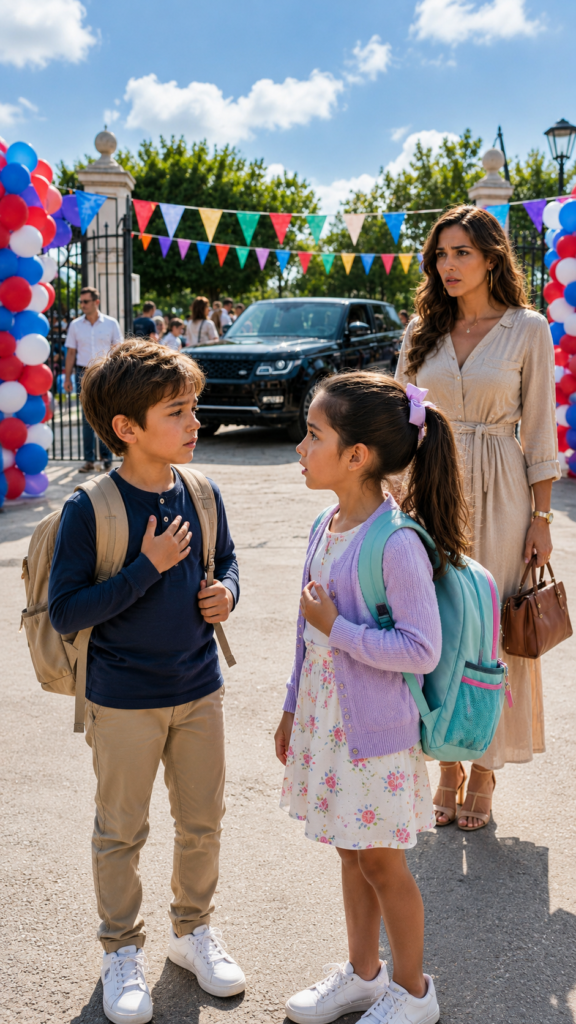
Renata stopped tying her shoelaces and stared at the boy as if he had just asked her for the moon. He was eight years old, his uniform perfectly pressed, wearing expensive sneakers and carrying a backpack that looked like it belonged in a luxury store.
But his face didn’t match any of that.
The boy kept glancing at the elementary school entrance over and over, with a weary hope that no child should ever know.
"My mom?" Renata questioned, scrunching her nose in confusion.
He nodded seriously.
"I’ll return her before dismissal."
Marisol, Renata’s mother, overheard everything from behind. She had arrived at the family festival with a cooler, milanesa sandwiches, hibiscus water, and peeled mandarins in a container.
She wasn’t a rich woman. She was a mom from Iztapalapa who worked as a receptionist in a dental clinic, performing miracles to ensure her daughter lacked nothing.
"And why do you want my mom?" Renata pressed.
The boy lowered his gaze.
"I’ll tell you after the race."
The teacher’s whistle cut the conversation short. The kids rushed to their parents for the sack race. Some parents laughed, others filmed with their phones, while several moms screamed as if it were the final match of the Liga MX.
But that boy didn’t move.
He stood still, clutching the straps of his backpack.
Marisol felt something in her chest. It wasn’t pity. It was an alarm.
She slowly approached and knelt before him.
"What’s your name, sweetheart?"
"Mateo."
"And hasn’t your dad or mom arrived?"
Mateo swallowed hard.
"My dad promised to come."
Marisol didn’t ask more. Not there. Not in front of everyone.
She simply extended her hand.
"Then while he arrives, you run with us."
Mateo looked at Marisol’s hand, then at Renata.
Renata lifted her chin as if she were a judge.
"Loan approved."
Mateo appeared confused. Then he smiled just a bit, as if he didn’t want to spend too much joy.
They tied their feet together for the three-legged race. Renata took Mateo’s arm, and Marisol positioned herself behind them, ready to catch them if they fell.
"Left foot first," Renata commanded.
"Your left or my left?" Mateo whispered.
"The good left, silly."
Mateo let out a small laugh.
They didn’t win. Not even close.
They fell twice, blamed each other three times, and ended up covered in dust. Renata claimed the ribbon was crooked. Mateo said he had never practiced. Marisol accused them both of talking too much.
For a few minutes, Mateo stopped looking at the gate.
Then came lunch. Renata pulled him toward a blanket under a tree.
"Now you have to eat with us."
"No, thanks," he said, halting.
"Don’t you like the sandwiches?"
"I didn’t say that."
He looked at the cooler as if it were something foreign.
"That food is for your family."
Marisol took out a plate without making him feel invited out of embarrassment. She placed a sandwich, grapes, a mandarin, and a juice next to Renata’s plate, as if it had always been meant for him.
"There’s enough, honey."
Mateo took the sandwich with both hands but didn’t bite.
"What’s wrong?" Marisol asked.
He lowered his voice.
"No one has ever made me lunch before."
Renata stopped chewing.
Marisol froze.
The playground was still filled with music, laughter, and screams. But on that blanket, everything fell silent.
Mateo bit quickly, as if regretting having said so much.
"It’s really good," he said, overly polite.
Renata pushed her juice toward him.
"You can take mine too."
"I already have one."
"I know."
"Then why are you giving me another?"
Renata shrugged.
"Because borrowed kids need double."
Mateo smiled for real.
In that instant, a black van entered the parking lot as if arriving from another country. Several parents turned. A tall man got out, dark suit, phone in hand, and a face clenched in guilt.
Mateo heard the engine before he saw it.
His smile vanished.
The man walked toward him. Any child would have run to his dad after waiting for him all afternoon.
Mateo didn’t run.
He remained seated, the sandwich in his hands.
And Marisol understood that innocent question—"Will you lend me your mom?"—hid a sadness that was just beginning to unfold.
PART 2
Alejandro Cárdenas knelt in front of his son in the middle of the playground. He didn’t blame traffic on Viaducto, or a meeting, or his cell phone, or the company.
He simply said:
"I’m sorry, Mateo."
The boy nodded.
Not like someone forgiving. Like someone already used to it.
Marisol saw that gesture and her heart tightened. There were kids who threw tantrums when their parents arrived late. Mateo didn’t. Mateo seemed to have learned not to ask for too much.
Before leaving, the boy turned to Renata.
"Thanks for lending me your family."
Renata raised her hand.
"You returned her before dismissal, just like you promised."
Mateo almost smiled.
Alejandro introduced himself with cold politeness. He thanked Marisol for looking after his son and offered apologies. She didn’t see a stuck-up rich guy, even though the van and suit screamed money.
She saw a man afraid to touch something he himself had broken.
Before they left, Marisol said:
"Children don’t remember expensive gifts, Mr. Cárdenas. They remember who showed up."
Alejandro didn’t respond.
But the phrase lodged itself deep.
The Cárdenas house, in Jardines del Pedregal, looked like a hotel. Electric gate, fountain, marble, silent employees, a huge dining room, and a nanny who remembered schedules as if she were keeping an agenda, not caring for a child.
Everything was perfect.
Nothing smelled like home.
That night, Alejandro locked himself in his study. Before him lay contracts, reports, and a glass he didn’t touch. His assistant, Bruno, entered with a folder.
"You’ve mentioned the lady from school four times, sir."
"I just asked if you knew who she was."
"Four times."
Alejandro fell silent.
Bruno lowered his voice.
"Mateo laughed today."
The phrase weighed more than any complaint.
Alejandro looked toward the window.
"I haven’t heard him like that in months."
The truth was older than that festival.
Years ago, Claudia, Mateo’s mother, hadn’t just been unfaithful to Alejandro. She had also paid an employee to pass along schedules, conversations, account movements, and details of the house.
When Alejandro discovered it, the marriage shattered. Custody remained with him, but trust died completely.
Since then, he had only hired older caregivers—discreet, efficient women. Women who took care of Mateo without intruding too much. All out of fear of another betrayal.
And without realizing it, he turned the house into an office with toys.
The next morning, during breakfast, Mateo looked up.
"Dad, can I visit Renata?"
The nannies exchanged glances.
Alejandro expected him to ask for a drone, a gaming console, new sneakers. Not an afternoon in someone else’s home.
"Yes," he finally replied.
Mateo’s smile didn’t last long, but it changed the atmosphere.
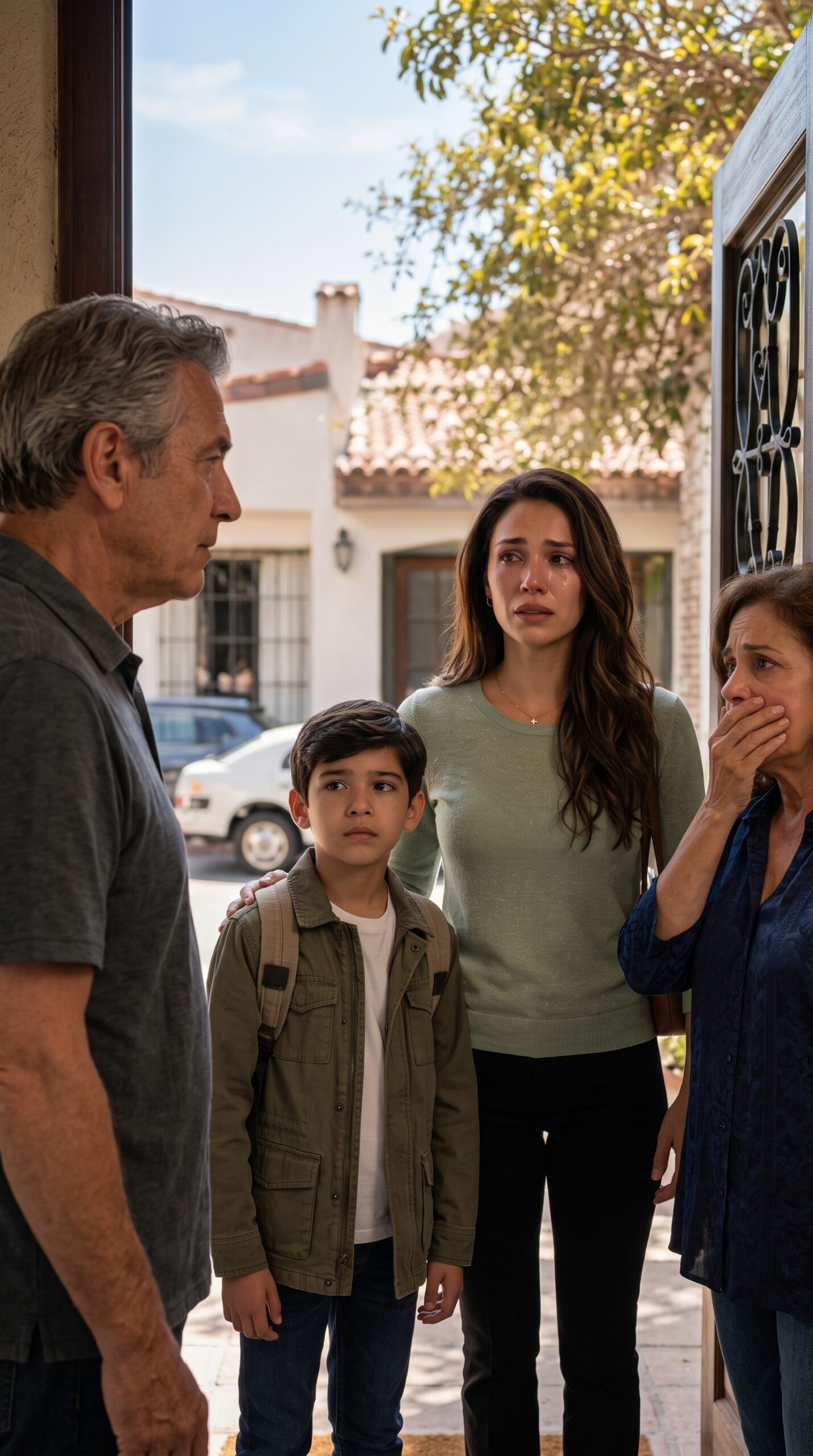
That afternoon, Alejandro took him personally. Marisol’s house, in a quiet neighborhood in Coyoacán, didn’t have a gate or fountain. It had flowerpots, drawings taped to the window, an old bicycle, the smell of pancakes, and a radio playing softly in the kitchen.
Renata opened the door, shouting:
"My borrowed brother has arrived!"
"I’m not your brother," Mateo said.
"We’ll see about that."
Inside was Don Toño, Marisol’s father, wearing a blue apron, flour on his cheek, and a wooden spoon in hand.
"Who stole my pancakes?" he asked, looking at the empty plate.
Renata pointed at Mateo without a hint of shame.
"It was the borrowed brother."
"You gave him to me!" he whispered, frightened.
Don Toño’s eyes widened.
"We have a thief and an accomplice."
Renata ran off laughing. Mateo stood frozen until Don Toño took a dramatic step.
Then he ran too.
The old man chased them through the yard, apron flying. Mateo looked back, surprised.
"Grandparents do run!"
Don Toño stopped next to the flowerpots, very dignified.
"I didn’t run. I administrated my energy."
Mateo let out a clean, strong, unexpected laugh.
From the entrance, Alejandro felt something breaking and healing at the same time.
Visits became routine. Mateo started counting the days until he could go. Don Toño taught him to water tomatoes. Renata challenged him to water fights. Marisol served coffee to Alejandro until one day he stopped saying, "No, thanks."
Nobody noticed the gray car parked in front of the house on a Saturday.
Inside, Claudia observed from the dark windows.
Her son laughed with a girl, with a woman who wasn’t her, and with an old man covered in flour.
He didn’t look like an abandoned child.
He looked like a child who had found something.
Claudia’s hands trembled on the steering wheel.
She wasn’t losing a fight. She was losing her place.
Two days later, when everyone thought it would be another quiet Saturday, the patio gate swung open violently.
Two unknown men entered.
They didn’t knock. They didn’t greet. They didn’t pretend to be polite.
"We’re here for the lady," one said.
Marisol emerged from the kitchen, drying her hands on a cloth.
"I am the lady."
The tall man pointed toward the street.
"You’re going to stay away from that family. You don’t belong there."
Renata hid behind her mother. Mateo stood still next to Don Toño. He didn’t cry. He didn’t scream. He only observed.
And that was what hurt the most afterward: knowing that an eight-year-old child already knew to stay still when something bad could happen.
Don Toño stood in front of the man.
"That’s enough."
The man laughed at seeing him in an apron and holding a spoon.
"Get out of the way, old man."
"My name is Antonio," the old man replied, "and when I’m in a bad mood, they call me Don Antonio."
The man shoved him.
Don Toño fell backward onto the brick pathway. The spoon rolled to a flowerpot.
For one second, the yard was devoid of air.
Then Mateo ran.
"Grandpa Toño!"
He knelt beside him and grabbed his arm.
"Does your head hurt? Can you sit up?"
Don Toño opened his eyes and smiled with effort.
"Only my pride hurts, kid."
Marisol grabbed a rolling pin from the table. She didn’t threaten, but her eyes made the second man hesitate.
The tall man advanced again.
Don Toño, assisted by Mateo, stood up covered in dirt.
"You’ll never touch my daughter again."
"And what are you going to do?"
Don Toño looked around, grabbed a plastic chair, and smashed it against the man’s shoulder. It wasn’t elegant, but it worked. The man slipped on the wet grass and fell.
Before he could get up, Don Toño sat on top of him.
Renata’s eyes widened.
"Grandpa? Did you just sit on the man?"
Don Toño adjusted his apron.
"Negotiation by body weight."
The neighbors were already coming out. Doña Chayo shouted that she had called the police. A boy was filming from the sidewalk. The second intruder ran away.
Alejandro’s black van arrived before the police.
He braked so abruptly that the tires screeched. Alejandro got out with his jacket askew and a pale face.
He expected blood. Screams. The worst.
He found Don Toño sitting on a stranger in the middle of the yard.
Bruno stepped down behind him and cleared his throat.
"Sir, it seems that Mr. Antonio has already controlled the situation."
Alejandro couldn’t smile. Not yet.
He crossed the yard.
"Mateo."
The boy looked up.
"I’m okay, Dad."
Alejandro examined him from head to toe.
"Did they hurt you?"
"No."
Then he looked at Marisol.
"Are you okay?"
"We’re fine," she replied, though her voice trembled.
The patrol arrived minutes later. The police lifted the detained man, though Don Toño seemed upset about leaving his strategic position.
The man spoke before reaching the Public Ministry. His cell phone had messages, audios, and transfers.
Everything pointed to the same name.
Claudia Salvatierra.
Mateo’s mother.
Hours later, Claudia entered the Public Ministry wearing dark glasses and with her chin held high, as if it were all a misunderstanding by ordinary people.
"This is ridiculous," she said. "I didn’t send anyone to cause harm."
The agent placed a cell phone on the table.
Claudia’s voice filled the office:
"Don’t hurt anyone. Just scare her. Especially the woman. She needs to understand that she can't interfere with my family."
Claudia froze.
"That’s taken out of context."
Then came arrests. Transfers. Statements. Every lie died before it was born.
"I just wanted her to stay away," she finally said, her voice breaking. "That woman is taking my son."
Alejandro looked at her.
"No. Mateo didn’t go with her."
Claudia pressed her lips together.
"Then what?"
"He went where he felt loved."
The phrase hit her harder than any accusation.
"I’m his mother."
"Being a mother doesn’t mean showing up when you’re afraid of losing the place you abandoned yourself."
Claudia stood up.
"You took my son from me."
Alejandro shook his head slowly.
"You lost custody in court. You lost his trust all on your own."
When they informed her that she was being detained for threats, coordinated breaking and entering, and damages, Claudia stopped looking at Alejandro.
She looked down.
For the first time, she didn’t seem angry.
She seemed defeated by the consequences of her own actions.
That night, everyone returned to Marisol’s house. The gate was still broken, a flowerpot lay in pieces, and the patio bore marks of the fight. But the kitchen smelled of coffee, cinnamon, and sweet bread.
Don Toño was on the couch with ice on his shoulder.
Renata and Mateo sat on either side of him like tiny bodyguards.
"Don’t look at me like that," he said. "I’m fine."
"You got pushed," Renata said.
"And then I won."
"You sat on a man," Mateo said, still impressed.
"Advanced strategy, kiddo."
Marisol covered her mouth to suppress a laugh.
Alejandro stood by the broken gate, watching the patio. Marisol approached him with two cups of coffee.
"You didn’t have to come back today."
He took the cup.
"I did."
"Why?"
Alejandro looked at his son. Mateo was leaning against Don Toño, listening to a story that was surely being exaggerated.
He didn’t look like a guest child.
He looked at home.
"Because this is the first place where my son seemed to belong to something."
Marisol didn’t respond.
The next morning, workers arrived to repair the gate, reinforce the door, and install lamps. Marisol stepped out with her arms crossed.
"I didn’t ask for this."
Alejandro turned to her.
"I know."
"I don’t want you thinking you need to fix my life with money."
"I’m not buying anything, Marisol. I’m protecting the people my son loves."
She lowered her gaze.
It wasn’t surrender. It was exhaustion letting go.
The following weeks didn’t erase the scare, but they transformed it. The house continued to smell of burnt pancakes on Saturdays. Don Toño insisted they weren’t burnt, "they were browned with character." Renata and Mateo resumed water fights. Alejandro began to stay longer than necessary.
One Saturday afternoon, Don Toño gathered everyone in the patio.
He wore his blue apron, already washed, though with a stain he called "combat decoration."
"I have an announcement."
Renata whispered:
"When he says that, it’s almost always weird."
"I heard you," Don Toño said.
Then he looked at Mateo.
"You came one day asking to borrow a mom."
Mateo lowered his gaze.
"Then you borrowed a sister," the old man continued.
Renata smiled.
"And a grandpa."
Don Toño raised a finger.
"Exactly. But it’s enough of borrowing."
The patio fell silent.
Alejandro placed a hand on Mateo’s shoulder.
Don Toño looked at the boy with a simple tenderness that didn’t need a speech.
"Here, we don’t lend people, kid. Here, those who learn to love stay."
Mateo’s eyes filled with water.
"So can I keep coming?"
Renata took his hand.
"No."
Mateo looked at her in confusion.
She smiled.
"Now you have to arrive. It’s different."
Marisol wiped a tear before anyone saw. Alejandro saw her, but said nothing.
That night, when Renata fell asleep on the couch and Mateo wrote in a new notebook, Don Toño called him to the porch.
He handed him a worn notebook.
"Here."
Mateo received it carefully.
"I can’t keep it."
"Of course you can. I already filled it."
The boy opened the first page. In large, shaky letters, it read:
"The Day a Boy Borrowed a Mom."
He flipped through the pages. Don Toño had written little memories: the pancake theft, the race in the yard, the water fight, the plastic chair, the day Mateo helped him get up from the ground.
On the last page, there was a phrase:
"Some children are born into a family. And some children find it when someone saves them a place at the table."
Mateo read that line twice.
Then he closed the notebook against his chest and leaned on Don Toño’s shoulder.
From the new gate, Alejandro watched.
Marisol came to his side.
"Thank you," she said.
"No," he replied. "You gave him something I didn’t know how to give."
Marisol looked at him calmly.
"You let him come. For a man who trusted no one, that wasn’t little."
Alejandro held her gaze. He saw her exhaustion, her strength, her way of loving without making noise.
He was about to say something.
But Don Toño shouted from the porch:
"If you’re done staring at each other like in a soap opera, someone bring me hot chocolate! The hero is still delicate!"
Renata let out a sleepy laugh from the couch. Mateo laughed too.
And for the first time in a long time, Alejandro understood that security wasn’t about controlling everything.
It was about the people who stayed.
Mateo looked at Renata, at Marisol, at Don Toño, and at his dad.
Then he understood that on that afternoon at school, he hadn’t borrowed a mom.
Unknowingly, he had found a home.