PART 1
—Sofía… stay with me tonight.
The chamomile cup trembled in Sofía Herrera's hands.
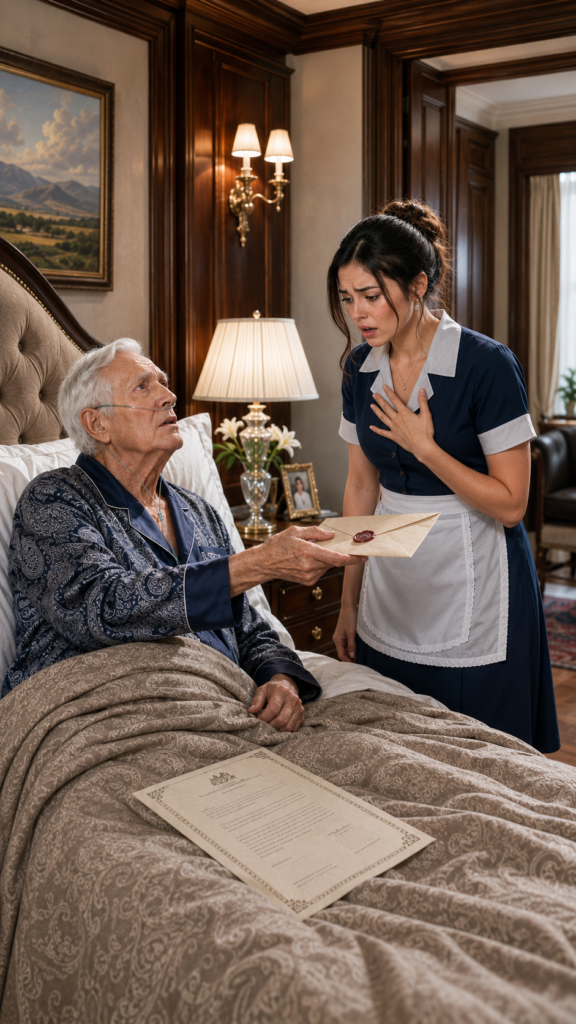
For a moment, she thought she had misheard. Don Alonso Beltrán, the most feared man in that family, wasn’t asking for medicine or for her to fluff his pillows. He was asking her to spend the night in his bedroom.
The Beltrán mansion, in Lomas de Chapultepec, felt more like a museum than a home. Cold marble, priceless paintings, employees whispering, and three adult children waiting, with false mourning etched on their faces, for the old man to stop breathing.
Sofía had worked there for three years. She entered through the service door, ate in the kitchen, and never sat on the white sofas in the main living room. To Rodrigo, Mónica, and Darío, she was “the girl.” To Don Alonso, lately, she was the only person who asked if he was cold.
—Sir… that doesn’t look right —Sofía said, lowering her gaze.
Don Alonso closed his eyes in shame.
—I’m not asking for anything dirty, my dear. I’m not that kind of old man. I just need someone to listen to what’s been stuck in my throat before I die.
Downstairs, the children were arguing over the Cuernavaca house, shares in the construction company, and a collection of Swiss watches. None had come up to check if their father was still breathing.
—Why me? —Sofía asked.
Don Alonso looked at her with a sadness that seemed ancient.
—Because you have Clara’s eyes.
Sofía froze.
—Who is Clara?
The old man turned his head toward a wooden box on the nightstand. On top was an old photograph: a young woman in a yellow dress, cradling a baby wrapped in a pink blanket.
—My daughter —he whispered—. The daughter this family erased.
Sofía felt a blow to her chest.
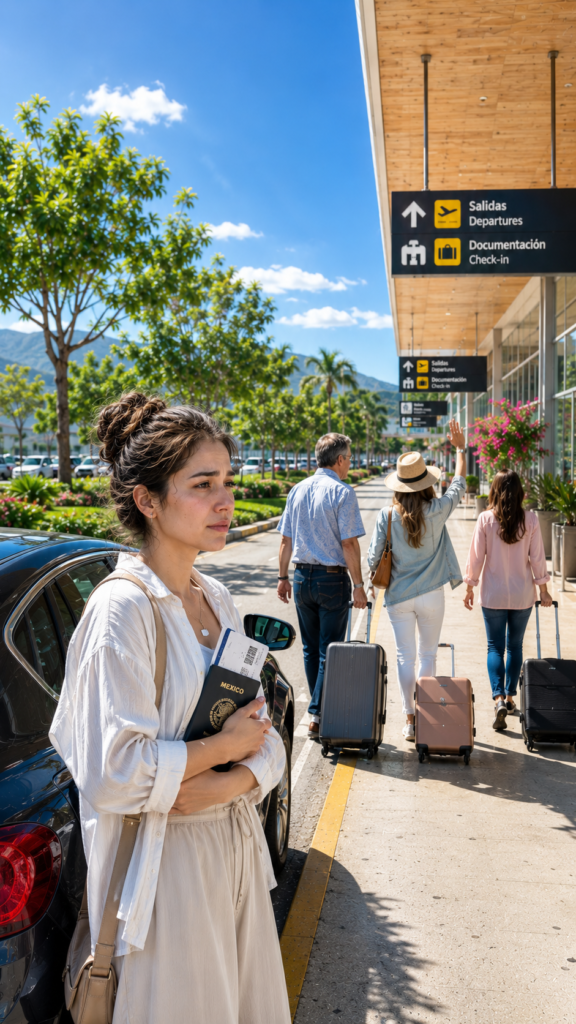
All her life, she’d heard her mother, Clara Herrera, speak of a large house she never wanted to describe. A house where love had come late, wrong, and with pride. Before she died, Clara left Sofía a silver pendant in the shape of a hummingbird.
Don Alonso saw it hanging around her neck.
His face changed.
—What was your mother’s name?
Sofía took a step back.
—Clara Herrera.
The old man began to cry.
At that moment, the door burst open.
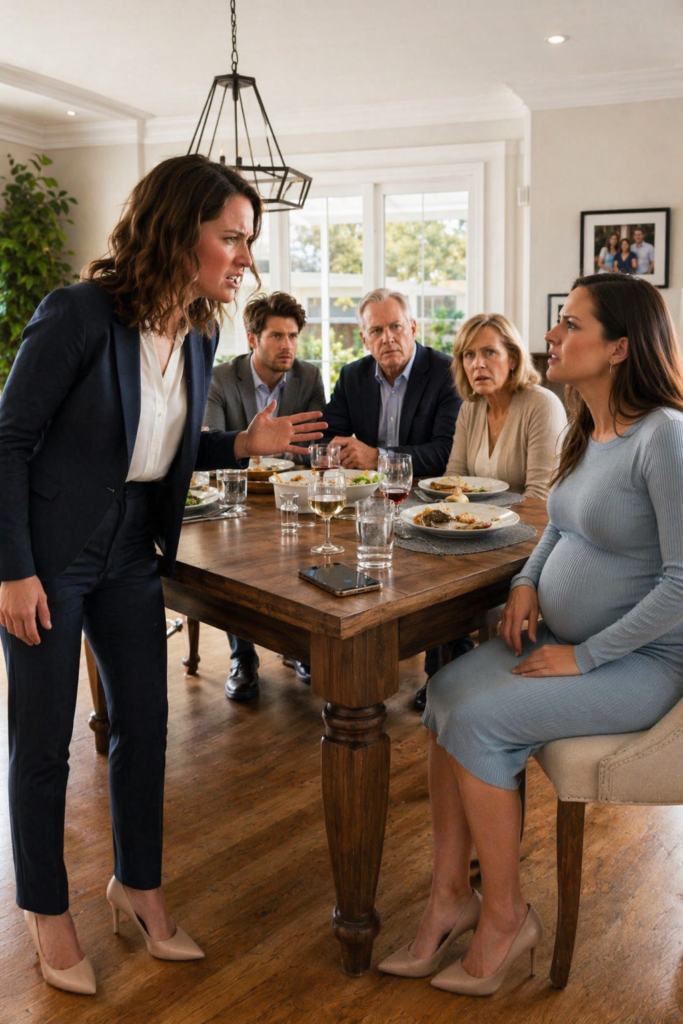
Rodrigo entered first, clad in a black suit with an attorney’s glare. Mónica followed, dripping with jewelry. Darío was recording on his cell phone.
—What a lovely novel you’re weaving —Rodrigo said.
Mónica looked Sofía up and down.
—Now the maid comes to invent surnames?
Don Alonso struck the bed with his trembling hand.
—Don’t ever call her that again. She is my granddaughter.
Sofía felt the air drain from her lungs.
Mónica let out a dry laugh. Darío stopped recording.
Don Alonso opened the wooden box. Inside was a yellowed envelope with a handwritten phrase:
Dad, please don’t punish my daughter.
Sofía recognized that handwriting.
It was her mother’s.
And when Rodrigo tried to snatch the envelope from her, Sofía understood that this night was just beginning.
PART 2
Rodrigo was the first to regain his composure.
—Dad is on medication —he said, looking at Sofía as if she were a cockroach on the carpet—. He’s confused. You don’t know what trouble you’re getting into.
Sofía pressed the envelope against her chest.
—All I know is that this letter was from my mom.
Mónica crossed her arms.
—Oh, please. All wealthy families have stories of people who appear out of nowhere. Really, what a coincidence that just as my dad is dying, the maid discovers she’s a granddaughter.
Sofía felt her face heat, but she didn’t lower her gaze.
For years, she had endured being called “the girl,” “the maid,” “the one from the kitchen.” She had smiled when Mónica left clothes strewn about the bathroom and said, “That’s what we pay her for.” She had stayed silent because she needed the paycheck, because rent in Iztapalapa wouldn’t wait, and because her mother taught her that dignity could also be washed and kept working.
But that night, she wasn’t defending a job.
She was defending Clara’s name.
—My mom wasn’t a freeloader —Sofía said—. And neither am I.
Don Alonso struggled to breathe.
—Rodrigo, call attorney Márquez.
Rodrigo tensed.
—Your lawyer? For what?
—Because she knows what you didn’t want to come to light.
Darío let out a nervous laugh.
—This is really strange. I’d better call Dr. Salcedo to come and say you’re not fit.
Don Alonso looked at him with a terrible calm.
—Salcedo is no longer my doctor. I fired him when I discovered you were paying him to increase my sedatives.
Silence fell heavily.
Mónica turned pale.
—Dad, don’t make things up.
—I’m not making things up. For the first time in 29 years, I’m speaking the truth.
Sofía opened the envelope with trembling hands.
The letter began with a phrase that shattered her inside:
Dad, I know you said that if I crossed that door, I would no longer have a daughter, but I am still Clara.
Sofía read in silence. Clara wrote that she had left because she fell in love with Julián Herrera, a broke junior high teacher, but with a pure heart. She wrote that Don Alonso had rejected her for marrying “a poor man.” She wrote that Julián had passed away in an accident when Sofía was just 5 months old.
And then came the worst part.
Clara didn’t ask for millions. She didn’t ask for a house. She didn’t ask to return as a repentant princess.
She asked for help for her baby.
She said she was working ironing others' clothes, living in a borrowed room near the Central de Abasto, that Sofía was often ill, and that she didn’t know how to pay for the doctor.
In the end, she wrote:
If you still hate me, hate me. But don’t let Sofía grow up thinking she has no family.
Sofía couldn't continue reading.
—Did you reply? —she asked, her voice breaking.
Don Alonso lowered his gaze.
—No.
The word was more cruel than a scream.
—I kept it. I thought I’d respond the next day. Then the next week. Then Christmas. Then I felt ashamed. And shame, when mixed with pride, becomes a tomb.
Sofía closed her eyes.
Her mother had died believing that no one in that house wanted to open the door for her.
Then there was a knock.
Attorney Teresa Márquez entered, a woman with gray hair, a navy blue suit, and a leather briefcase. She didn’t seem surprised. Just tired.
—Don Alonso asked me to be present if this conversation happened before dawn —she said.
Rodrigo exploded.
—This is absurd. We’re going to contest everything.
—You can try —the lawyer replied—. But Mr. Beltrán left everything protected.
She pulled out a folder.
—Six months ago, the will was modified. There were independent medical evaluations, a notary, and genetic tests. Sofía Herrera was legally recognized as Don Alonso Beltrán’s granddaughter, daughter of Clara Beltrán Herrera.
Mónica clutched her throat.
—It can’t be.
Darío murmured:
—She stole from us.
Don Alonso looked at him sadly.
—No, Darío. You all gradually stole the only thing that wasn’t yours: my conscience.
Rodrigo approached the bed.
—Dad, think carefully. You’re going to destroy what you built for a girl who cleaned your floors.
Don Alonso took Sofía’s hand.
—And yet, her hands are cleaner than yours.
Rodrigo fell silent.
Attorney Márquez opened another folder.
—There are recordings, too.
Mónica paled.
—Recordings of what?
Don Alonso pointed to the wooden box.
Sofía lifted the lid. Underneath, hidden between the red lining, was a small memory stick.
The lawyer connected it to her cell phone.
First, there was static. Then Rodrigo’s voice filled the room:
—If the old man changes the will, we say the maid manipulated him.
Then Mónica spoke:
—You give that woman money, and she shuts up. People like that always accept.
Darío laughed.
—And if she doesn’t accept, we give her a scare. No one will believe her over us.
Sofía felt cold.
It wasn’t just disdain.
It was calculated fear.
Don Alonso closed his eyes, as if each voice buried him a little more.
—You could have had it all —he said—. But you never had enough.
Mónica began to cry, though no one knew if it was out of guilt or rage.
Rodrigo tried to walk to the door, but two guards appeared in the hallway. The lawyer had called them before entering.
—No one leaves with documents or devices —she said—. There are already notarized copies.
Darío cursed under his breath.
Sofía looked at Don Alonso.
—Why did you hire me?
The old man took time to answer.
—When I saw you at the interview, I recognized the hummingbird. It was the same one I gave Clara when she turned 18. I had you investigated. I knew who you were. I didn’t have the courage to tell you the truth face-to-face.
—But you had the courage to watch me serve you coffee for three years.
The sentence landed hard.
Don Alonso nodded, crying.
—Yes. And no forgiveness will suffice for that.
Sofía didn’t respond.
Because it was true.
Attorney Márquez placed one last document on the bed.
—Don Alonso left a special instruction. Most of the shares can pass to Sofía or become a foundation named Clara, aimed at abandoned women with children, without homes or family support.
Sofía looked at the letter.
The help her mother requested 29 years late could come to other women in time.
Mónica let out a bitter laugh.
—How lovely. A foundation for strangers with our money.
Sofía raised her gaze.
—Clara wasn’t a stranger either. She was your sister.
Mónica opened her mouth but said nothing.
For the first time, her face seemed less stony.
—I was 16 when she left —she whispered—. Dad said she chose a poor man over us. I believed him.
—My mom wrote to you —Sofía said.
Mónica lowered her gaze.
—To me too.
Sofía felt something breaking again.
—And did you reply?
Mónica shook her head.
No need to say more.
Clara hadn’t knocked on a single door. She had knocked on several. All remained closed.
The dawn passed slowly. Outside, the city remained alive, with distant honking and dogs barking on some elegant street where no one seemed to suffer. Inside the bedroom, an entire family was crumbling without a sound.
Don Alonso asked to open the curtains.
Sofía walked to the window. The sky was beginning to turn gray over the trees lining the avenue. When she returned, the old man handed her the wooden box.
—It belonged to Clara —he said—. She said a hummingbird doesn’t stay where there are no flowers.
Sofía ran her fingers over the lid.
—My mom used to say something similar. That a woman could lose her house, surname, and money, but she must never lose her voice.
Don Alonso smiled through the pain.
—She was always braver than I.
The lawyer approached.
—We need to confirm your decision, Sofía.
Rodrigo raised his head.
—She can’t decide on something she doesn’t understand.
Sofía looked at him.
—You’re right. I don’t understand business. I don’t understand millions. But I understand what it is to wait for help and receive silence.
She took Clara’s letter.
—The house will keep my mom’s name. I don’t want to live here as the owner of a museum full of lies.
Darío frowned.
—So what are you going to do?
—The Clara Herrera Beltrán Foundation.
Rodrigo let out a dry laugh.
—You’re going to throw away the family legacy.
Sofía took a step toward him.
—No. I’m going to clean what you called a legacy.
Don Alonso squeezed her hand.
—I don’t deserve for you to stay.
Sofía looked at him for a long time.
She didn’t feel tenderness yet. She felt rage. She felt grief for her mother. She felt an enormous sadness for everything that could have been and wasn’t.
—I don’t know if I can forgive you —she said.
—I know.
—But I can stay until dawn.
The old man cried like a child.
For the next hour, he spoke of Clara. He told how she would sneak out to the market to eat esquites, how she hated dinners with businessmen, and how once she sold a gold bracelet to pay for a cook’s dog operation.
Sofía cried and smiled at the same time.
—She really was.
Then she shared what he never saw: Clara singing boleros while ironing, Clara saving coins in a cookie tin, Clara saying that one day Sofía would have a life without needing permission to enter through the front door.
Don Alonso died at 6:18 in the morning.
He didn’t die surrounded by impatient heirs.
He died holding the hand of the granddaughter he almost lost forever.
The news exploded that same day. The media spoke of fortune, scandal, and inheritance. Rodrigo promised to sue. Darío tried to sell interviews. Mónica disappeared for several weeks.
But the recordings spoke louder than they did.
Months later, the mansion opened its doors with another name at the entrance:
CLARA HOUSE
The party hall became a community dining room. The library turned into legal counseling. The empty rooms welcomed women with babies, broken backpacks, and fear in their eyes.
The first night, a 21-year-old arrived with a sleeping child in her arms.
She gazed at the marble and whispered:
—I don’t belong here.
Sofía recalled her first day entering through the service door.
She took the bag from her.
—You do belong. That’s precisely the point.
Outside, a hummingbird paused for a second over the flowers in the garden.
And Sofía understood that the true inheritance wasn’t the house, the money, or the surname.
It was the opportunity to finally open all the doors that had been closed to her mother.