PART 1
—Mariana, I need you to stay with me tonight.
The chamomile tea trembled on the tray.
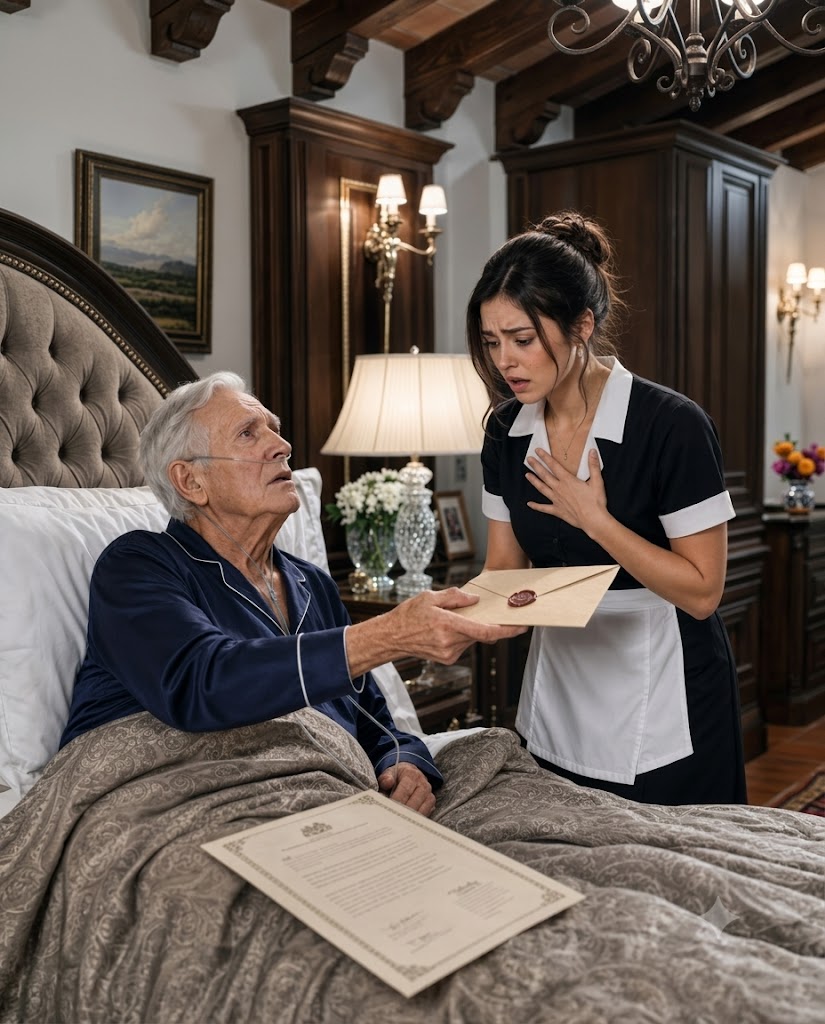
Mariana Cruz looked up, confused. Don Armando Beltrán, owner of hotels in Cancún, construction companies in Monterrey, and land throughout the Riviera Maya, lay in a huge bed, thinner than a shadow.
The house, a white mansion in Lomas de Chapultepec, felt like a museum: shining floors, priceless paintings, marble stairs, and staff moving silently.
Mariana had worked there for three years.
She cleaned, cooked when staff was missing, and accompanied Mr. Armando when his nurses left. But never, ever, had he asked her for something like this.
—Sir, I don’t think it’s appropriate —she replied, taking a step back.
Don Armando closed his eyes in shame.
—It’s not what you think, girl. I don’t even have the strength to lift a glass. I just want someone to listen before I die.
Downstairs, in the main room, his three children had been arguing since the afternoon.
Patricio wanted to review the will.
Jimena was asking about her mother’s jewelry.
Rodrigo was on the phone with a lawyer, repeating that their father “was no longer in a condition to decide anything.”
None had come upstairs to ask if he was in pain.
Mariana left the tray by the bed.
—And why me?
Don Armando looked at her for a long time. In his eyes was something stronger than illness: guilt.
—Because you look too much like her.
—Who?
The old man pointed to an old picture frame on the bedside. In the photo was a young woman in a yellow dress, smiling with a baby in her arms, under a tree full of bougainvilleas.
—Elena —he whispered—. My oldest daughter. The one this family decided to erase.
Mariana felt coldness creep up her spine.
She had always heard that Don Armando had only three children. In that house, no one spoke of an Elena.
—She fell in love with a teacher from Oaxaca —he continued—. I told her that if she left with him, she could forget my last name. And she left.
His voice cracked.
—Later she wrote to me. Her husband had died. She had a newborn girl. She asked for help, not for herself, but for her daughter.
Mariana stopped breathing.
A single mother.
A girl growing up in tenements.
A woman washing other people's clothes to pay for medicine.
Without realizing it, Mariana touched the hummingbird pendant she wore hidden under her uniform. It was the only thing her mother had left her before she died.
Don Armando saw the pendant and turned pale.
—What was your mother’s name?
Mariana wanted to lie.
She couldn't.
—Elena Cruz.
The old man began to cry.
In that instant, the door swung open.
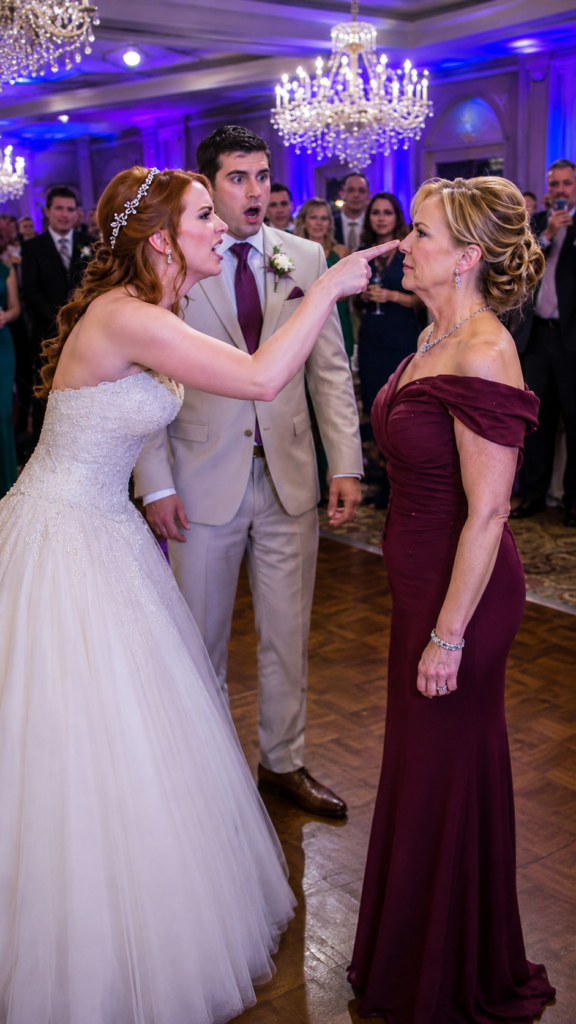
Patricio entered first, in a dark suit with a face full of hatred. Behind him came Jimena, covered in diamonds, and Rodrigo filming with his cellphone.
—What a nice novel —Patricio said—. The maid discovering she’s family just when my dad is dying.
Jimena looked at Mariana from head to toe.
—No way. Is the girl who cleans the bathrooms going to be the heir now?
Don Armando gathered strength and raised his voice.
—Never speak to my granddaughter like that again.
The word fell like a blow.
Granddaughter.
Mariana felt the floor open beneath her.
Don Armando opened a drawer with trembling hands and pulled out a yellowed envelope.
On the front, it read: Dad, please read this. It’s been 29 years and I’m still waiting.
Mariana recognized that handwriting.
It was from her mother.
Patricio advanced furiously.
—Dad, give me that. You’re confused.
Don Armando pressed the letter against his chest.
—I’ve been confused my whole life. Now, at last, I see clearly.
And when Patricio locked the door, Mariana understood that she hadn’t come up to serve tea, but to unveil a truth that this family was willing to bury at any cost.
PART 2
—No one leaves here until we clear up this madness —Patricio said.
Mariana backed away, but Rodrigo was already blocking the entrance. Jimena crossed her arms, a cold smile on her lips, as if she were watching an intruder dirty her carpet.
—Look, Mariana —Patricio said, lowering his voice—. My dad is medicated. He has bad days. You’re a smart employee, I don’t deny it. If you want money, we can arrange something.
—I don’t want your money —she replied.
Jimena burst out laughing.
—Oh, please. They all say that until they see a check with zeros.
Mariana felt rage, but she didn’t shout. She had learned to swallow too many humiliations since childhood. At school, for wearing borrowed shoes. At jobs, for entering through the service door. In that house, for hearing “the girl” instead of her name.
But that night was not about her.
It was for Elena.
—My mother asked for help —Mariana said—. She didn’t ask for a mansion. She didn’t ask for jewels. She asked that her daughter not grow up alone.
Don Armando closed his eyes.
—And I left her alone.
The phrase filled the room with a heavy sadness.
Jimena looked at the old man with impatience.
—Dad, Elena left because she wanted to. You’re not to blame for everything.
—I am —he replied—. But you are to blame for enjoying the silence.
Rodrigo stopped recording.
—What does that mean?
Don Armando pointed to a silver music box on the nightstand.
—Mariana, open it.
She obeyed.
The little box had a hummingbird engraved like the one on her pendant. Inside, there was no music, but a small memory, hidden beneath the velvet.
Patricio turned pale.
—What did you do?
—Learn from you —said Don Armando—. You always record when you think it benefits you. I do too.
Mariana connected the memory to the cellphone that Attorney Ángela, the old man’s lawyer, had prepared hours earlier. An audio appeared on the screen.
The first voice was Rodrigo.
—The old man is taking too long.
Then Jimena:
—As long as the will doesn’t change, he can last as long as he wants.
Patricio responded:
—The problem is Mariana. He trusts that maid. If she puts ideas in his head, we’ll get rid of her with an accusation of theft, and that’s it.
The audio ended.
No one spoke.
Mariana looked at the three siblings. They no longer seemed rich. They looked like scared children afraid of losing a toy.
—Were you going to accuse me of theft? —she asked.
Patricio clenched his jaw.
—That was a private conversation.
—That was a confession —Don Armando corrected.
At that moment, someone knocked on the door.
Patricio didn’t move.
—Don’t open it.
But from outside, a firm voice echoed.
—I am Attorney Ángela Montes. If you don’t open, the guards will enter with the notary and the police.
Rodrigo cursed under his breath.
Jimena opened.
The lawyer entered with a black briefcase and two security men behind her. She did not greet the children. She walked straight to the bed.
—Mr. Beltrán, everything is ready.
Patricio exploded.
—This is abuse! My dad isn’t well.
Ángela pulled out several documents.
—Mr. Beltrán was evaluated by three independent doctors. He signed legal changes six months ago, before a notary. Moreover, he left evidence of family pressure and possible attempts at asset manipulation.
Jimena lost her color.
—Legal changes?
Don Armando took Mariana’s hand.
—Six months ago, I confirmed what my heart already knew. Mariana is Elena’s daughter. My granddaughter.
Mariana slowly released her grip.
—Did you already know?
The old man lowered his gaze.
—I suspected when I saw your pendant. I investigated your story. Not to hurt you, but to be certain before facing them.
—And why didn’t you tell me?
—Because I was cowardly once again.
That honesty hurt more than a lie.
Ángela handed Mariana the yellowed envelope.
—Your mother wrote this letter when you were four months old. Mr. Armando received it but never replied.
Mariana opened the letter with trembling hands.
Elena didn’t ask for forgiveness for loving. She didn’t ask to return to the mansion. She said her husband had died, that she worked nights, that sometimes she didn’t have money for milk, and that all she wanted was for her daughter to have a chance.
The last line shattered Mariana inside.
Dad, if you still hate me, hate me. But don’t punish Mariana for being born.
Tears fell silently.
—My mom waited for a response her whole life —she said.
Don Armando was crying.
—I know.
—No, you don’t know —Mariana replied—. You didn’t see her checking the mail. You didn’t see her put away a fancy dress in a bag because she said it belonged to another life. You didn’t see her die working, while this house pretended she never existed.
The silence was brutal.
Jimena lowered her gaze.
For the first time, her arrogance cracked.
—I received a letter from Elena —she confessed softly.
Patricio looked at her furiously.
—Shut up.
—I was 17 —she continued—. Dad told us that Elena abandoned us for a good-for-nothing. I believed him. She wrote to tell me she had a daughter. I… I burned the letter.
Mariana felt something inside her freeze.
Her mother hadn’t just knocked on one door.
She had knocked on several.
And all had left her outside.
—You didn’t lose a sister —Mariana said—. You erased her from your memory because it was more comfortable.
Patricio slammed the table.
—Enough! What does this woman want? The house? The companies? The last name?
Don Armando breathed heavily.
—She asked for nothing. That’s why she deserves to decide everything.
Ángela opened another document.
—The main inheritance has two paths. Mariana can receive the mansion and a majority share of the personal assets. Or she can turn them into the Elena Cruz Foundation, to support single women with children, temporary housing, legal advice, and scholarships.
Rodrigo let out a bitter laugh.
—What a cliché.
Mariana looked at him.
—Cliché is crying over money and not for a dead sister.
Rodrigo fell silent.
Don Armando squeezed Mariana’s hand.
—The help I didn’t give your mother may come late… but it can reach others.
Mariana scanned the room: the expensive curtains, the paintings no one looked at, the bed where a rich man was dying surrounded by children calculating profits.
Then she thought of Elena, folding clothes with hands cracked from soap. In the nights when she pretended not to be hungry so her daughter could eat.
—The mansion stays —Mariana said.
Patricio smiled, thinking he had won.
But she continued:
—It stays with my mom’s name. And it opens as a shelter for women who have nowhere to go.
Patricio’s smile vanished.
—You have no idea what you’re doing.
—I do —Mariana replied—. I’m opening the door you shut on Elena.
Don Armando let out a sigh, as if he could finally rest.
—Thank you.
—I’m not doing it for you —she said—. I’m doing it for her.
The old man nodded.
—It’s fair.
That dawn, while the lawyers secured documents and the children frantically called their contacts, Don Armando asked to open the curtains.
The city was still dark.
Mariana sat beside him with Elena’s letter on her lap. He began to share memories: that Elena hated corporate dinners, that she preferred eating esquites on the street, that once she sold some expensive earrings to pay for a gardener’s dog operation.
Mariana smiled through tears.
—She was just like that. Always helping those who had less.
—She was better than all of us —he said.
—Yes.
The response was harsh, but true.
Don Armando didn’t ask for forgiveness again. Perhaps he understood that some forgiveness isn’t demanded on a deathbed.
He simply said:
—Do you think she knew I loved her?
Mariana looked at the letter.
Loving in silence feels too much like abandonment.
—I think she needed to hear it —she replied.
The old man closed his eyes.
At 6:18 AM, Don Armando Beltrán died holding the hand of the granddaughter he almost left out of his story.
The news exploded on social media that same afternoon.
“Mexican millionaire leaves mansion to unknown granddaughter and creates foundation in the name of the daughter he rejected.”
Patricio tried to contest the will.
Rodrigo wanted to sell interviews, but the audio sunk him before he could speak.
Jimena disappeared for weeks. Then returned with a box full of photos, letters, and a yellow dress kept for 29 years.
—I should have given you this earlier —she said.
Mariana took the box.
—Yes.
There were no hugs.
No immediate forgiveness.
But there was truth, and sometimes truth is the first brick of something less rotten.
Months later, the mansion stopped smelling of confinement.
The dining room that once only welcomed businessmen filled with young mothers, children with torn backpacks, and volunteers serving coffee from a pot.
The library became a legal office.
The party room, where luxurious weddings had been celebrated, turned into a daycare.
At the entrance, they placed a plaque:
ELENA CRUZ HOUSE
FOR THE WOMEN WHO ONCE KNOCKED ON A DOOR AND WERE NOT LET IN.
The first night, a 22-year-old girl arrived with a sleeping baby and a shopping bag full of clothes.
She looked at the marble in fear.
—I don’t belong here.
Mariana remembered her uniform, the tray, the looks of disdain.
She took the bag gently.
—You do belong. That’s precisely the point.
Later, people said Mariana had been lucky.
She went from employee to heir.
She won a mansion.
But that was never the real story.
The real story was a mother who wrote a letter without receiving a response.
A daughter who carried a silver hummingbird without knowing she bore a hidden last name.
An old man who realized too late that pride also kills.
And a house that, after 29 years of silence, finally learned to open the door.