PART 1
—Mom, don’t marry Julián… he made sure Dad never came back.
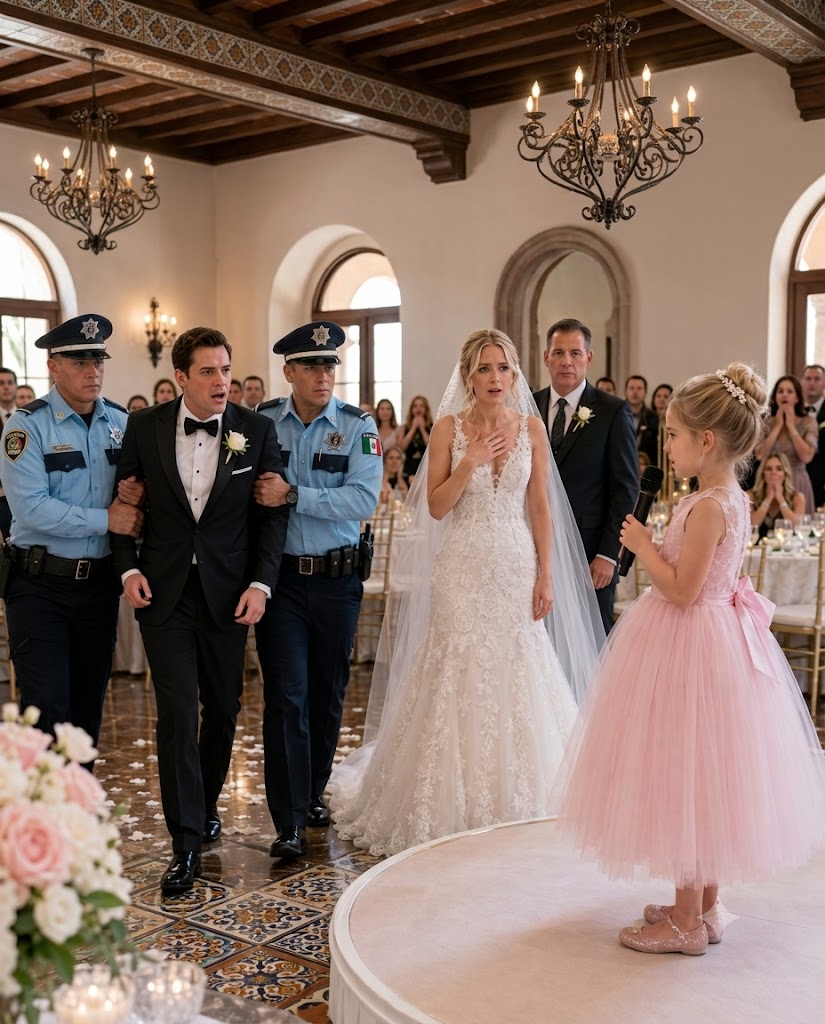
Camila’s voice, barely 5 years old, trembled through the speakers of the hall as if it had split the air in two.
No one moved.
Not the waiters with their trays of champagne, not the musicians of the trio, not the aunts who minutes earlier had been weeping with joy. Everyone stood frozen, staring at the little girl on the small stage, in her white flower dress, holding the microphone with both hands.
Mariana Rivas felt her legs go weak.
She was in the middle of her wedding, in an elegant hacienda on the outskirts of Cuernavaca, with bougainvillea hanging from the arches, candles on the tables, and a dance floor ready for the first dance.
In front of her stood Julián Mendoza, the best friend of her late husband.
The man everyone called “an angel.”
The man who had shown up at her house in the Del Valle neighborhood when she was widowed, broken, and unwilling to get up. The one who brought food, sorted paperwork, accompanied Mariana to the prosecutor’s office, and held Camila when the little girl cried, asking for her dad.
Santiago, Mariana’s husband, had died two years ago during the renovation of an old hotel in Puebla. According to the report, it was an accidental fall from a second story.
A mistake.
A tragedy.
A blow that destroys a family in seconds.
Julián was at the funeral. He carried the casket. He hugged Mariana in front of everyone and said:
—You’re not alone. As long as I live, I’ll take care of you.
And Mariana wanted to believe him.
Because when a woman is left alone with a small daughter, sadness becomes a huge house, and any gesture of help feels like light.
Julián gradually entered her days.
First fixing a leak in the kitchen. Then taking Camila to the park. Later staying for dinner. Eventually accompanying Mariana to kindergarten meetings, consultations, family birthdays.
Mariana’s mom repeated:
—Daughter, Santiago left you a good man nearby.
At first, Mariana wasn’t in love. She was tired. And sometimes fatigue disguises itself as love to avoid feeling so alone.
When Julián proposed during a trip to Valle de Bravo, he said with tears in his eyes:
—I don’t want to take Santiago’s place. I just want to give you the peaceful life he would have wanted.
Mariana accepted.
But Camila changed since that day.
She stopped running to Julián. She no longer called him “Uncle Ju.” She hid behind her mother’s legs when he entered. One night, before going to sleep, she asked with a seriousness that was not childlike:
—Mommy, if I say something bad, will you also go to heaven?
Mariana froze.
—Who told you that, my love?
Camila hugged her stuffed bunny and shook her head.
—No one.
Julián always found an explanation.
—She misses Santiago. She’s afraid of losing you. Don’t pressure her, Mariana. Poor thing, she’s confused.
And Mariana, filled with guilt for trying to rebuild her life, preferred to believe her daughter was jealous, not scared.
But that day, in front of more than 120 guests, Camila took the microphone and said the impossible.
Julián jumped up suddenly. His chair fell to the floor.
—Camila, get down right now —he ordered.
It didn’t sound like a worried stepfather.
It sounded like a man who had just had his grave opened.
Mariana rushed to the stage, almost breathless.
—My love, look at me —she whispered, kneeling before the girl—. Why do you say that?
Camila began to cry silently.
—Because I heard it.
—What did you hear?
The girl looked at Julián and trembled.
—A woman came to the house when you weren’t there. She had short gray hair and a black jacket. She told Julián that if he didn’t give her the money, she would tell what happened at the hotel.
A murmur swept through the hall.
Julián let out a false laugh.
—For God’s sake, Mariana. She’s 5 years old. She probably heard something on TV.
Mariana’s brother, Andrés, stepped in front of him.
—You don’t come near.
—Don’t be ridiculous, dude —Julián said through clenched teeth.
Camila tightened her grip on the microphone.
—The woman said she saw him push Dad.
Mariana’s mother screamed.
The bouquet fell to the floor.
Julián turned pale.
Mariana, her voice breaking, asked:
—Why didn’t you tell me before?
Camila clung to her neck.
—Because he told me that if I spoke, you would disappear too.
And in that instant, the whole wedding understood that this was not a child’s tantrum but the beginning of a truth that would destroy them all.
PART 2
The music faded.
The party turned into a scene of horror.
Guests began to rise from their tables, some recording with their phones, others crying, others repeating that this couldn’t be true. Mariana came down from the stage with Camila in her arms and felt the wedding dress weighing on her as if it were made of stones.
Andrés called 911.
Julián tried to approach.
—Mariana, listen to me. This is madness. Camila is confused. You know how much I’ve cared for you.
Mariana stepped back.
—Don’t ever touch my daughter again.
—After everything I’ve done for you, you’re going to repay me like this?
That phrase, said with rage and not with pain, finished breaking something inside her.
Julián had always spoken of help, of love, of protection. But in that moment he seemed like a man claiming ownership.
The police arrived before they served dinner.
Julián repeated six times that it was a slander. He said that Camila was traumatized, that someone had manipulated her, that Mariana should think clearly.
But Mariana could no longer stop remembering details.
The way Camila hid.
The strange questions.
The silences.
The fear.
That night, Mariana didn’t return to the apartment she already shared with Julián. She took her daughter to her friend Renata’s house in Coyoacán. Camila fell asleep still in her flower dress, her eyes swollen, and her fingers clutching her mother’s hand.
Mariana didn’t sleep.
At 7 AM, she was already at the prosecutor’s office.
A child psychologist spoke with Camila in a room filled with toys, colors, and a discreet camera. Mariana listened from another room with a shattered heart.
The girl told the same story.
The woman in the black jacket.
The demand.
The money.
The threat.
—Julián told her that if she spoke, my mom would leave like my dad —Camila said, looking down.
Mariana covered her mouth with her hands to suppress a scream.
Three days later, Detective Valeria Pineda summoned her.
She was a serious woman, around 50, with her hair tied back and a calm that didn’t seem cold, but rather experienced.
—We found the woman your daughter mentioned —she said.
Mariana felt the ground shift beneath her.
—Who is she?
—Claudia Moncada. She was an administrative assistant at the construction company managing the renovation of the hotel where Santiago died.
The detective opened a folder.
According to the original report, Claudia had left the building an hour before the accident. But a nearby gas station camera placed her in the area after the fall. Additionally, they had detected cash deposits and indirect transfers totaling nearly $180,000.
—Did Julián pay her? —Mariana asked.
Valeria looked at her carefully.
—Everything points to that.
Mariana felt nauseous.
—Why?
The detective took a deep breath.
—Claudia stated that night Julián arrived at the hotel while Santiago was reviewing plans. They argued. Not over money. Not over work.
She paused.
—They argued over you.
Mariana gasped.
Claudia recounted that Julián was obsessed with Santiago’s life. He said he always won, that he had the wife, the daughter, the house, the respect of everyone. Santiago told him to leave, said he was sick, that Mariana wasn’t a prize or a debt.
Then there was a struggle.
A push.
A fall.
Santiago didn’t die instantly.
That was what finally sank Mariana.
—What does that mean? —she asked, even though she didn’t want to hear.
Valeria looked down.
—It means he could have called for help immediately. But he waited.
Mariana remembered Julián at the funeral, holding her hand while she fell apart in front of the casket.
She remembered how he told Camila:
—Your dad would be happy to see that I take care of you.
And she doubled over in pain.
The case was reopened.
Julián was arrested, but his lawyers attacked from all sides. They said Claudia was an extortionist. They said Camila was a manipulated child. They said Mariana was making things up to claim insurance and properties.
People on social media were divided.
Some supported Mariana.
Others asked why she hadn’t suspected earlier.
That question was the cruelest, because she asked herself the same every night.
But the answer came during the search of Julián’s apartment.
In a safe, they found photos of Mariana taken before Santiago’s death. Photos of her leaving work, entering the supermarket, picking up Camila from kindergarten.
They also found a notebook.
On one page, written in tight handwriting, was a sentence that froze everyone:
“Santiago lives the life that should have been mine.”
Mariana then understood that Julián hadn’t come after the tragedy.
He had been waiting for her.
The trial began weeks later.
Claudia entered to testify in black pants, a white blouse, and a dark jacket folded over her arm. She didn’t look like a savior. She looked like a woman destroyed by her own cowardice.
—I saw Santiago Rivas fall —she said, her voice trembling—. And I lied because I was afraid. Then I accepted money because I was miserable. But that girl isn’t lying.
Julián’s lawyer tried to tear her apart.
—You received $180,000.
—Yes.
—You falsified your exit time.
—Yes.
—You blackmailed my client.
—Yes.
The lawyer smiled.
—Then why should we believe you?
Claudia lifted her head.
—Because Camila knew nothing about cameras, deposits, or false reports. She only heard what I confronted Julián about. I was cowardly. She wasn’t.
The silence in the room was brutal.
Then they presented the evidence: cameras, transfers, deleted messages, Julián’s notes, photos of Mariana, and a recovered recording where he told Claudia:
—You shut up and I’ll pay you. No one will believe a woman like you.
Mariana closed her eyes.
The truth was no longer a suspicion.
It was a complete monster before her.
When they played the recorded testimony of Camila, Mariana asked to leave. She couldn’t bear to hear her daughter repeating the threat.
In the hallway, Renata hugged her.
—It wasn’t your fault.
—I let him into my home —Mariana whispered—. I let him near my daughter.
—No. He took advantage of your pain. That doesn’t make you guilty.
Mariana cried like she hadn’t cried since the funeral.
When she returned to the courtroom, Julián asked to speak.
The judge warned him that everything would be recorded.
He stood up and looked at Mariana.
—I loved you before Santiago. I was always there. I would have been a better husband. A better father. Better at everything.
Mariana slowly rose.
—No, Julián. You didn’t love anyone. You wanted to win.
He clenched his fists.
—I took care of you when he no longer could!
Mariana looked at him without shouting.
—Because you made sure he couldn’t.
The room fell silent.
For the first time, Julián had no ready answer.
Days later, the verdict came down. Julián was found guilty of Santiago’s death, of concealment, and of threats against a minor. Claudia received a lesser sentence for false testimony and extortion, in addition to returning what remained of the money.
There were no applauses.
Justice doesn’t bring back the dead.
Mariana left the courthouse holding Andrés’s hand. Outside, the city remained unchanged: coffee vendors, honking taxis, people crossing hurriedly, as if the world didn’t know a family had just reclaimed a buried truth.
That afternoon, she went to pick up Camila from her grandmother’s house.
The girl ran toward her.
—Can Dad rest now?
Mariana embraced her with all her soul.
—Yes, my love. Thanks to you.
Camila cried, not understanding everything, but understanding enough.
Months later, they returned to live in the Del Valle house. Mariana thought of selling it, because every corner hurt: Santiago’s mug, his books, Camila’s height marks on the wall.
But she decided not to run away.
They lit a candle next to Santiago’s photo. Camila placed a drawing underneath: a mom, a girl, and a smiling man above, like a star.
—Dad watches over us —she said.
Mariana kissed her forehead.
—Always.
Therapy was slow.
Camila first drew closed doors. Then windows. Then trees. One day she drew a girl with a huge microphone and a mom hugging her.
Mariana learned to forgive herself in pieces.
By preparing breakfast without crying.
By laughing again on a Sunday.
By putting away the wedding dress without feeling shame.
By understanding that trusting someone didn’t make her guilty of that someone’s lie.
Years later, Camila still remembered the microphone.
Sometimes she said:
—I saved my mom.
Mariana always corrected her gently.
—You didn’t have to save me. You just had the right to be heard.
And that was the lesson that remained in their family.
Danger doesn’t always come screaming. Sometimes it arrives with flowers, favors, grocery runs, and sweet words when a woman is broken.
But no lie, no matter how perfect it seems, can last forever when a small voice dares to tell the truth.
And at that wedding, the voice that destroyed a criminal was that of a 5-year-old girl, with trembling hands, a white dress, and a microphone that weighed less than the secret she finally let fall.