PART 1
Alejandro Serrano didn’t shed a single tear when they buried his father.
Not one.
He stood before the grave, dressed in a tailored black suit, Italian shoes, and the gold watch his father had bequeathed him before dying.
Around him were businessmen, politicians, partners, and lawyers. They spoke in hushed tones, as if at an uncomfortable meeting, not a funeral.
His father, Don Ernesto Serrano, had been one of the most powerful men in Monterrey. Owner of construction companies, warehouses, investments, and a world full of connections.
But to Alejandro, he was never Dad.
He was the man who signed checks.
The man who never attended a school meeting.
The one who taught him to negotiate before he taught him to hug.
The one who would say, "Feelings are for the weak, son."
When the coffin was lowered into the ground, Alejandro felt only exhaustion. A dry emptiness. As if something had been taken from him that he never truly had.
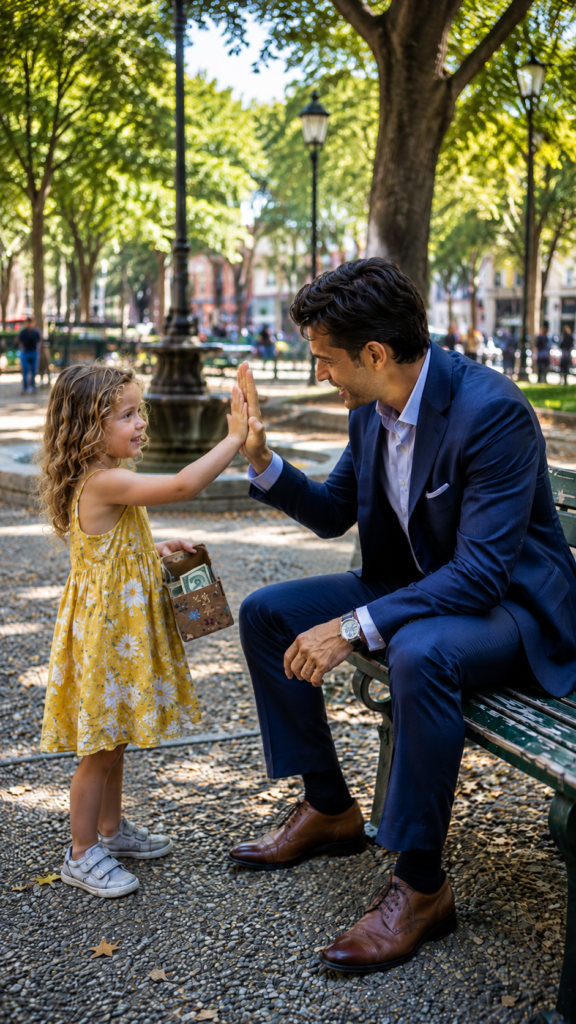
Three hours later, he sat alone on a bench in Parque Fundidora.
He had loosened his tie. He stared at the fountain without seeing anything. He had millions in the bank, four armored trucks, a penthouse in San Pedro, and a tech company that everyone admired.
But at that moment, he felt miserable.
The richest man in the park... and perhaps the loneliest.
Then he heard footsteps on the gravel.
In front of him appeared a girl about four years old, with messy curls, a yellow dress dotted with flowers, and worn Velcro sneakers.
She carried a little purse made of cardboard, duct tape, and princess stickers.
She looked at him with a seriousness that didn’t seem childlike.
"I have 50 pesos," she said, stretching out her little purse. "Can I rent a dad for today?"
Alejandro blinked.
He thought he had misheard.
"Excuse me?"
The girl opened her purse and pulled out coins, crumpled bills, and even an old arcade token.
"It’s 50 pesos. I saved them all. From the tooth fairy, for my birthday, and from the coins that fall out of my mom’s apron."
Alejandro felt something strange in his chest.
"And why do you want a dad?"
The girl looked down.
"Because at kindergarten they say I don’t have one. That I’m weird. That my mom works a lot because nobody wants us."
She pressed her lips together, trying not to cry.
"And I saw on TV that dads buy ice cream, push swings, and carry backpacks. So I thought maybe with 50 pesos someone could pretend with me."
Alejandro didn’t know how to respond.
He, who closed million-dollar deals without batting an eye, was left speechless in front of a little girl with a cardboard bag.
The child looked up again.
"Just for today. Tomorrow I won’t bother you."
That phrase shattered something inside him.
Suddenly, he saw himself at seven years old, standing at the door of an expensive school, watching other kids run to their dads. He always waited for the driver.
Never for his father.
Alejandro took a deep breath.
Then he carefully closed the cardboard purse and returned it to her.
"I’m not going to charge you, little one."
The girl’s eyes widened.
"So you will be my dad?"
Alejandro hesitated for a second.
Then he nodded.
"Just for today."
The girl’s smile lit up the entire park.
"I’m Lucía! First, I want ice cream."
And without asking for permission, she took his hand.
For the next few hours, Alejandro Serrano ceased to be the cold businessman everyone feared. He was simply the man pushing a swing.
He bought her a vanilla ice cream with sprinkles. She stained his blazer sleeve and apologized six times.
He laughed.
A strange, awkward laugh, like it had rusted.
Lucía told him her mom’s name was Marisol, that she worked in a café, that they had a cat named Frijolita, and that one day she wanted to have a house with a garden "so nobody would feel lonely."
Alejandro pushed her on the swings until his arms hurt.
He helped her climb on the jungle gym.
He took selfies with her.
And every time Lucía shouted, "Dad, look!" Alejandro felt a crack open in the wall he had built over thirty years.
As evening fell, Lucía led him to a simple neighborhood near Madero Avenue.
The house was small, with peeling paint, but it had clean flowerpots and a Virgin Mary at the entrance.
Before they could knock, the door swung open.
A young woman appeared in the doorway, wearing a café uniform, her hair tied back, and the face of someone who hadn’t slept well in weeks.
When she saw Lucía, she sighed in relief.
But when she saw her daughter’s hand held by a stranger in an expensive suit, she turned pale.
"Lucía? Who is this man?"
Lucía ran toward her happily.
"Mom, I did it! I rented a dad with my 50 pesos!"
Marisol froze.
She looked at Alejandro in horror.
"What did you do to my daughter?"
Alejandro raised his hands.
"Nothing, I swear. She approached me in the park. I just... couldn’t say no."
He pulled out his business card.
"I’m Alejandro Serrano. I didn’t charge her anything. I just tried to give her a good day."
Marisol took the card, but her eyes were still filled with fear.
Lucía hugged her cardboard purse.
"Mom, he knows how to be a dad. He bought me ice cream and pushed me high, really high."
Marisol swallowed hard.
Her embarrassment was so palpable that Alejandro felt worse than at the funeral.
"I’m sorry," he said. "I really am."
He turned to leave.
But before he could step down the last step, he heard Lucía ask with brutal innocence:
"Mom... can I rent him again tomorrow?"
Alejandro stopped.
And Marisol, with tears in her eyes, answered something that took his breath away:
"No, my love. Dads aren’t rented... dads stay."
PART 2
That night, Alejandro couldn’t sleep.
His penthouse in San Pedro was immaculate, silent, expensive. Too expensive.
From the large window, he watched the city lit up, but for the first time, the lights didn’t seem like success. They felt like distance.
He opened his phone and looked at a photo Lucía had insisted on taking.
She was pressed against his shoulder, ice cream on her chin. He was there with his tie crooked and a smile he didn’t remember using since he was a child.
He didn’t look like a millionaire.
He looked human.
For three days, he tried to return to his normal life.
He signed contracts.
Canceled two meetings.
Ignored messages from partners.
But Lucía’s voice wouldn’t leave his head.
"Just for today."
On the morning of the fourth day, Alejandro did something that would have driven his father crazy: he skipped an investor meeting.
He drove to Marisol’s house.
She was rushing out, Lucía’s backpack in one hand and a thermos of coffee in the other.
When she saw him, she froze.
"What are you doing here?"
Alejandro adjusted his jacket, nervous like a teenager.
"I was passing by."
Marisol raised an eyebrow.
"You live forty minutes away from here."
He looked down.
"Alright. I came because I wanted to know if Lucía was okay."
Before Marisol could respond, the girl came running out.
"Dad of 50 pesos!"
Alejandro chuckled.
Marisol put a hand to her forehead.
"Lucía, don’t call him that."
"Can you take me to kindergarten?" the girl asked. "Today they’re going to talk about family, and everyone is bringing a picture with their dad."
Marisol tensed up.
"Sweetheart, we already talked about that."
Lucía looked down.
"Yeah, but everyone laughs."
Alejandro felt his chest tighten.
"I’ll take her."
Marisol shook her head quickly.
"You don’t have to."
"I know," he replied. "That’s why I want to do it."
At kindergarten, Lucía didn’t let go of his hand.
When they entered the classroom, several kids stared at Alejandro’s suit.
Lucía stood in the center and proudly announced:
"This is Alejandro. He’s not my biological dad, but he did come yesterday."
The teacher fell silent.
A boy asked:
"How much does he cost?"
Lucía clenched her fists.
Alejandro crouched down in front of everyone.
"A dad doesn’t cost money. A dad costs time. And many adults don’t pay because they’re cowards."
The teacher was left speechless.
Lucía hugged him around the neck.
That day, something changed.
Alejandro started showing up more often.
First, it was taking her to kindergarten once a week.
Then fixing a leaky faucet in Marisol’s house.
Later, accompanying them to the grocery store.
Then having quesadilla dinners at a small table where nobody talked about stocks, mergers, or dollar accounts.
Marisol didn’t trust easily.
She was right.
She had raised Lucía alone since she was a baby. The biological father had left when he learned of the pregnancy. He promised to return “when he was ready,” but he never showed up.
Marisol worked double shifts, cleaned tables, endured insults, and cried in silence so her daughter wouldn’t see her.
So when Alejandro started staying over, she didn’t fall in love all at once.
She watched.
She wanted to see if it was just a rich man’s whim.
If one day he would get bored.
If Lucía would end up more broken than before.
But Alejandro didn’t leave.
He learned to make burnt pancakes.
He attended the school meeting.
Paid for Lucía’s dental treatment without bragging about it.
Swapped his glass office for afternoons in a park.
And for the first time in his life, he discovered that arriving early for a girl could feel more important than closing a deal.
But not everyone accepted it.
One afternoon, during a family meal at the Serrano mansion, his uncle Ricardo humiliated him in front of everyone.
"So now you’re playing house with a waitress and a stranger’s child?"
The table fell silent.
Alejandro clenched the napkin.
"Her name is Marisol. And the girl’s name is Lucía."
Ricardo burst into laughter.
"Your father must be rolling in his grave. He left you an empire, not a daycare."
A cousin added:
"Careful, Ale. Those women see an expensive suit and then file lawsuits."
Alejandro stood up slowly.
Before, he would have stayed quiet to avoid a scene.
But he was no longer the same.
"My father did leave me money, yes. But he also left me emptiness. If you think loving a girl makes me less of a man, then the problem isn’t me."
Ricardo slammed the table.
"That girl isn’t your blood."
Alejandro stared him down.
"And yet she has given me more family than all of you combined."
He left without tasting dessert.
That night, Marisol found out through an audio message someone from the family sent to mock him.
When Alejandro got home, she was waiting for him, serious.
"I don’t want Lucía to be a project to prove something to your family."
"She isn’t."
"I also don’t want you to wake up one day and say this was a beautiful phase."
Alejandro stayed silent.
Then he took out the old gold watch from his father’s pocket.
He placed it on the table.
"All my life, I thought this was an inheritance. Today I understand it was a chain."
Marisol looked at him, confused.
Alejandro took a deep breath.
"I don’t know how to be a perfect dad. No one taught me. But I want to learn. And not out of pity. Not out of guilt. Because when Lucía took my hand, for the first time, someone didn’t need my money. She needed my presence."
Marisol cried silently.
Still, the strongest test came on Father’s Day.
The kindergarten organized a festival.
Lucía wore a white dress with yellow bows. She went up on stage with a crumpled paper in her hands.
The hall was full of dads, moms, grandparents, and phones recording.
The director announced:
"Lucía wants to share a story."
The girl approached the microphone.
"Before, I thought not having a dad was my fault."
Marisol covered her mouth.
Alejandro felt a punch in his stomach.
"Then I saved 50 pesos to rent one. I thought that’s what a dad was worth for a day."
Some mothers began to cry.
Lucía searched for Alejandro in the audience.
"But Alejandro didn’t charge me. He bought me ice cream, pushed me on the swings, and then came back. And came back again. And again."
The girl took a deep breath.
"I thought I had found a borrowed dad. But I found one who stayed without anyone forcing him."
The hall erupted in applause.
Without thinking, Alejandro climbed onto the stage.
He knelt in front of her and hugged her so tightly that he finally cried.
He cried for his dead father.
For the boy he once was.
For the girl who had saved him with 50 pesos.
"You didn’t rent me, little one," he whispered. "You taught me to stay."
That night, Alejandro took Marisol and Lucía to a house with a garden.
It wasn’t the cold mansion of his father.
It was a warmer home, with bougainvilleas, a large kitchen, and an empty room with white walls.
Lucía ran down the hallway.
"Can Frijolita live here?"
Alejandro smiled.
"Frijolita, your stuffed animals, and even your entire zoo."
Marisol looked at him with fear and hope.
"Alejandro, don’t play with this."
He pulled out a folder.
It wasn’t a business contract.
It was a legally prepared adoption application, without pressure and with all the time the law required.
He also took out a small box.
"I’m not asking you to forget everything you’ve suffered," he said. "I’m asking you to let me build something different with you. Without buying it. Without imposing it. Without rushing."
Marisol opened the box.
Inside was a simple ring, nothing extravagant.
The kind of ring that didn’t want to flaunt wealth but promised presence.
Lucía appeared in the doorway with wide eyes.
"So I’m not renting you anymore?"
Alejandro burst out laughing through tears.
"No, my love. Not anymore."
Lucía hugged him around the waist.
"Then you’re free."
Marisol smiled through her tears.
Alejandro gently shook his head.
"No. Being a dad isn’t free. It costs waking up early, listening, caring, apologizing, and not leaving when it gets tough."
He looked at Marisol.
"But it’s the most beautiful price I’ve ever paid in my life."
Months later, Alejandro sold his father’s watch at a private auction.
With that money, he created a fund for fatherless children and working mothers in Nuevo León.
He named it "50 Pesos."
When the press asked him why a millionaire businessman chose such a small name, he replied:
"Because sometimes the smallest thing can buy you a whole life."
Years later, in the living room of that house with bougainvilleas, Lucía hung a drawing on the refrigerator.
It showed three figures holding hands.
Below, she wrote in crooked letters:
"My mom, my dad Alejandro, and me."
Alejandro looked at the drawing, then at Marisol preparing coffee and Lucía chasing Frijolita down the hallway.
There was less silence than before.
Less luxury.
Less control.
But for the first time, he had family.
And he understood that his father had died surrounded by millions without knowing how to love, while he had begun to live the day a poor girl offered him 50 pesos to pretend to be her dad... and ended up teaching him that true wealth isn’t inherited; it’s chosen to stay.