PART 1
—Dad… Diego is under the house.
Sofía’s voice didn’t sound like a childish tantrum.
It wasn’t that tone of a five-year-old inventing monsters to avoid sleep, nor that mischievous little voice she used when she wanted a candy at the store.
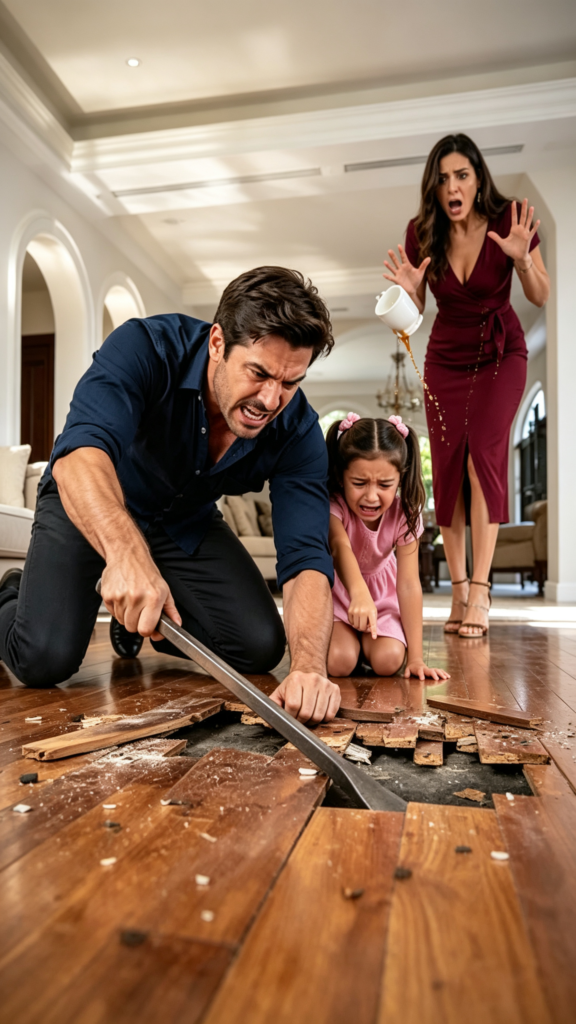
She said it kneeling in the middle of her Aunt Patricia’s living room, one small hand pressed against the freshly laid wooden floor.
—He says he’s cold.
Mariana, her mom, nearly fainted.
She was holding a cup of coffee, which she dropped onto the beige carpet that Patricia had just boasted was “imported.” The coffee spilled like a dark stain across that too clean, too perfect, too silent house.
Patricia pursed her lips.
—Oh, please. It’s just a child’s tale. Sofía has always had a vivid imagination.
But Ricardo Mendoza felt his blood freeze.
For eleven months, he had searched for his son Diego.
He was seven years old when he disappeared from their home in Guadalajara one Sunday afternoon. Ricardo was in the backyard, preparing carne asada. Mariana was arranging plates in the kitchen. Sofía was playing with her dolls in the living room.
The back door was found wide open.
Diego’s bike lay abandoned next to the lemon tree.
His sneakers were caked in dirt.
No one saw a car. No one heard a scream. No one knew anything.
The report was filed that same night at 8:13. At first, everyone helped: neighbors, police, volunteers, ladies from the neighborhood, even strangers who shared Diego’s photo on Facebook.
Then weeks passed.
Then months.
And people began to whisper when they saw Mariana at the supermarket.
Ricardo stopped sleeping.
Mariana stopped laughing.
Sofía stopped asking when her brother would come back.
That’s why Patricia, Ricardo’s older sister, invited them to spend the weekend at her new house in Querétaro.
—It’ll do you good to change the air —she said over the phone—. You can’t keep living stuck to the pain.
Patricia had always been like that.
Elegant.
Controlling.
With perfect nails, calculated phrases, and a way of hugging that seemed rehearsed in front of a mirror.
When Diego disappeared, she showed up first with food, blankets, and sleeping pills. She cried with Mariana, hugged Ricardo, and told the whole family they needed to stay united.
Three months later, she moved to Querétaro.
—I remodeled everything —she commented once—. I even changed the floor. The old one creaked horribly.
At that moment, Ricardo didn’t think much of it.
Now that phrase hit his chest like a hammer.
Sofía touched the wood again.
—Diego says he can’t open it.
Mariana covered her mouth with her hands.
Patricia let out a dry laugh.
—Enough, Sofía. Don’t scare your mom with nonsense.
Ricardo knelt beside his daughter.
—My love, look at me.
The girl slowly shook her head.
—If I speak loudly, he’ll get scared.
Ricardo pressed his ear against the floor.
At first, he heard nothing.
Only the hum of the refrigerator.
A dog barking in the distance.
Mariana’s broken breath.
And behind him, Patricia’s nervous voice.
—Ricardo, get up. You look ridiculous.
Then it came.
Three knocks.
Slow.
Weak.
From below.
Ricardo felt rage infuse his entire body.
He stood up, yanked the expensive rug aside, and dragged the coffee table. Patricia rushed toward him and grabbed his arm.
—Don’t do something stupid.
Ricardo stared at her.
She didn’t say, “there’s nothing there.”
She didn’t say, “you’re crazy.”
She said, “don’t do something stupid.”
And there, unwittingly, she confessed more than she imagined.
Near the wall, one floorboard didn’t fit like the others. The seam was poorly sealed, as if someone had rushed through the job. Ricardo knelt down and saw something pale trapped between the wood.
A tiny nail.
Sofía began to cry silently.
Mariana collapsed against the sofa.
Patricia took a step back, pale as paper.
Ricardo grabbed an iron rod that was next to the decorative fireplace. Patricia stood in front of him, trembling.
—Please, brother…
That word broke him completely.
Ricardo raised the rod.
And when the first blow opened the new floor, from beneath his sister’s perfect house came a voice so weak it seemed to rise from a grave:
—Dad…
PART 2
The second blow splintered a long shard.
The third broke the board.
Patricia screamed, but Ricardo no longer heard his sister. He heard a woman standing between his son and the truth.
He shoved the rod into the opening and pried the wood upward. The immaculate living room filled with dust, shattered varnish, and pieces of wood. The white cushions were stained. The beige carpet crumpled beneath Mariana’s feet, who kept repeating Diego’s name as if in prayer.
—Diego… Diego, my love…
First came the smell.
Dampness.
Confinement.
A sour, human scent, one that no pretty house can hide forever.
Sofía covered her ears.
—Hurry, Dad. He’s barely responding.
Ricardo tore off another board.
Then another.
Then he saw a small hand, covered in dust.
He took it gently.
The fingers barely closed around his own.
—Son…
It wasn’t a word.
It was a piece of soul shattering.
Under the floor wasn’t a normal basement. It was a cramped space between the old foundation and the new wood. A dark, poorly ventilated hole, with plastics, dirty blankets, empty bottles, cookie wrappers, and a bucket in one corner.
Diego was there.
Alive.
Way too thin.
Pale.
With cracked lips, long hair, and sunken eyes as if darkness had been slowly consuming him.
Ricardo pulled him out with desperate caution, fearing he would break him in his arms. Mariana fell to her knees in front of him, but she hesitated to touch him at first. She seemed afraid her son would dissolve away.
—Mom is here —she whispered—. You’re with us now.
Diego opened his eyes.
He looked at Mariana.
Then at Sofía.
And finally, he looked at Patricia.
His body began to tremble.
Patricia sat down next to the sofa, hands over her mouth.
—I didn’t want to… I didn’t want to…
A neighbor called emergency services after hearing the knocks and screams. Then others arrived. Someone was recording from the door. Someone was crying. Someone kept saying, “My God” over and over.
Ricardo wouldn’t let go of Diego.
When the paramedics entered, they had to ask him three times to let them check him.
—Sir, if you want to save him, let us work.
Then Ricardo released him.
And when he did, he saw the blue bracelet on the boy’s wrist.
Worn.
Filthy.
With his name scrawled in black marker: Diego Mendoza.
The same one he had been wearing the day he disappeared.
The same one Patricia swore she had never seen when she helped distribute flyers all over Guadalajara.
The police arrived minutes later.
Patricia didn’t try to escape.
She didn’t feign surprise.
She didn’t ask what was happening.
She just stared at the open hole as if she still expected the floor to swallow everything again.
An officer asked her if anyone else was in the house.
She shook her head.
But her eyes darted away, just for a second, toward a closet by the hallway.
Ricardo noticed it.
The officers did too.
Behind some boxes of Christmas decorations, they found a false panel. It led to an improvised stairway that descended into the hole beneath the living room. There was a battery-less lamp, a bag of medicine, water bottles, and a notebook where someone recorded dates.
Diego hadn’t fallen in.
Someone was coming in.
Someone was keeping him alive.
Barely alive.
In the hospital, the doctors spoke of dehydration, malnutrition, old injuries, panic attacks, and slow recovery. They used professional words to describe something that was neither professional nor humane.
Mariana didn’t leave the intermediate therapy glass.
Ricardo didn’t either.
Sofía slept in a chair, clutching a sweatshirt of her brother’s.
At dawn, Diego woke up.
The Public Ministry wanted to take a protected statement, but Ricardo only wanted his son to breathe without fear.
Mariana approached slowly.
—My love, you’re safe now.
Diego took time to recognize her. His eyes seemed to return from a very distant place.
Then he moved his lips.
Ricardo leaned in.
—What did you say, champ?
Diego swallowed hard.
—The aunt wasn’t alone.
Mariana froze.
Ricardo felt the entire hospital running out of air.
Diego squeezed his hand with the little strength he had left.
—Grandma also closed the door.
Doña Elena, Ricardo’s mother, arrived two hours later at the hospital. She was holding a rosary tangled between her fingers and wore that proper lady’s face she had always used to order without raising her voice.
—Where is my grandson? —she asked.
Mariana stood up.
—You can’t go near him.
Doña Elena raised her eyebrows.
—Honey, I understand your pain, but I’m his grandmother.
Ricardo stepped out of the room. His shirt was covered in dust, his knuckles scraped, and his gaze was that of a man who had just found hell beneath his sister’s living room.
—Did you know? —he asked.
Doña Elena was not surprised.
That detail broke him.
She didn’t say, “know what?”
She didn’t ask if Diego was okay.
She just clutched the rosary tighter.
—Ricardo, don’t make a scene here. People are watching.
Mariana let out a broken laugh.
—is that what you care about? People? After having my son buried under a floor?
The police were already piecing the puzzle together.
First, the contractor appeared. His name was Rogelio Mendoza, and he had installed the floor nine months earlier. At first, he denied everything, but on his phone, they found photos of the hole before sealing it, messages from Patricia, and an audio where she said:
—Just give me access through the closet. Don’t ask questions and I’ll pay you double.
Then appeared a receipt for wood dated three days after Diego’s disappearance.
Next, a security camera showed Patricia’s truck entering Querétaro the following morning.
The truth began to flow like dirty water.
And the reason was worse than Ricardo had imagined.
Money.
It had always been money.
Don Ernesto, Ricardo’s father, died two years earlier and left behind a house in Guadalajara, a plot in Chapala, and an investment account. In the will, there was a clear clause: a portion of the land would be protected for his grandchildren when they reached adulthood.
Diego was first on the list.
Patricia was drowning in debt.
Doña Elena wanted to sell everything.
Ricardo refused.
—My dad left that for my children —he told them three weeks before Diego’s disappearance—. I’m not signing.
Diego overheard an argument between Patricia and his grandmother. They talked about a forged power of attorney, about convincing Ricardo, and selling without Mariana knowing.
The boy emerged from behind the door and asked:
—Are you going to trick my dad?
Patricia got scared.
Doña Elena said he was just a kid, that he’d forget.
But Diego was smart. He was going to tell the truth.
That Sunday, during the barbecue, Patricia called him to the patio under the pretense of giving him a gift she had in the truck. Doña Elena kept Mariana busy in the kitchen. Ricardo was by the grill.
The back door was left open.
Diego climbed into his aunt’s truck.
And disappeared.
According to Patricia, she only wanted to scare him for a few hours. Make him promise not to say anything. But the hours turned into a day. The day turned into panic. And the panic turned into crime.
Doña Elena found out on the second night.
She didn’t call the police.
She didn’t call Ricardo.
She went to Patricia and said:
—If you let him go now, you’ll sink us all.
For eleven months, while Ricardo and Mariana were handing out flyers, they hid Diego. First in a warehouse. Then, when Patricia bought the Querétaro house, she had the new floor built to cover the old hole beneath the living room.
Patricia brought him food.
Water.
Sometimes sleeping pills.
Doña Elena visited from time to time.
Not to save him.
Not to hug him.
She went to check that he remained silent.
Diego recounted everything slowly. Not like in the movies, where a child can narrate the horror in one go. He did it in pieces. In drawings. In nightmares. In loose phrases.
He drew a small door.
Patricia’s black shoes.
His grandmother’s rosary hanging in front of the hole.
And Sofía above the floor, like a little star.
—I would knock when I heard children —he said one afternoon—. She did hear me.
Sofía changed too.
For weeks, she walked barefoot around the new house, stepping slowly, as if beneath any floor there could be someone crying. One night, Mariana found her lying in the hallway with her ear pressed against the tile.
—What are you doing, my life?
—I’m making sure no one is cold.
Mariana didn’t tell her there was no one.
She lay down next to her.
Because she had learned something brutal: children can invent shadows, ghosts, and dragons, but they don’t invent that kind of fear.
Patricia was charged with aggravated kidnapping, illegal deprivation of liberty, injury, and document forgery. Doña Elena too. Rogelio agreed to testify in exchange for a reduced sentence.
The family split in two.
Some said Patricia was ill.
Others said Doña Elena only wanted to protect her daughter.
An aunt called Ricardo to ask him not to destroy “the family name.”
He responded without yelling:
—The name was destroyed when you chose a piece of land over a child.
At the trial, they projected photos of the hole beneath the floor. Patricia cried. Doña Elena didn’t look down.
Then they played an audio found on an old phone. In the recording, Diego could be heard crying:
—Aunt, tell my dad. I’m not going to say anything anymore. I just want to go home.
Then the calm voice of Doña Elena sounded:
—If you behave, someday.
She didn’t scream.
She didn’t insult.
That was the worst part.
She spoke as if she were putting away a box in a warehouse, not locking her grandson in darkness.
At the end, Patricia asked for forgiveness.
—I didn’t want it to last so long —she said, looking at Ricardo.
He didn’t respond.
Because that phrase disgusted him more than silence. As if the crime lay in the eleven months and not in the first minute she snatched a child’s freedom away.
Diego returned home slowly.
There were no miracles.
He slept with the light on. He couldn’t stand closets. He covered his ears when someone walked on the upper floor. Mariana stopped closing doors. Ricardo checked each night the rooms of his children before attempting to sleep.
But one day, Diego asked for chicken soup.
Another day, he wanted to see his dinosaurs.
One afternoon, while Sofía was coloring at the table, he sat next to her and said:
—Thank you for listening to me.
Sofía didn’t answer.
She just handed him a blue crayon.
Months later, Ricardo sold the Guadalajara house, not to escape, but because some walls hold too many echoes. With what legally belonged to him from his father’s estate, he opened a protected account for Diego and Sofía. The Chapala plot was not sold.
Mariana planted a lemon tree in the new yard.
Diego took time to ask for a bicycle.
When he finally did, he wanted it red.
Sofía named it: Lightning.
Sometimes, Ricardo watched them play from the window and felt a strange, broken kind of happiness, but alive.
People believe that when someone returns, everything goes back to its place.
That’s not true.
No one returns the same from the darkness.
Not the one who was down below.
Not the one who listened from above.
Not the one who had to break a floor to find the truth.
One afternoon, Diego looked at the clouds and asked:
—Dad, can houses feel guilty?
Ricardo thought of Patricia’s perfect house, the white cushions, the new floor, the shiny wood hiding his son’s cries.
—I don’t know if houses can —he replied—. But people should feel guilty.
Sofía, from the swing, added:
—And when something cries below, we have to break the floor.
Mariana covered her mouth to hold back tears.
Ricardo hugged his two children.
Not because the hug could erase what had happened.
Nothing could erase it.
But he could promise them, even silently, that he would never again confuse a pretty house with a clean house.
Because now he knew that not all monsters live far away.
Some come with food when you’re broken.
Some tell you “family.”
Some pray in the front row.
And some change the floor so that no one sees what they buried underneath.