PART 1
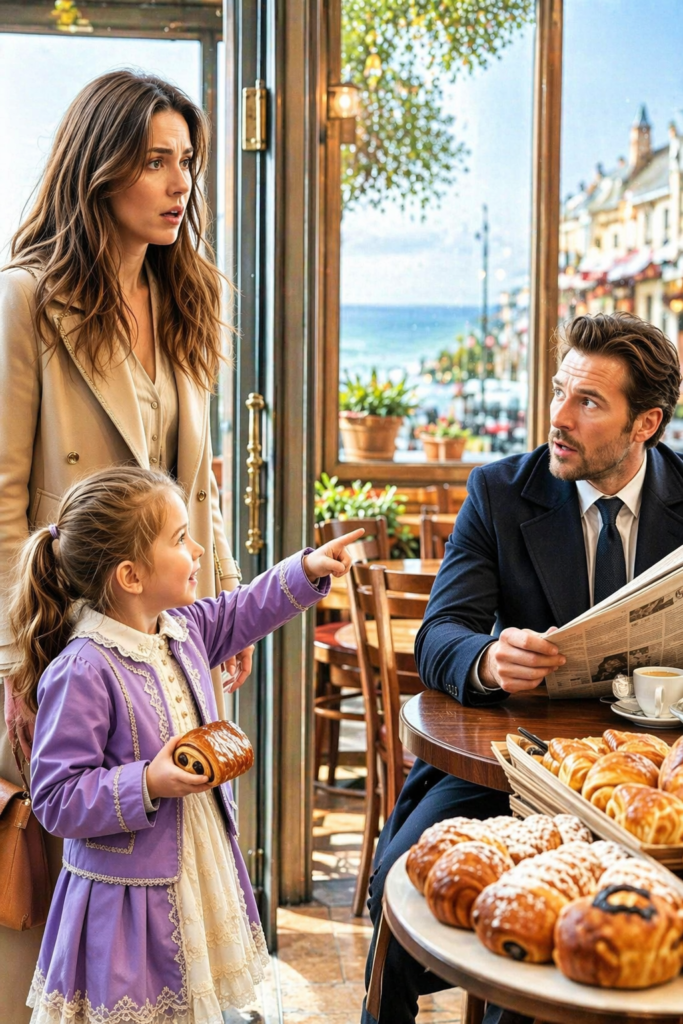
On the morning Valeria Montes walked into Panadería La Sirena with her 4-year-old daughter, all she wanted was to buy one chocolate concha and pretend for twenty minutes that life wasn’t weighing her down so much.
Outside, the rain fell over the Mazatlán boardwalk.
Inside, the air was thick with the scents of coffee, warm butter, and freshly baked bread. For Lucía, her little girl, this place was a palace filled with sugar. For Valeria, it was the only small luxury she could afford since leaving Monterrey with two suitcases, a pregnancy test, and a heart shattered into pieces.
Lucía wore a yellow raincoat and red boots. She hopped over the puddles at the entrance as if she didn’t know her mother had been fleeing from a surname that appeared in business magazines for four years.
“Can you buy me that, Mommy?” she asked, pressing her nose against the glass.
Valeria looked at the biggest concha.
Then she glanced at her wallet.
“Yes, my love. That one.”
She had learned to say yes to little things. To one concha. To a hair ribbon. To one more lap around the park. After so many nights counting coins for rent, those joys felt like miracles.
The line moved slowly.
Lucía squeezed her hand.
“Mommy…”
“What is it?”
“That man is looking at us really weird.”
Valeria turned.
And felt the air catch in her chest.
At a table in the back, behind an untouched cup of coffee, sat Andrés Villaseñor.
Her ex-husband.
The owner of a tech company that had graced covers, financial investigations, and dinners where everyone smiled while hiding knives. The man who once made her feel protected and later made her feel invisible inside a huge house.
She hadn’t seen him in four years.
Since the day she signed the divorce without telling him she was carrying a life inside her.
Andrés slowly lowered the cup.
His eyes fixed on Valeria.
Then they dropped down to Lucía.
And the color drained from his face.
The girl had his dark eyes. The same eyebrow raised when she was suspicious. The same firm chin that Valeria had loved and hated at different times.
Andrés stood up as if the floor had shifted beneath him.
“Valeria…”
She gripped her daughter’s hand.
“Lucía, go sit by the window.”
“Where I can see the boats?”
“Yes, sweetheart.”
The girl obeyed, but continued to glance at the stranger with curiosity.
Andrés took one step forward.
“Who is that girl?”
Valeria felt her throat tighten.
“My daughter.”
“Your daughter?”
His voice cracked.
“Valeria… how old is she?”
She didn’t answer.
It wasn’t necessary.
Andrés was too smart not to do the math. Divorce. Silence. Four years. A girl with his eyes sitting under the rain on the other side of the glass.
“You hid my daughter from me,” he said.
“Don't make a scene.”
“A scene?” Andrés let out a bitter laugh. “I just found out I’m a dad in a bakery, man. And you want me to calm down?”
Valeria glanced toward Lucía.
The girl had split her concha in two but wasn’t eating. She watched them as if something inside her already understood what no one dared to say.
Then Lucía got down from her chair, walked over to them, and asked with an innocence that left them frozen:
“Mommy… why does that man have my eyes?”
PART 2
The question landed among the noise of the coffee maker, the rain on the windows, and the murmurs of customers who suddenly seemed too close.
Valeria felt all eyes on her.
Andrés didn’t move.
The man who negotiated million-dollar contracts, who faced cameras and lawyers without flinching, was there, before a 4-year-old girl, with tears welling in his eyes.
Lucía watched him with the seriousness of someone who had just uncovered a secret door.
“Do you know him, Mommy?”
Valeria crouched in front of her.
“Yes, my love. I knew him a long time ago.”
“Is he good?”
The question hurt more than an accusation.
Andrés swallowed hard.
“My name is Andrés,” he said quietly. “And I met your mom when she still believed I was a better person.”
Valeria looked up, surprised.
She hadn’t expected that phrase.
She expected defense, arrogance, some elegant explanation. But he was just standing there, soaked from the inside, accepting a guilt he had never uttered before.
Lucía scrunched her nose.
“My mom says that good people don’t always do good things.”
Andrés let out a broken laugh.
“Your mom is right.”
Valeria grabbed Lucía’s backpack and paid quickly.
“We can’t talk here.”
“Tell me where,” he replied.
“Not in front of her.”
Andrés looked at the girl as if fearing that if he blinked, she would vanish.
“I won’t follow you. I promise.”
Valeria barely believed him.
The Andrés of before would have sent bodyguards, lawyers, or investigators. He would have called someone to find out where they lived in less than ten minutes.
But he didn’t move.
He just stood at the door of La Sirena, watching as Valeria took Lucía’s hand and disappeared under the rain of the boardwalk.
That night, Valeria left Lucía with Doña Toña, the neighbor who watched the girl when there were meetings at the primary school where she worked.
At nine, she arrived at the lookout on Cerro del Vigía.
Andrés was already there.
He wasn’t wearing a suit. He had jeans, a black jacket, and his hair was tousled from the humidity. No chauffeur, no flashy watch, no air of a world owner; he seemed like a tired man.
“Explain,” he said.
Valeria crossed her arms.
“Do you want me to lie pretty or do you want the truth?”
“The truth.”
“I left because I was afraid of you.”
Andrés closed his eyes.
“I would never have laid a hand on you.”
“What a lack of imagination you have,” she replied, her voice trembling. “There are men who don’t hit, but crush. You crushed me with silences, with money, with lawyers, with that family that decided even how I should breathe.”
He didn’t answer.
Valeria continued.
“I confronted you about the ghost companies. About the fixed contracts with officials. About that account in Belize you said I was too naive to understand. And when I told you that was wrong, you looked at me like I was a silly little teacher who didn’t know the real world.”
Andrés dropped his head.
“I was a coward.”
“You were cruel.”
“Also.”
The simplicity of his response disarmed her a bit.
The Andrés of before would have argued every word.
This one didn’t.
“When I found out I was pregnant,” Valeria continued, “I wanted to call you. Many times. But every time I saw your name in the news, every time your dad spoke of influence, every time your partners smiled like snakes, I thought my daughter was going to be born into a war.”
“She was my daughter too.”
“Yes. And that’s the part that will hurt me for the rest of my life.”
Andrés clenched his fists.
“My mom died without knowing she had a granddaughter.”
Valeria felt a blow to her chest.
Doña Elvira had been the only person in that family who treated her with tenderness. She would sneak her tea when she saw her crying after family dinners, where everyone talked about stocks, power, and appearances.
“I didn’t know how to tell her,” Valeria murmured.
“She asked about you until the end,” Andrés said. “She told me I lost more than a wife. She said one day I would understand, but it might be too late.”
Valeria covered her mouth.
The rain began to fall harder.
“I’m sorry,” she said.
Andrés slowly shook his head.
“I didn’t come for you to feel sorry for me.”
“Then why are you in Mazatlán?”
He fell silent.
And there Valeria understood that there was something more.
“Andrés…”
“I didn’t arrive by chance.”
The wind seemed to stop.
“What did you do?”
“After my mom died, I hired someone to find out if you were alive, if you were okay.”
Valeria took one step back.
“You had me investigated?”
“Yes.”
“You’re sick.”
“I know.”
“And you bought the blue house near the lighthouse?”
Andrés looked up.
“Yes.”
Valeria let out a bitter laugh.
“Of course. The great Andrés Villaseñor doesn’t ask for forgiveness. He buys a house by the sea and expects destiny to work for him.”
“It wasn’t destiny,” he said. “It was manipulation.”
She fell silent.
That direct acceptance hit her harder than any excuse.
“I didn’t know about Lucía,” he added. “I swear on my mother I didn’t know. The investigator told me you lived alone, that you worked at a primary school, that you didn’t go out much. He never mentioned a girl.”
“And now what do you want? To take her from me?”
Andrés raised his hands, horrified.
“No.”
“You can do it. You have money. Surnames. Lawyers.”
“And you’re right to hate me,” he said. “But I’m not going to fight for a daughter who doesn’t even know who I am as if she were a possession.”
Valeria felt tears, but she wouldn’t let them fall.
“Lucía isn’t a debt you’re coming to collect.”
“No. She’s a person I need to meet on my knees.”
For three weeks, Valeria allowed no visits.
Andrés didn’t complain.
He only sent short messages. Asking what food Lucía liked, what cartoons she watched, what stories she listened to before bed. He didn’t ask for photos. He didn’t demand schedules. He didn’t threaten.
Valeria replied little.
“She likes mermaids, stray dogs, and quesadillas without cheese because that’s what they’re called.”
Andrés responded:
“I’m going to study all that.”
She almost smiled.
But she forced herself to remember.
The first meeting was a Sunday at the Olas Altas beach.
Valeria arrived with Lucía and a purple bucket. Andrés waited off in the distance, sitting on a bench, with a backpack full of sunscreen, water, cookies, and a book about sea animals.
Lucía recognized him immediately.
“It's the man with my eyes!”
Andrés crouched down.
“Hello, Lucía.”
“Can you build sandcastles?”
“Terrible. But I came to learn.”
The girl took his hand with a trust that scared Valeria.
She wanted to stop her.
She wanted to tell her no.
But Lucía was already walking toward the shore, explaining to him that broken shells shouldn’t be thrown away because they were “little pieces of the sea.” Andrés listened as if she was revealing the secret of the universe.
He didn’t take out his phone even once.
For an hour, he dug holes, accepted that Lucía put seaweed on his head, and pretended to be a sea monster defeated by a princess in red boots.
At sunset, the girl sat between the two.
“Andrés, do you have kids?”
Valeria felt her blood freeze.
Andrés looked at her, silently asking for permission.
She took a deep breath and nodded.
He leaned toward Lucía.
“Yes, I have a daughter.”
“What’s her name?”
“Lucía.”
The girl’s eyes widened.
“Like me?”
“Not like you. You.”
The silence was enormous.
“Are you my dad?”
Andrés cried without hiding.
“Yes, my girl. I’m your dad. And I’m so sorry I wasn’t there before.”
Lucía looked at Valeria.
“Why didn’t you tell me?”
Valeria took her sandy hands.
“Because Mommy was scared. She thought hiding you was protecting you. But you deserved to know the truth.”
Lucía thought for a few seconds.
Then she looked at Andrés.
“My mom says that asking for forgiveness doesn’t work if you do the same thing again.”
Andrés smiled through tears.
“Your mom knows a lot.”
“Then you have to prove it.”
“Every day.”
“And you have to come to my festival. I’m going to be a turtle.”
“I’ll be in the front.”
“And you can’t disappear.”
At that, Andrés stopped smiling.
“Never again.”
The following months weren’t easy or pretty like a novel.
They were awkward.
Valeria set clear rules. No expensive gifts. No chauffeurs to impress. No showing up unannounced. No speaking ill of her. No using money to buy affection.
Andrés accepted all of it.
He went to the festival and applauded as if Lucía had won an Oscar dressed as a turtle in green cardboard. He learned to braid crooked pigtails. He sat in school meetings where no one knew that man could buy the entire building.
When Lucía had a fever, Andrés spent four hours sitting on the floor of the apartment reading mermaid stories while Valeria spoke with the doctor.
He didn’t offer a private hospital.
He didn’t flaunt his connections.
He was just there.
And that was what began to stir something inside Valeria.
Not his money.
Not his speeches.
His presence.
The blue house next to the lighthouse changed too.
Andrés renovated it with local builders and turned the ground floor into a free children’s library. He put in small tables, cushions, books, colors, and a large window facing the sea.
“The port gave you refuge,” he told Valeria. “I don’t want to buy forgiveness. I want to give something back.”
She didn’t reply.
But that night, when Lucía drew three figures holding hands in front of the lighthouse and wrote “my almost complete family,” Valeria cried silently in the bathroom.
The inauguration day brought half the neighborhood.
Doña Toña brought tamales. The primary school director brought her students. The children ran among books, pastries, and mango juices. Lucía proudly shouted:
“This is my dad’s library!”
Valeria watched Andrés kneel to help a child choose a story.
And for the first time in four years, she didn’t see the cold businessman or the dangerous surname.
She saw a man trying to learn to be a father.
That night, the three of them went up to the lighthouse.
The sea crashed against the rocks. The lights of the boardwalk shone in the distance. Lucía pressed her face against the glass.
“It looks like the world is pure water.”
Andrés smiled.
“A little bit, yes.”
Valeria stayed by his side.
“It still hurts that you investigated me.”
“I know.”
“And it still weighs on me that I hid Lucía from you.”
Andrés looked at her sadly.
“I’m not going to use that against you.”
“You should be furious.”
“Sometimes I am,” he confessed. “But I also understand that fear makes horrible decisions when it disguises itself as love.”
Valeria felt something break inside her.
“I thought protecting her meant hiding her.”
“Maybe it was the only thing you knew how to do.”
“No. It was the only thing I dared to do.”
Andrés fell silent.
The Andrés of before would have wanted to win the conversation.
This one just listened.
“I don’t know if I can go back to you,” she said.
“I don’t want to go back to what we were.”
Valeria looked at him.
“I want something different,” he said. “Without secrets. Without power over you. Without closed doors. Without making you feel small.”
“That takes time.”
“I have time.”
Lucía turned from the window.
“Mommy! Daddy! Come see a boat!”
Daddy.
The word still hurt.
But it no longer hurt like a lie.
One year after that rainy morning, Valeria walked into the lighthouse library with Lucía’s hand in hers.
Andrés was reading a story to several children. He was making voices for an octopus, shark, and crab with a ridiculous seriousness. Lucía ran and sat on his lap as if that place had been hers forever.
Valeria stood at the door.
That man who once measured life in meetings, investments, and scandals was now spending Saturdays reading stories to children who didn’t even know how much money he had.
When he finished, Andrés approached with a small envelope.
“It’s not an expensive gift,” he said quickly.
Valeria opened it.
Inside was a key.
“From the lighthouse?”
“From any door that is mine,” he replied. “Not to pressure you. Not to ask you to forget. Just so you know I don’t want to close anything off to you again.”
Valeria clutched the key.
“Andrés…”
“I love you,” he said. “But I’ve understood that loving doesn’t work if one doesn’t change what they do. So I’m going to keep proving it. For Lucía. For you. For what we might one day be.”
Valeria looked at her daughter.
Lucía had purple crayon on her cheek and was laughing with Doña Toña while organizing crooked books.
Then she looked at the lighthouse.
It no longer seemed like a house bought out of guilt.
It looked like a place filled with children, pastries, stories, sea breeze, and second chances that didn’t come clean but were earned.
Valeria tucked the key into her bag.
“I don’t promise forever today.”
Andrés nodded with shining eyes.
“I understand.”
“But I promise I won’t run away anymore.”
He exhaled as if he had waited for that phrase for years.
Lucía came running with a drawing.
It was three figures holding hands in front of the lighthouse.
Above it read: “My complete family.”
Valeria read those words and understood something many mothers learn late, with guilt and love: protecting a child doesn’t always mean hiding the truth.
Sometimes it means telling it carefully.
Sometimes it means accepting that one also made mistakes trying to save them.
And sometimes it means allowing someone to pay for their mistake not with money, but with presence, patience, and actions.
Because forgiveness doesn’t erase what happened.
But when someone shows day after day that they are no longer the same person, maybe life does deserve another page.
And it all began with a 4-year-old girl, a chocolate concha, and a question that made two adults tremble:
“Mommy… why does that man have my eyes?”