PART 1
—Dad… Emiliano is cold under the house.
Lucía said it without shouting, as if she had just heard someone ask for water from another room.
No one moved.
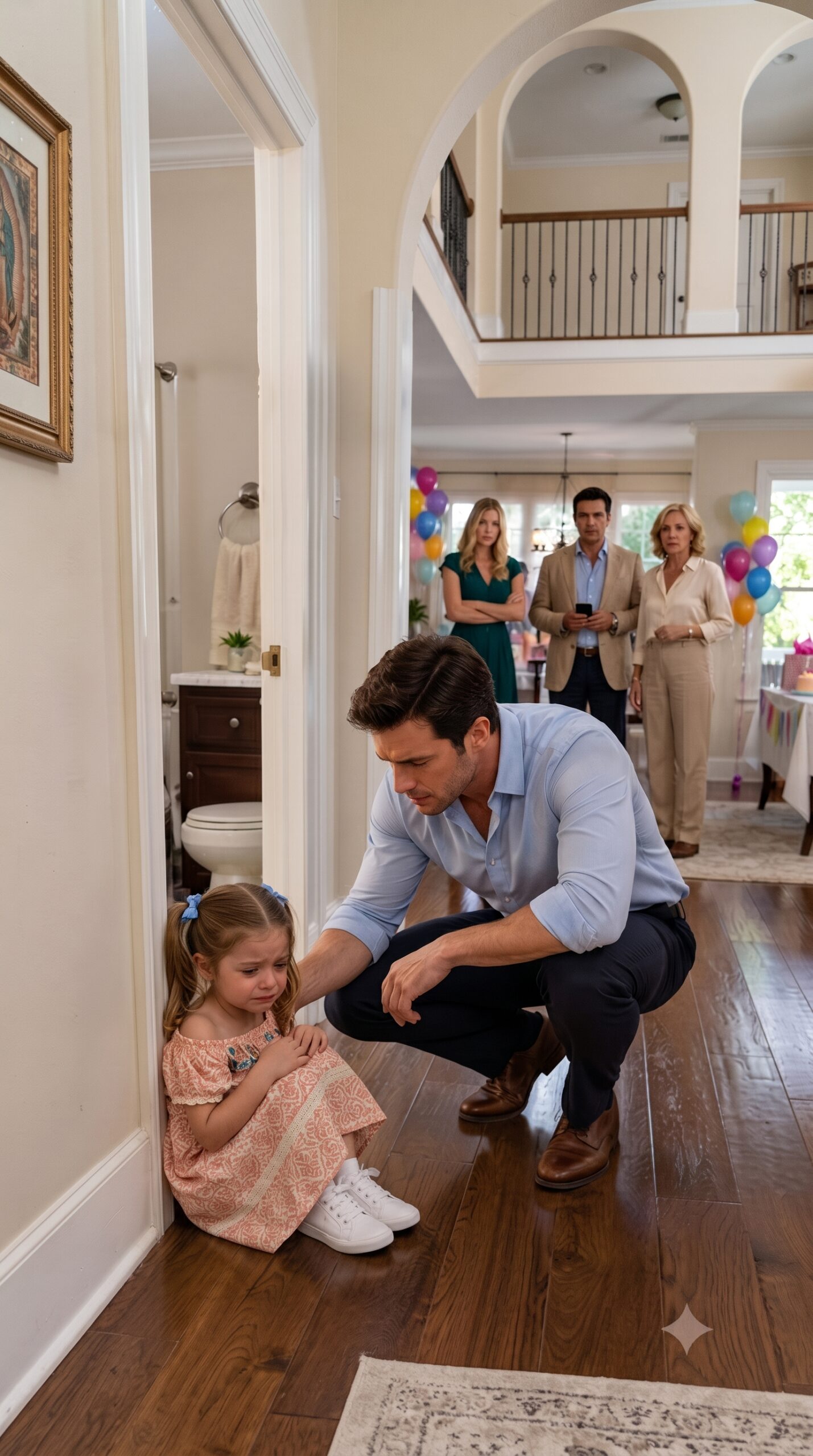
Patricia's living room, Rodrigo's older sister, was pristine: new light wood floors, white sofas, expensive candles, the smell of freshly brewed coffee, and the vibe of a magazine home in a private neighborhood in Querétaro.
But the 5-year-old girl was on her knees, her ear pressed against the floor.
—My brother is down there —she whispered—. He says he can't get out.
Valeria, Rodrigo's wife, nearly collapsed. She brought a hand to her chest and another to her mouth, as if those words had opened an old wound.
Because Emiliano wasn't in that house.
Emiliano had disappeared 11 months earlier, one Sunday afternoon in Guadalajara, while Rodrigo grilled meat in the yard and Valeria went inside for tortillas.
The boy was 7 years old.
His bicycle was left abandoned next to the lemon tree. His sneakers were caked in dirt. The back door was found wide open.
No one saw anything.
No one heard anything.
And since then, Rodrigo lived with his soul trapped in his throat.
Patricia was the first to embrace them that day. She brought food, prayed with them, distributed flyers, and cried in front of the cameras when the case made the local news.
Then she moved to Querétaro.
—I need to start over —she said then—. Besides, the house was horrible. I even changed the entire floor.
Rodrigo thought nothing of that remark.
Until now.
Patricia came out of the kitchen with a tray. Seeing Lucía on the floor, her smile vanished.
—What’s the girl doing there?
Valeria could barely speak.
—She says she heard Emiliano.
Patricia let out a dry laugh, too quick.
—Oh, please. Those are just children’s tales. She probably heard a pipe, a cat, something like that.
Lucía looked up.
—It's not a cat, Aunt. It's my brother.
The silence became heavy.
Rodrigo crouched next to his daughter.
—Lucía, look at me, my love. What did you hear?
The girl pointed to a gap between the boards.
—Tap softly. He says he's cold. And not to tell Grandma.
Patricia dropped a cup.
Coffee spilled on the perfect floor like a stain of guilt.
—That’s enough —she said, trembling—. The girl is tired. You all are too. Don’t come bringing your pain into my house.
Rodrigo pressed his ear against the wood.
At first, he heard nothing.
Only the refrigerator.
A car passing outside.
Valeria’s broken breath.
Then came three knocks.
Slow.
Weak.
From below.
Rodrigo stood up as if something inside him had exploded. He yanked the expensive rug that covered the center of the living room.
Patricia grabbed his arm.
—Rodrigo, don’t do something stupid.
He stared at her.
He didn’t say, “there’s nothing there.”
He didn’t say, “you’re crazy.”
He said, “don’t do something stupid.”
And in that phrase, the mask fell off.
Rodrigo pushed the table aside, checked the boards, and saw a poorly sealed joint near the wall.
Something pale protruded from the wood.
A small nail.
Valeria let out a moan.
Lucía began to cry silently.
Rodrigo picked up a decorative iron piece from beside the fake fireplace. Patricia stepped in front, white as paper.
—Please, brother…
Rodrigo raised the iron.
The first blow opened the floor.
And from beneath his sister's perfect house came a nearly dead voice:
—Dad…
PART 2
Valeria screamed her son's name, but her voice broke before she finished it.
Rodrigo struck again.
Then another.
The boards began to split like an old scab. The smell rose first: dampness, confinement, wet earth, fear.
A smell no father should recognize.
Patricia backed up until she hit the sofa. Her lips trembled, but she didn’t cry. She just kept repeating:
—I didn’t want to… I didn’t want to…
Rodrigo no longer heard her as a sister.
He heard her as someone standing between a child and the light.
With splinters filling his hands, he lifted a whole board. Then another. The expensive floor turned into pieces.
Underneath was not a normal basement.
It was a narrow hollow between the foundation and the new floor. There was black plastic, a dirty blanket, empty bottles, and a lamp without batteries.
And there was Emiliano.
Alive.
Skinny to the point of pain.
With long hair, chapped lips, and sunken eyes, as if darkness had been slowly swallowing him.
Rodrigo reached in and carefully pulled him out, afraid of breaking him.
—Emi… son… I’m here.
The boy barely opened his eyes.
He looked at his dad.
Then he saw Patricia.
And his body began to tremble.
Valeria knelt down, but she didn’t dare touch him abruptly. She looked at him as if any movement could shatter the miracle.
Lucía approached slowly.
—I heard you —she whispered.
Emiliano moved his fingers, searching for his sister's hand.
—I tapped when I heard your steps —he murmured.
A neighbor, alarmed by the knocks and screams, called 911. Minutes later, Patricia's elegant neighborhood was filled with patrol cars, paramedics, and onlookers peering from windows.
The paramedics wanted to take Emiliano away.
Rodrigo didn’t want to let go of him.
A Red Cross man placed a hand on his shoulder.
—Sir, if you want to save him, let us work.
Rodrigo loosened his hold, crying as he hadn’t cried even on the day of the disappearance.
When they lifted him onto the stretcher, Valeria saw a blue bracelet on the boy's wrist.
It was dirty, worn, almost broken.
But it still had written in black marker:
Emiliano Ortega.
It was the same bracelet he wore the day he disappeared.
The same one Patricia swore she hadn’t seen when she helped post flyers in Guadalajara.
The police searched the house.
Patricia didn’t try to escape. She sat on the white sofa, surrounded by dust, spilled coffee, and pieces of wood.
An officer asked her if there was another entrance to the hollow.
She denied it.
But her eyes drifted toward a closet in the hallway.
It was just a second.
Enough.
Behind some new boxes, they found a false panel. It led to an improvised staircase that descended into the space beneath the living room.
There were cookie wrappers, a bucket, a child’s blanket, and a notebook.
On the first page, in a child's shaky handwriting, it read:
“Dad, I’m down here.”
Valeria vomited in the garden.
Rodrigo felt his legs give out.
Emiliano hadn’t fallen there.
He wasn’t lost.
Someone had been coming in.
Someone was feeding him just enough to keep him breathing.
Barely alive.
In the hospital, the diagnosis was brutal: dehydration, malnutrition, mild infections, old wounds, and extreme fear of closed spaces.
The doctor spoke carefully, using gentle words to describe a savage cruelty.
Valeria stood by the therapy glass, her hands pressed against the glass.
—11 months —she said—. We had him just hours away from us.
Rodrigo didn’t respond.
His gaze was empty.
Because the question was no longer where Emiliano had been.
The question was who in the family had left him there.
That early morning, when the boy woke up, a child psychologist and a public prosecutor entered with the parents' permission.
They didn’t pressure him.
They didn’t ask him to tell everything.
They only told him he was safe now.
Emiliano looked at Rodrigo, then at Valeria.
—Can’t Aunt close the door anymore?
Valeria covered her mouth.
—No, my love. Not anymore.
The boy swallowed hard.
—And Grandma?
Rodrigo felt the entire hospital run out of air.
—What grandma, son?
Emiliano began to cry.
—Grandma Carmen also went down. She said if I talked, Mom would die of sadness.
Carmen, Rodrigo's mother, arrived at the hospital two hours later.
She had a rosary in her hand, a dark shawl, and that respectable woman’s face that everyone greeted at mass.
—Where is my grandson? —she asked.
Valeria shot up.
—You stay away.
Carmen frowned.
—Honey, don’t lose your head. I’m his grandmother.
Rodrigo stepped into the hallway with his shirt stained with dust and dried blood on his knuckles.
—Emiliano said you closed the door.
Carmen’s face didn’t change.
That’s what destroyed him.
She didn’t ask, “What door?”
She didn’t feign surprise.
She only tightened her grip on the rosary.
—Rodrigo, don’t make a scene here. People are listening.
Valeria let out a broken laugh.
—Is that what you care about? The people? After keeping my son under a floor?
Carmen lifted her chin.
—I didn’t keep anyone. That child is confused.
But the lies were already leaking.
First, the contractor spoke up.
His name was Efraín Mendoza, and he had installed Patricia’s new floor eight months earlier. At first, he said he was just doing his job.
Then the police found deleted messages, cash payments, and photos of the hollow before it was covered.
In an audio recording, Patricia said:
—Leave me a hidden entrance. No one will check. I’ll pay you double.
A security camera also appeared.
Patricia’s truck entered Querétaro in the early morning on the same Sunday Emiliano disappeared.
Then they found the motive.
Money.
It had always been money.
Rodrigo’s father had died two years earlier, leaving a house in Guadalajara, a plot in Chapala, and an investment account.
The most important clause stated that part of the land would go to the grandchildren when they turned 18.
Emiliano was first on the list.
Patricia had debts.
Carmen wanted to sell everything.
Rodrigo refused.
—What my father left for my children is not to be touched —he said at a family meal, three weeks before the disappearance.
That day, Emiliano overheard Patricia and Carmen talking in the kitchen.
He heard scattered words:
“False signature.”
“Land.”
“Don’t let Rodrigo find out.”
The boy stepped out from behind the door and asked:
—Are you going to trick my dad?
Patricia panicked.
Carmen said he was just a child, that he would forget.
But Emiliano didn’t forget.
He was going to tell the truth.
That’s why, during the barbecue, Patricia called him to the yard under the pretense of showing him a gift in the truck.
Carmen kept Valeria occupied in the kitchen.
Rodrigo was by the grill.
The back door was left open.
And Emiliano disappeared.
Patricia later stated that she only wanted to scare him for a few hours. That she intended to bring him back. That everything got out of control.
But Carmen, according to the recovered audio, was the one who turned fear into a plan.
—If you let him go now, you’ll sink us all —she told her.
For months, while Rodrigo and Valeria posted flyers, cried in interviews, and slept with the phone in hand, Patricia hid the boy in warehouses and borrowed houses.
When she bought the house in Querétaro with borrowed money, she had the new floor put in.
It wasn’t remodeling.
It was a tomb with a secret entrance.
Only Emiliano kept breathing.
And kept tapping.
He tapped when he heard footsteps.
He tapped when he heard laughter.
He tapped when the house fell silent.
Once he heard Lucía’s voice playing upstairs during the family visit.
Then he tapped harder.
And Lucía heard him.
The family split in two.
Some said Patricia was sick.
Others said Carmen only wanted to protect her daughter.
An aunt called Rodrigo to ask him not to destroy the family name.
Rodrigo replied without raising his voice:
—The name was destroyed when they chose land over a child.
The trial lasted months.
Valeria couldn’t attend all the hearings. There were days when pain left her weak.
Rodrigo did go.
Not for revenge.
He went because he needed to look into the eyes of those who embraced him in public while his son cried beneath a floor.
The day they projected the photos of the hollow, Patricia cried.
Carmen did not.
She remained seated, rigid, with the rosary between her fingers, as if she could still pray over the truth.
Then the prosecutor played a recovered audio from an old cellphone.
It was Emiliano’s voice.
—Aunt, tell my dad. I’m not going to say anything anymore. I just want to go home.
Then Carmen’s calm voice was heard:
—If you behave, someday.
The room froze.
Patricia apologized at the end.
—Rodrigo, I didn’t want it to last so long.
That sentence emptied him completely.
Because for her, the crime seemed to lie in the 11 months, not in the first minute.
Carmen received her sentence without asking for forgiveness.
Patricia was also convicted.
Efraín, the contractor, agreed to cooperate and turned over all payments.
Emiliano came home, but not like in the movies.
He slept with the light on.
He didn’t go into closets.
He couldn’t stand anyone walking on wood.
If he heard three knocks, he covered his ears and shook.
Lucía stopped playing on the floor.
Sometimes she lay in the hallway, pressing her ear to the tile.
—What are you doing, my love? —Rodrigo asked one night.
—I’m checking that no one is crying below.
Rodrigo didn’t tell her there was no one.
He lay down next to her.
Because he had learned that children can invent monsters, shadows, and ghosts.
But they don’t invent that kind of fear.
Months later, they sold the house in Guadalajara. Not to run away, but because some walls hold too many echoes.
With the legal part of the inheritance, Rodrigo opened a protected account for his two children.
The Chapala land wasn’t sold.
Valeria planted a lemon tree in the new yard.
Emiliano took weeks to go out to play.
One day he asked for a bicycle.
Red.
Lucía named it: Lightning.
The first time Emiliano pedaled, Rodrigo cried silently from the window.
It wasn’t complete happiness.
It was a broken, patched happiness, full of scars.
But it was life.
One afternoon, Emiliano looked at the new living room floor and asked:
—Dad, can houses feel guilty?
Rodrigo thought of Patricia's house, so clean, so bright, so perfect.
He thought of the white cushions, the expensive coffee, the new floor covering his son’s cries.
—I don’t know if houses can —he replied—. But people should.
Lucía, from the sofa, said softly: —And when someone cries below, we should break the floor.
Valeria covered her face to keep from crying.
Rodrigo hugged his two children.
He couldn’t erase what happened.
He couldn’t give Emiliano back those 11 months.
He couldn’t retrieve the family he thought he had.
But he could promise something in silence:
He would never again confuse a beautiful house with a clean house.
Because some monsters don’t live on the street.
Some come with food when you’re broken.
Some tell you “family.”
Some pray in the front row.
Some change the floor, paint the walls, and buy white sofas so no one looks at what they buried underneath.
And if a child whispers that someone is crying under the house, it’s better to believe him.
Because sometimes the truth doesn’t shout.
Sometimes it just knocks three times from the darkness.