PART 1
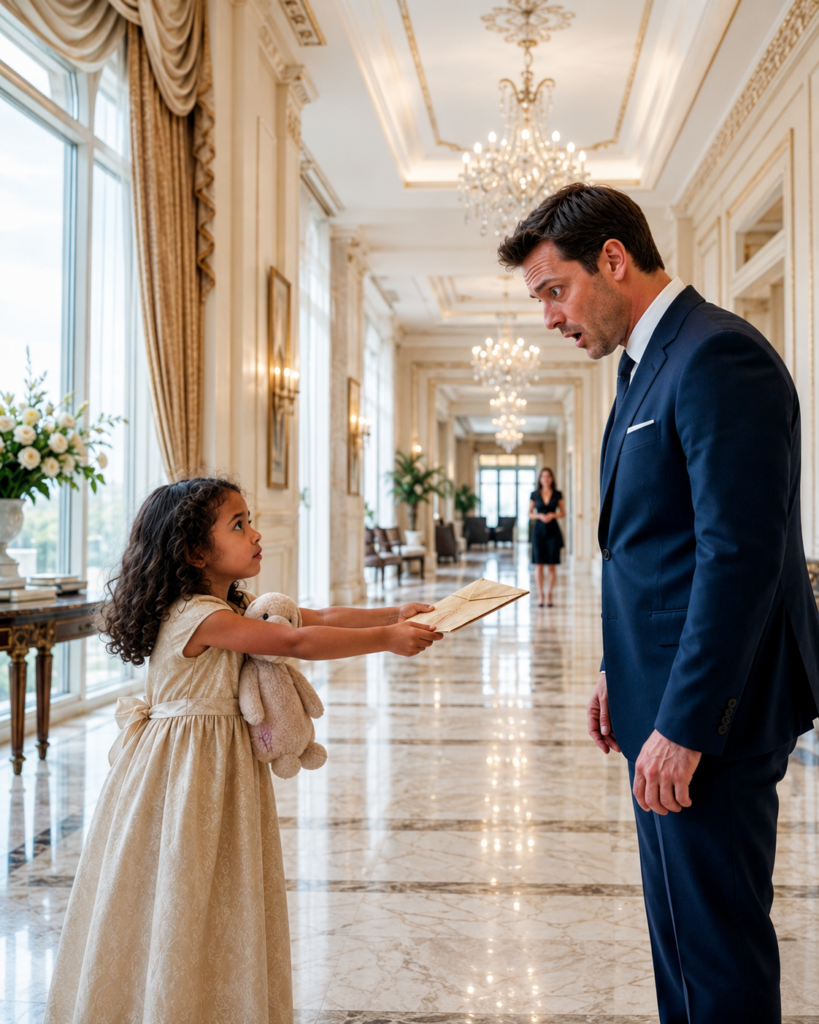
The little girl arrived at the mansion wearing an oversized purple coat and holding a stuffed elephant tightly against her chest.
She was 3 years old, her eyes swollen from fatigue, and a seriousness that didn’t match her tiny voice.
In front of her, Alejandro Santillán, owner of one of the most powerful real estate groups in Mexico, was about to leave for a meeting in Santa Fe.
But the girl lifted a crumpled envelope and said:
—My mom told me to give this to you if one day she disappeared.
Alejandro froze in the marble foyer of his house in Lomas de Chapultepec.
Next to him was Doña Teresa, a 58-year-old woman, the aunt of Clara Morales, the housekeeper who had worked for almost 2 years in that home without raising her voice, without asking for favors, and without ever sticking her nose where it didn’t belong.
—Where is Clara? —Alejandro asked, feeling a strange knot in his throat.
Doña Teresa looked down.
—She left us the day before yesterday, sir.
The word fell like a stone.
Alejandro looked at the girl. Lucerito wasn’t crying. She was just waiting for him to take the envelope, as if fulfilling that mission was the only thing left from her mom.
Clara had come to that house when Alejandro had just divorced Renata, an elegant, cold woman who was used to looking at everything as if it had a price.
Renata had left with his partner, leaving Alejandro a fortune, a huge mansion, and a shame that made him drier than ever.
He wasn’t a bad person. He paid well, gave generous bonuses, and never humiliated anyone.
But he also didn’t see.
He crossed the kitchen without looking at faces. He asked for coffee without noticing trembling hands. He said “thank you” only when he remembered.
Clara was discreet. She arrived at 7, cleaned, cooked something simple when needed, and left before 4.
One day she showed up with Lucerito because she had no one to take care of her.
—I’m sorry, sir. She will stay quiet in the laundry room. She won’t bother.
The little girl, instead of hiding, looked at Alejandro and said:
—You look like a sad lion.
From that day on, something changed without anyone saying a word.
Lucerito began to draw in the kitchen, to talk to her elephant Pancho, and to stick star stickers on Alejandro’s hand before his video calls.
He pretended to be annoyed, but he never took them off.
Clara watched everything in silence.
What Alejandro never saw was that Clara climbed the stairs in pain, that some days she breathed slowly, that she hid medical tests in a blue folder.
She had leukemia.
When the doctors told her that the treatment was no longer working, Clara wrote a letter. She tucked it in her daughter’s purple coat and explained with tears:
—If mommy disappears, you give it to Mr. Alejandro.
Now, in front of him, that letter burned his fingers.
Alejandro opened the envelope.
The handwriting was small, neat, humble.
“Dear Mr. Alejandro: you owe me nothing. You gave me a job when no one wanted to hire a single mother. Thank you for treating Lucerito well without anyone asking you to. She loves you. She says your eyes aren’t as sad when she’s around.
I’m not asking you to adopt her or to take on a responsibility that isn’t yours. I only ask that, if you can, you look at her from time to time. Don’t let the world dim her light.
My aunt Teresa will take care of her, but she is tired and sick. If one day Lucerito needs help, I hope you remember that my girl is worth it.
She likes purple. She talks to the clouds. She believes elephants dream of gardens. Please don’t let anyone tell her that’s silly.
With gratitude, Clara Morales.”
Alejandro finished reading with tears in his eyes.
Lucerito took a step toward him.
—Did you find my mom? —she asked—. Is she no longer missing?
Doña Teresa covered her mouth to keep from breaking down.
Alejandro knelt in front of the girl.
—Your mom left you a lot of love, Lucerito.
She extended the stuffed animal to him.
—Are you going to keep it?
Alejandro couldn’t respond immediately. He just pressed the letter to his chest.
And just when he thought nothing could hurt more, Doña Teresa pulled another paper from her bag and murmured:
—Sir… Clara also left this, but she asked me to read it only if you agreed to help the girl.
PART 2
Alejandro looked at that second envelope as if it were a bomb.
It wasn’t white like the first one. It was yellow, one of those bought at the stationery store, with a corner stained with coffee and Lucerito's name written in Clara’s handwriting.
—What is it? —he asked.
Doña Teresa swallowed hard.
—I don’t know. Clara made me swear I wouldn’t open it first.
Lucerito, still holding Pancho in her arms, watched everything with the seriousness of someone who understands more than adults think.
Alejandro set his briefcase on the floor.
The meeting in Santa Fe, the investors, the millions at stake… all seemed trivial.
He opened the yellow envelope.
Inside was a copy of a birth certificate, medical prescriptions, a notebook with hospital expenses, and a shorter letter.
“Dear Mr. Alejandro: if you are reading this, it means you didn’t close the door. I’m sorry for trusting you so much. I have no one else to turn to.
My cousin Maribel knows I’m sick. She looked for me months ago and asked for money to ‘help me,’ but then she threatened to take Lucerito away if I died. She doesn’t love my daughter. She wants anything she can get from her.
If she ever shows up crying and saying she’s family, don’t believe her too easily.
I also want you to know something else. Renata, your ex-wife, came to see me twice. She offered me money to stop bringing Lucerito to your house. She said a maid’s daughter shouldn’t be ‘making family’ with you. I didn’t accept.
I didn’t tell you because I didn’t want problems.
Take care of my girl, if your heart allows it.”
Alejandro felt blood rush to his face.
Renata.
Renata again sticking her elegant hands where she wasn’t invited.
Doña Teresa made the sign of the cross.
—That woman came to my house too. She said that if the girl stayed close to you, it would harm us.
Alejandro closed his eyes. For years he thought his divorce had been the worst blow Renata could deal him. But now he understood that there was something more cruel: trying to erase a girl simply because she reminded him that goodness still existed within him.
That same day, he canceled everything.
He summoned his lawyer, opened an educational trust for Lucerito, and requested that it be legally protected.
—From kindergarten to college —he ordered—. And medical attention, housing, therapy if she needs it, everything.
—Do you want to make it public? —the lawyer asked.
Alejandro looked at him coldly.
—This isn’t a campaign, man. It’s a moral debt.
From then on, he began to visit Lucerito at Doña Teresa’s house, on a simple street in Iztapalapa, where it smelled of soup, cheap fabric softener, and real life.
At first, he arrived stiff, wearing expensive shirts and shoes that didn’t know how to walk on broken sidewalks.
Lucerito welcomed him with Pancho.
—The sad-eyed man is here.
—Still sad? —he would ask.
She examined him like a doctor.
—Less. But you need more purple.
The following week, Alejandro showed up with a purple tie. Lucerito smiled for the first time since Clara’s funeral.
—Now you look like a person.
Doña Teresa burst into laughter. Alejandro did too.
And that laughter, so simple, hurt beautifully.
Months passed.
Alejandro learned to sit on the floor. He learned that Pancho “got sick” when it rained. He learned that Lucerito talked to the clouds because she said that’s where her mom answered her.
He also began to see what he had previously ignored.
At Grupo Santillán, he changed rules that no one had touched: health insurance for domestic workers hired on his properties, paid sick leave, emergency funds, support for single mothers, and subsidized daycare.
His Human Resources director asked him what had made him change.
Alejandro replied:
—A woman was dying in my house, and I was only seeing coffee served.
The phrase turned into a heavy silence throughout the office.
But the peace didn’t last.
Eight months later, Doña Teresa suffered a mild heart attack. She survived, but could no longer care for Lucerito alone.
Then Maribel, Clara’s cousin, appeared.
She showed up at the family court in a black dress, dark glasses, and fake tears so transparent that even the clerk raised an eyebrow.
—I’m blood of her blood —she said—. That girl should live with me, not with a millionaire who isn’t even family.
The news spread quickly. On Facebook, venomous comments began to appear.
“Surely the rich man wants to cleanse his guilt.”
“What is a single man doing with a girl who isn’t his?”
“Poor child, they want her for the money.”
Renata took advantage of the scandal.
She gave an interview without naming names but making everything clear.
—There are men who use other people’s causes to seem like saints —she said in front of a camera.
Alejandro could have destroyed his reputation with one call. He had lawyers, contacts, newspapers.
But he held back for Lucerito.
On the day of the hearing, the girl arrived wearing her purple dress and hugging Pancho tightly to her chest.
Maribel cried in front of the judge.
—I want to give her a real family.
Alejandro asked to speak.
—with all due respect, a family doesn’t appear when it smells like money.
The lawyer presented evidence: calls from Maribel asking about the trust, messages where she said that “that girl could leave her something good,” testimonies from neighbors, and Clara’s letter.
But the most powerful blow was still missing.
Doña Teresa, weak but firm, pulled out a USB drive.
—Clara recorded this one week before she died.
On the screen appeared Clara. She was pale, with a scarf on her head, but her eyes were still full of tenderness.
The room fell silent.
—If you’re watching this —Clara said—, it’s because my daughter is at risk. I name my aunt Teresa as guardian. And if she is absent or sick, I ask that Alejandro Santillán be considered as a trusted guardian. Not because he is rich. But because my daughter chose him before all of us.
Alejandro covered his mouth.
Clara continued:
—I know many will judge him. They will say he isn’t family. But I saw him change when Lucerito entered the kitchen. I saw a man dead inside start looking at the world again. And I also saw my girl smile when he arrived. Sometimes blood comes late. Sometimes love arrives without a surname.
Lucerito began to cry.
—Mom...
The judge lowered her gaze, moved.
Maribel lost color in her face.
Then came the twist no one expected.
Alejandro’s lawyer presented one last document: a transfer from Renata to Maribel made three days before she requested custody.
The concept said: “legal support.”
But the attached messages were clearer.
Renata had written to her:
“Do whatever you have to do. That girl can’t stay close to Alejandro. He is making me look ridiculous.”
The courtroom erupted in murmurs.
Maribel tried to deny everything, but it was too late.
The judge was firm. Doña Teresa would maintain guardianship with legal and financial support. Alejandro would remain as a backup guardian and authorized contact. Maribel would be investigated for attempted procedural fraud.
Renata, upon leaving, approached Alejandro in the hallway.
—You’re going to ruin your name for a girl who isn’t even yours.
Alejandro looked at her with a calm he hadn’t had before.
—No, Renata. My name was already ruined when I thought money was enough to be decent.
She pressed her lips together.
—They will use you.
—Honestly, the only one who used me for years was you.
Renata left in a fury, surrounded by cameras.
Lucerito released Doña Teresa’s hand and ran toward Alejandro.
—Are they not going to take me away anymore?
He bent down.
—Not while I can prevent it.
—And does my mom know?
Alejandro swallowed hard.
—I think she does.
The girl placed Pancho in his arms.
—Then keep him too. So he doesn’t get lost.
From that day on, Alejandro stopped visiting “to check” and began to belong.
On Lucerito’s 5th birthday, he brought purple balloons, chocolate cake, and a huge elephant piñata that Doña Teresa swore was too ridiculous.
Lucerito blew out the candles and made a secret wish.
Alejandro watched her close her eyes and felt something his mansion had never given him: home.
Years later, when Lucerito entered middle school, Alejandro inaugurated the Clara Morales Foundation to support single mothers with cancer, domestic workers, and children without family support.
He didn’t put his photo in any advertisement.
He put a phrase from the first letter:
“Don’t let the world dim your light.”
On the day of the inauguration, Lucerito took the stage in a purple dress. She was no longer the tiny girl in the big coat, but she still carried Pancho, old and patched, as a symbol of everything she had survived.
—My mom didn’t disappear —she said into the microphone—. She just left a letter for someone to learn to see.
Alejandro cried in the front row, not hiding.
Because in the end, he understood that Clara hadn’t left him a burden.
She had left him an opportunity.
The opportunity to become, late but truly, the good man that a housekeeper, a sick mother, and a 3-year-old girl had seen before he even realized it himself.
And that’s why many people argued for days on social media:
Does family come with blood… or is it proven when everyone else is gone?