PART 1
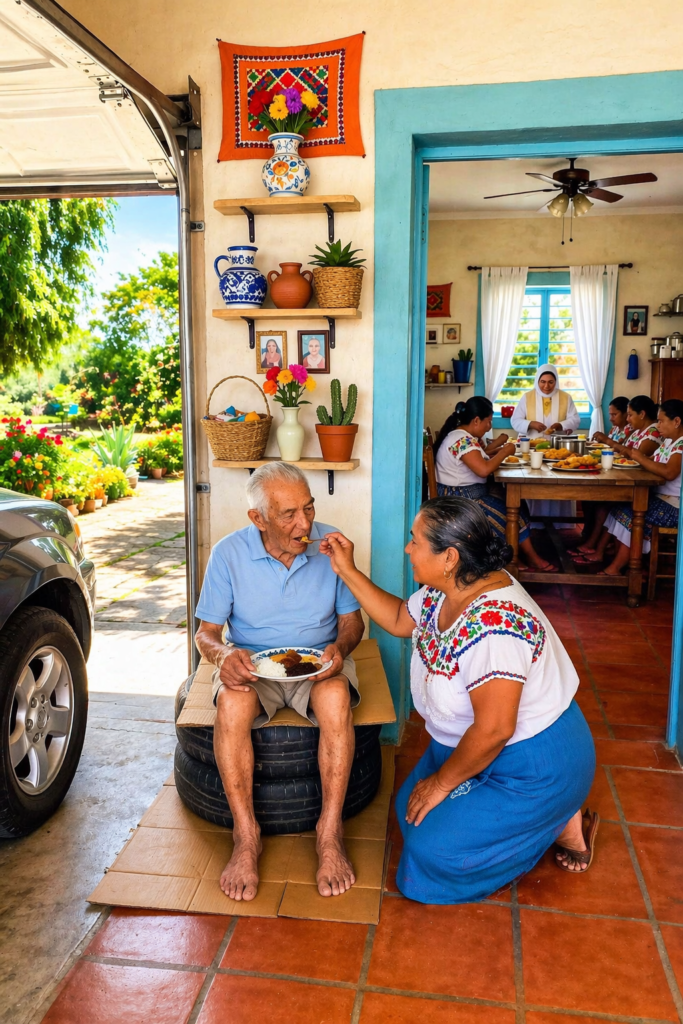
Doña Martina found Pedro sitting on the floor of the garage, on an old cardboard, next to four dusty tires and a bucket with rags.
Inside, in the dining room, there was a table set for twelve ladies from the prayer group.
White tablecloth, hot casseroles, vases, sweet bread, candles, and embroidered napkins.
Pedro had been served on a plastic plate, the kind used when no one wants to wash dishes.
He had advanced Parkinson's.
His right hand trembled so much that the spoon often reached his mouth empty.
Food fell onto his shirt, his knees, onto the cardboard.
And still, Pedro tried to eat quietly, staring at the concrete, as if apologizing for still being alive.
Doña Martina was 67 years old and had been married to him for 44 years.
Before the illness, Pedro made her coffee every morning.
It didn’t matter if he went to the factory early, if it rained, if there was no gas, if they were fighting.
He always left a cup on the nightstand, covered with a plate to keep it warm.
When the neurologist said “advanced,” they had to leave their little house in Iztapalapa and move in with their son Raúl and his daughter-in-law Liliana, in a nice neighborhood in Querétaro.
The rent and medicines no longer fit in the same wallet.
Liliana seemed good.
On Facebook, she posted pictures with rosaries, phrases about the Virgin, visits to nursing homes, food drives, and posts that said: “He who serves God, serves his neighbor.”
Martina believed her.
Until life began to show another face.
Pedro spilled the soup.
Saliva dripped from his mouth.
Sometimes he choked on the bread.
And Martina, exhausted, broke down in tears one night while washing dishes with Liliana.
—I can’t see him like this anymore —she said, her voice shattered—. It hurts me, but it robs me of my peace.
Liliana didn’t hug her.
She just listened.
And stored those words like one would keep a knife.
The next day was the prayer meal.
Martina was showering when she heard screams from the kitchen.
—Get him out of here! —Liliana ordered the girl—. He’s spilling everything. He’s going to scare the ladies.
—But Don Pedro hasn’t finished yet —the employee replied.
—Well, let him finish in the garage. Put a cardboard down. It doesn’t matter if it gets dirty there.
Martina ran out, her hair wet and her sandals on wrong.
She crossed the living room.
She saw Liliana holding hands with her guests, praying with closed eyes in front of the hot food.
Doña Carmela, a lady from her old parish, was there.
The same one who years ago told Martina that Pedro was “a saint of a man.”
Martina continued to the garage.
And there she saw him.
Her Pedro.
The man who made coffee.
Sitting on the ground, fighting with a spoon that no longer obeyed him.
—Liliana, how could you do this? —Martina shouted, crying with rage—. You talk about God every day!
Liliana adjusted the gold cross she wore around her neck.
—Don’t make a scene, mother-in-law. Pedro doesn’t even understand anymore. Besides, this is my house.
—He’s a sick man, not a nuisance.
—Well, if it hurts you so much, sit with him. But don’t ruin my gathering.
Then she took her Bible, her bag, and her shawl.
—I’m going to the healing mass. Let’s see if there’s peace there.
And she left.
Martina did not respond.
She sat on the concrete next to Pedro, carefully took the spoon away, and began to feed him slowly.
Pedro didn’t look at her.
Not once.
Then an odd silence fell.
Raúl, their son, was standing at the back door of the garage.
It was unclear how long he had been there.
His eyes were red.
And he was watching his parents on the floor as if he had just realized that his home had become something unforgivable.
PART 2
Raúl did not shout.
He didn’t throw chairs.
He didn’t go to look for Liliana at church to make a scene in front of the ladies.
He just took a deep breath, clenched his jaw, and entered the house.
Martina remained seated next to Pedro, giving him tiny spoonfuls, wiping his mouth with a napkin.
Pedro still didn’t see her.
That hurt more than the cardboard.
Because for 44 years, Pedro had always looked at her first.
When he entered a party, when he returned from work, when an old song played, when the kids misbehaved.
His eyes searched for her as if the world were incomplete until he found her.
But that day, in the garage, Pedro only stared at the plate.
As if he feared Martina would discover something.
When Liliana returned from mass, the house was silent.
The casseroles were still on the table, but no one was praying anymore.
The ladies had left, uncomfortable, murmuring quietly.
On the dining room door was a folded sheet, written in Raúl's firm handwriting.
Liliana opened it.
Her face lost color.
The note read:
“Liliana: today I understood that your prayers are mere noise. You cannot love a God you do not see if you despise the human being in front of you. I’m taking my parents. Stay with your house, your perfect table, and your spiritual peace. But do not say again that God lives here, because God does not dwell where a sick person is humiliated.”
Liliana stood frozen.
Then she ran to the bedroom and saw the drawers open.
Pedro's clothes were gone.
The medicines were gone too.
Martina's blankets had disappeared.
Raúl had taken his parents to a small apartment near the market, with two bedrooms, peeling walls, and a kitchen that barely fit three chairs.
It wasn’t a nice house.
But Pedro slept that night in a clean bed, not on cardboard.
Martina thought that peace would begin there.
She was wrong.
The next morning, while preparing oatmeal for Pedro, she saw on the table the same plastic plate from the garage.
Raúl had put it there.
On top was a cloth napkin folded in four.
Martina didn’t touch it.
She felt that this plate was not a plate.
It was an accusation.
Raúl emerged from his room with swollen eyes, as if he hadn’t slept either.
—Why did you bring that? —Martina asked, pointing at the plate.
Raúl didn’t answer immediately.
He poured coffee but didn’t drink.
Then he said something that broke her back.
—He heard you, Mom.
Martina froze.
—Who heard what?
Raúl looked at her sadly.
—My dad. He heard you that night in the kitchen.
The cup trembled in Martina's hand.
Not from illness.
From guilt.
The night of the dishes came back in full.
Liliana washing a glass.
Martina drying her tears with an apron.
The phrase she had let slip out of exhaustion, thinking Pedro was asleep.
—I can’t see him like this anymore. He robs me of my peace.
—He wasn’t asleep —Raúl said—. He got up to go to the bathroom and stayed in the hallway. He heard everything.
Martina had to sit down.
The air left her chest.
—Why didn’t he say anything to me?
Raúl looked down.
—Because he didn’t want to burden you further.
Then he told her what Martina didn’t know.
The morning after that phrase, Pedro got up before her.
He wanted to make her coffee, as always.
As he had for 44 years.
But his hand trembled too much.
The cup fell.
It shattered into pieces.
Raúl found him crouched, picking up shards with a hand that wouldn’t obey, crying silently so that Martina wouldn’t wake up.
Pedro said one thing:
—It’s going to be the first morning that your mom wakes up without coffee. Tell her I’m sorry.
Martina covered her mouth.
That apology hurt like a slap.
Pedro had heard that he robbed her of peace.
And instead of getting angry, he had wanted to apologize for not being able to serve her coffee.
Raúl continued speaking.
Each word was worse.
For weeks, Pedro had taken advantage of his moments of lucidity to talk to him.
Sometimes, in the early morning, when Liliana left for her church meetings and Martina was showering, Pedro asked his son for something impossible.
—He told me to put him in a nursing home, Mom.
Martina lifted her face, terrified.
—No.
—Yes. He said you deserved to rest. That he had fulfilled his duty. That he didn’t want the last memory you had of him to be of a man who robbed you of peace.
Martina began to cry silently.
Raúl did too.
—I couldn’t do it —he confessed—. I couldn’t leave my dad in a government nursing home for everyone to pretend to be tranquil. That’s why I started saving money. I sold my car. I took out a loan at work. I found this apartment. I wanted to take you both together.
Martina then understood that Raúl hadn’t acted impulsively.
He had been carrying that decision for a while.
She also understood why Liliana was so furious.
Raúl and she had been fighting for months.
Liliana said that her house was not a hospital.
That Pedro smelled of medicine.
That visitors were uncomfortable.
That Martina meddled too much.
That she hadn’t married to care for old people.
Raúl had tried to convince her.
Liliana had responded with prayers, pretty phrases, and a closed door.
Until she sat Pedro on the floor.
That day, Raúl stopped negotiating.
—Why did you also take me out? —Martina asked, her voice broken—. I failed too.
Raúl took time to answer.
—Because you ran to the garage, Mom. Late, but you ran. You sat on the concrete and fed him. Liliana took her Bible and left.
Martina didn’t know what to say.
Raúl set the cup down on the table.
—It’s not the same to be tired than to become cruel. But it’s also not innocent to say certain things, Mom. Dad doesn’t remember everything, but that phrase stuck with him.
Martina looked toward Pedro’s room.
He was sleeping, a hand resting on the blanket, barely moving.
That hand had worked for 40 years.
It had carried grocery bags, sleeping children, buckets of water, factory boxes.
That hand had made coffee.
And now it trembled as if it still bore everything no one wanted to say.
During the afternoon, Martina couldn’t approach the plate.
She circled it as if it were an open wound.
The napkin remained folded in four.
Clean on the outside.
Heavy on the inside.
That night, she entered Pedro’s room.
The apartment was dark.
Only yellow light from a street lamp filtered through the window.
Martina knelt beside the bed and took her husband’s trembling hand.
—Forgive me, Pedro —she whispered—. I shouldn’t have said that. It wasn’t the whole truth.
Pedro slowly moved his eyes.
It wasn’t clear if he recognized her.
Sometimes he knew who she was.
Sometimes he called her “miss.”
Sometimes he asked about his mother, who had died 30 years ago.
Martina rested her forehead on his hand.
—I do get tired. Yes, I get desperate. Yes, I’m afraid of what’s to come. But I don’t want a peace where you’re not. Do you hear me, old man? I don’t want that.
Pedro barely squeezed her fingers.
It could have been affection.
It could have been a reflex.
It could have been the illness.
Martina never knew.
And that was part of the punishment.
Because there are apologies that come too late, when the person still breathes but can no longer always return from the place to which they are going.
Martina slept on the floor, beside the bed.
Not out of humiliation.
By choice.
The next morning, before Raúl woke up, she went to the kitchen.
The plate from the garage was still there.
Martina took a deep breath and lifted the napkin.
Then she let out a moan.
Inside was the food.
It wasn’t empty.
There was dry rice, a piece of cold chicken, and the softest part of a rolled tortilla.
The food had been there for over a day.
It was already hard.
But Martina understood instantly.
Pedro hadn’t managed to eat almost anything.
Every time the spoon failed him, every time his hand trembled, he had saved the best from the plate.
Not for himself.
For Martina.
Sitting on the floor.
On cardboard.
Next to the tires.
After hearing his daughter-in-law say he made a mess.
After hearing his wife say he robbed her of peace.
Pedro had still saved food for her.
Like when they were young and couldn’t afford two pieces of chicken.
He would say he had already eaten at the factory.
It was a lie.
He saved his portion for Martina.
All his life, he had given her from his hunger.
And in the garage, sick, ashamed, barely able to bring a spoon to his mouth, he did it again.
That’s why he didn’t look at her.
It wasn’t just shame.
It was that he didn’t want Martina to discover that he was still taking care of her.
Even though she had doubted.
Even though she was tired.
Even though that house had treated him like a nuisance.
Martina sat in front of the plate and cried like she had never cried before.
She cried for the coffees she received without gratitude.
For the mornings she thought were normal.
For the seconds it took her to rush to the garage.
For confusing tiredness with the right to hurt.
Raúl found her like that, hugging the cold plate.
He said nothing.
He just sat beside her.
For several minutes, mother and son cried together without touching.
Then Martina washed the plate.
She dried it carefully.
She didn’t put it with the others.
She placed it on a high shelf, alone.
Like something sacred and shameful at the same time.
Liliana called many times that week.
She sent messages.
She said it had all been a misunderstanding.
That the ladies exaggerated.
That she was under pressure too.
That Raúl was destroying their marriage because of two old people.
Raúl didn’t respond.
Days later, Liliana came to the apartment.
She arrived with a bag of bread, a new rosary, and a victim's face.
—I came to apologize —she said from the doorway—. God touched my heart.
Martina looked at Raúl.
Raúl looked at Pedro, sitting in a chair, with a blanket over his legs.
Pedro didn’t fully understand who was there.
Liliana tried to get closer.
—Don Pedrito, forgive me. I care about you very much.
Pedro lifted the spoon he had in his hand and let it fall onto the plate.
The sound was soft.
But everyone heard it.
Tap.
Tap.
Tap.
Like the night when his tremor bothered the guests.
Liliana froze.
Raúl opened the door wider.
—Don’t come to use God to clean up what you did —he said calmly—. Forgiveness is not a photo for Facebook.
Liliana cried.
Martina felt pity.
But she didn’t open her arms.
Because understanding that someone is also afraid does not erase what they did with that fear.
Liliana left without bread, without a photo, and without public forgiveness.
Time passed, and the big house remained empty.
The ladies from the church stopped meeting there.
Some commented that Raúl had been cruel.
Others said Liliana brought it upon herself.
On Facebook, there were veiled hints, verses, and silences.
But in the small apartment, life went on.
Difficult.
Tiring.
Imperfect.
Every morning, Martina would wake up before Pedro.
She prepared coffee with cinnamon.
Served it in a simple cup and left it on the nightstand, covered with a small plate to keep it warm.
Then she warmed up breakfast.
Took the plate from the shelf.
The ugly plate.
The plate from the cardboard.
The plate that was no longer shame, but memory.
She served Pedro first.
And before placing the spoon in his hand, she set aside the best for him.
The softest piece.
The warmest tortilla.
The seedless fruit.
The part that before, for 44 years, he would have given to her.
There were days when Pedro looked at her and smiled.
There were days he asked who she was.
There were days when the food spilled, the spoon hit the plate, and Martina felt her patience cracking inside.
But then she would look at the shelf.
Look at the plate.
And remember that love doesn’t always resemble a pretty picture or a perfect prayer.
Sometimes love is staying on the floor.
Sometimes it’s feeding slowly.
Sometimes it’s accepting that one has also been unfair and still choosing to do better before it’s too late.
One morning, Pedro took a sip of coffee with Martina's help.
He stained his shirt.
She cleaned the drop with a napkin.
Pedro looked at her as if returning from far away.
—Thank you, Martita —he murmured.
It was barely a second.
Then his gaze lost focus again.
But that was enough for Martina.
She stayed sitting next to him, her hand trembling not from illness, but from memory.
And while Pedro chewed slowly on the best piece of his plate, Martina understood something that hurt and saved at the same time: the peace does not always come when the burden goes away.
Sometimes it arrives when we finally learn to carry it with love.