PART 1
—Dad… don’t tell Mom I told you, because she said she’d send me away.
Héctor Salinas stood frozen at the entrance of his home, work backpack slung over one shoulder, keys still in hand. He had just returned from Guadalajara after five days sealing a contract for the company where he worked as a site supervisor.
He expected to find Regina, his eight-year-old daughter, running to him as always, her rag doll in one hand and a thousand questions tumbling out of her mouth.
But that night, in their home in the Narvarte neighborhood, there were no joyful shouts.
Only a trembling whisper from the bedroom.
Héctor dropped his backpack on the couch and walked slowly.
Regina sat on the edge of the bed, hair tangled, eyes swollen, an oversized sweater almost covering her hands. She clutched a brown teddy bear as if it were the only thing left to protect her.
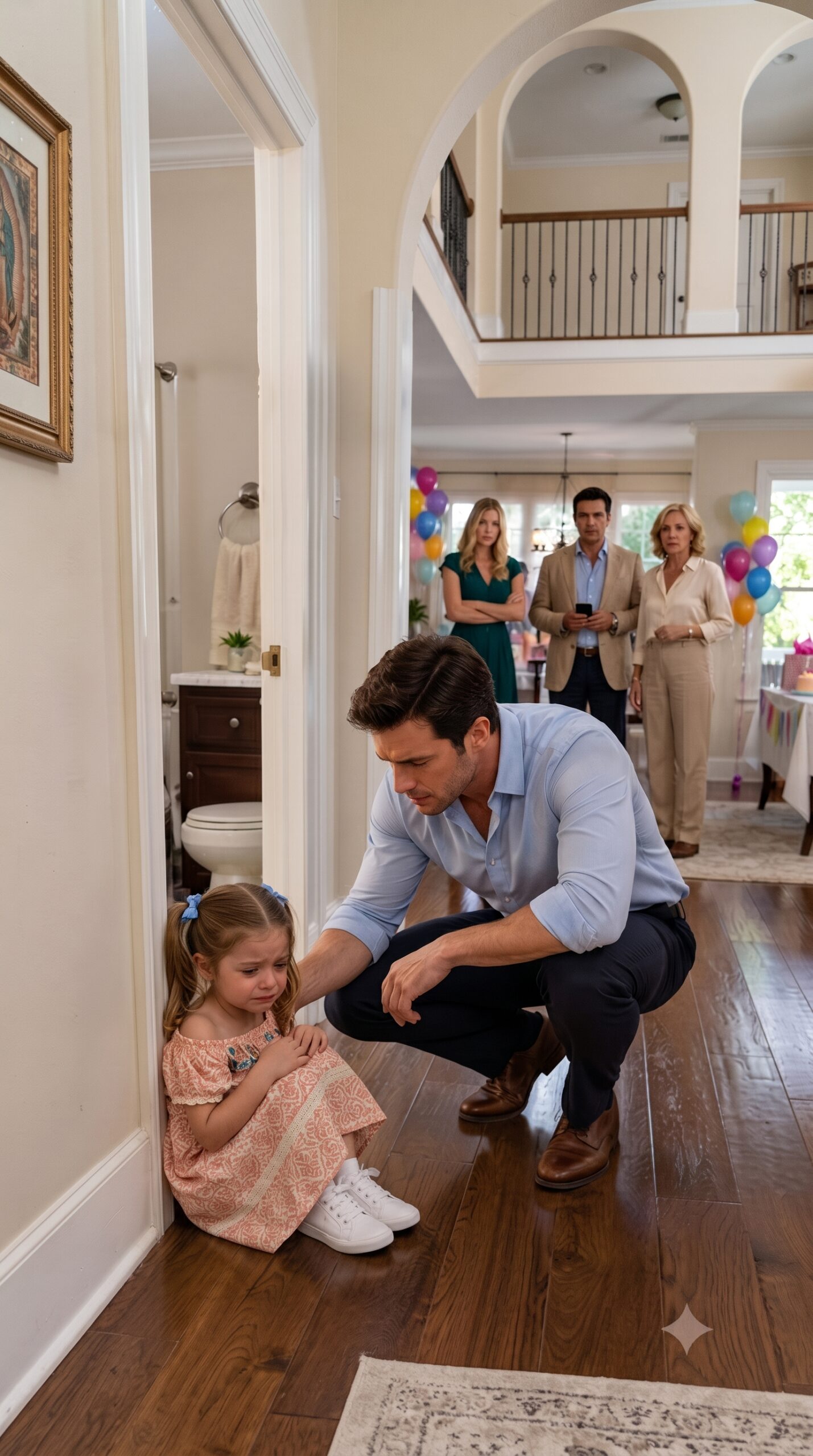
—What happened, my girl? —Héctor asked, kneeling in front of her.
Regina looked towards the door.
—Mom said it was my fault.
—What was your fault?
The little girl swallowed hard.
—I dropped a plate. Mom was talking to Grandma Carmen and got really mad. She said I always ruined her life when you weren’t around.
Héctor felt a tightness in his chest.
—Regina, tell me the truth. Did she hit you?
The girl shook her head quickly but then began to cry silently.
—She pulled me. I let go. Then she pushed me and I hit the corner of the wardrobe.
Héctor closed his eyes for a second.
—Where does it hurt?
Regina pointed to her lower back.
With great care, he lifted her sweater slightly. Upon seeing the dark, swollen bruise, a purplish mark in the center, he felt the air leave his lungs.
This wasn’t a playful hit.
This wasn’t just a fall.
—We’re going to the hospital —he declared.
Regina’s eyes widened in terror.
—No, Dad. Mom said if anyone saw it, you would hate her and I would destroy the family.
—You’re not destroying anything, my love. You’re just telling the truth.
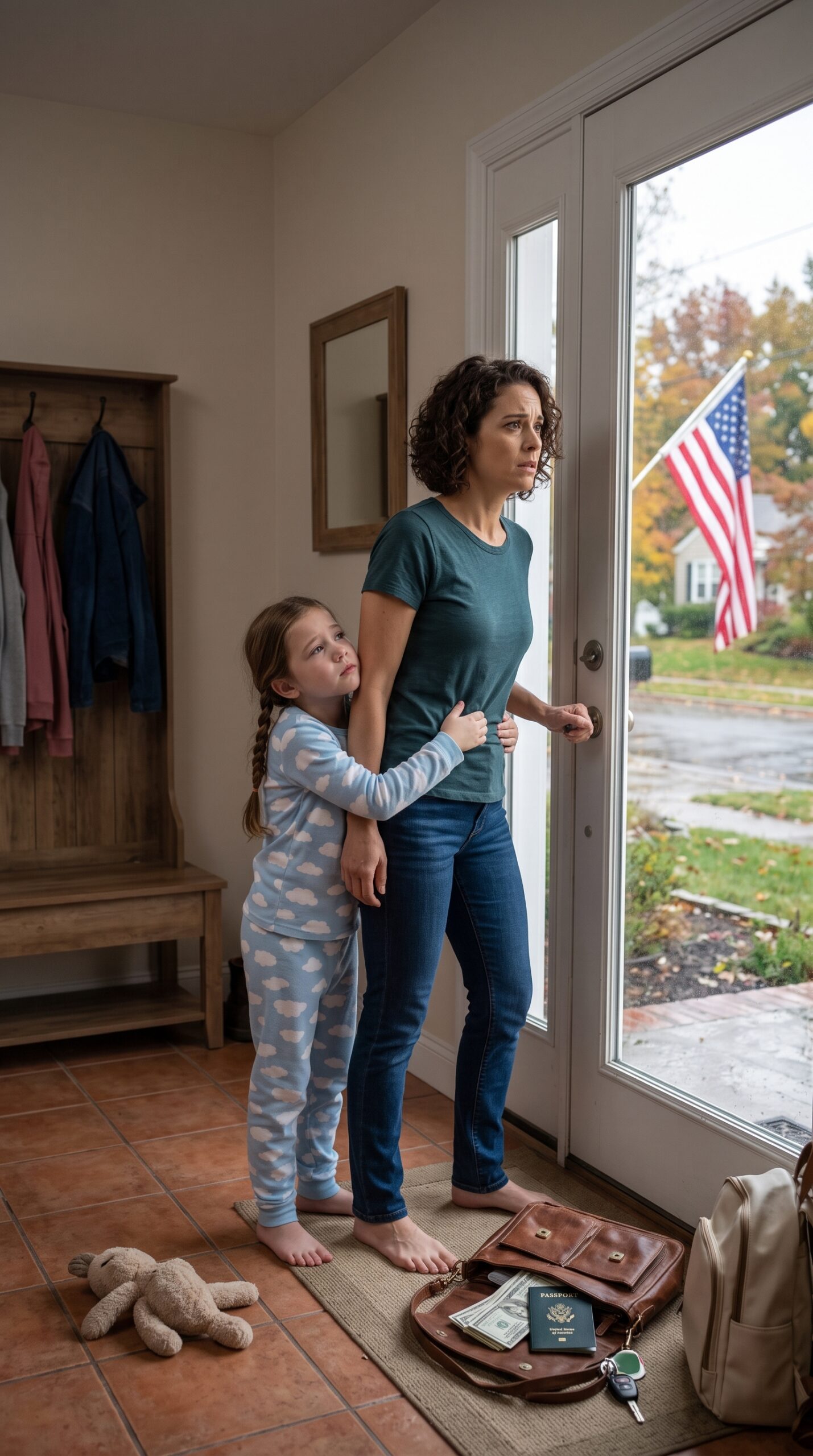
At that moment, they heard the electric gate. Then, high heels crossed the patio.
Marisol, his wife, appeared in the doorway with a bag of sweet bread and her phone glued to her ear.
Seeing Héctor carrying Regina, her expression changed.
—What are you doing?
—I’m taking her to the hospital.
Marisol hung up abruptly.
—Oh, don’t start with your drama. She fell. I already put ointment on it.
—She told me what happened.
Marisol shot a cold glare at the girl.
—Of course. Always making things up so you can carry her like a baby.
Regina buried her face in her father’s chest.
Héctor held her tighter.
—Never speak to her like that again.
Marisol stood in front of the door.
—If you leave with her, don’t come back. I’m warning you.
Héctor stared at her, unblinking.
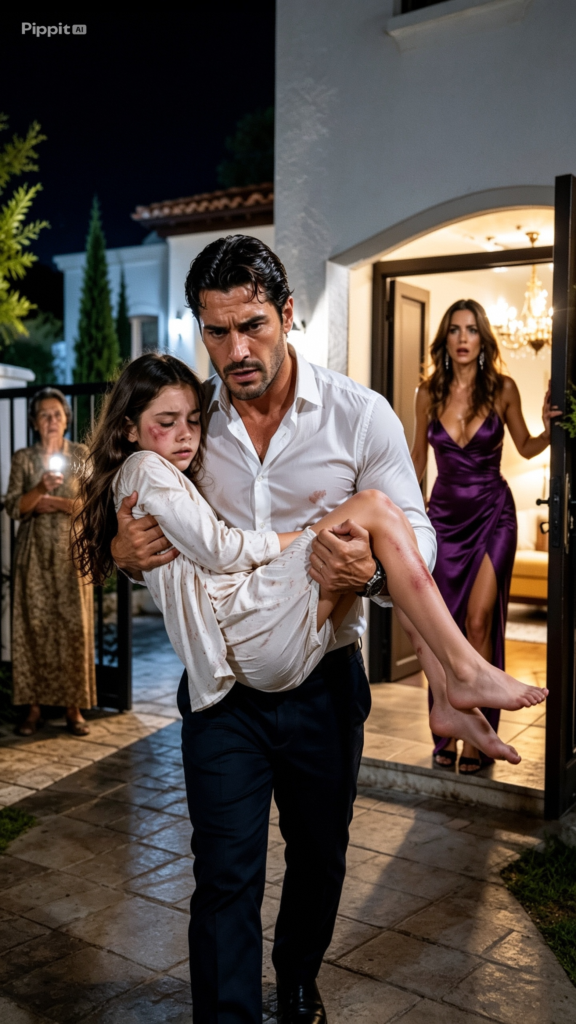
—Then I won’t come back.
As he crossed the threshold with Regina in his arms, he caught sight of Doña Elvia, the neighbor across the street, behind her gate. She was crying silently, her phone pressed against her chest, as if she had recorded something no one was meant to see.
And Héctor felt that the worst was yet to come.
PART 2
In the emergency room, Regina wouldn’t let go of Héctor’s hand even when the doctor examined her. The little girl bit her lips to stifle her complaints, but every time they touched her near the bruise, her body tensed up entirely.
Dr. Itzel Robles, the duty doctor that night, examined the injury seriously.
—The bruise is significant. It doesn’t seem compatible with a simple fall from a bed or patio. I need X-rays, medical photographs, and I’m going to request social work support.
Héctor felt a chill at the nape of his neck.
—Social work?
—By protocol. When a minor arrives with an injury like this, we have to investigate.
Regina squeezed her dad’s fingers.
—I didn’t want to come —she whispered—. Mom said they would punish me.
The doctor didn’t respond immediately. She just looked at Héctor with a mix of sadness and exhaustion.
A while later, while Regina rested with pain relief, Marisol arrived at the hospital accompanied by her mother, Doña Carmen.
Doña Carmen entered first, perfumed, well-groomed, with an expensive bag and an offended expression, as if the victim were her.
—Héctor, seriously, you have no shame —she said—. How dare you bring the girl here to make my daughter look like a criminal?
Marisol followed behind, her eyes red, but not from guilt. From anger.
—I already spoke with a lawyer —she said—. If you try to take Regina from me, I’ll say you’re hardly ever home. You leave me alone with everything.
Héctor stood up.
—That doesn’t explain the bruise.
—It was an accident.
—An accident doesn’t hide under a sweater.
Doña Carmen clicked her tongue.
—Oh, please. In the past, mothers corrected, and no one made such a fuss. Now they want to report for anything.
Héctor looked at her with disgust.
—Is correcting pushing a girl against a wardrobe?
Marisol clenched her jaw.
—I didn’t push her like that. She’s exaggerating. She’s just like you, dramatic, sensitive, always wanting to be coddled.
Before Héctor could respond, the social worker entered. Her name was Mariana Ayala. She carried a folder, spoke calmly, and had a gaze that wouldn’t be intimidated.
—I need to talk to Regina when she wakes up. Medical photographs of the injury will also be taken.
Marisol stepped forward.
—I don’t authorize anything.
Mariana observed her without losing her composure.
—The minor arrived accompanied by her father, who has already authorized the examination. Furthermore, by protocol, the girl has the right to express what she experienced.
—She’s 8 years old —Marisol said—. She doesn’t know what she’s saying.
—Precisely for that reason, we must listen to her carefully.
Doña Carmen approached Héctor and spoke in a low voice, though everyone could hear her.
—Don’t ruin your home over a tantrum. Kids forget. Scandals don’t.
Héctor’s phone vibrated.
It was a message from Doña Elvia.
“Sorry for meddling, son. My camera points to your entrance. Yesterday, I heard Regina scream. I also saw Marisol leave and leave her alone for almost 3 hours. I have the video.”
Héctor read the message twice.
He lifted his gaze to Marisol.
—Where were you yesterday from 7 to 10 PM?
She turned pale.
—I went to the grocery store.
—Doña Elvia has video.
Doña Carmen grabbed her daughter’s arm.
—Don’t answer.
But it was too late.
Regina opened her eyes. She saw her mother and hid behind the pillow.
The social worker noticed the gesture.
—Regina —she said softly—, do you want your mom to be present while we talk?
The girl shook her head.
Marisol approached.
—Tell the truth, Regina. Don’t be bad.
The girl started to cry.
—Mom told me that if I spoke, she would send me to a lady who locks up annoying kids.
Héctor felt the ground shift beneath him.
But Regina wasn’t finished.
—She also said I wasn’t the first girl who ruined her life.
Silence fell heavily.
Doña Carmen closed her eyes.
Marisol looked at her mother in panic.
And Héctor understood that the bruise wasn’t the only secret hidden in that family.
Mariana asked Marisol and Doña Carmen to leave the room. Marisol protested, shouted that she was the mother, that no one could treat her like a criminal, that it was all an exaggeration. But when two guards appeared in the hallway, she had to step back.
Before leaving, she looked at Regina with a hardness that broke Héctor’s heart.
The little girl curled up.
—She’s gone now —he whispered—. I’m with you.
Mariana waited a few minutes. She gave Regina water and explained that no one would punish her for telling the truth.
—Regina, do you know who that other girl was?
Regina hugged her teddy bear.
—I don’t know. But once I heard Mom crying in the bathroom. Grandma told her: “That girl doesn’t exist anymore, you signed, and it’s over.” Mom said, “But Regina looks at me like Daniela.”
Héctor froze.
—Daniela?
Regina nodded.
—Mom said that because of Daniela, she lost her scholarship, lost her youth, and had to live as if nothing happened. I thought she was talking about me, but no.
Héctor had never heard that name. In 11 years of being together, Marisol had never spoken to him about another daughter, an adoption, a previous pregnancy, nothing.
On the other side of the hallway, Marisol was arguing on the phone.
—Mom, I told you those papers had to disappear… No, Héctor doesn’t know about Daniela… Of course he doesn’t know!
Héctor felt a pang of intuition. He called his sister Lucía.
—I need you to go to my house. Don’t go in alone. Ask Doña Elvia to accompany you. Look for Marisol’s folder. Record everything.
Lucía didn’t ask anything.
—I’m on my way.
That morning, the photos arrived.
A gray folder hidden behind shoe boxes. An old certificate. Documents from a clinic in Puebla. Adoption papers. A letter signed by Marisol when she was 19.
Héctor read with trembling hands:
“I voluntarily give up custody of the minor Daniela…”
He sat in the hospital chair, defeated.
Marisol had a daughter before she met him.
A daughter her own mother forced her to erase.
The next morning, Héctor’s lawyer, Arturo Mendoza, arrived at the hospital. He reviewed the medical report, Doña Elvia’s video, the messages, the photos from the folder, and Regina’s statement.
—With this, we can request provisional custody and protective measures —he said—. Marisol must not approach the girl without supervision.
—And Daniela?
Arturo took a deep breath.
—That opens another door. If the adoption was legal, we can’t invade her life. But it does serve to show a pattern of harm, family pressure, and secrets used as threats.
Later, Marisol returned. This time she didn’t yell. She came made up, wearing a white blouse and holding a folder.
—Héctor, let’s talk like adults. I agree to therapy, you won’t proceed legally, and Regina won’t find out about things she doesn’t understand.
He stared at her intently.
—Things like Daniela?
Marisol lost color.
Doña Carmen, who was behind her, muttered:
—Who told you that name?
Héctor turned towards her.
—You just confirmed she exists.
Marisol closed her eyes. For the first time, she didn’t seem furious. She seemed trapped.
—I was 18 years old —she said—. I was studying design at UNAM. I got pregnant by a boyfriend who disappeared. My mom said if I had the girl, no decent man would marry me. She took me to Puebla, I gave birth, and I signed.
—And that justifies what you did to Regina?
Marisol cried.
—you don’t know what it’s like to live with that guilt. When Regina was born, everyone said now I could be a “good” mom. But every time she cried, I felt someone was coming to collect what I did. When you left, I was drowning. And she looked at me just like that…
Héctor felt rage and sadness at the same time.
—Regina wasn’t your punishment. She was your daughter.
Marisol lowered her gaze.
—It was once.
Héctor opened Doña Elvia’s video. Screams, slamming doors, Regina crying, and Marisol leaving the house while the girl was left alone.
It wasn’t once.
Marisol stepped back.
—That meddling old woman is destroying us.
—No —Héctor said—. She heard my daughter when I wasn’t there.
Doña Carmen tried to intervene.
—Think of the last name, the school, what they will say. You’re going to brand Regina forever.
Héctor felt a hard calm.
—Regina was already branded. On her back. In her fear. In the secrets. Now what I’m going to do is protect her.
That same day, the complaint was filed. The hospital submitted the report, Mariana added Regina’s statement, Doña Elvia shared the videos, and the judge issued temporary measures. Marisol could not approach Regina without supervision, and Héctor received provisional custody.
Marisol’s family exploded.
An uncle said Héctor was exaggerating. A cousin wrote that all mothers lose patience. Doña Carmen accused Regina of being manipulated. But when the lawyer showed messages where Carmen told Marisol: “Don’t let that girl dominate you like the other one,” the room fell silent.
Marisol cried upon hearing those words.
Maybe she understood that many phrases she repeated weren’t hers but inherited wounds.
Héctor rented a small apartment near Parque de los Venados. It had no garden or fancy living room, but it had silence. It had light. It had peace.
Regina chose yellow curtains and stuck stars on the ceiling. The first nights, she slept with the lamp on. Sometimes she asked if her mom knew where they were. Sometimes she hugged the teddy bear like a shield.
Héctor sat beside her and repeated:
—Here, no one will punish you for speaking.
Therapy began two weeks later. Regina drew houses with enormous doors and girls hiding under tables. Little by little, the doors became smaller. Then windows appeared. One day, she drew a house with a tree and wrote: “Here, they believe me.”
Héctor kept that drawing in his wallet.
Months later, an unexpected letter arrived.
Arturo had carefully investigated. Daniela lived in Querétaro with a loving adoptive family. She was 17 years old. Her adoptive mother agreed to receive a letter, not to demand anything, but to explain that she had a half-sister named Regina.
Daniela responded a month later.
“I don’t hate Marisol because I don’t know her. But no girl is born to ruin her mother’s life. Tell Regina she is not to blame for a sadness that started before her.”
Héctor read that sentence with the therapist before showing it to Regina.
The girl cried.
—So Mom was angry about something else.
—Yes, my love. But that other thing wasn’t your fault either.
During the first supervised visit, Marisol arrived without makeup, hands shaking. She didn’t try to hug Regina. That was her first correct act.
—What I did was wrong —she said—. I was the adult. You were the child. I shouldn’t have touched you, scared you, or asked you to keep secrets.
Regina looked at her seriously.
—I don’t want to live with you.
Marisol closed her eyes.
—I understand.
—But I want you to go to therapy —the girl added—. Because if one day I have kids, I don’t want my mom to scare them.
Héctor had to look at the floor to avoid breaking down.
There was no magical ending. Marisol continued in therapy. Doña Carmen was kept away by the judge's order. Héctor changed his hours, learned to braid hair poorly, and burnt more than one quesadilla. But Regina started laughing again.
A year later, at a school play, Regina appeared dressed as a butterfly. When it was her turn to speak, she looked at the audience, took a deep breath, and said loudly:
—A flower doesn’t grow where it’s stepped on. It grows where it’s cared for.
Héctor cried silently.
Marisol applauded from the last row, with court permission. Regina didn’t run to her, but she raised her hand to greet her.
It wasn’t forgiveness.
It wasn’t forgetfulness.
It was a girl reclaiming the right to decide.
That night, Regina left the teddy bear on the shelf.
—I don’t need you to protect me so much anymore —she said.
Héctor smiled.
—No?
—No. Now I know how to speak.
He turned off the light, leaving a little lamp on.
Before exiting, Regina called to him.
—Dad.
—Yes, my girl?
—Thank you for believing me.
Héctor stood at the door, his heart knotted.
Because he understood that a family isn’t saved by hiding bruises or defending appearances.
It’s saved when someone hears a whisper, opens the door, and chooses not to look away.