PART 1
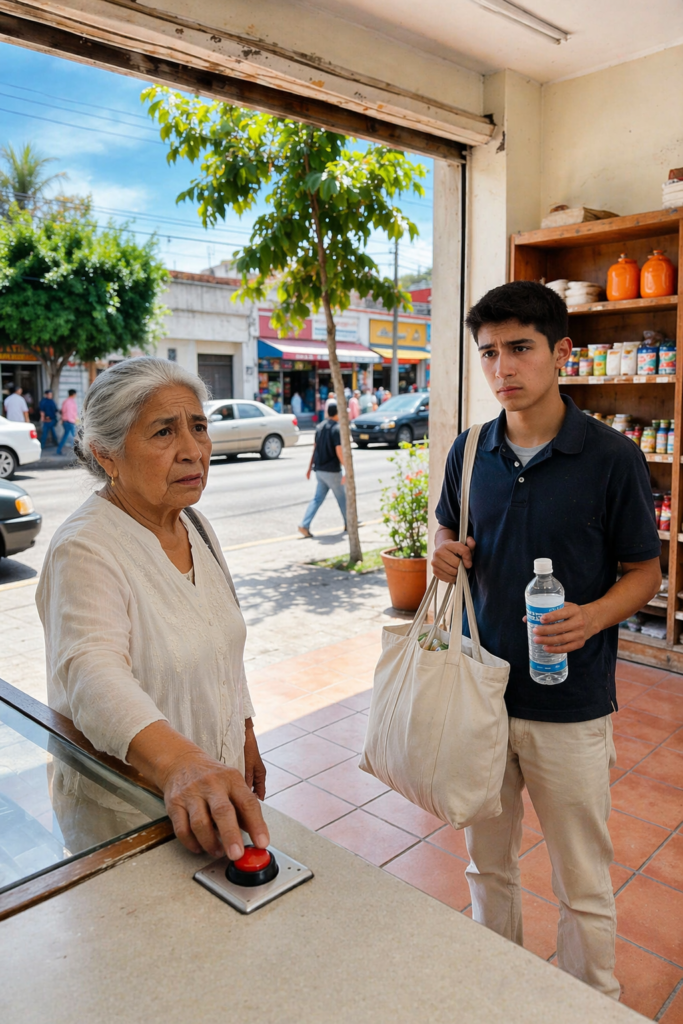
For 2 years, Doña Mercedes opened the door of her little store to a skinny boy with a scar crossing his brow, who only bought adult diapers, alcohol, and cream for rashes.
The first night she saw him, she almost pressed the panic button under the counter.
It was late, Avenida Revolución in Guadalajara was already half-empty, and she was lowering the curtain when the young man appeared in his worn-out sneakers, stained sweatshirt, and sunken eyes.
He didn’t ask for money.
He asked for work.
—I’ll sweep the sidewalk, organize the boxes, clean the storage room, anything, ma’am. I just need to take some diapers and alcohol for my mom.
Mercedes, a widow for 6 years, lived alone above the store and knew the street well. She could distinguish the abusive from the desperate.
And that boy didn’t seem bad.
He seemed broken.
His name was Iván. He was 21 years old and had a scar that split his right eyebrow as if someone had drawn a line of pain on his face.
He worked for 3 hours without complaining. He mopped the floor with cold water, organized drinks, carried sacks of pet food, and didn’t touch a single candy from the cash register.
When he finished, Mercedes gave him the diapers, the alcohol, a cream, and 200 pesos.
Iván stared at the money as if it burned his hand.
Then he broke down in tears.
He told her that his mom, Carmen, had suffered a stroke. That she no longer walked. That they discharged her from the hospital because “there wasn’t much to do.” That he took care of her alone because his little sister Sofía was too young to see those things.
Mercedes felt her chest soften.
The next day, she hired him.
Over the months, Iván became indispensable. He opened the store early, received suppliers, swept the sidewalk, carried water bottles, and even defended Mercedes when a drunk customer got rowdy.
He never missed a day.
He never stole.
He never asked for credit.
Every week he bought the same things: diapers, alcohol, wet wipes, gauze, and cream.
The only odd thing was one thing.
He never let Mercedes meet his mom.
—She’s very delicate, ma’am. She’s embarrassed to be seen like this.
Mercedes wanted to bring her soup, sweet bread, even a nurse friend from IMSS who could check on her.
Iván always said no.
Quickly.
Abruptly.
Then he would smile, as if regretting sounding rude, and change the subject.
One afternoon, Mercedes found a forgotten receipt in the cash register.
Diapers.
Alcohol.
Cream.
And a large, heavy lock, one of those from the hardware store.
She thought it might be to protect his house. In those neighborhoods, anyone had to take care of themselves as best they could.
But weeks later, a neighbor of Iván’s came in to buy soap and, inadvertently, let slip something that left Mercedes frozen.
—Stroke? I saw Doña Carmen walking in the yard not long ago. She even shouted something strange, and the boy ran her inside.
Mercedes said nothing, but that phrase stuck with her.
Then came the night that changed everything.
Iván didn’t show up to close the store.
In 2 years, that had never happened.
At 10:47 p.m., Mercedes received an audio message from him. His voice trembled.
—Ma’am… if I don’t come back… please, don’t enter the back room.
Mercedes felt her blood rush to her feet.
She grabbed the copy of the key that Iván had given her for emergencies and went home with the rosary tight in her fingers.
The back room had a lock on the outside.
The same lock from the receipt.
When she managed to open it, the smell hit her: confinement, alcohol, dampness, and old sadness.
On a mattress on the floor lay an extremely thin woman, disheveled, with sunken eyes.
The woman looked at Mercedes and began to cry.
—Get me out —she whispered—. He has me here.
Mercedes took a step back.
Then Iván appeared in the doorway, pale, with a bag of diapers in his hand.
—Ma’am… let her go. For whatever you hold dear, don’t let her out.
PART 2
Mercedes felt the world split in two.
The woman on the mattress gripped her wrist with impossible strength for someone who supposedly hadn’t moved for 2 years. Her nails dug into her skin, leaving half-moons of red.
Iván cried at the door, not stepping closer, as if fearing that any movement would make him guilty.
—What did you do, Iván? —Mercedes asked, her voice broken—. Why do you have your mother locked up?
Carmen cried and pointed at the lock.
—He… he locks me up…
Mercedes pulled out her phone with trembling hands. She dialed 9. Then 1.
Iván didn’t try to take it from her.
He just clasped his hands together as if praying to the Virgin.
—Call them, ma’am. Please do call them. But first, listen to me for 2 minutes. If afterward you want me taken away in handcuffs, I will step out to the sidewalk myself.
Mercedes hovered her finger over the last 1.
She didn’t know why.
Maybe because she knew that boy.
Maybe because for 2 years she had seen him work hard for some diapers and a bottle of alcohol.
Maybe because there was no threat in his voice.
There was exhaustion.
An old exhaustion, one that doesn’t cry well anymore.
—My mom didn’t have a stroke —Iván said.
Mercedes looked at him, confused.
—Then what does she have?
Iván leaned against the doorframe. His legs gave out, and he ended up sitting on the floor.
—A tumor in her head. They found it 2 and a half years ago at the Civil Hospital. They opened her up, saw it was very advanced, and closed her back up. They told me to take her home. To care for her. That there was nothing more.
Carmen stopped crying abruptly.
As if, inside, a storm had quieted.
She looked at Iván with a tenderness that didn’t seem feigned.
—My boy —she murmured.
Mercedes slowly lowered the phone.
—But she walked. The neighbor saw her.
Iván nodded.
—Yes, she walks. She was never disabled. I made that up because it was easier for people to pity a sick woman than to fear a woman who suddenly doesn’t know what she is doing.
Mercedes felt a chill.
Iván explained that the tumor had changed Carmen’s mind. There were days when she was the mother she used to be: sweet, worried, asking if Sofía had eaten or if Iván had his jacket.
And there were days when she woke up with a different gaze.
An empty gaze.
On those days, she screamed, threw things, wanted to go outside, accused Iván of being a thief, said her daughter was hiding on the roof, that someone wanted to kill her.
—Once she ran all the way to the avenue —Iván said—. A truck almost hit her. Another time, she grabbed a kitchen knife and didn’t recognize my sister.
Mercedes pressed the phone against her chest.
—Your sister? Where is Sofía?
Iván fell silent.
Carmen closed her eyes.
And that silence weighed more than any answer.
—I sent her to Tepatitlán with my aunt the next day —he finally said—. She was 12 years old. My mom had one of those episodes and… didn’t recognize her. Sofía ended up hiding under the table, trembling. When I got there, my mom was crying because she didn’t understand why the girl was afraid of her.
Mercedes looked at the scar on Iván’s brow.
She had seen it hundreds of times. The first night he said he got it from a drunk stepfather with a bottle.
Now everything fit together in a horrible way.
—That scar… it was her.
Iván lowered his gaze.
—It was one of those days. But nobody knows. Not even Sofía. And I beg you not to tell her.
—Why lie about something like that?
Iván raised his head.
He was 23 years old, but at that moment he looked like a child aged by blows.
—Because when my mom dies, I don’t want my sister to remember her as the woman who opened my brow. I want her to remember the mom who braided her hair for school. The one who sold tamales to buy us supplies. The one who went without food to give to us. I’ll keep the ugly part.
Mercedes felt her knees go weak.
She sat on the floor next to the mattress.
The room no longer felt like a prison.
It felt like a poor hospital.
One without nurses, without stretchers, without permits, without breaks.
A place where a son had tried to do the impossible with duct tape, alcohol, diapers, and fear.
Carmen reached out her hand toward Mercedes. This time she didn’t grip it.
She just touched it.
—You’re the lady from the store —she said softly—. Iván talks about you. He says you give him coffee when it’s cold.
Mercedes swallowed.
Iván approached slowly, as if asking for permission to enter his own pain. He knelt beside the mattress, tucked the blanket around his mother, and checked if her back was dry.
He did it with automatic tenderness.
Like someone who has been silently caring for someone for too long.
—And the lock? —Mercedes asked—. Why from the outside?
Iván closed his eyes.
—Because I work. Because if I left her alone, she could go out and get lost. Because once she turned on the stove and forgot. Because another time she opened the door and yelled at a girl in the street that she was Sofía. Because I didn’t have money to pay anyone. Because the government gave me 1 appointment for 8 months from now and at the DIF they told me they needed paperwork, studies, authorizations… as if the tumor was going to wait.
His voice cracked.
—I know it looks horrible, ma’am. I really know. I hate myself every time I lock that door. But if I didn’t do it, my mom would die in the street or hurt someone. And if I admitted her, she would die tied to a bed, among strangers.
Carmen began to cry silently.
Then she pulled Mercedes toward her.
This time she didn’t ask her to take her out.
She pressed her mouth to her ear and whispered 3 words.
—Save him.
Mercedes froze.
Those 3 words hit her like a blow.
Carmen, in the moments when she returned to being herself, understood everything. She knew her son was burying his youth in that room. She knew he was caring for her with love and guilt. She knew that lock didn’t just imprison her.
It also imprisoned him.
Mercedes put away her phone.
She didn’t call 911.
She called Chayo, her comadre, a retired nurse from IMSS.
—Come to this address —she said—. Don’t ask. It’s urgent.
Chayo arrived 40 minutes later, with a bag of medications, gloves, and that serious face of someone who has seen too much pain to be shocked quickly.
She examined Carmen. Took her blood pressure. Looked at her skin, the wounds, the dehydration, the wrongly administered medications because Iván had no one to explain anything to him.
Then she took Mercedes out into the hallway.
—This won’t be resolved with patrols —she said softly—. This lady needs palliative care. Medication to calm the episodes. Someone to accompany her. And that boy needs to sleep before he drops dead on us.
Mercedes didn’t ask how much it would cost.
The next day, she closed the store 3 hours early, something she never did even at Christmas.
She sold a gold chain her husband had left her. Took money from her savings. Chayo made calls. A palliative care doctor came to the house. Adjusted medications. Explained schedules. Showed how to move Carmen, how to bathe her, how to prevent wounds, how to calm her without locking her up.
That night, Mercedes took the lock from the door.
It felt like a burden.
She unlocked it.
She removed it.
And tossed it into her apron pocket.
—This door will no longer close —she said.
Iván put his hands to his face and cried silently.
It wasn’t complete relief.
It was fear.
Because for 2 years, the lock had been his only response.
Bad, sad, desperate.
But a response, at least.
Now there was another.
He was not alone.
The following weeks changed everything.
Mercedes would come in the morning before opening the store. Chayo would visit in the afternoons. A neighbor who had only gossiped before started bringing bread. The lady from the tortilla shop sent soup. No one spoke of the lock. No one asked morbid questions.
Perhaps because, in the neighborhoods of Mexico, people know that there are tragedies that don’t fit into a file.
Iván began to sleep 4 hours straight.
At first, he would wake up startled, running to the room, believing something bad had happened. Then he would sit beside his mother and hold her hand.
Carmen had moments of lucidity that became shorter each time.
In one of them, she asked to listen to Sofía.
Iván hesitated.
He had protected his sister for 2 years with sweet lies.
He told her that their mom was in a special hospital. That she was getting better. That they could visit her soon.
Every Sunday, he repeated the same lie, and every Sunday Sofía believed him because she wanted to believe.
Mercedes advised him not to carry another decision alone.
So they called the aunt from Tepatitlán.
Sofía arrived 3 days later.
She was 14, had a pink backpack, and the same tired eyes as Carmen.
When she entered the room, Carmen recognized her.
Not completely.
Not like before.
But she recognized her enough to lift her hand and say:
—My girl.
Sofía broke down.
Iván took a step to stop her, fearing his mother would have an episode. But Carmen didn’t scream. She didn’t push. She didn’t confuse anything.
She just touched her daughter’s hair.
—Forgive me —she whispered.
Sofía didn’t understand what she was apologizing for.
And maybe that was a blessing.
She hugged her carefully and said:
—Don’t worry, mommy. Iván told me you were getting better.
Mercedes looked at Iván.
He lowered his gaze.
It wasn’t cowardice.
It was love in its hardest form.
Carmen died 19 days later, one cold December morning, in her bed, with a candle of the Virgin of Guadalupe lit and her 2 children holding her hands.
She didn’t die alone.
She didn’t die tied up.
She didn’t die as a problem for anyone.
She died in her home, clean, combed, with well-cared skin and a blue blanket that Sofía adjusted until the last minute.
At the wake, people said many things.
That Carmen had been a good mother.
That Iván was strong, so young.
That it was a sad illness.
No one mentioned the lock.
No one spoke of the scar.
Sofía approached the coffin, left a white rose, and then hugged her brother with all her strength.
—Thank you for taking care of her —she said—. Thank you for not leaving her alone.
Iván closed his eyes.
Mercedes saw how he swallowed the truth once more.
She could have told him everything.
She could have told him that he had also been afraid. That he had also been a victim. That for 2 years he carried diapers, guilt, lies, and sleepless nights so that she could keep a pretty image of her mom.
But she didn’t.
She just hugged him and replied:
—She was our mom.
Months later, Iván continued working at the store.
He no longer arrived with sunken eyes. Sometimes he even joked with the delivery men and told Mercedes not to carry boxes because “she was getting old,” just to make her mad.
Sofía moved back to Guadalajara with her aunt nearby. She would come to the store for drinks and always hugged Iván before leaving.
She never knew where the scar had really come from.
Mercedes didn’t tell anyone either.
The lock was stored in the drawer of the cash register, next to the old panic button that she hardly used anymore.
From time to time, at night, when she closed the curtain and the avenue fell silent, Mercedes took out the lock and held it in her hand.
She no longer closed any doors.
She no longer protected anyone.
But it weighed.
It weighed for the times people judge without asking.
It weighed for all the children who care for the sick in small rooms, without money, without rest, and without anyone saying to them: “Hey, you matter too.”
It weighed because Mercedes realized too late that Iván was never a dangerous boy.
He was a desperate son trying to give dignity to his mother, even if achieving that meant looking like the villain of his own story.
And maybe that’s why, every time someone entered the store judging another for their clothes, for their scar, or for their silence, Mercedes looked at the drawer and remembered Carmen’s 3 words.
“Save him.”
Because sometimes the victim is not the one behind the door.
Sometimes it’s also the one holding the key.