PART 1
"Get down and be quiet."
That’s what Valentina, a 7-year-old girl, whispered to Gael Montemayor on the morning he was supposed to fly from Culiacán to Mérida to close a deal with five men who wouldn’t forgive delays.
Gael stepped out of his grand house in Las Quintas wearing a dark gray suit, an expensive watch, a cellphone in one hand and keys in the other. Outside, his black truck was idling, ready for him.
The driver stood by the back door, waiting.
Everything seemed normal.
But Valentina, daughter of Don Julián, the gardener, came running through the bougainvillea and tugged on his sleeve.
“Sir, don’t get in.”
Gael looked down, irritated.
He wasn’t a patient man. At 39, he had survived ambushes, betrayals, searches, and enemies who smiled with tequila in hand while ordering graves to be dug.
In Sinaloa, people whispered his last name.
But there was one rule he never broke.
He didn’t yell at children.
“What’s wrong, kid? I’m late.”
Valentina pointed toward the tall trees by the wall.
“Hide there. Please.”
Gael was about to ignore her, but the girl didn’t cry, didn’t tremble, didn’t exaggerate.
She just looked at him with big, serious eyes, as if she had seen too much for her age.
So he followed her.
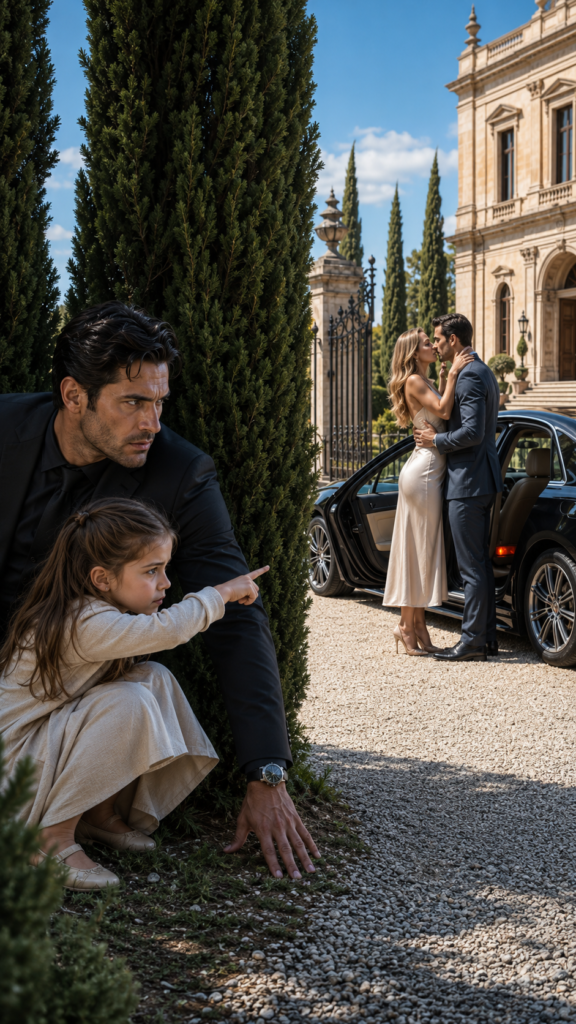
They crouched behind the ficus, next to an old wall covered in ivy. From there, they could see the main entrance, the idling truck, and the driver waiting.
Gael spoke almost without moving his lips.
“Why are we hiding?”
Valentina pointed at the truck.
“That's not Don Toño.”
Gael frowned.
“Don Toño has driven me for four years. He took me to the hospital when my son was born. I know that man.”
“It's not him,” the girl repeated.
“How do you know?”
Valentina swallowed hard.
“Because the license plate changed. Yesterday it ended in 1. Today it ends in 7. I see it every day from the wall while my dad prunes the roses.”
Gael felt a cold stab in his stomach.
He didn’t even know his own truck’s license plate.
He had never needed to know.
The truck was always there. The driver was always there. The security was always there.
“And what else?” he asked.
“Don Toño opens the door with his right hand and keeps the keys in his left. That man opened with his left and has the keys hanging in his right.”
Valentina lowered her voice.
“My dad says you first look at the hands, then the face.”
Gael looked again.
This time with calm.
The body was similar, the cap the same, the dark glasses identical.
But the posture wasn’t.
Nor were the hands.
At that moment, his cellphone vibrated.
It was Camila, his wife.
“Love,” she said in a sweet, almost hurried voice. “Why haven’t you gotten in? Marco told me the driver has been waiting for 10 minutes. You can’t be late for that flight.”
Gael stared at the fake driver.
“I’m on my way, my love. Give me 2 minutes.”
“Hurry, please.”
He hung up.
Valentina grabbed his wrist.
“If I’m wrong, you can run away with my dad. We’ll leave, and that’s it. But if I’m right and you get in, you won’t come back.”
Then she pulled an old cellphone from her dress pocket, the screen cracked.
“I recorded them.”
She pressed play.
First, Camila’s voice.
Not sweet.
Not nervous.
Cold.
“He has to be inside by 7:15. When it explodes, everyone will think it was the guys from Mérida.”
Then a man spoke.
Not Don Toño.
“When Gael falls, you get the house. I get the routes. Those who don’t kneel, disappear.”
Gael squeezed the cellphone until his knuckles turned white.
At that instant, Camila stepped out of the house.
She wore an elegant white outfit, as if going to mass. She walked through the entrance with a smile that Gael had kissed hundreds of times.
The fake driver leaned toward her.
And Camila kissed him.
It wasn’t a quick kiss.
It wasn’t a mistake.
It was a pact.
Gael stood frozen.
The fake driver opened the back door of the truck.
Beneath the seat where Gael always sat, a small red light blinked.
Valentina whispered:
“Sir…”
Gael spoke without tearing his gaze away.
“Run to your dad. Tell him to close the garden gate.”
The girl ran between the trees.
Gael dialed a number.
When his most trusted man answered, he simply said:
“Bring everyone. Now.”
He didn’t shout.
And that was what was dangerous.
Because men who shout still expect the world to listen to them.
Those who whisper have already decided what comes next.
But Valentina returned pale, breathless.
“My dad isn’t in the tool shed. And the garden gate is locked… from the outside.”
The broken cellphone vibrated in Gael’s hand.
An unknown number sent a photo.
Don Julián was sitting in a chair, his wrists bound and blood on his shirt.
Below it said:
“Get in the truck or the gardener dies.”
Valentina broke down.
“They have my dad.”
Gael knelt before her.
“No, shorty. Now I have them.”
At that moment, three black trucks entered through the gate.
Gael thought they were his men.
But the first one to step down was no ally.
It was his brother, Darío Montemayor.
The same man Gael had buried two years ago.
PART 2
Darío walked through the entrance as if death had merely been a misunderstanding.
He wore a navy blue suit, a trimmed beard, and a gold ring on his left hand. It was the same ring Gael had placed in the coffin with his own hands.
Valentina covered her mouth.
“Is he a ghost?”
Gael didn’t answer.
Ghosts don’t smile with such arrogance.
Darío approached Camila and the fake driver.
“Where is he?” he asked.
Camila lost color.
“He said he was coming. He answered me.”
“He had to be inside the truck.”
The fake driver looked around nervously.
“Maybe he suspected.”
Darío slapped him.
“Maybe? That’s how you plan to kill my brother? With maybe?”
Gael took Valentina’s hand and backed away through the ivy.
The girl pointed to a hidden door behind the trees.
“My dad goes through there when he puts away the tools.”
Gael had lived in that grand house for eight years and didn’t know that entrance existed.
Another shame.
Another opportunity.
They entered through a damp corridor smelling of wet earth, old wine, and gasoline. Above them, footsteps, shouts, and orders echoed.
Valentina walked quickly, as if she knew every shadow.
“Have you been through here?” Gael asked.
“When it rains. My dad says every house has secrets. You just have to know where they hide.”
They reached a half-open door.
Inside was Don Julián, tied to a chair, beaten but conscious.
In front of him stood Marco, Gael’s trusted guard, with a trembling gun in his hand.
“My daughter has nothing to do with this,” Don Julián pleaded.
“She does now,” Marco replied. “She saw too much.”
Gael entered.
“Marco.”
The guard froze.
“Boss…”
“You called me to ask where I was. From my own house.”
Marco swallowed hard.
“I didn’t want this.”
“But you opened the gate.”
Marco barely raised the gun.
“You don’t understand. Darío said only you would die. That the child wouldn’t suffer. That Mrs. Camila would fix everything.”
Gael stepped forward.
“My son?”
Don Julián lifted his head.
“They took Emiliano last night. The nanny left crying with two suitcases. The lady told Valentina not to say anything.”
For the first time, Gael’s face shattered.
Emiliano was four years old. He slept hugging a wooden horse and believed his dad could fix anything.
Valentina screamed:
“Dad!”
Don Julián, chair and all, lunged at Marco’s legs. The gun went off, shooting the ceiling. Gael reached him in two steps and slammed him against the wall.
Marco fell.
He didn’t get up.
Valentina ran to hug her father.
“My girl,” Don Julián murmured. “I told you to hide.”
“I hid,” she cried. “And I found him.”
Gael cut the ropes.
“Where’s my son?”
Don Julián didn’t answer quickly.
That was worse.
“Darío wants a notebook,” he finally said. “One that his dad hid before he died. It has names, accounts, payments, betrayals… everything.”
“That notebook doesn’t exist.”
Don Julián looked at him.
Gael understood.
It did exist.
Only he didn’t know about it.
“Your dad didn’t die of old age, boss,” the gardener said. “He died because he wanted to keep secrets from people heavier than you.”
Above, Darío’s voice echoed through the house.
“Gael! I have your wife, your gardener, and I can make your son disappear whenever I want. Come out before this gets ugly.”
Gael took Valentina’s broken cellphone, still recording, and Marco’s phone.
“Men like Darío always talk too much,” he said.
They climbed a service staircase until they were behind a hidden panel in the dining room.
Camila was at the long table, nervous. The fake driver was looking out the window. Darío was pouring tequila into a crystal glass.
“You hit me outside,” Camila complained.
“And you lost my brother,” Darío replied.
“Your plan was garbage.”
“My plan worked until you called too early.”
Camila gritted her teeth.
“I did exactly what you said.”
Darío raised his glass.
“When Gael dies, Mérida takes the blame. Sinaloa burns. In the smoke appears the notebook. And men go back to choosing the Montemayor name… but now they choose the right brother.”
Gael connected the call with his captains and the five men waiting in Mérida.
They all listened.
Darío didn’t know.
The arrogance filled the room so much that it left no space for suspicion.
Gael opened the panel.
The dining room froze.
Camila let out a stifled scream.
“Gael…”
He didn’t look at her.
He looked at Darío’s ring.
“I buried that.”
Darío smiled.
“You buried a hand, some teeth, and an expensive suit. Enough to make you cry.”
Gael felt the punch in his chest, but he didn’t look away.
“I cried for you.”
“I know. I saw you from afar at the cemetery.”
Camila took a step toward Gael.
“Love, listen to me. I had no choice.”
Gael spoke dryly.
“You had many choices. You made all the wrong ones.”
The fake driver tried to pull a weapon, but Don Julián aimed first.
“Don’t move, buddy.”
Gael’s phone rang on speaker.
The voice of his captain rang clear.
“Boss, the guys from Mérida heard everything. They say the dead man talks pretty.”
Darío stopped smiling.
Outside, tires screeched. More trucks entered, this time belonging to Gael’s loyal men.
The fake driver dropped his weapon.
Camila backed away until she bumped into the table.
Darío, however, started to laugh.
“Do you think this is the end for me?”
“No,” Gael said. “I think it’s just beginning.”
Then a man burst in.
“We found Don Toño. Alive. Beaten, but alive.”
“And my son?”
No one answered.
The room changed temperature.
Camila let out a low laugh.
Gael turned slowly.
“What did you do?”
She lifted her chin, cornered but proud.
“I kept a life insurance policy.”
Darío looked at her, furious.
“You moved the child without telling me?”
“You were dead for two years,” she spat. “Don’t come talk to me about trust.”
At that moment, Gael’s phone received a video call.
Unknown number.
Upon answering, a fancy dining room in Mérida appeared.
The five men waiting were tied to their chairs, alive but beaten.
In the background stood a silver-haired woman, dressed in white, with a black veil. On her lap sat Emiliano, asleep, hugging his wooden horse.
Gael stopped breathing.
“Your son is fine,” the woman said. “For now.”
Camila whispered:
“No…”
Darío paled.
The woman smiled.
“Thanks to the girl, you didn’t die in Culiacán. If you had flown, you’d die in Mérida. Either way, the Montemayor name had to end today.”
Valentina stumbled out of the hallway unintentionally.
The woman saw her on screen.
“There she is.”
Don Julián pulled his daughter behind him.
Gael looked at the gardener.
“You know her.”
Don Julián closed his eyes.
The woman spoke:
“Ask him what he stole from me seven years ago.”
Valentina looked at her dad.
“Dad?”
Don Julián broke down.
“I didn’t steal anything,” he said with a broken voice. “I saved her.”
The woman stopped smiling.
Don Julián stepped forward.
“She is my daughter. Not your merchandise. Her mother died escaping from you. I took her out of that house in Veracruz when she was just months old. I changed names, changed cities, lowered my head, and became a gardener so they would never find her.”
Gael understood the true twist.
Valentina hadn’t saved a boss by chance.
She had been raised to observe, to be silent, and to survive.
The woman on the screen stroked Emiliano’s hair.
“Bring me the girl, and I will return the boy.”
Camila smiled just a little, as if she could still win.
Gael finally looked at her.
“All of this… did you know it too?”
Camila didn’t answer.
It wasn’t necessary.
Darío slammed the table.
“That old woman used us all.”
“And you let yourself be used,” Gael said.
Don Julián knelt before Valentina.
“Forgive me, my girl. I just wanted to give you a normal life.”
She cried silently, but hugged him.
Gael raised the cellphone.
“I’m not going to trade a girl for my son.”
Camila’s eyes widened.
“He's your son!”
“And exactly for that reason, I’m not going to teach him that a girl’s life is worth less.”
The call was still open.
On the other side, the woman narrowed her eyes.
Gael spoke calmly.
“You made a mistake. You wanted everyone to look at the truck. But Valentina taught me something: first, you look at the hands.”
The camera trembled.
Behind the woman, Don Toño appeared, beaten but free, with one of his captors’ weapons in hand. The men from Mérida, who had pretended to be defeated, freed themselves at the same time.
Gael had sent the alert from the very first minute.
The woman tried to rise, but Emiliano bit her hand and ran with his wooden horse.
“Dad!” he shouted from the screen.
For the first time in years, Gael cried without hiding.
The federal police arrived at the house in Mérida and at the grand house in Culiacán almost simultaneously. Not out of kindness, but because the recording was already in enough hands that no one could erase it.
Darío was arrested alive.
So was Camila.
Marco confessed.
The fake driver spoke.
The woman in white, named Aurelia Ponce, fell with a net of trafficking, extortion, and murders that had been hidden behind respectable surnames for 20 years.
Don Julián reclaimed his real name but asked to remain Julián.
“That name gave me my daughter,” he said.
Weeks later, Valentina returned to the garden.
Gael no longer lived as before. He sold the grand house, distanced his son from that world, and opened a fund for children who had grown up learning to hide.
One day, Emiliano gifted Valentina his wooden horse.
“So you won’t be afraid anymore,” he told her.
She smiled sadly.
“It’s not fear. It’s memory.”
Gael watched them from a distance.
He had been the most feared man in Sinaloa, but a 7-year-old girl had taught him that power means nothing if you don’t know how to look at what’s in front of you.
Because that morning, he wasn’t saved by a gun.
He wasn’t saved by his last name.
He was saved by a girl whom everyone had treated as invisible.
And perhaps that’s why the story became impossible to forget: because sometimes the one who is most silent in a house is the one who has seen all the truth.