PART 1
Renata Villaseñor arrived alone at Angeles Universidad Hospital one Thursday afternoon, her hands cold and her heart racing as if it were trying to escape her chest. She was 31 years old, married to Daniel Arriaga for four years, and had been ten days late, which she had tried to justify with stress, sleepless nights, and the half-hearted meals she swallowed during meetings.
The doctor smiled when she saw the screen.
"There it is. It's still very tiny, but yes, you’re six weeks pregnant."
Renata didn’t cry. She stared at that little white dot, as if someone had lit a candle inside a dark house. She thought of Daniel, how nervous he would get, how maybe he would finally stop listening so much to his mother, Doña Amparo, who had been repeating at family dinners for years:
"A house without children grows cold, honey. And a man tires of waiting."
Renata carefully tucked the ultrasound into her bag. She was going to buy a little box, place it there, prepare green chilaquiles just the way Daniel liked them, and tell him that night that life was giving them another chance.
But as soon as she crossed the ER hallway, she heard a voice that froze her blood.
"Help her, please! Save my wife!"
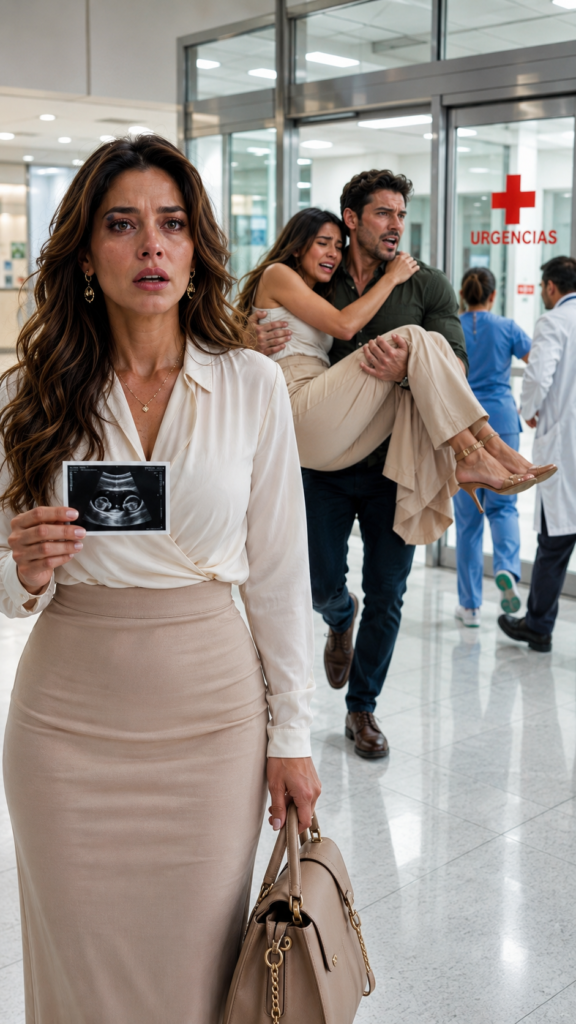
Daniel appeared carrying a pregnant woman, sweating, pale, with her blouse open and a hand pressed against her belly. Renata recognized her instantly: Natalia Cárdenas, the architect who supposedly worked with him on a project in Santa Fe. The same one who sent texts at 11 p.m. The same one for whom Daniel said, "Don't be intense, it's all work."
He was trembling as he signed papers.
"My wife is in labor, doctor. Don’t leave her alone."
Renata was less than eight meters away. The legal wife was her. The one whose last name was on deeds, contracts, and shared accounts was her. But there, in the middle of the hospital, Daniel didn’t glance her way even once.
Natalia groaned and squeezed his hand.
"Don’t let go, Dani… promise me you’ll be with me."
"I’m here, love," he replied.
The ultrasound slipped through Renata’s fingers. A nurse asked her if she felt okay. She wanted to say no, that she had just witnessed her marriage shatter in public, but she only nodded.
Then her cellphone vibrated.
It was a message from Daniel.
“I had an emergency at work. Don’t wait up for dinner. I’ll explain later.”
Renata looked at the man who had just called another woman his wife and understood something with brutal clarity: she didn’t need an explanation; she needed to get out of there before she lost herself.
She took a taxi to the apartment in the Narvarte neighborhood. The doorman greeted her with pity.
“Mrs. Renata… I thought you were coming with the gentleman. He went up earlier with a pregnant girl and his mother. They had baby bags.”
Renata didn’t respond.
Upon opening the door, the smell of chicken broth hit her like a wave. In the living room, there were diapers, blue blankets, and an expensive store bag with Natalia Cárdenas's name on the receipt. In the shoe rack, just where her sneakers belonged, were brand new pink slippers.
In the kitchen, Doña Amparo had left a warm pot on the stove. Renata remembered when she had a fever of 39, and her mother-in-law had said:
"Don’t exaggerate, honey. Daniel is tired; make him something to eat."
She entered the bedroom. Half the closet was no longer hers. There were maternity dresses, foreign perfume, and a golden brooch on her vanity.
Renata grabbed a suitcase.
She packed her passport, cards, the title deed to the apartment, contracts for the family business, copies of transfers, bank statements, and the ultrasound. She left the keys on the pink slippers with a small note:
"I’m not taking anything that isn’t mine. But what is mine, don’t touch it again."
As she was closing the door, a message from Doña Amparo arrived:
“Renata, don’t make a fuss. The Arriaga family has good news. Learn to behave like a wife.”
Renata looked at the screen, took a deep breath, and walked down the stairs without crying.
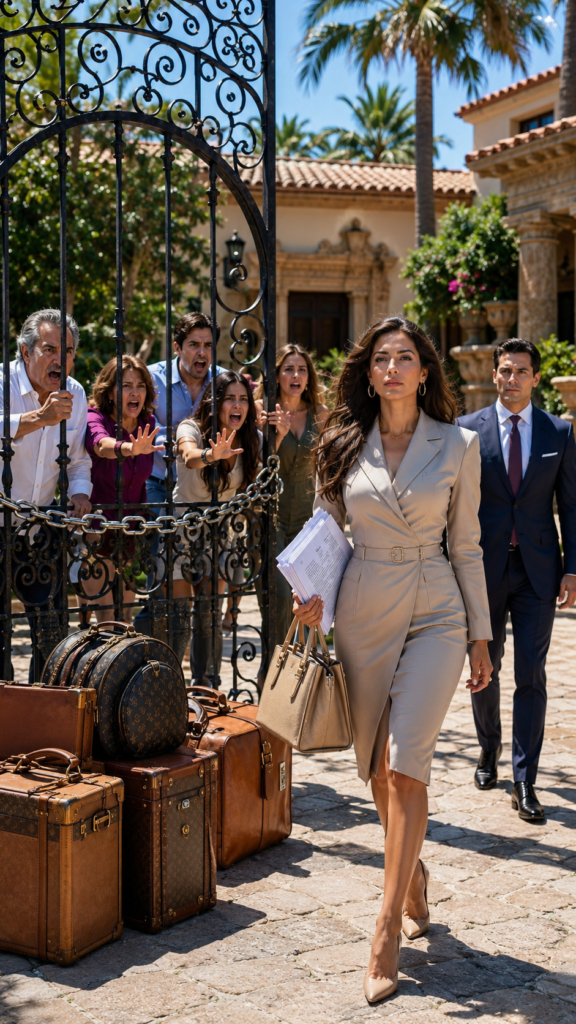
No one in that family imagined that the woman they had just thrown out of her own home had in her bag the document that could sink them all.
PART 2
Renata stayed at a small hotel in Roma Sur, in a room with beige curtains and a window overlooking jacarandas falling onto cars. That night, she placed the ultrasound on the table next to the contracts and stared at it for a long time.
She didn’t call Daniel. She didn’t call Doña Amparo. She didn’t drop hints, cause scenes, or send crying audio messages. She simply turned off her phone for three days, ate soup, took folic acid, and silently repeated a phrase that held her soul together:
"You’re not alone. Neither are you nor I."
When she turned her phone back on, the screen exploded: 43 missed calls from Daniel, 18 from Doña Amparo, 6 messages from Daniel’s sister, and several audios from numbers she didn’t even have saved.
She opened one from her mother-in-law.
"That’s enough, Renata. Natalia just had a beautiful baby boy. Daniel is under a lot of pressure. You, as his wife, should support the family, not throw tantrums like a scorned woman."
Renata closed her eyes. Then she received a call from Mónica, her cousin and the only one who never bought the story that Daniel was a saint.
"Have you seen the family group?" Mónica asked, furious.
"No."
"Doña Amparo made food to introduce the 'heir Arriaga.' They posted a picture with a blue cake. And she said something very crude about you."
Renata stood still.
"Tell me."
Mónica took a deep breath.
"She said that some women have a womb as silent as an abandoned house, and that Natalia knew how to give a boy to the family."
Renata felt nauseous, but not because of the pregnancy. Mónica sent her the photo. Natalia was sitting on Doña Amparo’s couch, wrapped in a fine shawl, holding a baby. Daniel was beside her, serious, tired, with a hand on the baby’s head. On the table, there was a cake that said:
"Welcome, heir Arriaga."
Renata saved the image.
Then she opened the folder of contracts.
Her father, Don Ernesto Villaseñor, had left her a majority stake in a small but solid construction company: Grupo Villaseñor. Daniel had used her for years as moral and financial collateral to launch his own projects. He told her they were just "paperwork," that she shouldn’t get involved in heavy matters, that he knew how to run the business.
Doña Amparo used to mock at dinners:
"Renata is lucky. Beautiful, married, and doesn’t need to understand numbers. That’s what her husband is for."
But Renata did understand. She had been silent for peace, not ignorance.
That morning, she called Adrián Luján, her father’s trusted lawyer.
"I need to review all the guarantees signed with Arriaga Desarrollos," she said, "And I want to suspend any disbursement that depends on my authorization."
Adrián didn’t ask too many questions. He set up a meeting for the next day at a discreet café in the Nápoles neighborhood. He arrived with a thick folder and a look of bad news.
"Renata, this is no longer just a divorce. There are inflated invoices, suppliers linked to Daniel’s family, unverified advances, and transactions where they used your signature to secure credits. If you request an audit, it will stir up trouble, but you are fully entitled to it."
Renata reviewed the documents. Her signature appeared over and over again alongside Daniel’s. She remembered every night he placed papers in front of her at dinner and said:
"Sign here, love. It’s to speed things up. I promise not to worry you."
She signed the suspension of payments. She signed the audit request. She signed the review of guarantees.
"From this moment on," Adrián warned, "don’t talk on the phone. Everything in writing. Daniel is going to explode."
It didn’t take long.
At 7:42 p.m., the first message arrived.
"What did you do? The bank froze Bosques de Lerma. Don’t mix our personal problems with my business."
Renata replied with a single line:
"Any legal matters in writing."
The next day, Pablo, Daniel’s assistant, inadvertently leaked the first crack. He sent Adrián an incorrect email discussing an urgent meeting, altered invoices, and a heated argument with Natalia.
Minutes later, Mónica sent a screenshot.
"Natalia says that if Daniel no longer has money, she’s not going to sink with him. She’s got an envelope. Apparently, the baby isn’t his."
Renata read that sentence four times.
She didn’t feel joy. She felt an old weariness, as if the lie had grown so large it no longer fit in any house.
That same afternoon, at Arriaga Desarrollos, Natalia opened the envelope in front of Daniel and Doña Amparo. It was a private DNA test. Daniel was not the father of the baby.
The blow was brutal.
According to Pablo, Daniel turned pale. Doña Amparo screamed at Natalia that she was a nobody. Natalia, crying with rage, let out the truth: Daniel had sought her out because he wanted to feel admired, because his mother pressured him to have a son, and because he was desperate to prove he still had some control over something.
"You wanted an heir, Dani," she said. "I wanted security. Don’t play innocent."
The argument was recorded. Within two hours, the video circulated among employees, partners, and neighbors in the residential area. Doña Amparo, the woman who boasted of mass, last names, and morals, was seen screaming that it was all Renata’s fault.
"That woman cursed us! She wants to take what belongs to my son!"
But what was collapsing wasn’t a spell. It was a lie sustained by other people’s money.
The formal meeting occurred two days later in a conference room on Paseo de la Reforma. Renata arrived in black pants, a white shirt, and her hair tied up. She wore no jewelry. She wore no excessive makeup. Just a folder with contracts, messages, photos, receipts, and the divorce petition already signed.
Daniel stood up as soon as he saw her.
"Renata, please. We need to talk."
"Today I come as a representative of Grupo Villaseñor," she replied. "The personal matters will be handled by my family lawyer."
Doña Amparo let out a bitter laugh.
"Look at her. Years pretending to be a little mouse, and now she knows how to talk about businesses."
Renata looked her straight in the eye.
"I wasn’t dead, ma’am. I was tired of talking to people who only listen when they see money at risk."
The silence was dry.
The auditor projected the transactions: overcharges, undelivered materials, suppliers linked to a cousin of Doña Amparo, duplicate payments, and credits backed by Renata’s signature without sufficient explanation.
Daniel clenched his fists.
"This is revenge. You’re using a marital dispute to destroy me."
Renata opened her folder and laid the evidence on the table.
First, the photo of Natalia with the baby and the “heir” cake. Then, the receipt for the pink slippers. After that, the audio where Doña Amparo called her useless for not giving her son children. Finally, the screenshot of the message where Daniel said he was in a work emergency while calling another woman his wife in the ER.
"What happened with Natalia destroyed my marriage," Renata said. "What happened with the invoices destroyed your business. Don’t confuse one thing with the other just because in both cases you chose to lie."
Daniel looked down.
"I didn’t know how to tell you about Natalia."
"You didn’t have to say it nicely. You just shouldn’t have done it."
Doña Amparo slammed her hand on the table.
"In my family, no one divorces over a whim!"
Renata pulled out the last envelope.
"In mine, no woman stays where she’s humiliated so that others can feel decent."
Adrián placed the divorce petition in front of Daniel. No one spoke for several seconds. Daniel looked at the papers as if they were a sentence he had written himself over the years.
"Renata… I made a mistake. Everything got out of control. Mom pressured me, Natalia sought me out, the company…"
"No, Daniel," she interrupted him. "Making a mistake is forgetting an appointment. You brought another woman into my home. You let your mother celebrate her in my place. You used my last name to ask for money. And when everything blew up, you wanted to call it drama."
Daniel covered his face with one hand.
"Is there someone else? Is that why you’re so calm?"
Renata felt the impulse to touch her belly, but she didn’t. Her baby didn’t belong in that room, nor to that guilt, nor to that family that only valued blood when they could boast about it.
"My peace doesn’t need another man," she replied. "I fought too hard to get it back."
The audit progressed. Arriaga Desarrollos lost two important contracts. The bank demanded explanations within seven business days. The partners who used to call Daniel “brother” began sending legal letters. Doña Amparo stopped attending breakfasts in Polanco and went to live with a sister in Coyoacán, where she could no longer flaunt handbags or grandchildren.
Natalia disappeared from the city with her child. Renata learned from Mónica that the real father also didn’t respond. She felt sadness for the baby. Children are not to blame for the lies that adults put them into.
Daniel wrote for weeks. First with rage, then with pleas, and finally with a sadness that came too late.
"Every time I see the pink slippers, I can’t breathe."
"Forgive me. I destroyed the only good thing I had."
Renata didn’t respond. Not out of revenge. She simply understood that some apologies don’t ask for forgiveness: they ask to regain access to the person they can no longer control.
At twelve weeks, she returned to the hospital, this time accompanied by Mónica. They passed through the same hallway where Daniel had carried Natalia calling her wife. There were stretchers, nurses, nervous families, and crying babies. The world continued to spin as if nothing had happened, but Renata was no longer the same.
The doctor moved the transducer over her belly.
And then the heartbeat sounded.
Fast. Tiny. Stubborn. Alive.
Mónica cried. Renata smiled with her hand over her abdomen. That baby had endured hotels, lawyers, humiliation, cruel audios, and nights when she thought she was going to break.
Upon leaving, she received a message from an unknown number.
"I heard you’re pregnant. That baby is…"
Renata deleted the message before finishing it.
Someday, if the law required it and if it was best for her child, she would discuss what was necessary. But not out of guilt. Not out of pressure. Not to give a new heir to a family that had celebrated her absence.
That afternoon, Mónica took her out for pozole. Renata ordered little chili, lots of tostadas, and hibiscus water. Outside, the city was still noisy: vendors, cars, kids coming out of school, couples arguing over trivial matters.
She thought about the pink slippers, the broth that wasn’t for her, the blue cake, and Doña Amparo’s voice calling her useless. Everything remained in her memory, but it no longer dragged her down.
Because sometimes a woman doesn’t leave because she stopped loving.
She leaves because she understood that staying one more day would teach her child that humiliation can also be called family.
And that, truly, no mother should inherit.