PART 1
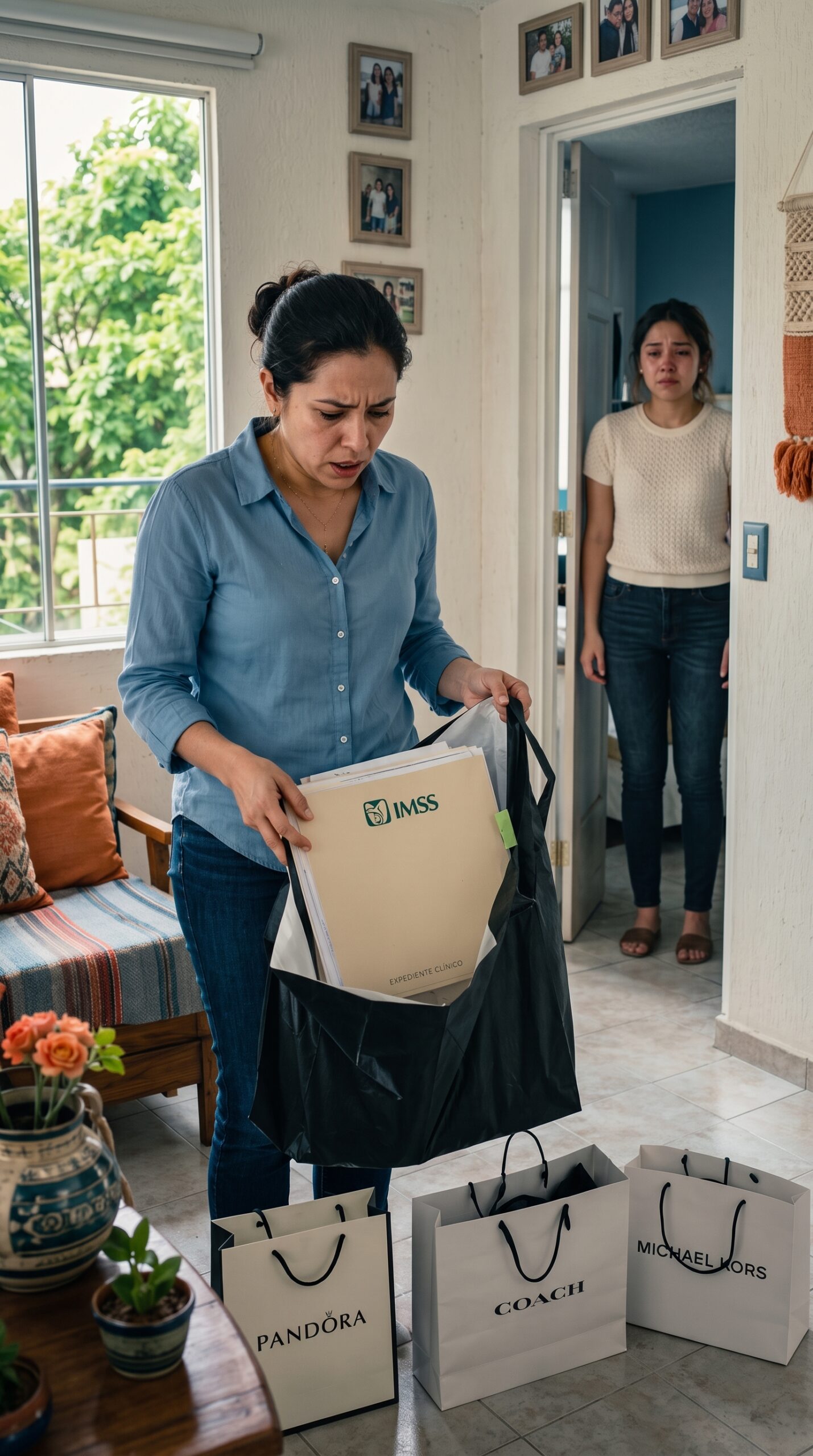
—If you’re not going to say who got you pregnant, get out of this house right now.
Arturo Salgado's voice was so loud that even the neighbor across the street turned off her blender.
Valeria was 19 years old and had a pregnancy test clenched between her fingers. She stood in the middle of the living room, her face pale, her school backpack still hanging from her shoulder, and her heart pounding like a drum.
They lived in a quiet neighborhood in Puebla, where everyone knew the gossip before the people involved did. For Arturo, a man who had worked for 26 years at a chemical plant near the Atoyac River, the family name was sacred.
And a pregnant daughter, without a husband or explanation, was a public shame.
Teresa, her mother, was next to the dining table, folding clothes she couldn’t even see anymore. She cried silently but didn’t dare to intervene.
—Tell me his name —demanded Arturo—. Right now.
Valeria swallowed hard.
—I can’t.
Arturo let out a dry laugh, one of those that aren’t funny at all.
—Can’t or don’t want to?
—Dad, it’s not what you think.
—Then explain it to me, because I’m not going to support the child of some guy who hid like a coward.
Valeria felt the urge to scream the truth. She wanted to say that the father was Mateo Rivas, a young environmental engineer who had come to Química Santa Clara to supervise permits and waste.
She wanted to tell that Mateo was no coward.
That he had discovered fake documents, illegal discharges into the river, under-the-table payments, and sick workers that the company forced to be silent.
But Mateo had disappeared 6 days earlier.
The last time Valeria saw him, he handed her a USB wrapped in a napkin from a bakery.
—If something happens to me, don’t give it to anyone from the plant —he told her—. Not even to those who seem like good people.
Valeria didn’t know if her father was involved in that. She didn’t know if Arturo had seen something. She didn’t know if he had been an accomplice or a victim.
She only knew one thing: if she said Mateo’s name, she would also put her baby in danger.
—Someday you’ll understand —she whispered—. But today I can’t tell you more.
Arturo hit the table with such force that a cup shattered against the floor.
—You have 1 hour. Get rid of the problem or leave.
Teresa covered her mouth.
Valeria looked at her mother, hoping she would say something. A word. A defense. A “she’s our daughter.”
But Teresa just cried.
And that silence hurt more than the yelling.
Less than 1 hour later, Valeria was on the sidewalk with an old suitcase, 600 pesos, and a thin jacket.
From the window, Teresa watched her with red eyes.
Valeria waited.
She waited for 5 minutes.
She waited until the light in the living room went out.
The door never opened.
That night she slept at the Puebla Bus Terminal, clutching her suitcase and with one hand on her belly.
At dawn, she took a bus to Guadalajara, where a high school friend found her a room behind a hair salon.
There she started over.
She sold sandwiches. Washed dishes. Cleaned offices. Studied accounting online when fatigue didn’t overcome her.
When her son was born, she named him Emiliano.
The boy had Mateo’s deep eyes and a strange seriousness for his age. He asked about everything: why he didn’t have grandparents, why his mom kept a yellow folder locked, why they never talked about his dad.
Valeria always answered the same:
—Someday, my love.
That day came when Emiliano turned 10.
In front of a simple chocolate cake, the boy looked at her sadly.
—Mom, I want to meet them even if they don’t want me.
3 days later, Valeria returned to Puebla with her son, a yellow folder, and the USB hidden in the lining of her bag.
The house looked the same.
The brown door.
The bougainvillea over the wall.
The same step where one night they left her alone.
She knocked.
Arturo opened.
When he saw her, he turned pale.
Teresa appeared behind him and, upon seeing Emiliano, put a hand to her chest.
Valeria didn’t greet anyone.
She stepped into the living room, took out an old photograph, and placed it on the table.
In the picture was Mateo Rivas, wearing a yellow helmet, smiling next to Arturo in front of the entrance to Química Santa Clara.
Arturo recoiled as if he had seen a ghost.
On the back of the photo, there was a phrase written in shaky handwriting:
“Your father tried to save us.”
Emiliano looked at the photo, then at his mother.
—Mom… is that man my dad?
And in that instant, everyone understood that the shame they had expelled 10 years ago was not shame.
It was a buried truth that was about to destroy them.
PART 2
Valeria knelt in front of Emiliano and took his hands.
—Yes, my love. His name was Mateo Rivas. And he was your dad.
The boy didn’t cry immediately. He just looked at the photograph with a mix of fear and tenderness, as if trying to recognize a part of himself in that face.
—Did he know I existed?
Valeria closed her eyes.
—I didn’t get to tell him. He disappeared before.
Arturo slumped into a chair. The man who had shouted like a judge 10 years earlier now seemed like an old man lost in his own home.
—Mateo Rivas… —he murmured—. That kid.
Teresa turned to him.
—Did you know him?
Arturo took a moment to respond. He ran his hand over his face, as if a buried memory was clawing its way out.
—He came to the plant as an environmental supervisor. He wouldn’t let himself be bought. He asked too many questions. He reviewed papers that no one wanted him to review.
Valeria took out the USB and placed it on the table.
Arturo’s face changed.
He no longer looked guilty.
He looked terrified.
—Put that away —he said in a low voice.
—Why?
—Because that thing shouldn’t have come here.
Valeria felt a horrible chill down her spine.
—For 10 years I thought you kicked me out out of pride. I thought you preferred your surname over your daughter. But now I’m looking at your face, Dad. You know something.
Arturo began to cry.
He didn’t cry loudly. He didn’t shout. He just broke inside, like those men who carry a guilt so old that they no longer know where it begins.
—I don’t know if I know… or if they made me forget.
Teresa crossed herself.
—Arturo, what are you saying?
Then he spoke.
He told that, 10 years ago, several workers at Química Santa Clara began to fall ill. Skin rashes, dizziness, miscarriages, children with respiratory problems in neighborhoods near the river.
No one reported it.
The company paid well and threatened better.
The owner, Ramiro Castañeda, was one of those businessmen who appeared in magazines smiling with politicians, donated food packages during campaigns, and bought silence for cash.
Mateo had gathered evidence: water samples, receipts, videos, names of doctors, payments to officials, and falsified reports.
—One night he came to me —Arturo said—. He asked for help to get documents out of the plant. He told me he trusted me because I had a daughter his age.
Valeria gasped.
—And did you help him?
Arturo looked down.
—I think so.
—What do you mean you think? —Teresa asked, trembling.
Arturo recounted that he remembered a white truck, a warehouse, the strong smell of a chemical, and Mateo's voice saying: “If we get out of this, Valeria needs to know everything.”
After that, nothing.
He woke up at dawn inside his truck, near the river, with mud on his shoes and dried blood on his sleeve.
Teresa screamed.
—Whose blood was that?
Arturo covered his face.
—It wasn’t mine.
Emiliano hid behind Valeria.
She felt the world shatter around her.
—Did you kill Mateo?
Arturo denied it desperately.
—I don’t know. And that has destroyed me all these years.
At that moment, the landline rang.
The phone hadn’t rung in months.
Everyone froze.
It rang again.
Arturo picked up the receiver before Valeria could stop him.
He listened for a few seconds and lost his color.
—How did they know she was here? —he whispered.
Then he hung up with a trembling hand.
Valeria hugged her son.
—What did they say?
Arturo looked at Emiliano with horror.
—That Mateo should have stayed buried.
Valeria didn’t wait any longer.
She put the USB away, grabbed Emiliano’s backpack, and headed for the door.
—We’re leaving.
—Where to? —Teresa asked.
—To someone who doesn’t owe favors to Ramiro Castañeda.
That same night they arrived in Cholula, at the home of Mariana Leal, an independent journalist who had been investigating industrial pollution in Puebla for years.
Mariana welcomed them with her laptop open.
—I was able to open almost everything —she said—. But there’s a locked folder.
On the screen appeared a name:
LUZDELPUERTO.
Arturo turned pale.
—That place exists.
Valeria looked at him.
—Where?
—An old warehouse near the terminal. They kept materials there when there were surprise audits.
Mariana didn’t hesitate.
—Then let’s go.
Teresa stayed with Emiliano, although the boy insisted on accompanying them.
—It’s my story too —he said, clenching his fists.
Valeria caressed his hair.
—That’s why I need to come back alive to tell it to you.
It was Mariana, Valeria, and Arturo.
The warehouse was almost abandoned, with rusty sheets and an old sign that was barely legible. An old guard recognized Arturo and froze upon seeing Mateo's photo.
—I thought this would never come out —he murmured.
He took them to the back.
There was locker 214.
Arturo broke the padlock.
Inside they found a yellow helmet, old newspapers, a stained handkerchief, and a box with a hidden compartment.
Underneath was another USB.
Black.
Without a brand.
But before they could leave, a voice came from the hallway.
—What a nice family reunion.
Ramiro Castañeda appeared in a dark coat, expensive shoes, and a calm smile, as if he still believed money could buy air.
Two men were with him.
Valeria felt her legs freeze.
Ramiro looked at Arturo.
—You’ve always been sentimental, Salgado. That’s why you were never good at keeping secrets.
Arturo stepped in front of his daughter.
—What did you do to me that night?
Ramiro let out a low laugh.
—Enough for you to doubt yourself for 10 years.
Valeria pressed the USB against her chest.
—And Mateo? What did you do to him?
Ramiro's smile faded for a second.
—That kid wanted to play the hero. He thought that with some videos, water samples, and 4 recordings, he could take down a company that fed half the city.
—It wasn’t feeding them —Valeria said—. It was poisoning them.
Ramiro looked at her with disdain.
—Just as dramatic as he was.
Mariana remained silent, with her phone pressed against her body. No one noticed she was live-streaming to 3 media outlets, an environmental lawyer, and a contact in the federal prosecutor’s office.
Ramiro continued speaking, confident.
He confessed that the plant had been dumping waste into the river for years.
He confessed that Mateo had gathered evidence.
He confessed that Arturo had tried to help him.
He confessed that they drugged him to break him, threw him in his truck, and left blood on his clothes to make him believe the worst.
—Fear is cheaper than killing everyone —Ramiro said.
Arturo cried out in rage.
—Because of you, I kicked my daughter out.
Ramiro smiled.
—No, Salgado. You did that all by yourself.
The phrase fell like a knife.
Because it was true.
Ramiro had sown fear, yes.
But Arturo had chosen to shout instead of listen.
He had chosen pride over an embrace.
He had turned off the light while his pregnant daughter slept in a bus terminal.
Suddenly, sirens were heard.
Ramiro turned furious.
Mariana raised her phone.
—Everything was heard, Mr. Ramiro. Honestly, you picked a terrible moment to brag.
The two men tried to run, but federal agents entered from both sides.
Ramiro shouted names, threats, pending favors.
This time no one obeyed.
Hours later, at Mariana’s house, they connected the black USB to a computer without internet.
Emiliano sat next to Teresa, serious, with swollen eyes from crying.
The memory asked for a password.
Arturo whispered:
—Luz del puerto.
The system opened.
Folders appeared with videos, receipts, maps, payments, names of officials, doctors, police, and directors. There were testimonies from sick families, water analyses, and photos of drums buried near the river.
Then a folder appeared that made Valeria stop breathing.
EMILIANO.
—It can’t be… —she whispered.
Mariana opened the file.
On the screen appeared Mateo Rivas.
He had a bruised face, a torn shirt, and a tired look. The date was marked 2 days after his disappearance.
Valeria covered her mouth.
Emiliano stood up slowly.
—Mom…
Mateo looked at the camera.
—Valeria, if you see this, forgive me for not coming back. Castañeda knows I have evidence. If I survive, I will come looking for you. If I don’t survive, you need to know something.
Arturo began to tremble.
Mateo continued:
—Your dad didn’t betray me. Arturo tried to save me. They drugged him to break him. Don’t carry that hate your whole life.
Arturo fell to his knees.
Teresa cried like never before.
Valeria didn’t know what to do with so much pain. She had waited 10 years for an explanation, but not for such a heavy truth.
The video continued.
—And if our child is born… because I think there might be a possibility… tell him it wasn’t a mistake. Tell him his life was worth more than my fear. Tell him I left everything prepared for him.
Emiliano touched his chest.
—Did he know about me?
Valeria cried.
—He suspected you, my love. He loved you before he met you.
Then a message appeared on the screen:
FINAL ACCESS REQUIRES HEIR RECOGNITION.
Mariana frowned.
—Heir?
The laptop’s camera turned on.
Emiliano stepped back.
Valeria took his hand.
—Don’t be afraid.
A green line scanned his face.
ACCESS GRANTED.
Mateo’s voice was heard again.
—Hello, Emiliano. If you’re seeing this, it means your mom was braver than all of us.
Teresa let out a broken cry.
Arturo looked at his grandson as if he had just seen a miracle.
The final folder contained legal copies, signed testimonies, compensation requests, and a trust created with the help of a notary. Everything was in the name of the son Mateo might never meet.
Emiliano was not just the child they had called shame.
He was the key that could unlock the largest environmental corruption case Puebla had seen in decades.
Months later, Química Santa Clara was shut down.
Ramiro Castañeda and several accomplices were prosecuted.
Dozens of families received medical attention and compensation.
Mateo’s remains were found near the river, in an area where the company had buried waste for years.
The funeral was small.
Valeria brought white flowers.
Emiliano left a drawing on the grave: him, his mom, and a man with a yellow helmet holding hands.
After the ceremony, Arturo approached Valeria. He had a hunched back and eyes full of regret.
—I have no right to ask you for forgiveness.
Valeria looked at him for a long time.
—No. You don’t.
Arturo lowered his head.
Then Valeria took Emiliano’s hand.
—But he does have the right to decide if he wants to meet you.
Arturo looked at the boy, perhaps expecting a hug, a sweet word, an easy miracle.
But Emiliano didn’t run.
He didn’t call him grandpa.
He just looked at him with the same serious eyes as Mateo and said:
—Start by not being afraid again.
Arturo broke down again.
Teresa hugged Valeria carefully, as if she knew that a hug didn’t erase 10 years, but it could be the first brick of something different.
Valeria didn’t respond immediately.
Because forgiving wasn’t about slamming a door open.
Sometimes it was just about stopping the run.
She looked at Mateo’s grave, then at her son, and for the first time in 10 years felt that the truth no longer chased her.
It held her.
Because a family isn’t destroyed by a single lie.
It’s destroyed every time someone chooses to obey fear over protecting those they love.
And if it ever rises again, it’s not for those who stayed silent.
It’s for those who had the courage to return, look everyone in the eye, and show that the child they called shame was, in the end, the one who saved them all.