PART 1
Mariana Beltrán had been told not to ruin the night.
That was the last thing her husband, Rodrigo Salcedo, said to her before stepping out of the truck in front of his mother’s house in Lomas de Chapultepec. The residence was aglow with warm lights, waiters carrying silver trays, and women adorned in jewelry that seemed to weigh more than their smiles.
Doña Eugenia was turning 65 and had organized an "intimate" dinner for 80 guests. Intimate, according to her, because she hadn't invited anyone without a notable last name, a family business, or a house in Valle de Bravo.
Mariana arrived carrying a three-tiered cake, decorated in creamy white, sugar leaves, and tiny jade-colored details. She had baked it over two nights, checking each layer as if it truly mattered.
It wasn’t to please anyone.
She did it because she still had that sad habit of giving her best even where she only received disdain.
Rodrigo entered beside her, impeccable in a navy blue suit, smiling as if he owned the world. As they crossed the dining room, Mariana spotted Jimena Rivas sitting next to Doña Eugenia.
Jimena wasn’t family.
But everyone treated her as if she already were.
She was introduced as an image consultant for Grupo Salcedo, although even the waiters knew that Rodrigo took her on trips, meetings, and lunches that had nothing to do with work.
“Oh, what a lovely cake,” Jimena said, pulling out her cellphone. “It looks so homemade. Like something a woman with nothing better to do would make.”
Some guests let out uncomfortable chuckles.
Mariana lowered her gaze. She had been hearing similar phrases for 8 years. That she had no class. That she was too simple. That a grateful woman didn’t respond. Rodrigo always told her the same: “Don’t be so intense, Mariana. You’re the one making yourself less.”
Doña Eugenia raised her glass.
“I toast to the true family,” she said. “To the people who know how to occupy their place without begging for respect.”
Mariana felt the blow before she understood it.
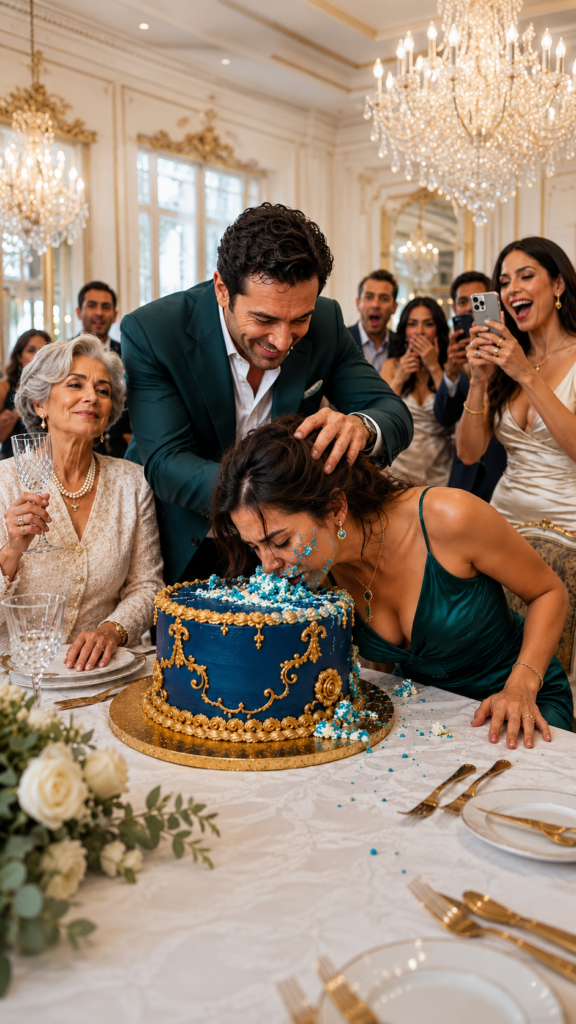
Rodrigo's hand fell on her neck and shoved her face into the cake.
The cream covered her nose, her mouth, her eyelashes. The dining room erupted in laughter. Someone shouted, “That’s it, dude, that’s how it’s done!” Jimena filmed so close that her perfume mixed with the sweet smell of frosting.
“Finally, she served to decorate the table,” Jimena murmured.
The cellphone captured it all.
Rodrigo laughed nervously, as if the cruelty were less serious if everyone celebrated it.
“Come on, my love. Don’t make a scene. It’s cake, not poison.”
Mariana slowly lifted her head.
Her face was covered in green cream. Her beige dress was stained. Her hands trembled, but her eyes didn’t cry.
And that made everyone more uncomfortable than any scream.
She wiped her mouth with a napkin. Then she touched the small golden pendant around her neck: an old key that almost nobody noticed.
“Enjoy the party,” she said calmly.
She walked out without looking back.
As she walked toward the street, she heard another laugh and Jimena’s voice saying:
“Post it now. Let everyone see who’s in charge here.”
Mariana got into her car, shut the door, and breathed heavily. She had cream in her hair, in her throat, and in her dignity.
Then her cellphone vibrated.
It was an email from the Asset Custody Center.
“Subject: Urgent decision on financial rescue of Grupo Salcedo. Approval required by controlling beneficiary.”
Mariana read the message twice.
Then she looked at the illuminated house where Rodrigo was toasting with his mistress, unaware that he had just humiliated the only woman capable of deciding whether his empire would survive or collapse by Monday.
PART 2
Mariana didn’t go back inside.
She stayed several minutes in the car, cleaning herself as best she could with tissues that only smeared the cream further. Outside, the guards glanced the other way. Inside, the music continued to play as if no one had just shattered something that couldn’t be fixed.
Rodrigo texted her 16 minutes later.
“Don’t exaggerate. My mom is really upset that you left like that.”
Mariana stared at the screen until it went dark.
He had pushed her in front of his mother, his mistress, and half the family’s social circle. And still, she was to blame.
That had been the trap for 8 years: making her believe that defending herself was vulgar, that crying was manipulation, that staying silent was maturity, and that forgiving was obligatory.
She drove to the house in San Ángel that Rodrigo called “my house.”
He always said that.
“My house, my rules.”
“My roof, my effort.”
“My last name opened doors for you.”
Mariana never corrected him. Not because she didn’t know how to respond, but because her grandfather had taught her that sometimes people reveal themselves better when they think no one is listening.
The house wasn’t Rodrigo’s.
Nor the Salcedos’.
It belonged to a trust of the Beltrán family, created long before the wedding. Rodrigo had signed the usage contract 8 years ago without reading it fully, mocking the notary because, according to him, “the rich make papers for everything, even breathing.”
Mariana entered the kitchen.
On the counter were the boxes of flour, the fondant cutter, the sugar flowers she hadn’t placed, and a clean spatula. Right there, she almost broke down.
Not because of the cake.
But for all the times she had tried to smooth over a table where everyone had hidden knives.
Rodrigo came home past midnight. He smelled of whiskey, expensive perfume, and that absurd confidence of men accustomed to getting away with emotional bills.
“You left without saying goodbye,” he said, throwing the keys on the table.
“I was dismissed in front of everyone,” Mariana replied.
Rodrigo froze.
He hadn’t expected that voice.
“Don’t start. It was a joke.”
“No. It was a demonstration.”
He loosened his tie in annoyance.
“Look, Mariana, my mom is right. You never fit in. And after today’s little show, it’s clear this isn’t working anymore.”
His cellphone vibrated.
On the screen appeared Jimena’s name with a green heart.
Rodrigo smiled before flipping the phone facedown.
That gesture hurt more than the blow.
Mariana went upstairs without arguing. She closed the door, opened her computer, and accessed a private folder she had been silently feeding for months.
There were the bank statements.
Three purchases at a boutique in Polanco.
A jade dress.
An Italian purse.
Designer shoes.
All charged to an additional card that Mariana had never authorized.
Registered username: Jimena Rivas.
Mariana felt cold in her stomach.
Rodrigo wasn’t just cheating on her. He was also using her information to pay for luxuries for his mistress. And that very woman, dressed in stolen money, had just filmed her with her face buried in a cake.
Below, Rodrigo was speaking softly on the phone.
“Yeah, babe. Don’t worry. She’ll get over it. She always does.”
Mariana began to gather everything.
Screenshots. Videos. Dates. Messages. Bank statements. The audio where Jimena said, “who’s in charge here.” The message from Rodrigo blaming her. The video posted online. The family’s comments celebrating.
At 1:08 AM, she called Inés Arriaga, her family lawyer.
“Is he being aggressive now?” Inés asked.
“He’s downstairs. He hasn’t touched me since the party.”
“Don’t confront him about the cards. If there was one fraud, there could be more. Send me everything and let him think you’re still alone.”
Mariana touched the golden key at her neck.
“He thinks I have nothing.”
Inés fell silent for a moment.
“Then let him keep thinking that until tomorrow.”
By morning, the video was in group chats.
Some mocked.
Others called it “couple humor.”
But several comments changed the tone:
“That's not a joke, that's abuse.”
“And the mistress recording?”
“What a vulgar family with money.”
Jimena deleted the post by noon, but it was too late. The screenshots were already circulating everywhere.
At 11:30, Doña Eugenia called.
Mariana activated the recorder before answering.
“You made my son look bad,” the woman said without greeting. “A decent wife laughs and continues the party. She doesn’t leave like an offended maid.”
“Anything else, Doña Eugenia?”
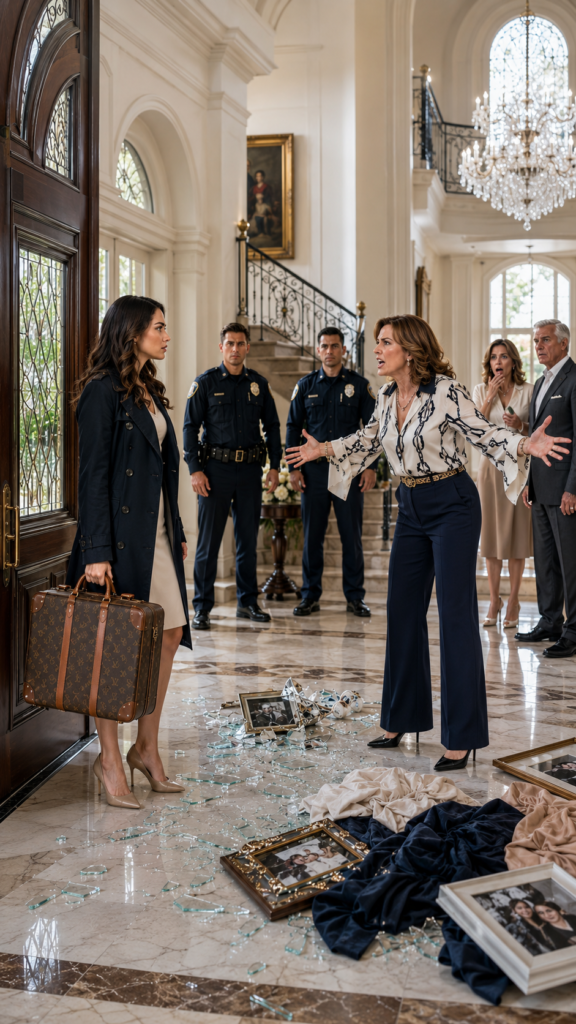
“Yes. Leave that house before Rodrigo has to throw you out. At least Jimena knows how to accompany an important man.”
Mariana closed her eyes.
“Thank you for making that clear.”
She hung up.
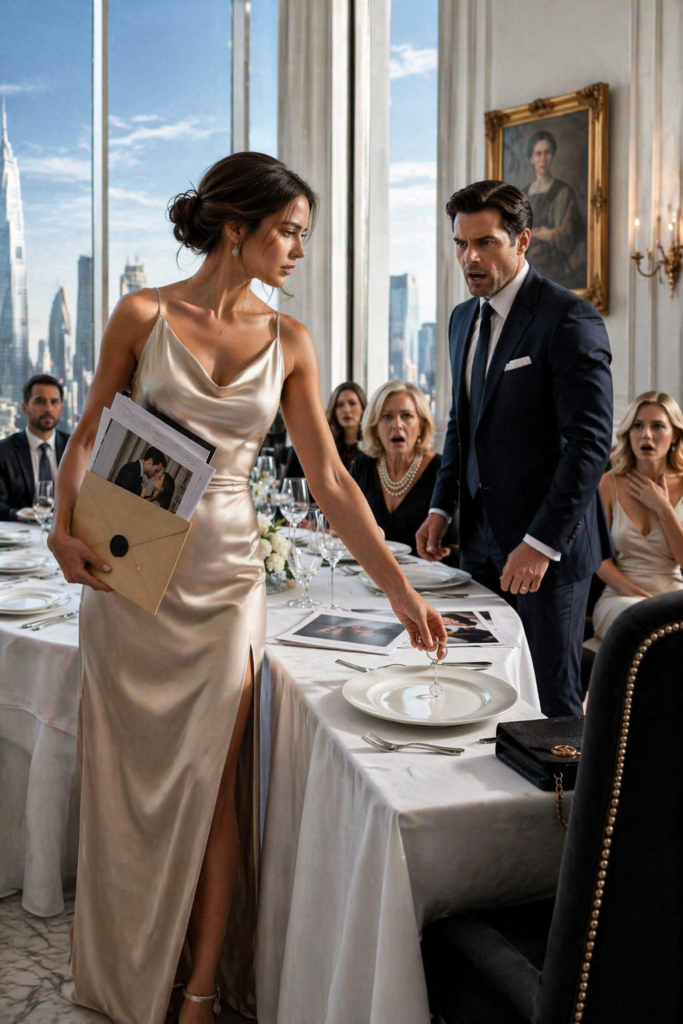
An hour later, Rodrigo arrived with a cream-colored folder.
“My lawyer prepared this,” he said, leaving it on the table. “I don’t want to make you suffer anymore.”
Mariana opened the folder.
It was a divorce proposal.
It demanded that she leave the house within 30 days, renounce any claims on assets “acquired by Mr. Salcedo’s efforts,” and take only her clothes, personal items, books, and baking equipment.
Mariana read that last part twice.
The man who had shoved her face into a cake was being so generous as to let her keep the mixer.
“I won’t sign anything without my lawyer,” she said.
Rodrigo let out a dry laugh.
“Your lawyer? Oh, Mariana, come on. You’re not in a novel. I paid for this life. I maintain that house. Don’t humiliate yourself fighting over things you don’t understand.”
She looked at him without raising her voice.
“Then you won’t have a problem proving it.”
Rodrigo clenched his jaw.
“I’m going to the National Innovation and Transport Gala tonight. Grupo Salcedo is a finalist for a large investment. I’ll take Jimena. After what happened yesterday, I need someone who knows how to behave.”
Mariana’s cellphone vibrated on the table.
New email from Asset Custody:
“Executive access confirmed. Final capital decision scheduled for tonight.”
Rodrigo didn’t get to see it.
“Hope the gala gives you what you deserve,” Mariana said.
“Finally, you’re making sense,” he replied.
In the afternoon, Mariana arrived at the offices of the Asset Custody Center in Santa Fe. Inés was waiting with two folders, a secure tablet, and the expression of someone who wouldn’t allow any nonsense.
Custody wasn’t just any firm.
It was the financial arm of the Beltrán family, a family that had rescued Mexican companies with potential for decades, as long as they accepted audits, controls, and transparency.
Grupo Salcedo was on the list.
It had overdue debts, inflated invoices, angry suppliers, and an urgent capital request to avoid losing public and private contracts.
Rodrigo thought that night he would get money.
He didn’t know that the decisive vote belonged to Mariana.
“This must be handled cleanly,” Inés warned. “No revenge. If the company is viable, it will be rescued. If there’s fraud, it will be documented. The personal goes through legal channels.”
Mariana nodded.
“I don’t want to destroy anyone.”
Inés looked at her seriously.
“No need to destroy them. Just stop covering for them.”
That night, Rodrigo entered the Gran Hotel de la Ciudad de México with Jimena on his arm. She wore the jade dress charged to the disputed card. Doña Eugenia walked behind them with a pearl necklace and a queen’s smile. Diego, Rodrigo’s brother, was filming stories to show off.
“Now you look like a worldly man,” Jimena whispered.
Rodrigo smiled.
“When the capital from Custody comes in, no one will look down on us again.”
In a private room, two floors up, Mariana was reviewing documents with advisors. She wore a simple black dress, her hair pulled back, and the golden key resting on her chest.
She wasn’t going to compete with Jimena.
She wasn’t going to plead for respect at a table where it had already been denied.
She was going to remember who she was before she learned to walk softly to avoid inconvenience.
At 8:00, the lights in the main hall dimmed.
The presenter spoke of innovation, Mexican investment, and family businesses capable of transforming. Then he announced the new stage of the Asset Custody Center.
Rodrigo applauded loudly.
Jimena squeezed his hand.
“It’s your night,” she murmured.
Then the presenter changed his tone.
“We also present the new chairwoman of the investment committee and controlling beneficiary of the Beltrán Trust.”
Rodrigo stopped applauding.
The side doors opened.
Mariana entered.
The entire hall turned.
She didn’t come in through the guest entrance. She came in through the executive access, escorted by Inés and two advisors. Her face no longer bore cream. Her gaze no longer asked for permission.
Doña Eugenia murmured:
“It can't be.”
Jimena let go of Rodrigo’s arm as if it burned.
Mariana walked past them without stopping. That was what hurt them most. She didn’t ignore them out of pride, but because she had finally stopped making them the center of her life.
She ascended the stage.
“Ladies and gentlemen,” said the lead advisor, “Mariana Beltrán.”
At first, there was silence.
Then the hall stood up.
Rodrigo felt his mouth dry. Bankers who had given him only 3 minutes now applauded the woman he thought to throw out of “his house” with a list of utensils.
Mariana took the microphone.
“Money should not reward appearances,” she said. “It should support companies capable of telling the truth: how much they owe, what they’ve hidden, and what they’re willing to correct.”
She didn’t mention Rodrigo.
She didn’t mention the cake.
She didn’t mention Jimena.
And yet, every word hit him.
On the screen, Grupo Salcedo appeared among the companies under special review. Not as a winner. Not as an untouchable company. But as an organization with urgent debt, unverified expenses, and deficient internal controls.
Jimena tried to stand up.
A man in a gray suit approached her with an envelope.
“Miss Rivas, you are hereby notified.”
She paled.
“Notified of what?”
“Preservation of electronic evidence, disputed credit activity, and requirement for documentation for purchases made in the name of Mrs. Beltrán.”
Rodrigo stood up.
“This is a trap.”
Inés appeared beside the table.
“No. It’s a procedure. You can go to the executive room with your lawyer, if you have one.”
Doña Eugenia tried to intervene.
“Mariana is acting out of spite. This is vulgar.”
Mariana finally looked at her from the entrance of the room.
“You asked me to leave a house that was never your son’s. I just came to organize papers.”
No one responded.
In the executive room, Rodrigo tried to maintain his composure, but his hands trembled.
“You hid who you were from me,” he said.
Mariana looked at him sadly.
“I gave you a marriage without flaunting my last name. You gave me a divorce petition where you allowed me to take my molds.”
“If you had told me about Custody, none of this would have happened.”
There was the truth.
No remorse.
Just wounded convenience.
“If I had told you I had power, you would have treated me better,” Mariana replied. “That’s why I never told you.”
Jimena broke the silence.
“Rodrigo told me that card was for representation expenses.”
“Shut up,” he snapped.
But it was too late.
Inés took notes. Doña Eugenia lowered her gaze. Diego put away his cellphone.
Over the next 48 hours, Custody froze any negotiations with Grupo Salcedo until the audit was completed. Banks demanded explanations. Suppliers demanded payments. The company placed Rodrigo on administrative leave while contracts, cards, and lines of credit were reviewed.
The statement was brief.
It didn’t talk about lovers.
It didn’t talk about cake.
It talked about financial controls.
And that was worse, because without drama, Rodrigo couldn’t play the victim.
Doña Eugenia called 9 times. In the last one, she left a message.
“Daughter, I think we all got carried away. The family should talk before hurting each other.”
Mariana saved the audio and sent it to Inés.
No response.
Jimena deleted photos, stories, and messages, but the screenshots were already preserved. The jade dress, the charges, the video, and her comment became part of a file that she could no longer control.
Rodrigo sought out Mariana 5 days later, outside Custody.
He had a scruffy beard, a loose tie, and red eyes.
“I’m losing everything,” he said.
Mariana stopped.
For 8 years, she would have rushed to console him. She would have apologized for making him feel bad. She would have carried a guilt that wasn’t hers.
Not anymore.
“You’re not losing everything,” she replied. “You’re just getting to know what you chose.”
“I loved you.”
She felt a clean pain, like a wound finally ceasing to fester.
“No. You loved that I endured.”
The divorce wasn’t quick, but it was clear.
The house was off the table due to the trust. The cards were investigated. Grupo Salcedo survived, but under external supervision and without Rodrigo in daily command.
Mariana didn’t throw him out.
She didn’t need that to feel justice.
Sometimes, justice isn't about destroying those who hurt you. It’s about taking away their power to keep doing it from a big chair.
Months later, Mariana sold the house in San Ángel.
Not because Rodrigo had gained anything, but because she no longer wanted to sleep in a place where she had learned to walk slowly to avoid causing discomfort.
She moved to a bright apartment in Roma Norte, close to her office and a bakery where the coffee smelled like Sunday.
On her next birthday, she baked again.
A white cake with green details.
When she placed it on the table, no one laughed. No one pulled out a cellphone to humiliate her. No one shoved her head.
Mariana calmly cut the first slice.
The golden key rested on her chest.
It was no longer a secret.
It was a reminder.
She never had to prove how much she was worth.
She just had to stop placing her value in the hands of people who never knew how to see it.