PART 1
—Did someone run you over or are you just looking for an excuse, Mariana? My mom hasn't eaten.
Esteban Vallejo's voice came through the phone like a slap. He didn’t ask if she was alive. He didn’t ask if it hurt. He just sounded annoyed, as if she had committed a crime by being in the emergency room.
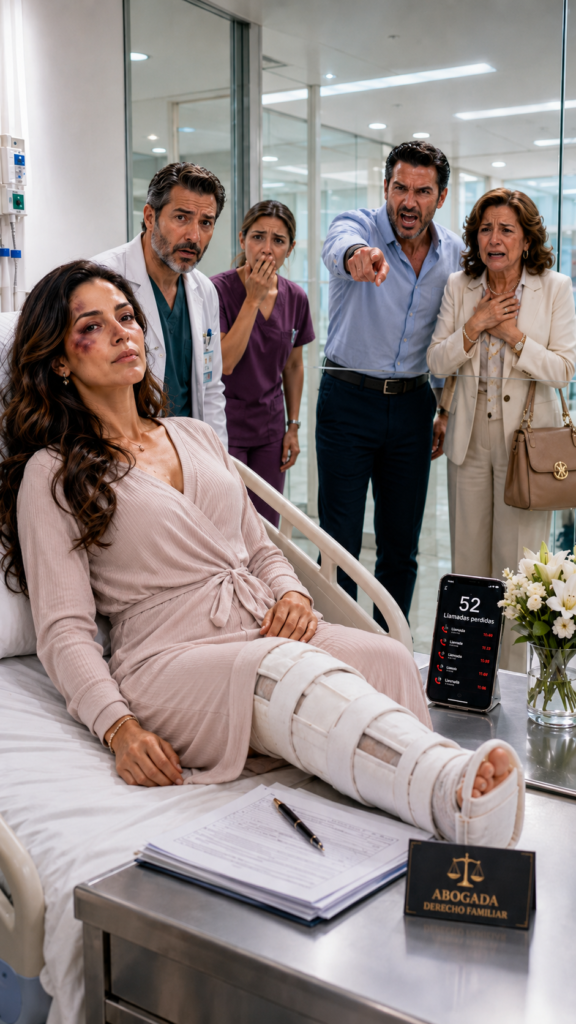
Mariana Alcázar lay on a gurney at the General Hospital of Xoco, her right leg immobilized, an open wound on her calf, her dress stained with blood. A taxi had hit her as she left her café in the Narvarte neighborhood, on her way to buy strawberries for the day's cakes.
The nurse cleaning her wound paused, staring at the phone.
—Esteban, I’m in the hospital —Mariana said, breathing with difficulty—. I fractured my tibia. I can’t walk.
There was a brief silence.
Then he let out a dry laugh.
—Come on, you’re always so dramatic. My mom needs her salt-free soup before 2. What do you want me to do? Cook for her myself?
The doctor stopped writing.
For four years, Mariana had cooked for Doña Elvira, Esteban's mother, as if it were a wife's obligation. Oatmeal without sugar, boiled chicken, fat-free broth, soft gelatins. Meanwhile, Esteban flaunted his position as regional director at Grupo Vértice, an appliance company where, according to him, everyone depended on his talent.
What he never mentioned was that he got that position through connections.
What he didn’t know was who had built that company.
—Your mom can order food —Mariana replied.
—Is that how you talk to me? Remember who pays for the house, the truck, and the comfortable life you have.
Mariana glanced at her bandaged leg.
The physical pain was intense, but that phrase opened an even older wound.
—This marriage is over, Esteban.
—Don’t say stupid things.
—It’s over.
She hung up.
Half an hour later, two police officers walked in.
—Mariana Alcázar?
She raised her hand.
—We received a report of abandonment of a dependent elderly person. Your husband says you left the house after an argument and refused to return.
Mariana let out a humorless laugh.
—I was hit by a car at 12:18. Here’s my admission, my X-ray, and my medical report. I didn’t abandon anyone. I’m hospitalized.
The officer looked at her leg. Then at the phone.
—You have 52 missed calls.
—All from my husband. Demanding I go back to cooking.
The doctor intervened:
—The patient cannot stand. She has a fracture and an open wound.
The officer called Esteban from his official phone.
—City of Mexico Police. Your wife is hospitalized due to a traffic accident. Your report does not match the facts.
Esteban hesitated.
—I… didn’t know it was that serious.
Mariana spoke from the gurney:
—You didn’t know because you never asked if I was alive.
Then he changed his tone.
—If you want a divorce, fine. But the house in Coyoacán, the truck, and the 100,000 pesos account stay with me. You leave with your cast and what you’re wearing.
Mariana took a deep breath.
—You’re mistaken.
—Mistaken about what?
—Believing I’m the helpless woman you wanted to have.
When the police left, Mariana requested copies of everything: medical records, X-rays, prescriptions, disability forms, and call logs. Then she made four calls.
To the bank, to freeze the joint account.
To the notary, to confirm that the house couldn't be sold without her signature.
To Daniela, her best friend, to ask for clothes, a laptop, and a lawyer.
And to Héctor Salinas, general director of Grupo Vértice.
—Mrs. Alcázar —he answered with immediate respect.
—I need the internal file of Esteban Vallejo. And prepare a surprise audit.
Héctor fell silent for one second.
—Understood. Will you reveal who you are?
Mariana looked at her cast.
—Not yet. I want to see how far he dares to command from a chair that exists thanks to me.
Because Esteban didn’t know. Neither did his mother. Nor his family.
Before marrying, Mariana had founded Grupo Vértice and protected her shares under a trust called Raíz Dorada. To everyone, she was just a stubborn pastry chef with a small shop that smelled of butter.
Fifteen minutes later, Esteban and Doña Elvira stormed into the hospital.
—Are you done with your show? —he yelled.
Doña Elvira clutched her chest.
—Oh, poor me. I’m dying of hunger and she’s lying here.
Mariana pressed the nurse call button.
—Please call security. They’re interfering with my medical care.
Esteban paled.
—Are you going to kick your husband out?
—A husband asks if it hurts. You asked about the soup.
Doña Elvira pointed her finger at Mariana’s face.
—When you leave this family, you’re not taking a single spoon.
Mariana stared back, unblinking.
No one could believe what was about to happen.
PART 2
Daniela arrived first, carrying a small suitcase and a fury visible in her clenched jaw. Behind her walked Licenciada Sofía Arriaga, dark blue suit, thin glasses, and a black folder under her arm.
Her presence changed the air in the cubicle.
Esteban, who had been yelling seconds before, lowered his voice.
—And who is she?
—My lawyer —Mariana replied.
Doña Elvira’s eyes widened.
—Lawyer? Wives don’t call lawyers. Wives endure.
Sofía adjusted her glasses.
—Wives are people, ma’am. Not furniture included in the marriage.
Esteban tried to regain control.
—Mariana has nothing. I paid for everything.
—Is the house solely in your name? —Sofía asked.
He didn’t answer.
—Is there a document where my client renounces her share?
Silence.
—Was the truck paid for only with your money or also with the joint account?
Esteban gritted his teeth.
Mariana spoke slowly:
—Sofía, request a preventive annotation to prevent the sale or mortgage of the house. Notify the bank that the 100,000 pesos account can only be moved with dual authorization. And ask for an inventory of assets, insurances, bills, and cards.
Esteban stepped toward the gurney.
—Don’t you dare check my finances.
—Touch me one more time and this lawsuit will also include a report for assault within a hospital.
Security entered.
Doña Elvira started crying loudly.
—An elderly sick woman being thrown out by her daughter-in-law!
—She can cry in the hallway —Mariana said—. Here I need medical attention.
Before leaving, Esteban leaned toward her.
—You don’t have a real job. How long do you think you’ll last playing powerful?
Mariana looked at him.
—Watch your position, Esteban. A strong wind is coming.
He didn’t understand.
That night, the Grupo Vértice file arrived. Salary, bonuses, travel expenses, representation costs, and internal reports. There were three anonymous complaints: family meals charged to the company, out-of-route gasoline, and suspicious contracts with a distributor called Luna Norte.
The owner was Óscar Vallejo, Esteban’s cousin.
The same cousin that Doña Elvira defended as an "entrepreneur" even though he always owed money.
Mariana sent everything to Héctor.
—Audit invoices, contracts, mileage, travel expenses, and emails. Don’t mix my divorce. Let him fall for internal compliance.
—Understood, ma’am.
The next day, the family chat exploded.
Aunts, cousins, and sisters-in-law called Mariana interested, lazy, a freeloader, and a bad woman. Esteban wrote that she was faking the fracture to take his money and humiliate his mother.
Mariana stored every screenshot in a folder called DEFAMATION.
Thirty minutes later, Sofía sent a legal notice to the group. The accident was documented by the hospital, police, and X-rays. Any additional lies would be used in a civil lawsuit.
Everyone started deleting messages.
That afternoon, Doña Elvira called from an unknown number.
—Mariana, I’m in the Cardiology unit. Come. I’m going to tell you the truth about the house.
Daniela called the mentioned hospital.
There was no patient by that name.
—Doña Elvira —Mariana said over the phone—, your lie has just been recorded.
The woman’s voice changed.
—You’re a wretch! Is that how you treat an elderly woman?
—You are not my mother. And I am no longer your servant.
She hung up.
Five minutes later, Daniela received a call from the Coyoacán watchman.
—Mariana, there’s a moving truck in front of your house.
The trap had failed. They were now going for her things.
—Daniela, don’t go in alone. Call the police, the manager, and record everything. Say aloud that my ID, passport, jewelry, notarial documents, agreements, and Raíz Dorada folder are inside.
An hour later, the video arrived.
The bedroom was open. The drawers were empty. The box where Mariana kept personal documents had been forced open. In the hallway, Doña Elvira was seen leaving with a small safe pressed to her chest.
In a video call with the police, Mariana spoke clearly.
—My passport, ID, cards, a bracelet from my grandmother, a gold pendant, and private documents are missing. I want to file a report for theft and unlawful retention.
That night, Esteban wrote to her:
“If you want your papers, cancel the divorce.”
Mariana sent the screenshot to Sofía, Héctor, and the officer.
Then she replied:
“You just put a price on the rest of your life.”
On Monday, Grupo Vértice notified Esteban that there would be an expense audit. They only told him half the truth. They didn’t mention Luna Norte, Óscar, or the edited records.
At 11:27 PM, Marisol, a finance assistant, sent an urgent email to Human Resources:
“The director Vallejo ordered me to modify old invoices. If I don’t comply, he will fire me.”
Héctor forwarded it to Mariana.
She read it from her bed, with her leg elevated, and understood that Esteban had just opened the door she needed.
Two days later, the doctor authorized a temporary exit of three hours to take inventory at the house. Mariana arrived with crutches, accompanied by Daniela, Sofía, two police officers, and the neighborhood manager.
The door was open.
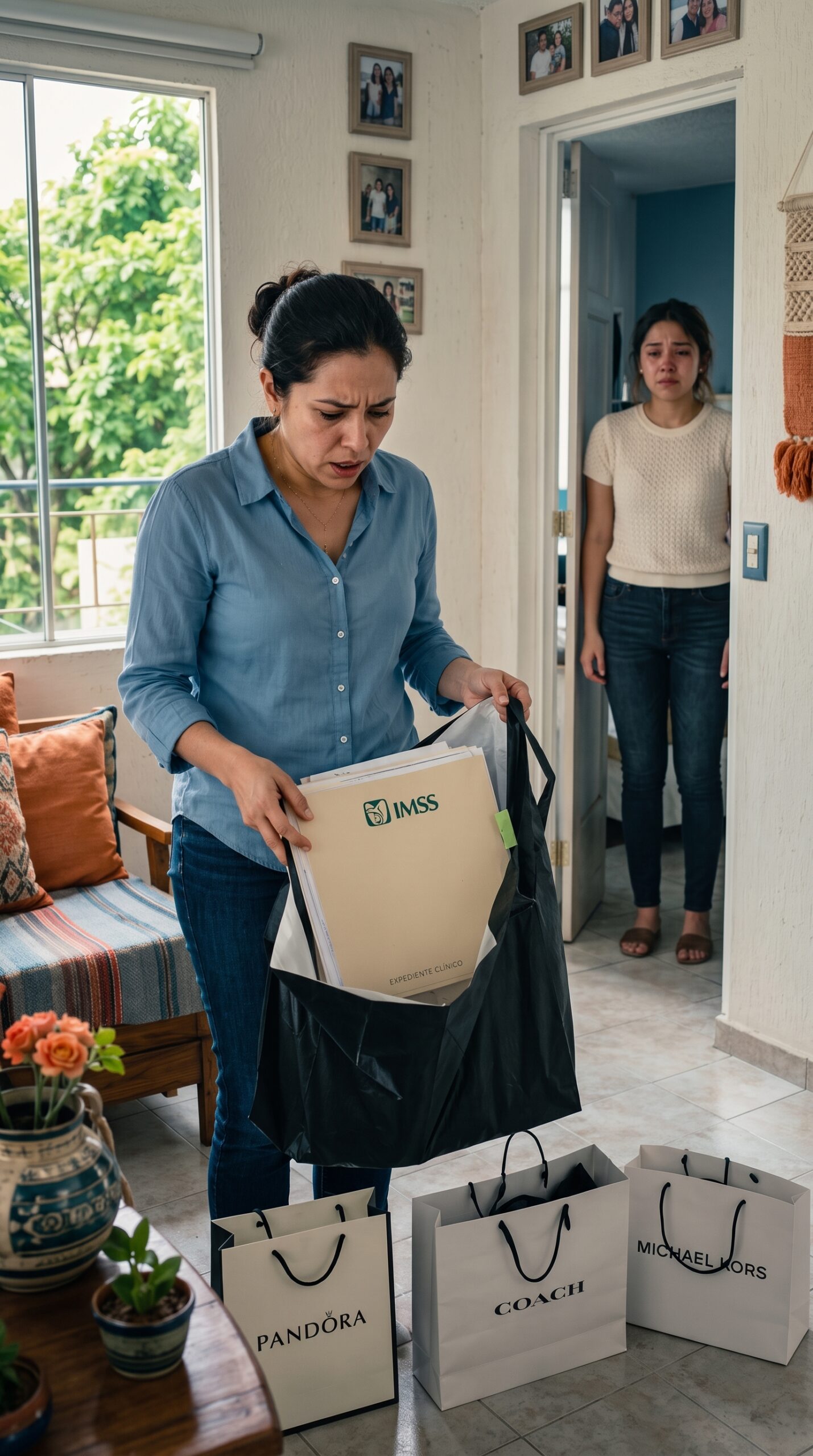
Doña Elvira was sitting in the living room, surrounded by boxes, black bags, and three relatives pretending to know nothing.
—So you had the audacity to come back? —she yelled—. This is my son’s house.
Mariana leaned her crutch on the floor.
—It’s also mine.
Sofía showed the deed.
—The property is in the name of Esteban Vallejo and Mariana Alcázar. My client is here for her documents and belongings taken while she was hospitalized.
Doña Elvira began to cry.
—I’m being treated like a criminal!
Mariana pointed to the manager's tablet.
—You recorded yourself carrying my box.
The video showed Doña Elvira leaving the bedroom with the safe.
The woman stopped crying.
—I just wanted to see what you were hiding.
She opened the box reluctantly. Inside were the passport, ID, cards, marriage agreements, and the Raíz Dorada folder with the seal broken.
Doña Elvira looked at the name.
—What is this? How much money do you have? If you’re my son’s wife, that money is also the family’s.
Mariana closed the folder.
—Two days ago, you said you wouldn’t let me take even a spoon. Remember this feeling: seeing money that you’ll never touch.
That night, Esteban called 18 times. Mariana answered the last one with Sofía present.
—What is Raíz Dorada? —he asked without greeting her.
—My assets prior to marriage.
—Do you have shares?
—Yes.
—How much are we talking about?
—Nothing that belongs to you.
Esteban’s breathing quickened.
—You hid who you were from me.
—You hid that you forced Marisol to modify invoices. You hid that Luna Norte is your cousin’s. You hid that you used corporate gas to take your mom to the casino and charged family meals to the company.
—Did you investigate me?
—No. Vértice audited you.
—You talk as if you were someone there.
Mariana looked at Sofía.
—You’ll understand soon enough.
The first mediation session was two weeks later. Mariana entered the family court with only one crutch. Esteban looked thinner, with deep dark circles, but he still had that look of someone who thinks everyone owes him something.
The mediator asked if there was a possibility of reconciliation.
Esteban lowered his voice.
—Mariana, I made mistakes. My mom is getting older. Work had me stressed. We were a family.
Mariana didn’t raise her voice.
—When I was hit, you didn’t ask if I was alive. You asked who was going to cook.
His lawyer slid a proposal. Mariana had to withdraw complaints, renounce her share of the house, and protect Esteban’s reputation. In return, he “would allow” her to keep her pre-marital assets if she paid him compensation for emotional damage for hiding her identity.
Daniela let out a dry laugh.
Sofía didn’t even blink.
Mariana took the paper and tore it in two.
—I didn’t come to ask for permission. I came to end this according to the law.
Esteban slammed the table.
—You deceived me! If I had known you were rich, I would never have let my mom live like this.
—Your mom lived in a spacious house, with a nurse on call, air conditioning, homemade food, and a daughter-in-law whom she treated like a servant. You’re not mad because I hid money. You’re mad because you couldn’t use it.
The mediator closed the folder.
—The mediation is concluded.
But before the trial, Esteban’s chair fell.
At Grupo Vértice, corporate falls weren’t noisy. They were clean, cold, and swift. Esteban was summoned to a windowless room. In front of him were Compliance, Human Resources, and the corporate attorney.
—Mr. Vallejo, you are terminated for cause with immediate effect due to expense fraud, conflict of interest, misuse of corporate assets, and retaliation against subordinates.
—This is because of my wife —he shouted—. I want to speak with the board!
The lawyer looked at his watch.
—You have 10 minutes to collect your things.
Fifteen minutes later, Esteban left the Santa Fe tower carrying a cardboard box. A black truck was waiting for him on the sidewalk.
The window rolled down.
Mariana sat in the back seat, in a white suit and her leg still immobilized.
—You wanted to talk to the board, Esteban.
He froze.
—You…
—The company didn’t destroy you. It merely put your actions on a scale. What sank you was the weight of your own corruption.
The Luna Norte file was sent to tax authorities. Marisol received protection as a whistleblower. Óscar began receiving subpoenas. The truck was under review because Esteban had mixed corporate resources with family payments.
When Doña Elvira learned of the dismissal, she showed up in the lobby of the apartment where Mariana was recovering.
—Please, Mariana. Esteban is my only son. You have so much. The house and money are nothing to you.
Mariana stood one meter away.
—I’m not fighting because I need the house. I’m fighting because it’s mine.
—You’re leaving us with nothing!
—When a rich person is robbed, it’s still robbery. When a strong woman is humiliated, it’s still abuse.
Doña Elvira lifted her chin.
—When you’re old, no one will take care of you.
—I prefer to pay professionals than to buy false affection by allowing myself to be mistreated.
The trial came a month later. Mariana was already walking without crutches, though with a slight limp. Esteban sat at the opposite table in an expensive but worn suit. Doña Elvira sat behind him, disheveled, with a handkerchief in her hand.
His lawyer tried to attack Raíz Dorada.
—The lady hid considerable wealth during the marriage.
Sofía stood up.
—My client’s assets were acquired before the marriage and protected by notarized agreements. Mr. Vallejo had independent counsel. There is no mixture of marital resources. For four years, he despised my client’s pastry business and treated her as a domestic servant. Now that he knows she’s a businesswoman, he wants a share. That’s not a right. It’s ambition.
The judge looked at Esteban.
—Did you sign those agreements?
—Yes.
—Were you forced?
—No.
—Do you have proof that money from the marriage was invested in Raíz Dorada?
Esteban lowered his head.
—No.
Then came the rest: the house bought during the marriage, the 100,000 pesos account frozen before Esteban could empty it, the truck, the stolen jewelry, the withheld documents, the legal expenses, and the defamation in family chats.
Esteban exploded.
—It’s not fair! She has millions. Why does she want my house, my car, and my money?
Mariana looked at him.
—Because they’re not yours.
Then the judge requested her statement.
Mariana stood up.
—Your Honor, I’m not here for revenge. The day I was hit, my husband didn’t ask if I was okay. He filed a false report, demanded I leave the hospital to cook for his mother, and then tried to take my documents, assets, and reputation. I’m not asking for compassion. I’m asking that my rights be respected.
The room fell silent.
The verdict was clear. Divorce granted. Raíz Dorada was excluded from any claims. The house was to be sold and divided according to the law, with discounts for damages and obstruction. The joint account would be divided, but part of Esteban’s share would be retained for jewelry, documents, and legal fees. Additionally, he was to publish an apology for defamation.
Doña Elvira broke down in tears.
—And where am I going to live?
Mariana didn’t look back.
She had asked her to crawl with a broken leg to cook for her. Now it was her turn to find her own way.
But Esteban still refused to accept losing.
A week later, he attempted to sell the truck with a fake contract and a supposed debt of 1.5 million to Óscar. Since the unit was under judicial and corporate alert, Grupo Vértice detected the movement.
The bailiff arrived before they completed the paperwork.
Sofía reviewed the promissory note and smiled slightly.
—Without a notary, without a transfer, altered date, and questionable signature. This isn’t a debt. It’s evidence.
On the day of the appraisal, Doña Elvira appeared in a wheelchair, even though everyone knew she walked perfectly. Upon seeing the expert, she began to breathe heavily.
—I’m being killed. This is abuse of an elderly woman.
Sofía showed her recent medical review.
—No incapacitating condition.
Doña Elvira stopped gasping and began shouting so the neighbors could hear.
—She’s a millionaire and is fighting me for a house!
Mariana approached.
—The house is not yours.
—I’m your mother-in-law!
—Since the judge signed, you are an occupant without rights.
Then Doña Elvira grabbed a glass of water and threw it. Daniela pulled Mariana away just in time. The glass shattered on the floor.
The officer noted the attempted assault.
Esteban held his mother.
—Mom, enough.
She slapped him.
—If you hadn’t married this woman, we wouldn’t be like this!
The slap echoed in the empty room.
For the first time, Esteban saw the edge of the weapon he had wielded for years: his mother.
The house was sold. Esteban hid keys, ripped out smart devices, and tried to take built-in lamps. Everything was documented and deducted from his share.
On the day of the final delivery, Mariana returned for an old bread mold she had left in the pantry.
Before marrying, she had told Esteban she dreamed of a quiet café. He mocked her.
—A café? That smells like minimum wage. I need a wife who elevates my image.
He never wanted a partner.
He wanted an obedient ornament.
Esteban stood in the middle of the empty room.
—If that day I had asked you if it hurt… would it have been different?
Mariana took the mold.
—Don’t ask now to feel less miserable.
—Is there nothing left?
—My last act of love was not letting you sink before. Pay what you owe and don’t ever come looking for me again.
She walked out without looking back.
Six months later, Óscar was investigated for commercial fraud. Luna Norte was banned by Grupo Vértice. Esteban had to pay civil damages. Doña Elvira returned the value of what was stolen and ended up in a small apartment, without an elevator, without a cook, and without a daughter-in-law to humiliate.
Esteban’s public apology was brief because Sofía rejected three versions filled with excuses.
“I, Esteban Vallejo, spread false information about Mariana Alcázar. I demanded she leave a hospital while receiving care for a serious injury. I damaged her reputation, privacy, and security. I offer a public apology and commit to not harassing or defaming her again.”
That same day, Mariana officially opened her café in Polanco. Not as a hidden pastime. Not with shame. With her full name on the door.
Esteban appeared outside, thin, in an old jacket, with empty eyes.
—I just wanted to buy some bread.
—This place doesn’t serve people with a restraining order.
—I already published the apology.
—An apology pays a debt. It doesn’t buy a ticket back.
He looked at the sign.
—You did open your café.
—Yes.
—I said I would help you someday.
—You said many things. None had funds.
Esteban lowered his head.
—I regret it.
—Regret is your problem. My peace is mine.
Mariana entered and closed the door.
That afternoon, the first tray of conchas came out of the oven. Daniela broke one and smiled.
—Corporate group president and pastry chef?
Mariana placed the old mold on a shelf, like a silent trophy.
—A woman can smell like butter and run an empire.
Since then, she only answers calls if she wants to. She crosses every door with her own keys.
And if someone asks what a woman loses when she leaves the wrong marriage, Mariana answers without hesitation:
She loses a fake house, cold dinners, insults disguised as duty, and a man who thought he owned her life.
Then, she recovers herself.
And when someone asks how much it cost, she touches the scar on her leg and smiles.
A broken leg was enough to see the full path.
Now she walks slower, yes.
But no one ever forced her to return again.