PART 1
When Ximena Cortés fell from the helicopter, she didn’t hear the wind first.
She heard her sister’s voice.
"Don’t bother, Xime. No one is going to find you here."
Then came the impact against the branches, the snap of her leg, and a pain so wild that it stole the breath from her chest. Above, the helicopter drifted away over the Sierra Madre Occidental, leaving behind a red dot among pines, ravines, and stones.
Ximena was 36 years old, the owner of a medical logistics company in Guadalajara, and for years she had shouldered her entire family as if it were her sacred duty.
When her parents died in an accident on the way to Colima, she took charge of her older sister, Lorena, even though Lorena had always boasted about knowing how to live better.
Ximena paid off debts, rent, doctors, a failed boutique, and even a truck that Lorena swore she would use for work.
She never asked for anything in return.
That’s why it hurt so much when Lorena looked at her with envy every time someone said, "Ximena made it on her own."
Then came Adrián, her husband.
He was a corporate lawyer, suave, with a calm smile, one of those men who greets aunts with a kiss on the hand and convinces anyone that he is decent. Ximena met him at a charity auction in Zapopan.
Eight months later, they were married.
Lorena was the maid of honor.
In the photos, she embraced Ximena at the waist, smiling as if she truly celebrated her happiness. But people don’t see what happens behind a pretty picture.
They don’t see the lingering glances.
They don’t see the deleted messages.
They don’t see when a sister starts to feel less because of the shine of the other.
Three weeks before the business trip to Chihuahua, Adrián insisted on updating Ximena’s life insurance.
“It’s asset protection, love. Your business has grown too much. We need to be covered.”
The amount was set at 90 million pesos.
Adrián was the primary beneficiary.
Lorena, the secondary beneficiary.
Ximena signed because she trusted. Because she thought that doubting her husband and her own blood was beneath her.
The trip included a private helicopter tour over a ravine area. Ximena invited Lorena to reconcile, to heal old wounds, to show her that they could still be sisters and not rivals.
Lorena accepted too quickly.
During the flight, she asked about the signal, about nearby towns, about how long it would take for rescuers to arrive if someone got lost.
The pilot, a man named César, landed on an isolated platform, saying he would check a malfunction.
Adrián wasn’t on the helicopter. He said he had an urgent call with insurers.
Lorena opened the door and smiled.
“Come on, sister. A picture with the landscape. So we never forget this day.”
Ximena moved closer.
The air swept her hair back.
Then she felt Lorena's two hands pushing her back.
It wasn’t an accident.
It wasn’t a stumble.
It was a decision.
As she fell, she caught a glimpse of Lorena leaning from the door, her face hard, without tears, without fear.
And before crashing into the pines, Ximena understood something that broke her more than her bones: her husband must have already been practicing his widowed face.
PART 2
Ximena woke up when night had already fallen.
Her mouth was filled with dirt, dried blood on her brow, and her right leg bent in a way that no body should endure. Each breath burned her ribs.
She wanted to scream, but the forest returned only silence.
She tried to move and nearly fainted.
The fall hadn’t killed her because a huge tree had cushioned part of the impact. But it left her trapped among branches, stones, and a wet slope where any misstep could send her tumbling further down.
For minutes, Ximena cried silently.
Not because of the pain.
But because of the image of Lorena pushing her.
She remembered her sister as a child, hiding dolls from her for fun. She recalled when Lorena promised in front of their parents' coffin that she would never leave her alone. She remembered Adrián kissing her forehead the night before and telling her, “Rest, my life. Tomorrow is going to be an unforgettable day.”
Yes.
Unforgettable.
With pieces of her shirt, Ximena bound her leg to two branches. She used an earring to cut the fabric. She drank rainwater pooled on a large leaf. She crawled inches for hours, leaving trails of blood in the earth.
On the first day, she thought they would search for her.
On the second, she understood that no one was looking where she was.
On the third day, she heard a helicopter in the distance, but it never flew over her.
That’s when certainty hit her like a slap: Lorena and the pilot had given false coordinates.
On the fourth day, two young Rarámuri guiding tourists heard a noise among the trees. At first, they thought it was an injured animal.
They found a woman almost unrecognizable, feverish, with cracked lips and a fierce gaze.
“My name is Ximena Cortés,” she whispered. “My sister pushed me. My husband wants to collect my insurance.”
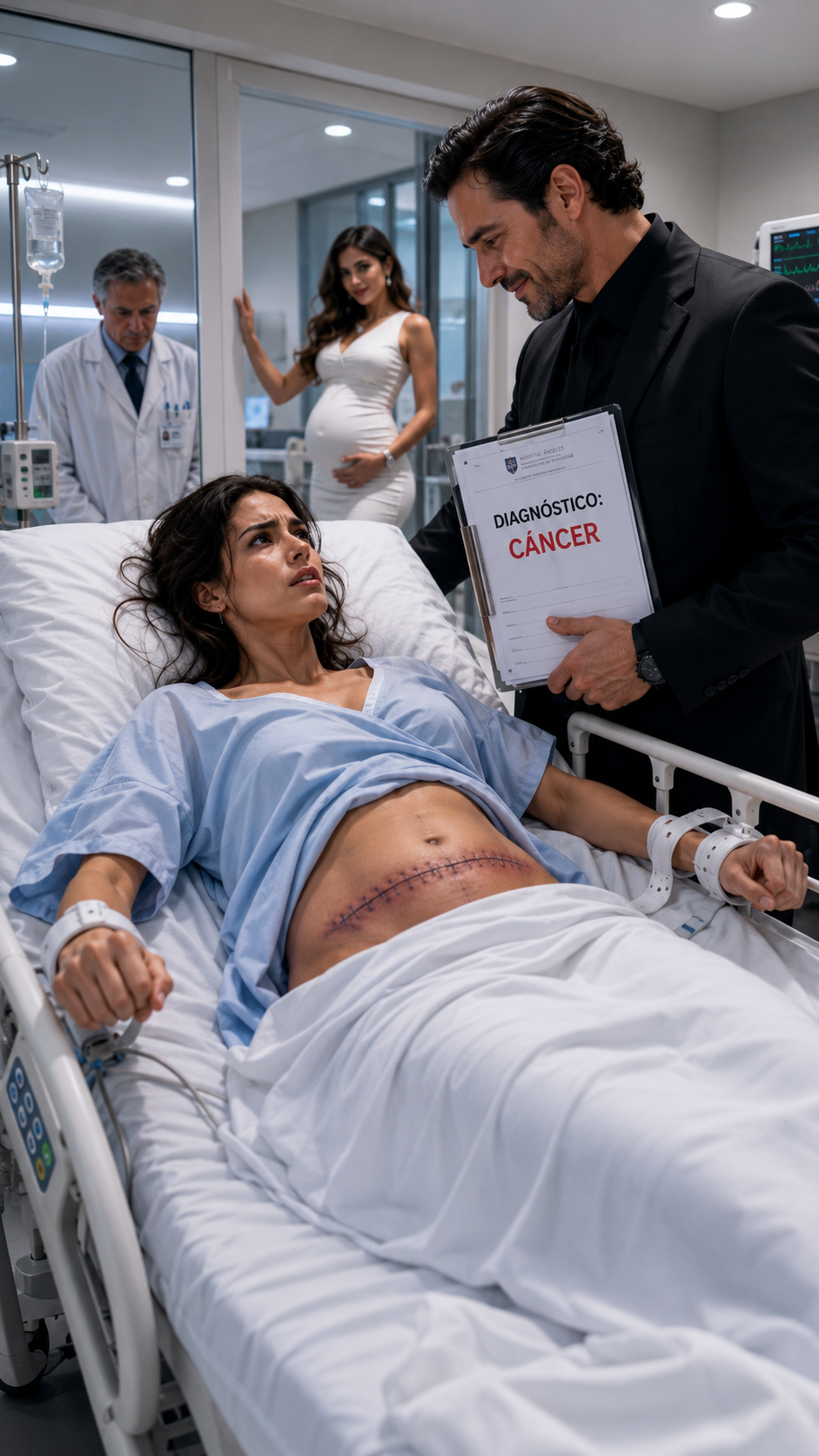
They took her to a hospital in Chihuahua as an unknown patient. She had a fractured leg, three damaged ribs, and severe dehydration.
While the doctors treated her, a nurse left the TV on in the room.
That’s where Ximena saw her own photo.
“Jalisco businesswoman disappears after air accident. Family prepares symbolic ceremony.”
The reporter said there was no body, but authorities presumed a probable death due to the height of the fall.
Adrián appeared before the cameras, in a black shirt, perfect beard, and moist eyes.
“My wife was my world,” he declared. “I just want to give her peace.”
Lorena was by his side, hugging him too closely.
Ximena didn’t scream.
She didn’t break anything.
She just stared at the screen and said in a hoarse voice:
“Let them keep acting.”
That night, Public Prosecutor Valeria Montes arrived. There was something odd about the case. The coordinates of the supposed accident didn’t match where Ximena was found. The pilot César had given contradictory statements. And Adrián had initiated the insurance claim just 18 hours after the fall.
Valeria listened to the whole story without interrupting.
Then she placed a folder on the bed.
“There are deleted messages between your husband and your sister. We are recovering them.”
In 48 hours, the Prosecutor’s Office had more than they expected.
Messages that said: “Chihuahua is perfect.”
Another: “Without a body it takes time, but they pay.”
Transfers to César.
A policy modified 21 days before the trip.
And the worst of all: a video from Ximena’s living room camera, recorded the same night of her supposed death.
Adrián and Lorena toasted with tequila.
“For freedom,” he said.
“And for the 90 million,” she replied.
Then they kissed.
Ximena watched the video without blinking. No one in the room said anything.
Agent Valeria expected her to break down. But Ximena only asked when the funeral would be.
“Saturday, in Guadalajara. They want to do it even though there’s no body.”
Ximena closed her eyes.
“Then don’t arrest them yet.”
Valeria frowned.
“Mrs. Cortés, that could be dangerous.”
“Not more dangerous than sleeping next to a man who already buried me alive.”
On Saturday, Guadalajara woke up to a fine drizzle.
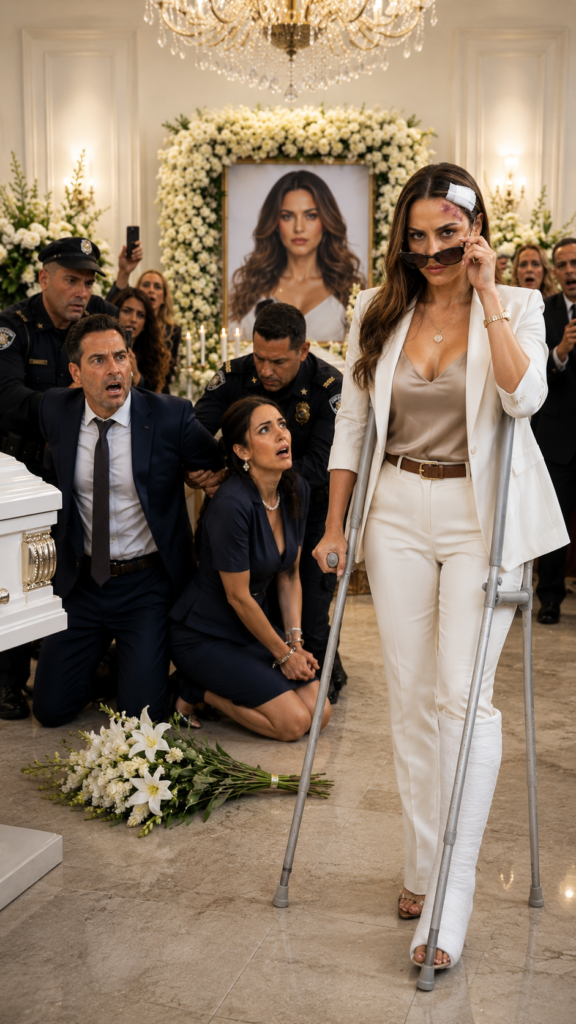
The funeral home was in an upscale area of Providencia, with arrangements of white flowers, hot coffee, and a huge photo of Ximena smiling in a blue blazer.
Under the photo was a phrase written in golden letters:
“You will always live in our hearts.”
Ximena entered, leaning on a cane, with her hair dyed darker, large glasses, and a long coat that concealed the bandages. She walked alongside Valeria, who pretended to be a family friend.
No one recognized her at first.
Her employees were genuinely crying.
Her assistant, Marisol, had swollen eyes. Don Chava, the driver who had worked with her since the company had three trucks, was wiping tears with the sleeve of his jacket.
That hurt.
Because there were people who truly wanted her alive.
Up front were Adrián and Lorena.
Adrián held a white handkerchief, pretending to grieve delicately, almost like a high-budget soap opera. Lorena wore a new black dress, high heels, and a necklace that Ximena had gifted her years ago.
The most disgusting part was that they were holding hands beneath the chair.
When it was time to speak, Lorena went up first.
“My sister Ximena was an extraordinary woman,” she said with a trembling voice. “Sometimes life takes away those who fly the highest.”
Ximena tightened her grip on the cane.
Lorena continued:
“I’m left with her smile before the accident. She left happy, looking at the sky.”
Some people cried.
Ximena felt like vomiting.
Then Adrián spoke.
“I’m still waiting for Ximena to walk through that door and tell me it was all a nightmare.”
Then Ximena took one step.
Then another.
The cane hit the marble floor.
Tap.
Tap.
Tap.
People turned around.
Adrián stepped down from the podium and looked at her with false courtesy.
“Excuse me, were you a friend of my wife?”
Ximena took off her glasses.
“No, Adrián. I’m the wife you couldn’t kill.”
Silence fell like a stone.
A lady dropped a cup. Marisol let out a scream. Don Chava crossed himself.
Lorena backed away until she bumped into the altar of flowers.
“No... it can’t be.”
“That’s what you said when you saw me fall,” Ximena replied. “But look, sis. Here I am. Broken, yes. Dead, no.”
Adrián reacted quickly.
“This is madness. She’s traumatized. She doesn’t know what she’s saying.”
Agent Valeria showed her badge.
“Adrián Salcedo and Lorena Cortés, you are under arrest for attempted femicide, fraud, criminal association, and false statements.”
Two plainclothes officers approached.
Adrián raised his hands, trying to look indignant.
“My wife suffered an accident. My sister-in-law is devastated. This is a show.”
Valeria opened the folder.
“We have recovered messages, transfers to the pilot, urgent requests for insurance payment, and a video where you toast for the 90 million.”
Lorena started to cry.
But these weren’t tears of regret.
They were tears from someone who finally understood they had been caught.
“It was Adrián,” she screamed. “He convinced me. He said Ximena would never stop overshadowing me.”
Adrián glared at her with contempt.
“Don’t be ridiculous. You hated her long before. You said you deserved half of everything.”
The entire funeral home listened.
Every guest, every employee, every distant cousin who had come to express condolences, saw how the perfect marriage and the grieving sister tore each other apart.
Ximena raised her voice.
“My mistake was believing that family always protects. But a sister doesn’t push another into the void. A husband doesn’t practice tears while filling out insurance forms. And no one who loves you toasts to your death.”
Lorena fell to her knees.
“Forgive me, Xime. I’m your sister.”
Ximena stared at her for a long time.
It hurt.
Because a part of her still remembered the girl who braided her hair and hid sweet bread in her backpack. But that girl was no longer there.
“No,” she finally said. “My sister died the day she decided my life was worth less than her envy.”
They took Lorena away crying and Adrián silent, with a tight jaw, as if he were still calculating a new lie.
The trial lasted 11 months.
César, the pilot, testified that Adrián paid him to leave them alone on the platform. He swore he didn’t know Lorena was going to push her, but the messages proved that he at least suspected.
Adrián received 32 years.
Lorena received 28.
When she heard the sentence, Lorena didn’t look at the judge. She looked at Ximena, as if she were still hoping her sister would save her.
But Ximena had already understood something brutal: forgiving doesn’t mean opening the door again to someone who pushed you into the abyss.
Months later, she sold the house where she had lived with Adrián. She changed offices. She walked again without a cane, though her leg hurt when it rained.
With part of the recovered money, she created a fund for women victims of domestic violence and property fraud.
She also financed satellite radios for Rarámuri communities that supported rescues in the mountains.
A year later, she returned to the lookout in Chihuahua.
She didn’t board any helicopter.
She stayed behind the railing, looking at the pines where she almost died. The wind touched her face like a late apology.
Marisol, who was now her partner, asked her:
“Do you regret going to the funeral?”
Ximena slowly shook her head.
“No. They wanted to bury me with a lie. I just went to remind them that my story still breathed.”
Since then, Ximena no longer believes in the saying, "blood calls."
Because sometimes blood betrays.
Sometimes the one who saves you is a stranger with a badge, a loyal employee, a guide who hears a whimper among the trees, or a friend who doesn’t let go of your hand when everyone counts you as dead.
Ximena lost a sister, a husband, and the innocence that made her trust without questioning.
But she walked out of her own funeral.
And that, in a country where many still ask you to endure for family, was her hardest lesson:
Not every family deserves forgiveness.
And not every fall ends in death.
Sometimes, falling from the sky is the only way to learn who deserves to stay on earth with you.