PART 1
The invitation arrived in an ivory envelope, thick, perfumed, and with golden lettering—one that didn’t announce a wedding but rather an elegant threat.
Sofía Benítez held it up before the window of her penthouse in Santa Fe, the city below shimmering as if nothing could touch it.
"With the honor of your presence, the De la Vega family invites you to the marriage of Alejandro De la Vega and Renata Iturbide."
Sofía didn’t laugh out loud.
She only let out a dry breath.
Alejandro De la Vega, her ex-husband, heir to one of the wealthiest families in Monterrey, was finally marrying the woman his mother always wanted: young, refined, with a political surname and a smile trained for magazines.
Doña Victoria De la Vega must be overjoyed.
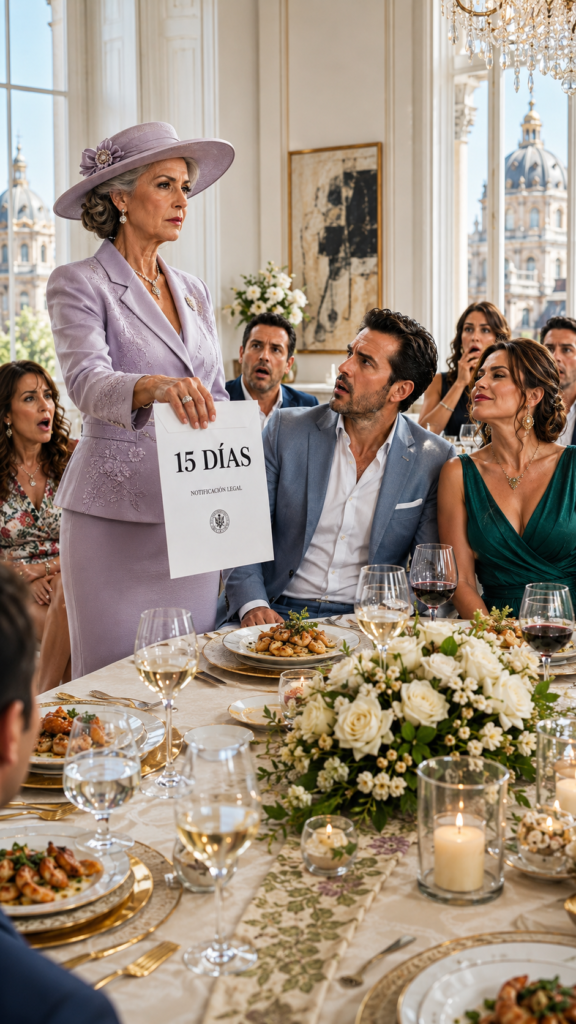
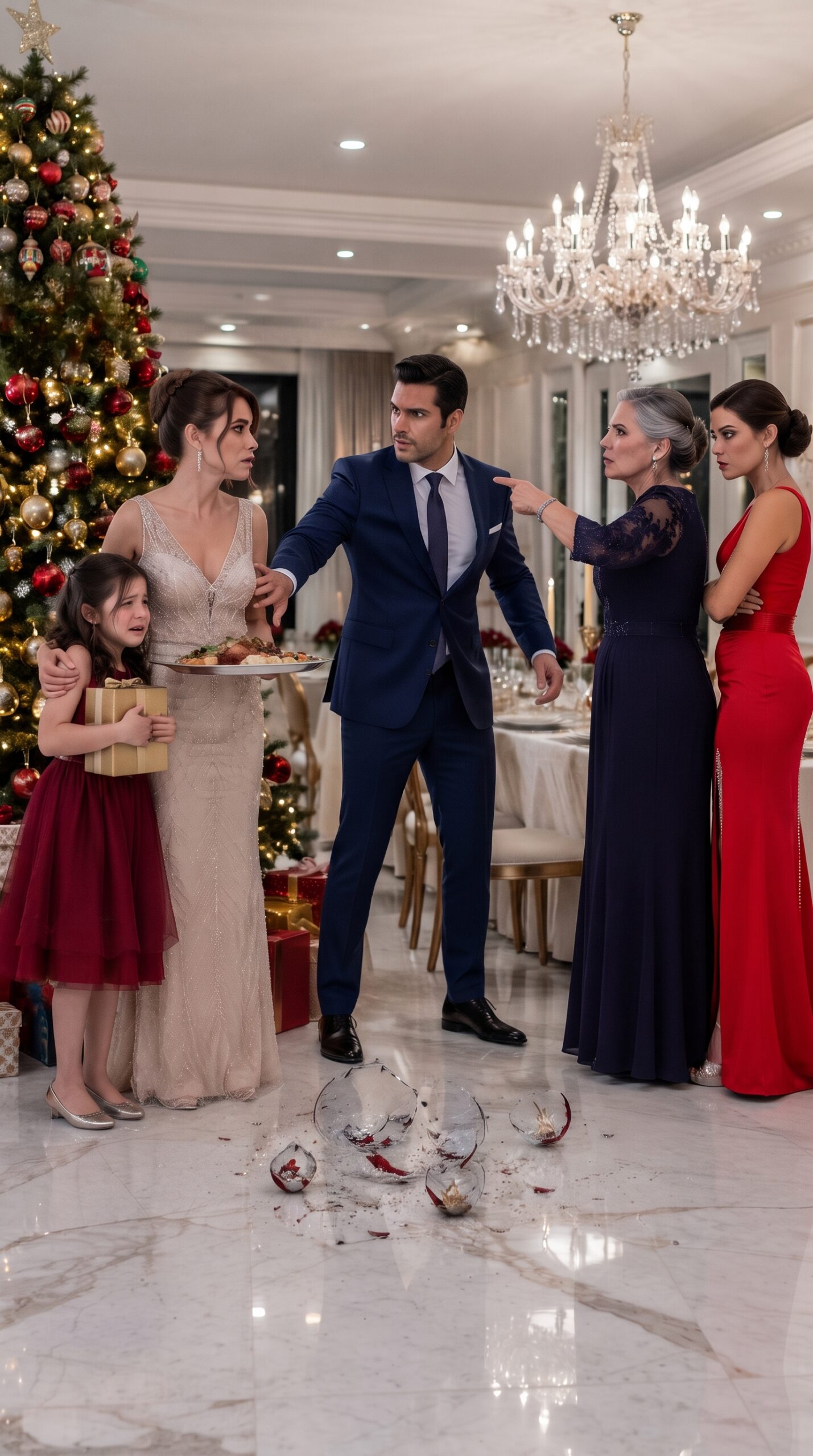
The same woman who, four years ago, had looked at Sofía in a marble dining room and said:
—Women like you are meant to entertain a man, dear. Not to give a name to a family.
Alejandro didn’t defend her.
Not that day.
Not when his mother demanded the divorce.
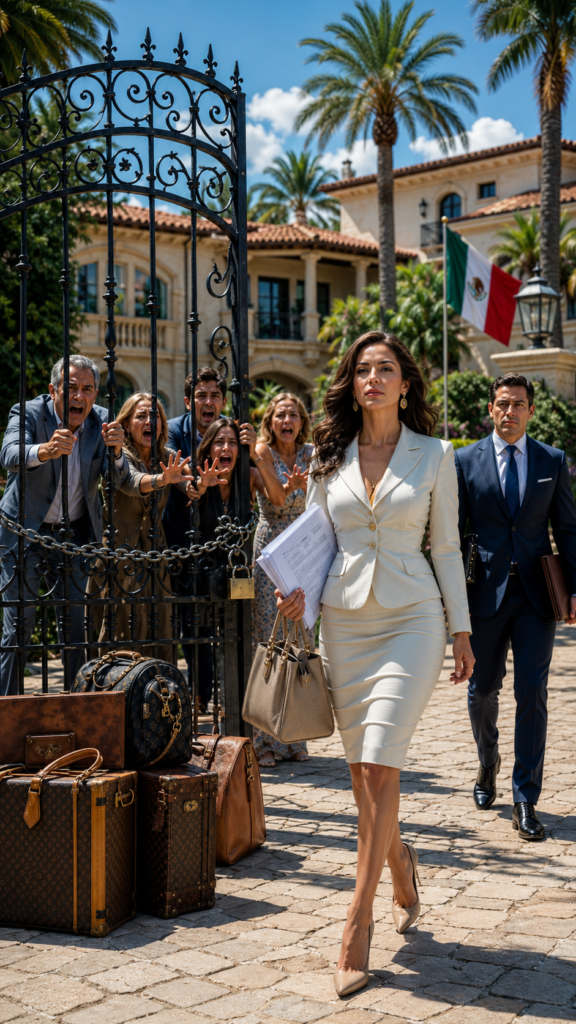
Not when the lawyers removed her from the mansion as if she were a fired employee.
But there was something nobody knew.
Sofía left pregnant.
With three children.
Triplets.
For four years, she hid because she knew the power of that family. She was aware of their lawyers, their contacts, their judge friends, and their way of turning money into a weapon.
If Doña Victoria found out, she wouldn’t see babies.
She would see heirs.
And Sofía was sure she would try to take them.
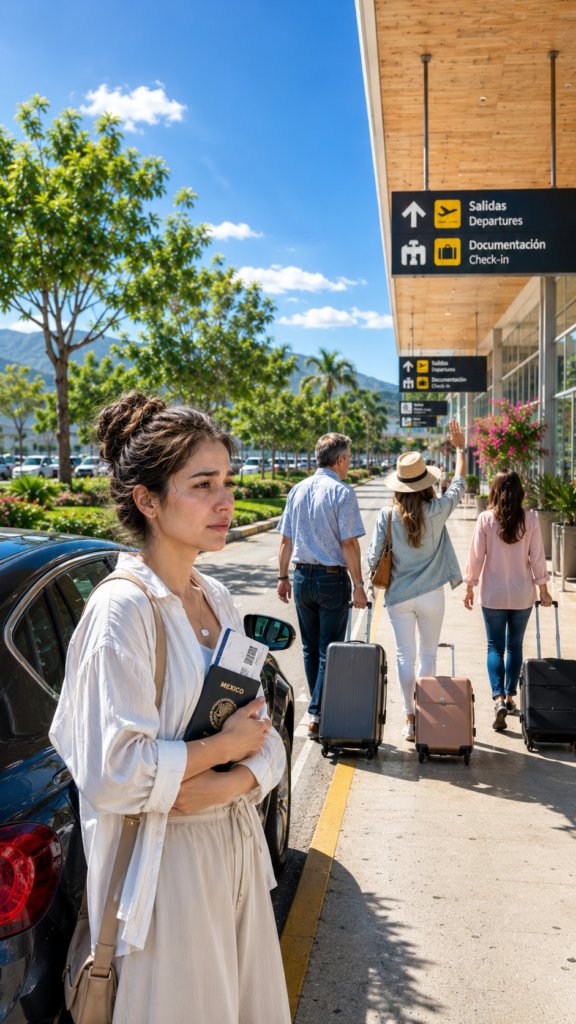
So she ran.
She worked 18-hour shifts, running digital campaigns from a borrowed laptop. She answered calls while warming bottles, closed contracts with a sleeping child on her chest, and cried silently in the bathroom so as not to wake anyone.
But she didn’t break.
She built a marketing agency so strong that she started managing small brands and ended up advising companies in Mexico, Miami, and Madrid.
By the time her children turned three, Sofía was no longer “the girl without a surname.”
She was a CEO.
And quite wealthy, to the frustration of anyone who had humiliated her.
—Mommy, what is that? —Leo asked, tugging at her skirt.
Behind him, Mateo and Bruno fought over a plastic dinosaur on the carpet.
All three had Alejandro’s gray eyes.
The same dark, wavy hair.
The same small jaw that appeared in all the old portraits of the De la Vega family.
Sofía looked at the invitation.
Then at her children.
—It’s a family gathering —she said softly.
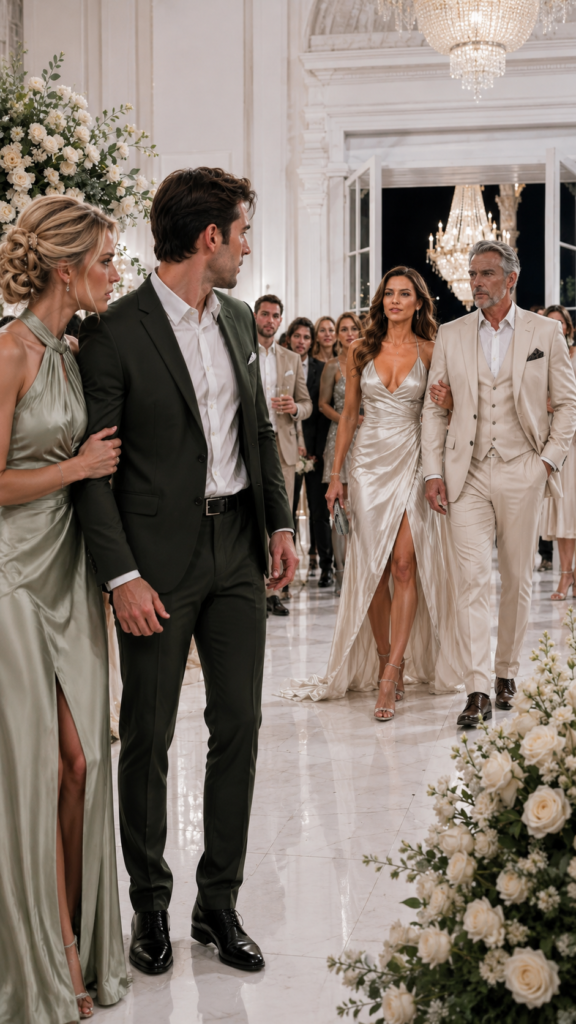
On Saturday, the wedding took place at a private estate in Valle de Bravo.
Perfect gardens, white roses, discreet bodyguards, politicians, businessmen, women adorned with diamonds before sunset, and waiters serving champagne as if it were water.
Doña Victoria had placed Sofía at table 22.
Next to the service entrance.
Far from the photos.
Close to the kitchen.
She invited her to see her alone, defeated, forced to watch as Alejandro married someone “of his level.”
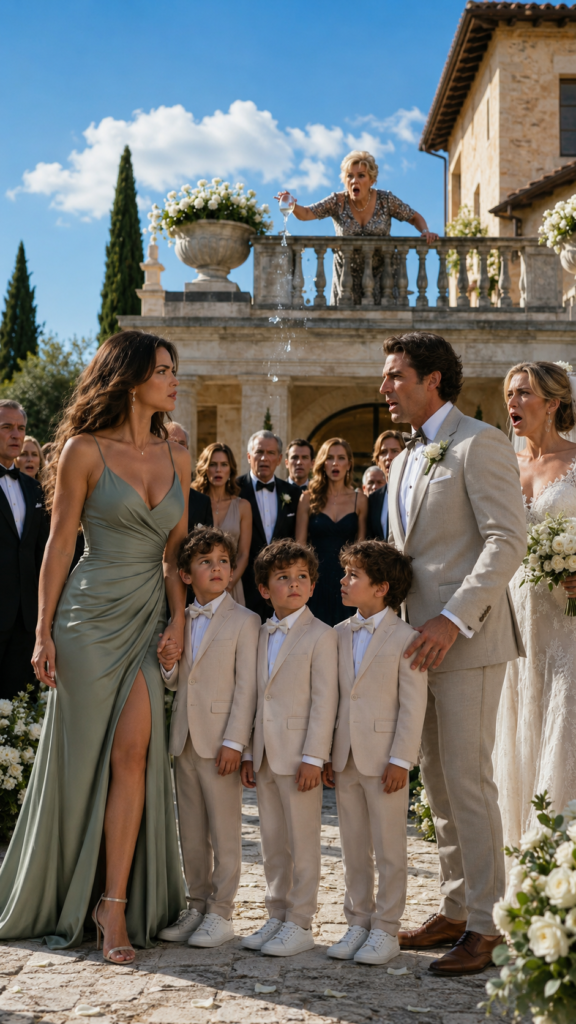
But when the guests heard three black SUVs screech to a halt in front of the garden, conversations hushed.
First, Sofía stepped out.
Emerald green dress, impeccable heels, hair up, and a calm that pained to behold.
She didn’t look like a broken woman.
She looked like a sentence.
Then she opened the back door.
Leo stepped down first, in a tailored navy suit.
Next was Mateo.
Then Bruno.
Three three-year-olds, standing together, identical to the groom.
The entire garden fell silent.
A glass fell to the floor.
A bridesmaid covered her mouth.
Alejandro, dressed as the groom at the end of the aisle, lost all color in his face.
Doña Victoria, from the balcony, dropped her crystal glass.
And when Renata, the bride, saw the three children, she took a step back, the veil trembling in her hands.
Then Sofía took her children’s hands and walked toward the altar, as everyone understood that this wedding had just become something no one could believe.
PART 2
Sofía didn’t raise her voice.
She didn’t make a fuss.
She didn’t need to.
Every step on the path of white petals sounded louder than any scream.
The guests parted as if an invisible current pushed them aside. The children walked calmly, a bit confused by all the stares, but glued to their mother.
Alejandro remained frozen.
His eyes jumped from Sofía to the children, from the children to Sofía, as if his brain couldn’t piece together what his heart had already understood.
—Sofía… —he murmured.
Doña Victoria rushed down the balcony stairs, her face rigid.
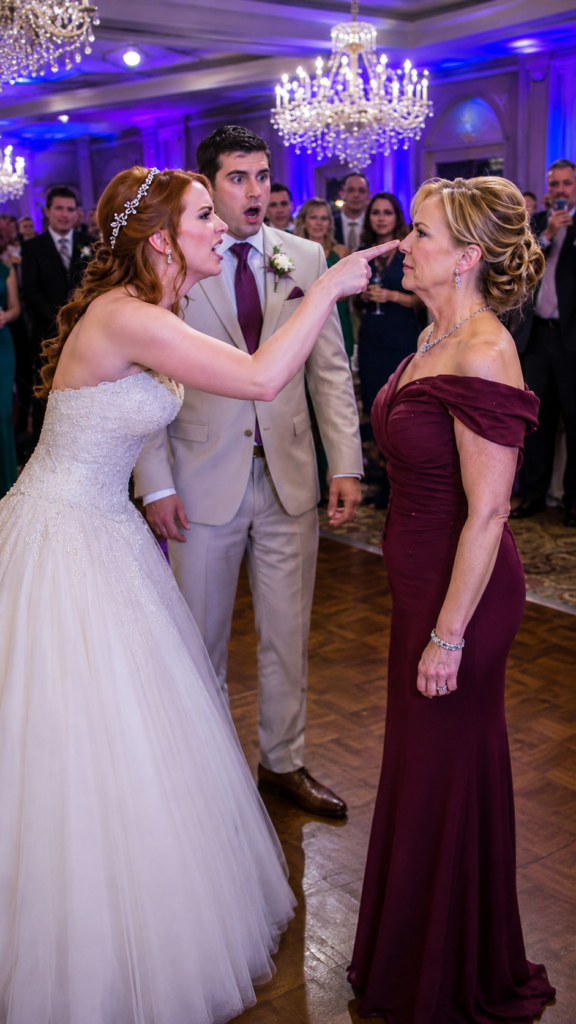
—What vulgarity is this? —she spat, trying to regain her queenly tone—. Are you here to ruin a wedding with children we don’t even know whose they are?
An uncomfortable murmur spread through the garden.
Renata looked at Alejandro.
—What does this mean? —she asked, her voice breaking.
Sofía stopped in front of the altar.
Leo squeezed her hand.
—Calm down, my love —she said, leaning slightly—. No one is going to hurt you.
That phrase fell like a stone.
Because it wasn’t for the children.
It was for Doña Victoria.
Alejandro stepped toward them.
—Are they…?
He couldn’t finish.
Sofía pulled a black folder from her bag and placed it on the table where the floral arrangements were.
—They are Leo, Mateo, and Bruno Benítez —she said—. They are three years old. And yes, Alejandro. They are your children.
The bride dropped her bouquet.
Doña Victoria turned pale but immediately lifted her chin.
—Anyone can say that. In this family, we don’t accept blackmail.
—How curious —Sofía replied—. That same phrase appeared in the email your lawyer sent me four years ago.
Victoria’s face changed slightly.
Almost nobody noticed.
But Sofía did.
Alejandro frowned.
—What email?
Sofía opened the folder and pulled out a sheet.
—The one that said if I tried to claim anything from the marriage, you would accuse me of fraud, infidelity, and mental instability.
Alejandro shook his head slowly.
—I never saw that.
—Of course not —Sofía said—. You never saw anything when it came to your mother.
A soft “oof” was heard among the guests.
Doña Victoria pressed her lips together.
—Don’t allow this, Alejandro. You’re marrying Renata today. This woman only wants money.
Sofía smiled without joy.
—I already have money, ma’am.
She pulled out another sheet.
—Private DNA. Certified. 99.99% compatibility with the De la Vega paternal line. I did it two months ago, with a legal sample taken when Alejandro donated blood at the family foundation.
Alejandro looked at her, stunned.
—You knew I was coming?
—No. But I knew that one day you would cross my path again.
Renata slowly removed her veil.
—Alejandro, tell me the truth. Did you know she was pregnant?
—No —he said, his voice breaking—. I swear I didn’t know.
For the first time, Sofía saw something different in his eyes.
Not defense.
Not pride.
Fear.
And guilt.
But the true explosion came from where no one expected it.
Renata turned to Doña Victoria.
—You knew, didn’t you?
The garden went cold.
Doña Victoria feigned indignation.
—Don’t be ridiculous, girl. That woman disappeared because she wanted to.
Renata raised a trembling hand.
—No. I saw a document.
Alejandro looked at her.
—What document?
Renata swallowed hard. A tear ran down her cheek, but she didn’t look away.
—Three weeks ago, when I was asked to sign the prenuptial agreement, the lawyer left an incorrect folder in the study. There was a report from a clinic in Guadalajara. It said “probable multiple pregnancy.” The name was Sofía Benítez.
Sofía felt the air burning in her chest.
She never knew that Victoria had proof.
Never.
Alejandro turned to his mother.
—Mom…
Doña Victoria stiffened.
—I did what I had to do to protect the name.
There the farce ended.
The guests began to murmur loudly.
An aunt crossed herself.
Renata's father, a retired senator, looked at the matriarch as if he had just seen trash beneath an expensive dress.
—Protect it from your own grandchildren? —Renata asked, her voice nearly gone.
Victoria pointed at Sofía.
—That woman was not going to raise De la Vega heirs in a rented apartment! Not with that family, not with that blood!
Leo hid behind Sofía.
Mateo asked quietly:
—Mommy, is that lady mad at us?
Alejandro’s face crumpled.
It was a simple question.
From a child.
But it hit harder than any legal claim.
He crouched down in front of them, slowly, without touching them.
—No, champ —he said, his throat tight—. You didn’t do anything wrong.
Sofía looked at him sternly.
—Don’t promise them anything if you’re not going to follow through.
Alejandro closed his eyes.
For years he had been the obedient son. The comfortable heir. The man who let his mother decide for him because it was easier than fighting.
But in front of three children who had his same face, that cowardice no longer seemed like elegance.
It seemed like misery.
Doña Victoria tried to take control.
—Alejandro, get up. You’re making a fool of yourself in front of everyone.
He didn’t stand.
—No, Mom. The one who made a fool of herself is you.
The silence grew heavy.
No one in that family had ever spoken to Victoria De la Vega like that in public.
Never.
—What did you say?
Alejandro stood up.
—I said it’s over.
Renata, still in her wedding dress, wiped her tears.
—I’m not marrying a man who needs to find out at the altar that he has children. And I’m certainly not joining a family that is capable of hiding babies for convenience.
She took off the ring.
She left it on a silver tray.
The sound was small.
But it shattered a million-dollar alliance.
Doña Victoria lost her composure.
—Renata, don’t be dramatic. Your family and ours…
—My family doesn’t negotiate with children —she interrupted.
Renata's father signaled his bodyguards with a glance. In less than a minute, several political guests began to withdraw.
The perfect wedding bled out in front of everyone.
Sofía took her children.
—Let’s go.
Alejandro stopped her with his voice, not with his hand.
—Sofía, please. Let me talk to you. Let me meet them.
She turned around.
—Now?
He looked down.
—Yes. Late, horrible, like an idiot… but yes.
Sofía took a deep breath.
She didn’t want to see him suffer.
She wanted him to understand.
That he was different.
—When I was alone with three newborns, you were in social magazines smiling at foundation dinners —she said—. When one of them had a 102-degree fever, I drove alone to the hospital at 3 AM. When I couldn’t afford diapers, I sold my wedding ring. When all three cried at the same time, none of the De la Vega family showed up to hold one.
Alejandro was shattered.
—I didn’t know.
—No —Sofía said—. But you never asked.
That was worse.
Because it was true.
Doña Victoria let out a bitter laugh.
—Oh, please. Are we all going to cry over this soap opera now? If they are Alejandro’s, it gets fixed. They get a surname, a trust, and an education. You, Sofía, sign shared custody, and we leave this theater.
Sofía looked at her like one looks at a door that is finally going to close.
—I didn’t come to negotiate my children.
She pulled out a small USB drive.
—I came because my lawyer has already filed a complaint for threats, concealment of medical information, manipulation of evidence, and harassment. And because the legal department of my company found payments from your office to a private investigator who followed me during my pregnancy.
Victoria blinked.
Alejandro turned to her.
—You followed her?
Sofía nodded.
—They followed me to Puebla. That’s why I went to Chicago. That’s why I changed my business name. That’s why my children grew up without a father.
The retired senator, who still hadn’t left, asked to see the USB.
Sofía didn’t hand it over.
—The prosecution already has it.
For the first time, Doña Victoria couldn’t find a poisonous phrase.
She simply looked around.
And understood that everyone was watching her.
Not as matriarch.
As a monster.
The photographers, who had been hired to capture luxury, were documenting ruin.
The next day, there was no wedding cover.
There was scandal.
“Hidden heirs appear at De la Vega wedding.”
“Bride cancels wedding after discovering family deception.”
“Mexican entrepreneur reveals harassment by powerful Monterrey clan.”
But what hurt the most didn’t make the press.
It happened two weeks later, in a private family mediation room.
Alejandro arrived without his mother’s lawyers.
Without an ostentatious watch.
Without arrogance.
He brought three small backpacks filled with toys, stories, and sweatshirts.
Sofía watched him from across the table.
—I’m not going to fight for custody —he said before she spoke—. Not yet. Not like this. I want to earn the right to be close. If you allow me.
Sofía didn’t respond immediately.
Not because she doubted her power.
But because her children deserved something more complicated than revenge.
—You’ll start with supervised visits —she finally said—. Without your mother. Without photographers. Without a surname used as a trophy.
Alejandro nodded.
—I accept that.
—And they will decide over time how to address you.
He squinted.
—I accept that too.
From the hallway, Leo, Mateo, and Bruno watched him with curiosity.
Not with love.
Not yet.
But also not with fear.
And that, for Sofía, was already enough.
Doña Victoria never entered the family home again.
The board forced her to resign from the foundation. Her friends stopped answering her calls. The women who once laughed at her cruel comments now crossed the street to avoid greeting her.
Renata, far from being seen as a dumb victim, broke her silence in an interview and said a phrase that went viral:
“A wedding can be canceled. A robbed childhood cannot.”
Months later, Sofía took the children to Lincoln Park in Polanco. Alejandro arrived with three vanilla ice creams and a heart tied in knots.
Bruno was the first to approach.
—Are you the man who looks like us?
Alejandro smiled with tears in his eyes.
—Yes, champ. I think so.
Sofía watched them from a bench.
She didn’t forgive everything.
Not yet.
Maybe never.
But she had learned that justice doesn’t always sound like a slamming door.
Sometimes it sounds like three children laughing, as a powerful family understands too late that no surname is worth more than a mother who refused to hand over her children.