PART 1
"Sign today, Mariana. After this, your dad stops being a problem."
Gerardo said it with a calmness colder than a scream. He stood in the kitchen of their apartment in Del Valle, dressed in an ironed shirt, an expensive watch, and that understanding husband smile he always wore when he wanted her to obey.
Mariana Aguilar was 42 years old and had spent the last two years believing her husband was protecting her from a family that no longer wanted her.
That morning, they had an appointment at 10 at a notary in the Historic Center. According to Gerardo, she just needed to sign the sale of her 35% shares in Textiles Aguilar, the medical uniform factory her father, Don Efraín Aguilar, had built in Naucalpan over 40 years.
"Your dad is finished," he insisted, pouring her some coffee. "The factory is in debt, the suppliers are breathing down our necks, and you don’t have to sink with an old fool."
Mariana stared at the cup without touching it.
For months, the coffee left her with a strange heaviness, as if her body didn’t belong to her anymore. Gerardo said it was anxiety. That she was fragile. That’s why he had to take care of everything.
Before she died, her mother had told her in the hospital: "Don’t give away those shares. They are your defense."
Mariana thought it was delirium from the medications. Gerardo took it upon himself to repeat the opposite until he convinced her: her dad had forgotten her, blamed her for not working at the factory, and would only come looking for her when he needed money.
He also assured her that no letters ever arrived, that calls were lost, that Don Efraín was proud and spiteful.
Little by little, Mariana stopped calling.
Little by little, she believed she no longer had a father.
At the notary, they were greeted by Arturo Salcedo, Don Efraín's partner and Gerardo's close friend. He was an elegant man, dressed in a blue suit, shiny shoes, and a smile of someone who always collects before greeting.
"Marianita," he said, kissing her cheek. "Today this nightmare ends."
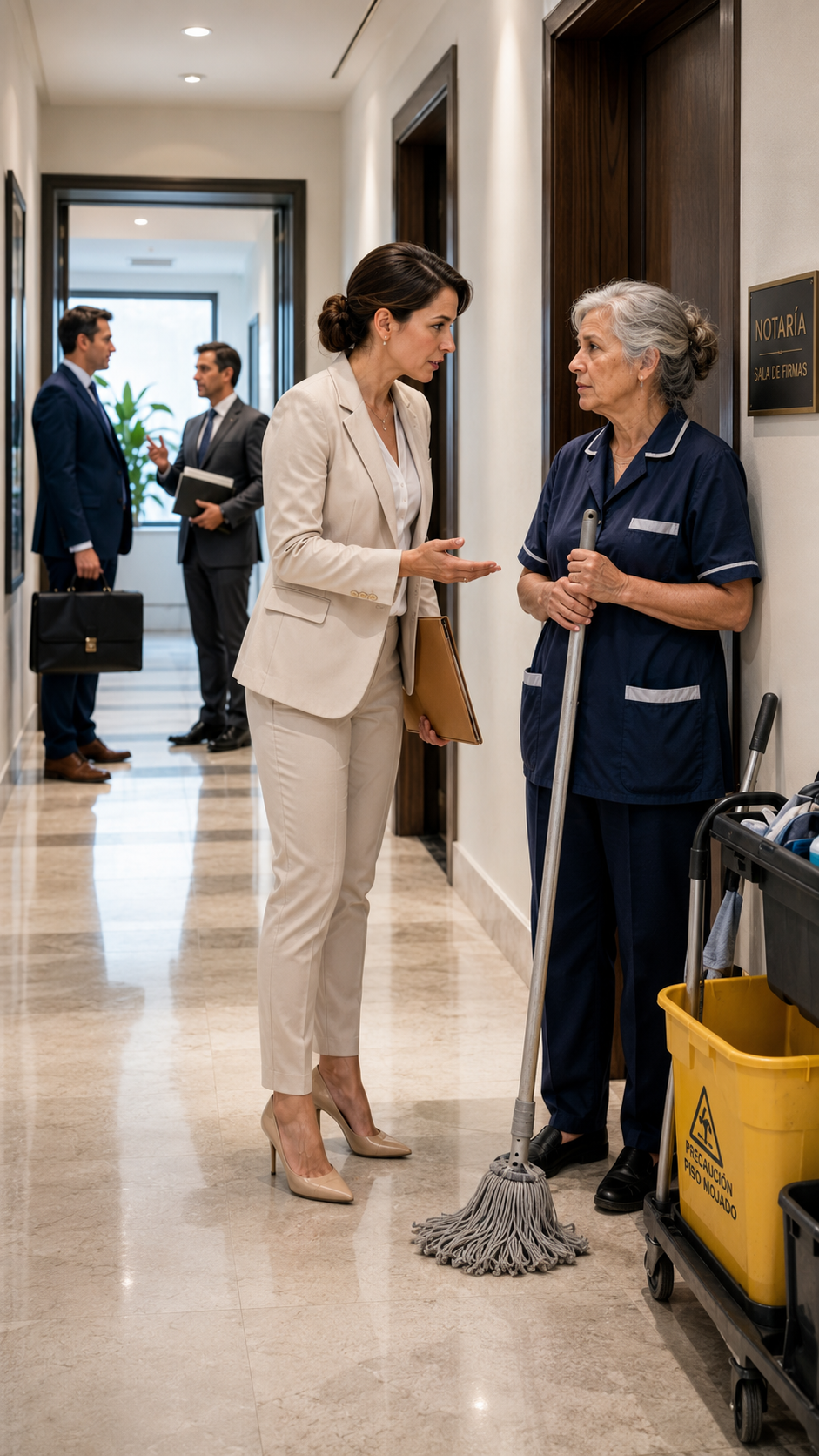
Gerardo and Arturo entered the notary's office first to review "the final details." Mariana was left alone on a bench in the hallway, clutching her bag against her chest.
The place smelled of bleach, old paper, and reheated coffee.
Then an older woman appeared, short, with white hair tied up, wearing a gray apron and rubber sandals. She mopped slowly, as if no one could see her.
As she passed by Mariana, she murmured without looking up:
"Are you Don Efraín's daughter?"
Mariana tensed.
"Yes."
The woman continued mopping, turned around, and upon returning, dropped a dirty rag over Mariana's lap.
"Go to the bathroom," she whispered. "And don’t sign anything."
Mariana trembled as she entered the restroom. She closed the last stall and unfolded the wet rag. Something small fell into her hand.
It was a USB drive.
It had a label written in black marker:
"Watch it before you sign."
When she emerged, Gerardo was already waiting for her outside the office.
"All set, love. Just go in and sign."
Mariana placed a hand on her stomach.
"I feel sick."
Gerardo's smile vanished.
"Don’t start with your nonsense."
"I can’t sign like this."
Arturo stepped out behind him. The two exchanged a quick glance filled with a fear Mariana had never seen in them.
And then she understood that the dirty rag didn’t bring trash.
It carried a truth capable of destroying them.
PART 2
Gerardo wanted to take her straight home, but Mariana pretended to feel dizzy and asked to stop by a pharmacy. As soon as he went down to buy her pills, she hopped into another taxi and gave an address in Roma Sur.
There worked Lorena, her best friend from high school, in a small print, copy, and computer repair shop.
Mariana arrived with her dress clinging to her body from the drizzle, her face pale, and the USB drive clenched in her fist.
Lorena looked up and gasped.
"What happened to you, girl?"
Mariana laid the rag on the counter.
"I need to open this. And close the curtain."
Lorena asked no questions. She shut the shop, locked the door, and plugged the USB into the back computer.
There were four folders: contracts, invoices, letters, and audio files.
First, they opened contracts.
Mariana expected to find debts, lawsuits, red numbers. But on the screen appeared recent orders from hospitals in Monterrey, Guadalajara, Puebla, and Mérida. Signed contracts, advance payments, large orders for surgical uniforms.
The factory was not bankrupt.
The factory was worth more than ever.
Lorena leaned closer to the screen.
"Mariana, seriously, this isn’t ruin. This is a goldmine."
Next, they opened invoices.
They were the same documents Gerardo had shown her for months to scare her. Alleged debts, supposed suppliers, supposed lawsuits. Lorena searched for the tax data and frowned.
"All these companies have the same address. And several don’t even exist. This smells like a shell company, girl."
Mariana felt a cold jolt in her chest.
Then came the letters.
There were seven scanned letters, all signed by Don Efraín. The handwriting was large, crooked, shaky, just as she remembered from childhood.
"Daughter, I don’t know why you don’t answer anymore. If I did something that hurt you, come and tell me to my face. The factory has never been worth more than you. I’m waiting for you."
Mariana covered her mouth.
For two years, she had cried thinking her dad despised her. For two years, Gerardo had held her close saying, "There are fathers who don’t know how to love."
But her father had looked for her.
Someone had buried every attempt.
The last folder was worse.
Lorena opened the audio files.
Gerardo's voice filled the shop.
"She’s about to sign. I’ve kept her isolated for two years. I controlled calls, letters, medications, everything. She believes her dad abandoned her."
Then Arturo’s voice was heard.
"With her 35%, we reach 60%. We get the old man out, sell the machinery, liquidate the staff, and in six months, the land is clean for the real estate company."
Gerardo let out a low laugh.
"And don’t forget my commission. I didn’t marry Mariana for love, buddy."
Lorena turned off the audio as if it burned her fingers.
Mariana didn’t scream.
She didn’t cry.
She stood still, eyes wide open, as if she had just woken up inside a burning house.
"Print everything," she said. "And make three copies."
Then she picked up the phone in the shop and called her father.
Don Efraín answered on the fifth ring.
"Hello?"
His voice sounded tired, older than Mariana remembered.
"Dad... it’s me, Mariana."
There was silence.
Then she heard a sob he tried to hide.
"Daughter."
Mariana closed her eyes.
"I’m coming over. Please don’t hang up."
"I won’t hang up. I’ll wait for you with coffee. Just like before."
She arrived in Naucalpan almost at dusk. Don Efraín's house still stood next to the factory, with the same green door, the same clay pots, and the same smell of machine oil.
When he opened the door, Mariana saw a thin man with white hair and eyes filled with broken hope.
They didn’t speak.
They just embraced.
It was a long, awkward, painful hug. A hug weighed down by two years of lies.
Mariana placed the documents on the table.
"Dad, forgive me. You need to see this."
Don Efraín listened to the audios with his jaw clenched. When Gerardo talked about isolating her, he shut his eyes. When Arturo mentioned selling the machinery, he slammed his fist on the table.
"That bastard ate in this house. Your mother served him mole on birthdays."
Mariana told him about the woman with the rag.
Don Efraín paled.
"It must be Doña Amparo. She worked 25 years in the archives. Arturo fired her when she started reviewing documents she shouldn’t have."
That same night, the factory's fired accountant and a lawyer named Jimena Vélez, recommended by Lorena, arrived.
Jimena reviewed everything in silence.
"There’s fraud, coercion, forgery, fraudulent administration, and manipulation of correspondence," she said. "But to catch them properly, they must believe that tomorrow Mariana is going to sign."
Mariana looked at her father.
"Back to the notary?"
Jimena nodded.
"Yes. This time the trap won’t be for you."
The next morning, Gerardo woke up sweetly.
He made coffee, fixed her hair, and spoke to her as if nothing was wrong.
"Today we finish this, love. Afterwards, we’ll go away for a few days to Los Cabos. You need to rest."
Mariana left the cup untouched.
In the taxi, he took her hand. She didn’t pull away. Sometimes, to survive, a woman must remain still until the predator steps right into the trap.
The notary looked the same.
The same beige hallway. The same smell of bleach. The same bench. Arturo awaited them in his immaculate suit and a red handkerchief in his pocket.
"Now, Marianita," he said. "Today the drama ends."
They entered the office.
Gerardo stopped dead in his tracks.
Don Efraín was by the window.
Beside him were Licenciada Jimena, the accountant, Doña Amparo with her gray apron, and two agents from the Prosecutor’s Office. On the desk lay folders, printed copies, three USB drives, and a formal request to suspend any proceedings.
Arturo tried to laugh.
"What nonsense is this?"
One of the agents stepped forward.
"No one is signing anything, Mr. Salcedo."
Jimena placed a sheet in front of the notary.
"We request to suspend the operation due to indications of fraud and coercion against my client."
The pale notary read the documents.
"With this, I cannot authorize any transfer."
Gerardo looked at Mariana.
"What did you do?"
She held his gaze.
"What I should have done two years ago. Listen to the truth."
Arturo slammed his fist on the desk.
"Those recordings are useless."
Doña Amparo lifted her chin.
"You spoke in the office as if I were part of the mop. I cleaned, sir, but I wasn’t deaf."
Arturo pointed at her with disdain.
"Old meddler."
Don Efraín stepped toward him.
"That woman in sandals had more dignity than you in a suit."
Then Jimena played the audio.
Gerardo's voice echoed in the office:
"I’ve kept her isolated for two years..."
Then came the laughter.
"I didn’t marry Mariana for love."
The silence that followed was brutal.
Mariana finally cried. It wasn’t a weak cry. It was a furious, old cry, as if they were tearing away a bandage stuck to an infected wound.
Gerardo lowered his head, not out of guilt, but because he no longer wore a mask.
When the agents asked him to turn around, he still tried to approach.
"Mariana, I’m your husband."
She stepped back.
"No. You are the man who slept next to me while stealing my life."
They also detained Arturo. He shouted names, contacts, threats, and political favors. No one responded. His red handkerchief ended up on the floor, stepped on by Doña Amparo’s sandal.
In the following weeks, the investigation uncovered more fake invoices, hidden transfers, and emails where they planned to empty the factory before selling the land. Gerardo had blocked numbers, intercepted letters, and changed medications to keep Mariana confused and exhausted.
Mariana returned to the apartment once, with Jimena and two witnesses.
On the refrigerator were notes from Gerardo:
"Forgive me."
"Your dad is manipulating you."
"Without me, you won’t be able to."
She ripped them one by one and tossed them in the trash.
She left her ring on the table with a note:
"I will never sign my life away for anyone again."
The factory wasn’t saved in a day. There were audits, lawsuits, distrustful suppliers, and frightened employees. But Mariana stayed.
She learned about contracts, payroll, antibacterial fabrics, bids, and industrial machines. Don Efraín taught her how to distinguish good stitching from cheap. She taught him how to use video calls and spreadsheets.
The accountant was reinstated.
Doña Amparo was made in charge of the archives and internal control.
No one treated her as invisible again.
A month later, Mariana saw the gray rag folded inside a transparent box, next to the first USB drive.
"Did you keep it?" she asked.
Doña Amparo smiled.
"Of course. Some things look like trash until they save a family."
Mariana hugged her.
"You saved me."
The woman patted her on the back.
"No, daughter. I just gave you the rag. You chose not to sign."
That afternoon, Mariana and her father walked through the main hall. The machines were running. Employees were cutting white fabric. Boxes were being shipped to hospitals in Puebla, Monterrey, and Querétaro.
The noise was loud, but to Mariana, it sounded like music.
Don Efraín stopped in front of the first machine he bought with his wife.
"Your mom knew," he said. "That’s why she left you those shares."
Mariana touched the cold metal.
"And I almost handed them over."
"But you didn’t."
She learned that not all thieves break in through doors. Some kiss your forehead, make you coffee, tell you that you’re exaggerating, and convince you that everyone has abandoned you.
And she also learned that the truth doesn’t always come dressed in a suit, with a seal, or authority.
Sometimes it arrives in the hands of a tired woman, wearing rubber sandals, holding a bucket and a dirty rag.
That’s why many later wondered what hurt more: losing an inheritance or discovering that the person sleeping next to you had been planning to sell you in silence for two years.