PART 1
The rain hammered against the windows of an elegant house in Lomas de Angelópolis, Puebla. From the outside, that family looked perfect: a spacious residence, two cars in the garage, kids studying in private school, and a couple smiling in their Christmas photos.
But inside that house, Mariana was no longer sleeping.
That night, she sat in the living room, watching her children, nine-year-old Sofía and six-year-old Diego, play on the rug with an old tablet. The kids giggled softly, unaware that their mother had been counting every movement of their father for days, like someone listening for footsteps behind a closed door.
In the kitchen, Esteban hummed a tune while stirring pots.
He wore a black apron he'd never used before. He chopped onions, heated tortillas, and spoke with a fake sweetness that sent chills down Mariana’s spine.
“Tonight I made carne en su jugo, just like in Guadalajara,” he called from the kitchen. “You’re going to love it.”
Any wife would have smiled.
Mariana did not.
Because Esteban never cooked. For eleven years, he had claimed the kitchen was for women, for maids, for those without “business vision.” He couldn’t even make coffee without complaining.
But for the past two weeks, he had been coming home early, washing his hands with exaggerated calm, and blocking the kitchen entrance with his body.
“Don’t come in, love. It’s a surprise.”
At first, Mariana wanted to believe it was guilt. Esteban had debts, came home late, drank too much, and hid his calls. Perhaps he was trying to compensate for his yelling, his absences, his lies.
But one afternoon, she saw something.
A white residue by the sink.
Esteban cleaned it up too quickly.
“What is that?” she asked.
“Flour, come on. You know how intense you are.”
That word stuck in her like a dagger.
Intense.
That’s what he called her every time she suspected.
That dawn, while Esteban slept, Mariana entered his study. She searched for receipts, IOUs, threats from collectors. What she found inside a gym bag nearly stopped her heart.
There was a small jar with clear liquid.
And next to it, three new life insurance policies.
One in Mariana’s name.
One in Sofía’s name.
One in Diego’s name.
The sole beneficiary was Esteban.
The total amount was 16,500,000 pesos.
Mariana sat on the cold floor, papers in hand. She didn’t cry. She didn’t scream. She couldn’t even breathe properly.
She thought about running away that very night.
But she knew Esteban. He had contacts, lawyer friends, and a family that always defended him. If she spoke without proof, they would all say she was crazy.
So she did the only thing a desperate mother could do.
She pretended.
Every dinner became a silent battle. Esteban served Mariana’s plate and the kids’ first. His he left aside on the counter, as if it were protected.
When he went for beer, napkins, or salsa, Mariana switched the plates.
She gave Sofía and Diego sweet bread, fruit, or small quesadillas first so they wouldn’t eat much.
“Mommy, why don’t we have dinner normally anymore?” Sofía asked one night.
Mariana kissed her forehead.
“Because mommy is keeping you safe, my love.”
That Friday afternoon, Mariana found the empty jar in the guest bathroom trash.
Empty.
When Esteban placed the plates on the table and smiled as if he were serving love, Mariana felt her blood freeze.
“Eat, family,” he said. “Tonight I want to see clean plates.”
Then Mariana looked at her children, glanced at Esteban’s plate on the counter, and understood there wouldn’t be another chance.
“Love,” she whispered, “can you bring me lime and salsa?”
Esteban smiled.
“Of course, my life.”
As he turned away, Mariana swiftly and silently swapped the plates.
And when Esteban returned, he took the plate he thought was safe, sat down in front of his children, and took the first big spoonful.
Mariana couldn’t believe what was about to happen at her own table.
PART 2
Esteban chewed slowly, as if savoring every second of his supposed triumph. He looked at Mariana with a chilling calm, then glanced at the kids.
“How is it?” he asked. “Isn’t Dad a better cook than you thought?”
Diego tried to smile but barely touched his food. Sofía had her eyes fixed on her mother. She was no longer a distracted child; she had understood that something was wrong, even if she couldn’t name it.
Mariana brought a minuscule piece to her mouth. She chewed without swallowing much. She had her phone hidden in her lap, the emergency number ready.
For five minutes, nothing happened.
Esteban kept eating.
Then his smile began to fade.
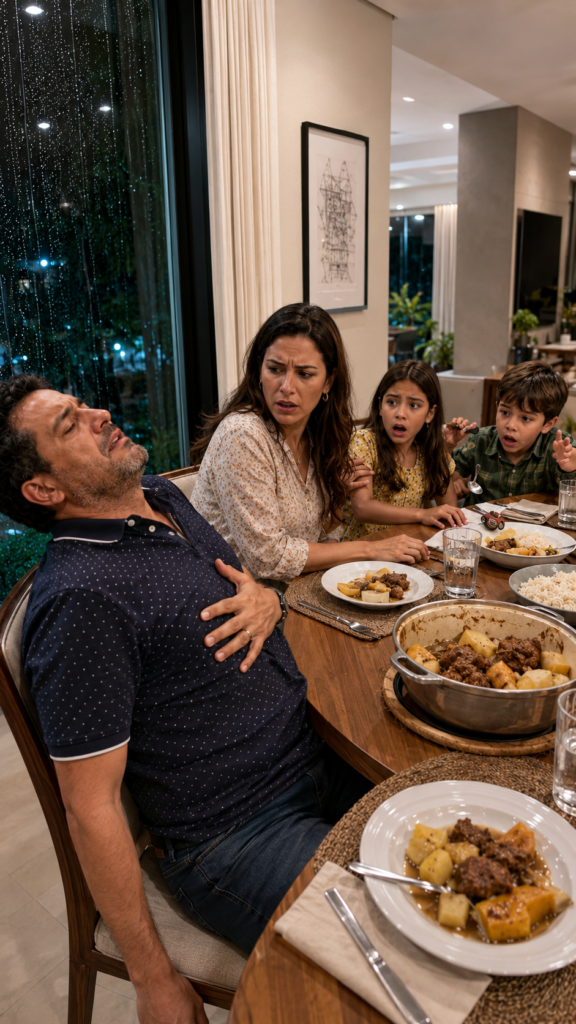
First, he touched his neck. Then his chest. Then he dropped his fork onto the plate with a loud clatter that made Diego jump.
“Esteban?” Mariana asked, her voice unnervingly calm.
He tried to respond, but only a hoarse sound came out.
His forehead broke into a sweat. His lips lost color. He wanted to stand up, but the chair scraped violently against the floor.
“Water… Mariana… water…”
Sofía screamed.
Diego leaned back and started to cry.
Esteban took two clumsy steps, put a hand on the table, and collapsed beside the dining room with his eyes wide open, his body trembling.
Mariana dialed 911.
“My husband collapsed during dinner,” she said. “There are two minors in the house. We need an ambulance and the police. I suspect poisoning.”
On the other end of the line, there was a short silence.
“Do you know what he consumed?”
Mariana looked at the plate.
Then she looked at Esteban.
“The same thing he wanted us to eat.”
Esteban, lying on the floor, managed to hear her. His eyes filled with terror.
“What did you do?” he murmured.
Mariana crouched at a safe distance. She no longer looked at him as a wife. She saw him as a stranger who had entered her home wearing her husband’s face.
“I didn’t do anything, Esteban. You made dinner.”
He tried to shake his head.
“You switched the plates…”
Mariana felt a blow to her chest upon hearing it.
It wasn’t a question.
It was a confession.
The ambulance arrived eleven minutes later. Behind it came a patrol car. The paramedics lifted him onto a stretcher while the police cordoned off the kitchen.
A neighbor, Doña Malena, came out into the hallway in her robe and slippers.
“What happened, Mariana? Are the kids okay?”
Mariana hugged Sofía and Diego against her body.
“They are.”
That answer was enough for everyone to understand that something terrible had occurred.
An officer inspected the table. Another took pictures of the plates. Mariana handed over a bag with copies of the policies, photographs of the jar, and screenshots of bank messages showing Esteban receiving payments for loans she had never authorized.
“Why didn’t you report him sooner?” the officer asked.
Mariana swallowed hard.
“Because everyone believes him. He’s a businessman. He’s charming on the outside. I’ve been called exaggerated for years.”
That same night, Esteban was taken to the hospital under custody. He didn’t die, but tests confirmed he had ingested a toxic substance. Later, forensic experts found compatible remnants on the plate he had used.
The problem for Esteban was that this plate wasn’t his.
It was the one he had served for Mariana.
When the news reached the family, the real hell began.
Doña Rebeca, Esteban’s mother, arrived at the hospital with a rosary in her hand and a fury that made everyone turn.
“Mariana, you wretched woman!” she screamed. “You wanted to kill my son to keep the house!”
Mariana sat with the kids in the waiting room. Sofía hid behind her. Diego covered his ears.
“Don’t shout in front of my children,” Mariana said.
“My grandchildren!” Rebeca replied. “They are my blood too!”
Mariana stood up.
“Then ask your son why he took out insurance on them.”
Doña Rebeca froze.
Mariana pulled out the three policies.
One.
Another.
Another.
Esteban’s name appeared as the beneficiary on all of them.
Doña Rebeca’s gaze dropped, but instead of being surprised, she pressed her lips together.
That detail didn’t escape Mariana.
“You already knew,” she said quietly.
The woman didn’t respond.
And that silence was louder than any scream.
The next day, the Prosecutor's Office reviewed Esteban’s cell phone. There appeared the first twist that changed everything: messages with a woman named Karla, an insurance advisor and Esteban’s mistress for the past eight months.
Karla not only knew about the policies.
She had helped him process them.
In the messages, Esteban told her he couldn’t keep paying interest, that the collectors had already threatened him and that Mariana “was a hindrance.” Karla responded coldly:
“First her. Then the kids. After we cash in, we’ll leave Mexico for a bit. Hang in there, dude.”
Mariana read that line in the Prosecutor's Office and felt nauseated.
It wasn’t a burst of rage.
It wasn’t a one-night madness.
It was a plan.
But the second twist was even worse.
Among the recovered audio files was a call with Doña Rebeca.
Esteban’s mother didn’t directly talk about killing anyone, but she did say something that froze the room:
“I already told you, son. If that woman and those kids are the obstacle to saving the family name, then do what you have to do. But don’t come to me with cowardice.”
Doña Rebeca swore she was referring to divorce.
No one believed her entirely.
Mariana recalled all the times her mother-in-law told her she wasn’t “worthy” of her son. That Sofía was too sensitive. That Diego was weak. That Esteban deserved a woman who wouldn’t question him.
Suddenly, every cruel comment cast another shadow.
The Prosecutor's Office also found enormous debts. Esteban owed money to lenders, banks, and betting platforms. He had sold Mariana’s jewelry without permission, had taken out loans using family documents, and had drained the kids’ savings account.
The pretty house wasn’t wealth.
It was a facade.
Everything was sustained by lies.
When Esteban woke up, he tried to defend himself. He said Mariana had manipulated him, that she was depressed, that she made up stories to take his children.
“She has always been unstable,” he said in front of the agents. “Ask my mom.”
But the house had cameras.
Mariana didn’t know until a technician from the private security company delivered the backups. Esteban had installed cameras to watch Mariana, believing that way he could control everything.
One of those cameras caught him in the kitchen.
He was seen carefully plating three dishes. Then he took something small from his pocket, leaned over, and added a few drops to Mariana’s, Sofía’s, and Diego’s plates.
Then he set his aside on the counter.
The video needed no explanation.
When Mariana saw it, she didn’t cry at first. She stayed rigid, hands on the table in the Prosecutor's Office.
Then she asked:
“Can you pause it there?”
The image froze just as Esteban leaned his hand over Diego’s plate.
Mariana broke down.
Not for herself.
For her six-year-old son, who still slept with a stuffed dinosaur and asked if monsters existed.
Yes, they did.
Sometimes they sat at the head of the table and said, “enjoy your meal.”
Sofía later testified with a DIF psychologist. She told that her dad got upset if anyone entered the kitchen. That her mom gave them bread before dinner. That one night she heard Esteban say on the phone:
“Not much longer.”
Diego only asked one question.
“Did my dad want me to go to heaven?”
The psychologist couldn’t respond immediately.
Mariana hugged him so tight that the boy complained.
“I’m sorry, my love,” she said, crying. “Mommy is here. And as long as mommy breathes, no one will hurt you.”
The case went viral in Puebla and then throughout Mexico.
On Facebook, people debated as if they had sat at that table.
Some said Mariana was brave.
Others asked why she didn’t run away sooner.
Some even criticized her for switching the plates.
But no one who hasn’t lived in fear can understand what a mother does when the threat sleeps in the same bed and has the keys to the house.
Months later, Esteban was linked to trial for attempted murder, fraud, forgery, and domestic violence. Karla also fell, as she had altered information to expedite the insurance claims. Doña Rebeca wasn’t jailed at that moment but was under investigation for concealment and threats.
Mariana requested protection measures.
She sold the Lomas de Angelópolis house as soon as she could. She didn’t want her children growing up looking at the dining room where their father tried to turn a family dinner into a tragedy.
She moved to Atlixco, to a smaller house, with bougainvilleas at the entrance and an open kitchen where there were no doors to close.
That first night there, Mariana made noodle soup, beans, and warm tortillas.
Nothing fancy.
Nothing chef-like.
Nothing for appearances.
Sofía set the plates. Diego arranged the glasses. Mariana sat across from them and for the first time in months didn’t check the food with fear.
Diego looked at his plate for a long time.
“Mommy…”
“What’s wrong, my sky?”
“Can we eat everything this time?”
Mariana felt her heart break in two.
Sofía looked down.
Diego’s question was small, but it contained all the horror of the past months.
Mariana took a deep breath, held her children’s hands, and smiled through tears.
“Yes. This time, yes. This meal has no fear.”
The three ate slowly.
Outside, it started to rain again, but it no longer sounded like a warning. It sounded like relief.
Because sometimes justice doesn’t arrive with shouts or blows.
Sometimes it arrives in silence, with a mother watching, waiting, protecting her children, and deciding that no surname, no fortune, and no husband is worth more than the life of the children sitting at the table.
And that’s why the question lingered throughout Mexico:
Did Mariana do wrong by switching the plates… or did she simply return to Esteban the death he had served himself?