PART 1
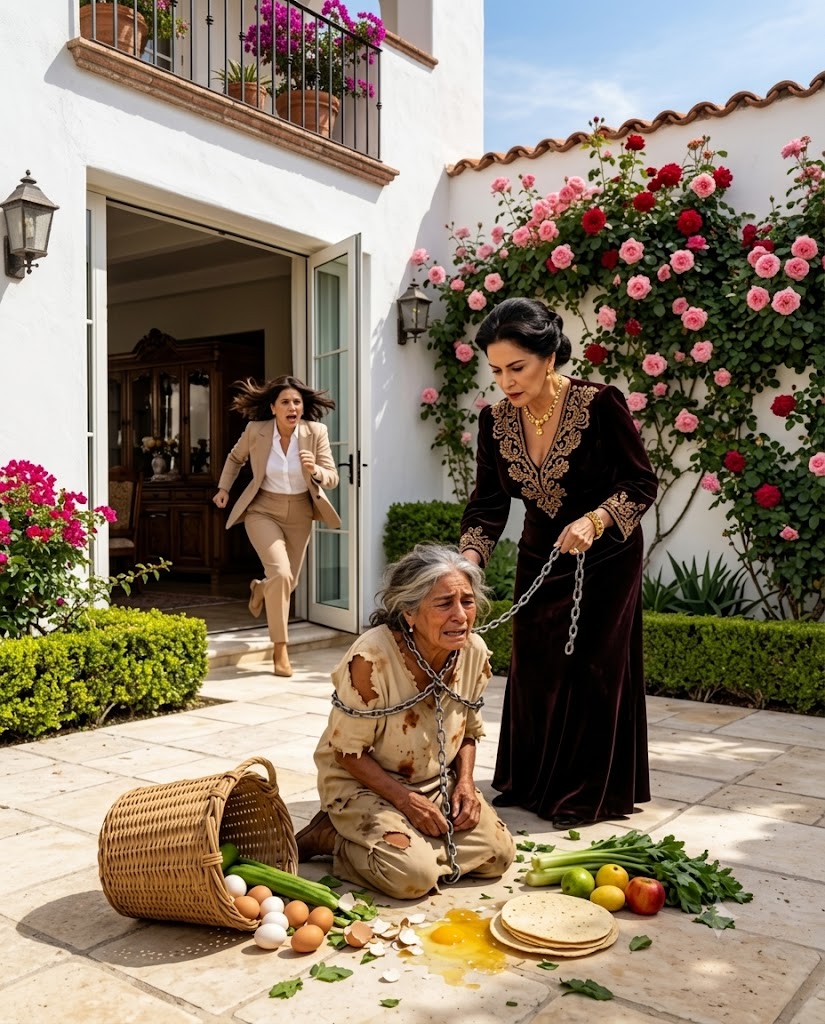
—If you want to enter this house, you should walk like an animal. That’s how you understand your place.
Lucía Santillán stood frozen at the entrance of the building, an elegant tower in the Del Valle neighborhood of Mexico City. She had just exited the elevator with a call from the office still open when she heard her mother-in-law's laughter.
Her blood ran cold.
At the end of the hallway was her mother, Doña Teresa, kneeling on the marble floor, a dog chain wrapped around her neck.
Pulling it from the other end was Doña Beatriz, her husband's mother, a woman dressed in expensive clothes, with red lips and that poisonous gaze of someone who confuses money with dignity.
—Come on, lady —Beatriz mocked—. Let’s see if this teaches you that you don’t come here with grocery bags like it's a slum.
Doña Teresa was 64 years old. She had traveled from Atlixco with a bag full of mole, cheese bread, fruits, and handmade tortillas. She only wanted to see her daughter, because she had heard her voice dimming for weeks.
But Beatriz blocked her way.
She told her she smelled like a ranch, that she was dirtying the building, that the neighbors could see her. Then she took Diego’s dog chain and put it around Teresa’s neck as if it were a joke.
Lucía felt something break inside her.
At 34, she was a financial lawyer, and for years she had protected her private life with almost perfect silence. Diego’s family believed she was a well-paid employee, but they didn’t know that before getting married, she already had investments, land in Querétaro, and a house valued at over 28,000,000 pesos.
They also didn’t know that many of Diego’s “opportunities” came from contacts she had opened for him.
She never boasted about anything.
She wanted to see who respected her without knowing the size of her accounts.
And that day, she received the cruelest response.
—Let her go —Lucía said, her voice low.
Beatriz turned, pretending surprise.
—Oh, sweetie, don’t be intense. I was just teaching her some manners.
Doña Teresa lifted her face. She wasn’t crying from pain, but from shame.
—Daughter, let’s go. Don’t make a scene.
Lucía crouched down, removed the chain from her mother’s neck, and threw it against the wall.
—My mom is never to be touched again.
At that moment, Diego came out of the apartment. Shirt unbuttoned, expensive watch, an annoyed expression.
He didn’t ask what had happened.
He didn’t see the red mark on Teresa’s neck.
He only saw his mother clutching her chest.
—Diego, your wife threatened me —Beatriz said—. This woman has gone mad.
Diego walked towards Lucía and slapped her so hard that the sound echoed throughout the hallway.
—Apologize to my mother. On your knees.
Doña Teresa tried to intervene, trembling.
—No, please, young man...
Lucía held her mother’s arm.
—You are not to kneel, Mom. Especially not in front of people who need to humiliate to feel superior.
Diego gritted his teeth.
—If you cross that door, don’t come back. And forget about claiming anything. Everything you have here is also mine.
Lucía entered the apartment without saying a word. She grabbed a small suitcase, her laptop, a gray folder, and a box with personal documents.
Beatriz laughed behind her.
—Look at that. The little lawyer got offended because her mom doesn’t know how to behave.
Lucía stepped out with Teresa and waited for the elevator. Before entering, she looked at Diego with a calmness that unsettled him.
—Enjoy these days thinking you won.
Diego laughed.
—Oh, Lucía, you’re really crazy.
But what neither of them knew was that the hallway camera had recorded everything.
And they could never imagine that that very night, while her mother slept with ice on her neck, Lucía would find in Diego’s hidden accounts the secret that would sink his entire family.
PART 2
Lucía took her mother to a discreet hotel near Reforma. She requested a room on the top floor, called a private doctor, and took photographs of the red mark the chain had left on Doña Teresa’s skin.
The lady couldn’t stop looking at her hands.
—I was to blame, daughter. I shouldn’t have come without warning.
Lucía knelt before her, but not out of humiliation. She did it to look her in the eye.
—No, Mom. It wasn’t your fault. The blame lies with those who thought they could treat you like you were worth nothing.
Teresa lowered her gaze.
—I just wanted to bring you food. I thought it would do you good.
Lucía took the fabric bag she had rescued from the hallway. The mole had spilled, the bread was crushed, and several tortillas were broken.
That hurt her more than the slap.
That night, when her mother finally fell asleep, Lucía opened her laptop. She wasn’t going to cry. Not yet.
First, she checked shared credit cards, bank statements, duplicate charges, unusual payments. Diego always said he was investing in materials, suppliers, and permits for his new construction business.
But what she found were debts.
Diego owed over 5,000,000 pesos in personal loans, sports betting, loans with outrageous interest, and promissory notes signed with dangerous people from Naucalpan.
Then came monthly transfers to a woman named Camila Robles.
Rent.
Medical consultations.
A crib.
Baby clothes.
A 7-month ultrasound.
Lucía froze.
Diego didn’t just have a mistress. He was going to have a child with her.
She continued searching in a folder synced with her family account. There she found conversations saved by mistake.
“I’m almost convincing her to sell the Querétaro house.”
“My mom is going to pressure her with that lady. Lucía breaks easily when it comes to her mother.”
“When I sign the power of attorney, we’ll settle my debts and buy the apartment for Camila.”
Lucía felt the urge to vomit.
This wasn’t just infidelity. It was a plan.
Beatriz and Diego had been trying for months to manipulate her into signing a power of attorney over a property valued at 28,000,000 pesos. A house that Lucía had bought before marrying, with money inherited from her father, and protected in a trust.
Diego didn’t know that.
He also didn’t know that Lucía had designed asset protection contracts for clients with fortunes much larger than his.
At 2:40 AM, she called Gabriel Fuentes, her colleague and trusted friend.
—I need to act fast —she said—. Domestic violence, attempted fraud, possible forgery, and asset abuse.
Gabriel didn’t ask unnecessary questions.
—Do you have proof?
Lucía looked at the video from the hallway.
—I have enough to start. And I’ll get more.
In the following five days, Lucía operated with precision. She blocked additional credit cards, changed bank access, notified the trustee, requested copies of notarial movements, and filed a complaint for domestic violence against Diego and Beatriz.
But she didn’t file for divorce yet.
Gabriel warned her of something important.
—If you confront them now, they will say it was all a misunderstanding. We need them to accept their economic intention. To sign something. To let their guard down.
Then Lucía did something that seemed absurd.
She called Diego, crying.
—I don’t want to end this way —she said, her voice broken—. What happened hurt me, but I reacted badly. Maybe we can fix it.
Diego was silent for a few seconds.
—And your mom?
—She went back to Atlixco. She won’t get involved.
That was all that mattered to him.
—Well —he replied—. At least you’re starting to understand.
Lucía closed her eyes.
Her throat burned, but she continued.
—There’s something I wanted to propose. The Querétaro house can enter a private project. It’s worth 28,000,000 pesos. If we stay together, I want you to manage it. To show you that I trust you.
On the other side, Diego completely changed his tone.
—That does sound like a supportive wife, my love.
Lucía clenched the phone.
—We just need to sign some papers.
—Whatever it takes.
Lucía returned to the apartment two days later. She brought flowers for Beatriz and a box of imported chocolates. The mother-in-law opened the door with a triumphant smile.
—Are you coming to apologize?
—I’m here to fix things —Lucía replied.
Beatriz raised her chin.
—It was about time. In this family, we don’t like arrogant women.
Lucía lowered her gaze just enough for Beatriz to believe she had broken her.
That night they went to dinner at a restaurant in San Ángel. Diego invited several relatives: uncles, cousins, and a godmother who always talked about lineage even though she lived asking for loans.
Beatriz took the opportunity to humiliate her in front of everyone.
—Lucía finally understood that marriage isn’t about throwing tantrums. Your mom also needs to learn there are levels.
A cousin let out a laugh.
—Seriously, how embarrassing to arrive with wrapped food like it’s a market.
Diego raised his glass.
—What matters is that my wife knows who’s in charge now.
Some laughed.
Lucía barely smiled.
Then she pulled out a blue folder.
—For Diego to manage the Querétaro house, the fund requires a wealth declaration, authorization for credit review, and acknowledgment of liabilities. It’s just paperwork.
Diego frowned.
—Why so much paper?
—Because you’re going to handle an asset worth 28,000,000 pesos. They need to know you don’t have hidden debts or conflicts of interest.
Beatriz took the pen and put it in her son’s hand.
—Sign, Diego. People with money always sign things. Don’t get nervous like a kid.
Diego signed.
He declared no significant debts.
Authorized bank review.
Accepted that any falsehood could result in civil and criminal liability.
Beatriz signed as a witness. She also declared she knew the legitimate origin of the assets and assured that there was no family pressure to transfer property.
Lucía put away the folder.
—In 48 hours, we’ll have a response.
Diego hugged her at the waist as they left.
—See how easy everything is when you stop being dramatic.
Lucía didn’t respond.
Forty-eight hours later, no contract arrived.
An official did.
Gabriel, two lawyers, a public prosecutor’s agent, and a provisional protection order for Lucía and Doña Teresa arrived.
Diego opened the door in sweats, disheveled, with his cellphone in hand.
—What’s going on?
Lucía stepped out of the elevator.
—What should have happened since the first blow.
Beatriz appeared behind him, pale.
—What’s this show about, girl?
Gabriel placed the documents on the table.
—Notification for domestic violence, attempted fraud, possible document forgery, and measures of asset preservation.
Diego let out a nervous laugh.
—This is ridiculous. Lucía is making everything up because she’s mad.
Then Lucía played the video from the hallway.
Beatriz’s voice filled the room.
—If you want to enter this house, you should walk like an animal.
On the screen, Doña Teresa was on her knees, with the chain around her neck and the tortillas scattered on the floor. Then Diego was seen hitting Lucía.
No one said a word.
Beatriz tried to cover her face.
—That’s taken out of context.
Lucía looked at her unblinkingly.
—What context makes it normal to put a chain around a 64-year-old woman?
Diego tried to take the tablet away, but the agent stopped him.
—Don’t even think about it.
Then came the second part.
Bank statements.
Debts.
Bets.
Messages.
The Querétaro house.
And Camila's name.
Beatriz turned to her son.
—Who is Camila?
Diego swallowed hard.
—Mom, not now...
But the door opened again.
Camila entered with a lawyer. She had a noticeable belly and a medical folder under her arm.
—I also want to hear the answer —she said—. Because he promised me an apartment bought with a house that, according to him, was already his.
Beatriz lost control.
—You’re the mistress! Don’t come here acting dignified!
Camila glared at her with rage.
—And you’re the fine lady who helped your son rob his wife.
Diego started shouting that everyone was exaggerating, that the debts were temporary, that Lucía should support him because that’s what spouses were for.
Lucía listened in silence.
She felt no victory.
She felt disgust, sadness, and a strange calm.
The investigation progressed over months. Expert analyses confirmed that Diego had attempted to obtain false notarial data and that he had used copies of Lucía’s personal documents without authorization.
It also became clear that his debts were not family debts but personal, and that many transfers had been hidden during the marriage.
The divorce was inevitable.
Since the Querétaro house and the main investments belonged to Lucía before the marriage, Diego received nothing.
No house.
No money.
No respectable last name he bragged about.
His construction company lost partners. Lenders began to pursue him. Camila sued him for prenatal support and paternity acknowledgment.
Beatriz paid as well.
The apartment where she lived, which had gone ten months without maintenance or credit payments, ended up in foreclosure proceedings. The relatives who mocked Doña Teresa disappeared when they understood there would be no more dinners, trips, or favors.
One day, in a hearing, Beatriz approached Doña Teresa.
She wore no jewelry or expensive perfume anymore. Just a worn bag and sunken eyes.
—Forgive me —she said—. Tell Lucía to withdraw the complaint. Diego is my only son.
Teresa looked at her for a long time.
Lucía feared her mother, out of nobility, would ask for compassion.
But Doña Teresa stood up.
—I don’t want to see her destroyed, ma’am. But when you put that chain on me, you didn’t think I was a mother too. Forgiveness doesn’t mean erasing what you did.
Beatriz lowered her head.
Diego, from the other side of the room, looked at Lucía.
—We were spouses. You loved me. You can’t do this to me.
Lucía took a deep breath.
—I did love you. That’s why I stayed silent, paid, helped, and endured more than I should have. But loving doesn’t mean allowing them to humiliate my mother, hit me, and rob me. I’m not destroying you, Diego. I just stopped saving you.
The judge continued.
There were no screams.
No revenge.
Just evidence, signatures, and consequences.
Months later, Doña Teresa returned to Atlixco. Lucía bought her a small house with a patio, but her mother refused to stay quiet.
—I don’t want to live off pity, daughter. I want to sell what I know how to do.
Thus was born a small brand of mole, sauces, and preserves made by women from her community. The first store that accepted her products was in Roma Norte.
When Doña Teresa arranged the jars on the shelf, she smiled with pride.
—Just look. In the end, my things from the village did reach fine places.
Lucía hugged her tightly.
That day she understood that dignity isn’t found in an expensive building, nor in a surname, nor in speaking as if one is better than others.
It’s in not allowing anyone to put a chain around you.
And in remembering that no mother, daughter, or wife should kneel so that a false family feels superior.