PART 1
—As soon as I sign after the wedding, Adrián puts the apartment up as collateral and we save the construction company. With his 8 million, we can finally breathe.
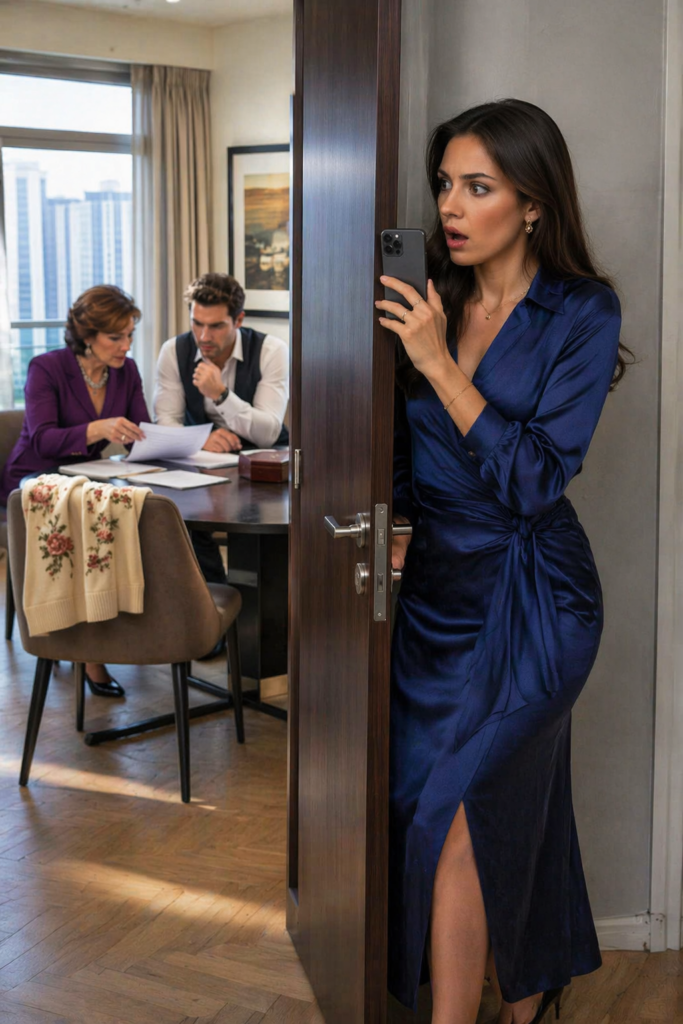
Sofía stood frozen behind the door of her future mother-in-law's apartment in the Nápoles neighborhood.
She had come back for an ivory sweater her mother had knitted before she died. It wasn’t an expensive piece, but to her, it was worth more than any wedding jewel. On the right sleeve were embroidered two tiny jacarandas because her mom always said one was to remind her of her roots and the other to protect her when she could no longer embrace her.
That night, Sofía should have been resting. Tomorrow, she would marry Adrián at a hacienda in Tlalpan, with 140 guests, mariachi, white flowers, and a dress that had been hanging in her bedroom for months.
The life she thought she was building was also ready: an apartment in Santa Fe, purchased with six years of work as a financial manager, a heavy loan, and the inheritance her mother had left her with so much sacrifice.
Adrián always repeated:
—When we get married, there won’t be yours or mine, love. We’ll be a team.
Sofía thought that was tenderness.
That’s why it hurt so much to hear Doña Patricia, her future mother-in-law, speak of her as if she were a checkbook with a veil.
—That girl is naive, almost too foolish to trust —said Doña Patricia—. If Adrián tells her to sign for love, she’ll sign. And if she gets difficult, we remind her everything this family has done for her.
Ximena, Adrián’s sister, let out a laugh.
—What have we done for her, Mom? She’s the one who always pays for everything.
—Well, that’s better —the lady replied—. She’s already used to it.
Sofía felt the air leaving her.
That very afternoon, Doña Patricia had kissed her on the forehead and said, “Tomorrow, you gain a family.” Ximena had posted stories crying, writing that she would finally have a sister.
Inside, they continued talking.
—The notary already has the draft —Ximena said—. Adrián just needs Sofía to sign the power of attorney during the honeymoon. He’ll tell her it’s for the travel insurance and couple’s paperwork.
—And the joint account —added Doña Patricia—. Don’t forget that. We’ll use it for the debt with suppliers.
Sofía slowly opened her bag. With trembling fingers, she activated her phone recorder and brought it close to the gap.
Then she heard the voice that shattered her.
It was Adrián.
—I don’t want her to find out before signing. If she gets scared, everything falls apart.
Doña Patricia replied:
—Then be affectionate. Tomorrow, in front of the priest, she won’t be able to back out without looking crazy.
Adrián sighed.
—I feel bad about her mom.
—Oh, please —his mother said—. Her mom left her that money to live well. And with you, she’ll live well when we rescue the construction company.
Sofía didn’t knock. She didn’t scream. She didn’t cry there.
She put her phone away and walked toward the elevator, leaving the sweater inside that house. In the mirror, she saw her pale face, but she also saw something she had never seen: a woman about to save herself.
When she reached the parking lot, Adrián called her.
—My love, did you arrive? Tomorrow, our life finally begins.
Sofía looked toward the lit window on the 4th floor.
—Adrián, tell me the truth. Do you love me or do you need me?
On the other side, there was a long silence.
—What kind of question is that?
—Sleep well —she said.
She hung up, got in the car, and drove aimlessly for several minutes, not imagining that recording wasn’t the complete betrayal, but merely the tip of a lie prepared for months.
PART 2
Sofía arrived at her apartment in Roma Sur just after 1 AM.
The wedding dress hung next to the window, protected by a transparent cover. The fabric shimmered in the streetlight, as if it still believed in the party, in the promises, in the man waiting for her at the altar.
Sofía left the keys on the table and played the recording.
She listened to it once. Then again. Then one more time.
Each phrase hit her differently: “the notary,” “the joint account,” “the collateral,” “if she signs for love.” But what hurt the most was Adrián’s voice. He didn’t sound pressured. He didn’t sound confused. He sounded calculating.
On her computer, she opened the shared folder where Adrián had stored the tickets to Cancún, the hotel reservation, and supposed travel documents.
Among files with normal names, she found one titled “International Coverage for Couples.”
She opened it.
It wasn’t coverage.
It was a broad power of attorney for the administration and ownership. The document authorized Adrián to represent Sofía to manage assets, sign contracts, apply for loans, mortgage properties, and move bank accounts.
On the last page, her full name, her CURP, her RFC, the details of her apartment in Santa Fe, and a signature that looked too much like hers appeared.
Sofía felt like vomiting.
She remembered that weeks before, Adrián had asked her for copies of her deeds, account statements, and pay slips. He told her they were for filing the matrimonial insurance and reviewing tax benefits as a couple.
She had handed them over without hesitation.
Not because she was stupid. Because she trusted.
At 3:18, she called Beatriz, her mother’s best friend and civil attorney. Beatriz answered with a sleepy voice, but after hearing 30 seconds of the recording, she said:
—Don’t delete anything. Don’t touch any files. I’m coming over.
She arrived before dawn, with her hair tied back, glasses, a folder, and a battle-ready face.
She reviewed the document, the recording, the digital folder, and the linked emails.
—Sofía, this isn’t a meddling mother-in-law talking nonsense —she said—. This looks like an organized attempt to gain control over your assets through deceit. And we need to check this signature because it looks forged.
Sofía brought her hands to her face.
—I was supposed to get married tomorrow.
—No —Beatriz replied—. Tomorrow they were going to trap you with flowers.
At 6:40, Beatriz called a contact at the bank where the credit process had been initiated. Then she called the notary mentioned in the draft. Then she checked public records.
Each answer opened a new hole.
The bank file had existed for four months. Adrián’s construction company had requested urgent financing for 4 million pesos. Sofía’s apartment was listed as possible collateral. In an internal note, someone had written: “The owner will sign after the wedding celebration.”
But there was something worse.
In an annex, Adrián declared that he and Sofía had already been living under a marital property regime for three months.
Beatriz read that line out loud, as if it was hard for her to believe it too.
—He invented a property relationship that doesn’t exist.
—Could that affect me?
—If we don’t stop it today, yes. And a lot.
At 7:12, Sofía took her cell phone and wrote a single message:
“Adrián, the wedding is canceled. Don’t look for me. Any issues will be handled by my attorney.”
She sent it.
For 10 seconds, nothing happened.
Then the phone exploded.
Adrián called 17 times. Doña Patricia 9. Ximena sent crying audio messages. A cousin of Adrián wrote: “What’s wrong with you? People from Puebla are coming.” An aunt asked if it was a joke.
Sofía didn’t respond.
At 8:03, Adrián arrived at the building. He pounded on the door desperately.
—Sofía, open! You’re ruining everything over a misunderstanding!
Doña Patricia was with him.
—Honey, think of the guests! Think of what people will say!
Beatriz approached the door without opening it.
—I’m Licenciada Beatriz Robles, legal representative of Sofía. Leave or I’ll call security and file a report.
Adrián lowered his voice.
—Beatriz, don’t get involved. This is between my fiancée and me.
Sofía stood up. She was wearing an old t-shirt, her hair down, and her face swollen from lack of sleep. She didn’t look like a bride. She looked like a survivor.
She opened the door just with the chain on.
—Explain to me why my apartment appears in a loan from your construction company.
Adrián went pale.
—You don’t know how it works. It was preventive.
—Explain to me why there’s a signature similar to mine.
Ximena, who was behind her mother, burst into tears.
—I didn’t think it was a crime. Adrián said you would sign later and that it was just to expedite the process.
Doña Patricia turned around, furious.
—Shut up, idiot!
The hallway fell silent.
Sofía looked at Adrián. She didn’t need another confession. That explosion from Ximena had said it all.
—Did you ask her to copy my signature?
Adrián clenched his jaw.
—I was desperate. The company was going down. You know how hard I’ve fought.
—No —Sofía said—. I knew how much you lied while smiling.
Doña Patricia changed her crying for anger.
—Oh, don’t play the martyr. If you love my son, you help him. That’s what marriage is for.
—No, ma’am —Sofía replied—. Marriage is not an ATM with a white dress.
Beatriz asked security to remove them. Before leaving, Adrián managed to say:
—You’ll regret this. No one will love you like I do.
Sofía closed the door.
For a full minute, she didn’t move. Then she walked to the bathroom and vomited.
When she came out, Beatriz was sitting in the living room with an untouched cup of coffee.
—Now comes the ugly part —she warned—. They will try to make you look exaggerated, greedy, or unstable.
She wasn’t wrong.
As the hacienda in Tlalpan remained decorated with white centerpieces and empty chairs, Adrián’s family began calling everyone.
They said Sofía had suffered a nervous breakdown. That she canceled because Adrián couldn’t give her luxuries. That she became arrogant since she inherited money. That she humiliated a hardworking family.
Doña Patricia even posted on Facebook:
“There are women who prefer money over building a home.”
Sofía read the phrase and almost replied.
Beatriz took the phone away from her.
—Don’t give them a show. Give them documents.
That same day, they filed notices with the bank, the notary, and the relevant legal department. They also requested the cancellation of any processes made with Sofía’s information and prepared a complaint for misuse of data and possible forgery.
The notary responded quickly: he had never authorized the power of attorney but had received emails from Adrián’s account requesting urgent review.
In those emails was the true map of the deceit.
Adrián’s construction company owed salaries, suppliers, and had a delinquent credit line. Doña Patricia had mortgaged her own apartment years before. Ximena had debts from credit cards and a new car she couldn’t afford.
And they all saw in Sofía the perfect solution.
Not the bride. Not the future wife. Not the woman who had cared for Adrián when he lost contracts.
The solution.
Among the recovered messages, Beatriz found one from Adrián to his mother:
“I’m afraid Sofía might ask too many questions.”
Doña Patricia replied:
“That’s what the honeymoon is for. She’ll be happy there, holding hands, believing everything is love. You slip the papers between reservations and she signs.”
Adrián answered:
“Okay. But later we’ll explain.”
Sofía slammed the computer shut.
She cried for the first time sitting on the kitchen floor. She didn’t cry for the lost wedding. She cried for the five years she had confused patience with love, help with commitment, and silence with peace.
In the following days, more cracks appeared.
Beatriz reviewed old transfers. Sofía had lent Adrián’s family a total of 780,000 pesos: machinery repairs, Ximena’s tuition, a surgery for Doña Patricia, overdue salaries, and “emergencies” that never had a receipt.
Adrián always said:
—I’ll pay you back after the next contract, love.
He never did.
In a legal meeting, the three arrived with offended faces.
Doña Patricia wore black, as if she were the victim. Ximena didn’t lift her gaze. Adrián had dark circles under his eyes and a thin folder.
—I don’t want to fight —he said—. But I can’t accept that you treat us like criminals.
Beatriz placed the transcribed recording, the emails, the draft of the power of attorney, and the transfers on the table.
—Then explain this without using the word “misunderstanding.”
No one spoke.
Sofía looked at Adrián.
—I just want to hear one truth from your mouth. Were you going to marry me because you loved me or because you needed my apartment?
Adrián swallowed hard.
—Both things mixed together.
That phrase was crueler than a slap.
Because he didn’t deny anything.
Ximena started crying.
—Mom said that if you entered the family, you also had to support. I copied the signature from a card you gave us for Christmas. I thought nothing would happen.
—I could lose my house —Sofía said—. The house my mom helped me buy while dying of cancer and saving every last peso. Is that “nothing” to you?
Doña Patricia slammed her hand on the table.
—Your mom wouldn’t have wanted to see you alone.
Sofía stood up.
—My mom wouldn’t have wanted to see me robbed either.
The agreement was tough. Adrián agreed to pay back the 780,000 pesos in installments guaranteed with a company truck and machinery that wasn’t yet seized. Ximena signed a statement acknowledging that she copied the signature at Adrián’s instruction. Doña Patricia had to delete her posts and commit to not defaming.
The bank investigation would continue separately.
As they were leaving, Doña Patricia took a cloth bag and tossed it on the table.
—Here’s your famous sweater. You destroyed my son for this thing.
Sofía opened the bag.
The ivory sweater smelled of someone else’s perfume, but the two jacarandas were still intact.
She hugged it to her chest.
—No, Doña Patricia. For this thing, I discovered that your son wanted to destroy me.
It was their last conversation.
Months later, Sofía finally moved to the apartment in Santa Fe. For a long time, she had imagined it with Adrián, with pictures chosen by both, with family dinners and wedding photos in the living room.
The first night, she arrived alone, with boxes, a bougainvillea plant, and her mother’s sweater folded in her suitcase.
She opened the windows. The city sparkled below, enormous, indifferent, alive.
Sofía thought she would feel defeated.
But she felt space.
The wedding dress remained stored until she found an association that supported women getting married civilly without resources. She donated it without announcing it on social media, without a speech, without dramatizing.
The volunteer asked her:
—Are you sure? It’s new.
Sofía caressed the fabric.
—Yes. Let someone use it who reaches the altar with respect, not with fear.
The first payment came late, but it arrived. The second came incomplete, and Beatriz pressed legally. The third arrived after Adrián sold construction equipment. The company closed before the year ended.
Some acquaintances said Sofía had been too harsh. Others said she did well. Her case became dinner-table gossip: whether a woman should help the man she loves, whether money separates families, whether canceling a wedding was too humiliating.
She never argued with anyone.
She only replied:
—Helping is lending a hand. Deceiving to take a house is something else.
One Sunday, Sofía visited her mother’s grave at the Panteón Jardín. She wore the sweater, even though it was sunny. In front of the headstone, she placed two fresh jacarandas.
—I didn’t get married, Mom —she whispered—. But I arrived on time.
There was no magical wind or movie signal. Just a clean silence.
And for the first time since that night, Sofía felt peace.
Later, she understood that her mother had left her prosperity, but not just in money. She left her intuition. She left her dignity. She left her a garment that made her return just when she needed to come back.
Because sometimes the scandal of canceling a wedding lasts weeks.
But marrying someone who looks at you as credit, collateral, and financial salvation can cost you your entire life.