PART 1
Don Ernesto Valdés was fifty years old and owned a dairy ranch on the outskirts of Santa Cruz de las Flores, Jalisco, a town where people might forget to pay a debt, but never a rumor.
The ranch spanned eighty hectares, with old corrals, a small cheese shop by the roadside, and a white house that for the last three years had seemed larger than life.
Once, that house was alive.
It held Marina's laughter, his wife.
Marina had been so much more than just the woman he married at twenty-eight. She kept the accounts, attended to customers, made cajeta, negotiated with suppliers, and managed to get even the roughest workers to wash their hands before sitting down to eat.
Then came cancer.
For nearly a year, Ernesto watched her fade away without a complaint. Marina died one Thursday morning, and the next day he was already in the barn, milking cows as if work could seal the gaping hole in his chest.
The room where Marina kept the accounts remained locked.
Her cup still sat in the cabinet.
Her shawl hung behind the chair.
Ernesto didn’t touch anything, for opening that door felt like accepting she wouldn’t return.
The only person who frequently crossed the neighboring land was Valeria Mendoza.
Valeria was twenty-five, studied agricultural management in Guadalajara, and returned to the town to revitalize her family’s twenty-five hectares. She raised goats, sold jams online, and drove a tractor better than many men who thought too highly of themselves.
She was not a lost girl.
She fixed fences, negotiated prices, and had taught Ernesto how to sell cheese on Facebook. At first, he scoffed at such youthful nonsense until, in December, he sold almost double.
Two weeks after Marina’s funeral, Valeria appeared at his doorstep with a pot of soup.
“I made too much,” she said. “Help me finish it.”
Ernesto understood the white lie.
“You didn’t have to do this.”
“I know.”
From then on, almost every Tuesday she arrived with something: sweet bread, coffee, vegetables, a stew, or simply silence.
Ernesto always said it wasn’t necessary.
Valeria always replied:
“I know.”
Over time, Tuesdays became a sacred ritual. He didn't ask if she would come, but prepared two cups of coffee. She’d sit on the porch, talking about her greenhouses or sitting in silence, gazing at the hills.
And that silence didn’t hurt.
It accompanied him.
Ernesto told himself many times that Valeria was just a kind neighbor, a hard-working young woman, the daughter of a decent family. Nothing more.
Until that September morning.
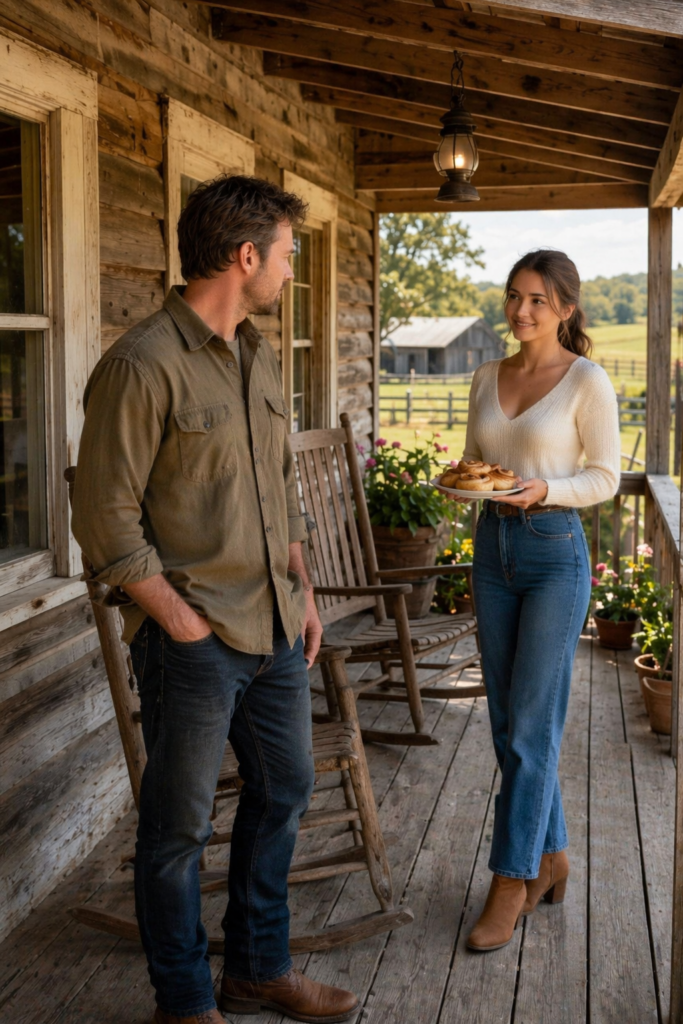
Valeria arrived with a freshly baked apple pie. Flour dusted her cheek, worn jeans hugged her figure, and a rolled-up plaid shirt adorned her arms. The scent of cinnamon filled the porch.
Ernesto looked at her and smiled without thinking.
“If I were twenty years younger… I’d marry you.”
He expected a laugh.
But Valeria didn’t laugh.
She looked at him with a calmness that disarmed his very soul.
“That doesn’t matter to me, Ernesto.”
He froze.
“Excuse me?”
Valeria tightened the cloth holding the pie.
“Your age doesn’t change who you are.”
Then she lowered her gaze.
“I need to check the irrigation.”
She walked across the field, leaving Ernesto with the pie in his hands, feeling as if something forbidden had just opened.
That very afternoon, his sister Beatriz arrived unannounced. She saw the pie, the two cups, and Ernesto staring towards Valeria's land.
She said nothing to him.
But that night, in the family group chat, she wrote,
“Now we see who wants to take over Marina’s ranch.”
PART 2
The message landed like a stone in murky water.
In less than an hour, the photo was already circulating on other phones in town. Valeria appeared from behind, crossing the field in work clothes with a basket in her hand. There was nothing wrong with the image, but Beatriz had added enough poison.
“So young and so smart.”
“That ranch is worth millions.”
“Poor Marina, not even cold in her grave and they already want to take her place.”
Ernesto saw the messages when his nephew Alfredo, Beatriz’s son, showed them to him with a false smile.
“Tío, I’m just letting you know because sometimes you don’t see things. That girl doesn’t cross the field out of charity.”
Ernesto felt rage, but also fear.
Not fear of Valeria.
Fear that the town was right about one thing: he was a fifty-year-old man falling for a twenty-five-year-old woman.
And that, in Santa Cruz, was dynamite.
For a week, he avoided discussing the topic. Valeria continued to come the following Tuesday, but she arrived more serious. She left a bag of bread on the table and didn’t sit down.
“I saw what your sister posted,” she said.
Ernesto lowered his gaze.
“I’ll talk to her.”
“I don’t need you to fight for me later. I needed you not to hide before.”
That hurt him, because it was true.
“Valeria, people will talk.”
“People talk even when they have no teeth.”
He almost smiled, but she didn’t.
“I know who I am. I manage my land, pay my bills, sign my contracts. I don’t need anyone’s ranch.”
“I know.”
“Then say it like you know it.”
Ernesto found no words.
Valeria took a deep breath.
“The gossip doesn’t hurt me. What hurts me is that you use it as an excuse to push me away.”
From that day on, the visits changed. She no longer stayed for coffee. No longer brought hot food. She left store orders, asked about the cows, and left.
Absence began to make noise.
Tuesdays kept coming, but they no longer brought peace.
Meanwhile, Diego Santillán started appearing more often. He was twenty-nine, had a new truck, a clean smile, and a family that owned the largest agricultural distributor in the region. To the town, he was the perfect man for Valeria.
For Beatriz, he was a solution.
“That guy is good for her,” she told Ernesto one afternoon. “Stop making a fool of yourself. You’ve already had your life.”
Ernesto clenched his jaw.
“Don’t talk about my life as if it were over.”
Beatriz let out a dry laugh.
“Then behave. Marina would die of embarrassment if she saw this.”
That blow hit home.
Because Marina continued to be the most delicate place in Ernesto’s heart.
That night, sitting in front of the locked room, he remembered a phrase his wife had told him when she was already sick:
“When I go, don’t turn this house into a tomb.”
He had gotten angry.
“Don’t say that.”
Marina caressed his hand.
“You’re going to keep living, Ernesto. The question is whether you’re going to live or just breathe.”
Back then, he hadn’t understood.
Now he did.
But understanding was not the same as daring.
A week before the town fair, Valeria came to the ranch store to deliver jams. Ernesto helped her arrange the jars without looking at her too much.
“Diego invited you to the fair,” he said.
“Yes.”
“He’s a good man.”
Valeria stood still.
“Is that all?”
Ernesto swallowed hard.
“He’s your age. He’s stable. He can help you grow the business.”
She let out a sad laugh.
“Are you recommending a husband like one recommends fertilizer?”
“I just want you to think about your future.”
Valeria slammed a box shut with more force than necessary.
“Once again, you decide for me.”
“I don’t want to hurt you.”
“No. What you don’t want is to be judged.”
Ernesto didn’t respond.
Valeria looked at him with bright yet firm eyes.
“I’m not going to beg a man for courage who hides behind his age, his sister, and even a dead woman who surely loved you free of the constraints you allow yourself.”
Then she left.
Two days later, Ernesto heard that Valeria had agreed to go to the fair with Diego.
On the fair night, he stayed home. He said he had work, but since seven, there was nothing left to do. From the kitchen, he saw the distant lights, heard the band music, and imagined Valeria laughing alongside Diego, just as everyone expected.
At nine-thirty, a truck stopped in front of the ranch.
Valeria got down alone.
She wore a dark blue dress, clean boots, and her hair down. He had never seen her so beautiful or so tired.
Ernesto opened the door.
“What are you doing here?”
“I left the fair.”
“And Diego?”
“He stayed to explain to your sister that I’m not merchandise.”
Ernesto frowned.
Valeria entered, but didn’t sit down.
“Diego asked me to be his girlfriend in front of half the town. Your sister started clapping as if a deal had been closed.”
“Valeria…”
“And then Diego said something curious. He said that together we could control the water on the south side, connect my greenhouses with your well, and turn everything into a family project.”
Ernesto felt his stomach tighten.
“What?”
“I realized he didn’t want me. He wanted my land next to yours. Your sister had been telling him that you’d sell someday if I stayed away.”
The living room fell silent.
That was the first blow.
The second came when Valeria pulled out her phone and played an audio.
Beatriz’s voice rang clear:
“You pressure her, Diego. If that girl marries you, Ernesto stays alone, and the ranch will eventually return to the family as it should. I won’t allow an opportunist to encroach where Marina was.”
Ernesto turned pale.
Valeria put her phone away.
“Your sister wasn’t defending Marina’s memory. She was defending her own interest.”
He couldn’t speak.
He had let them tarnish Valeria in the name of his wife when what they truly wanted was to control his life and his estate.
“I don’t want your ranch,” she said, her voice breaking. “Not your cows, not your house, not the room where you keep Marina’s shawl. I wanted you. Even if you were stubborn. Even if you were scared. Even if the whole town said I was crazy.”
Ernesto took a step toward her.
“I love you too.”
Valeria shut her eyes as if those words had come too late.
“Wanting isn’t enough, Ernesto. You also need the guts to protect what you love.”
He looked at the photo of Marina on the shelf.
For three years, he had used that portrait as an altar and a wall. That night he understood that honoring Marina didn’t mean staying frozen in pain. Honoring her meant not allowing her name to be used to hurt an innocent person.
“You’re right,” he said.
Valeria looked at him, incredulous.
“I hid. I let my sister speak about you. I let the town judge you. And the worst part is that I pushed you toward Diego to avoid admitting that I was afraid to love you.”
“And now?”
Ernesto took a deep breath.
“Now I’m going to open a door I should have opened a long time ago.”
He walked toward the hallway, took the key to Marina’s room, and inserted it into the lock.
Valeria didn’t follow him at first.
Ernesto opened the door.
Dust floated in the light. The desk remained the same. The notebooks, the cup, the shawl. On the chair sat a wooden box he had never checked.
He opened it with trembling hands.
Inside he found receipts, letters, and an envelope with his name on it.
He recognized Marina’s handwriting immediately.
Ernesto sat down and read.
Marina had written to him during her last days. She told him she knew he would close himself off in guilt. That she knew his stubbornness. That she didn’t want to see him turned into a shadow wandering through the house.
At the end, there was one underlined phrase:
“If one day someone returns to sit with you on the porch and your heart rests, don’t chase her away out of fear. I was not your prison, Ernesto. I was your love.”
Ernesto wept without hiding.
Valeria covered her mouth.
The truth he had searched for over three years was not in the town's gossip or Beatriz’s cruelty. It was in that letter he had never dared to read.
The next day, Ernesto went to the plaza before mass, just as everyone was buying barbecue, bread, and coffee. Beatriz was there with Alfredo, Diego, and several ladies pretending not to watch.
Ernesto stood in front of his sister.
“I want you to hear this in front of everyone.”
Beatriz paled.
“Don’t put on a show.”
“The show was yours when you used Marina’s name to tarnish Valeria.”
People gathered around.
Ernesto played the audio.
Every word from Beatriz hung in the plaza like black smoke. Diego looked down. Alfredo tried to snatch the phone away, but several men stopped him.
Beatriz wanted to cry.
“I just wanted to protect you.”
“No. You wanted to decide for me. You wanted my land, my solitude, and my guilt.”
Then Ernesto looked at Diego.
“And you, kid, don’t ever come near Valeria or my wells again. I’ll send my lawyer your proposals.”
Diego left without saying a word.
Beatriz, red with shame, murmured:
“Marina would never have allowed this.”
Ernesto pulled the letter from his pocket.
“Marina asked me to live. You wanted me buried.”
No one said a word.
From that day on, the town no longer had the same gossip. Some continued to murmur, of course, because in Mexico, even saints have neighbors. But now Valeria walked with her head held high, and Ernesto stopped looking down.
They didn’t start immediately.
Valeria asked for time.
“I don’t want to be the prize of your late courage,” she told him. “If this is going to happen, let it be clean.”
Ernesto agreed.
For two months, there were no grand promises. Just sincere conversations, coffees without hiding, and strolls to Guadalajara away from the town’s noise. He learned not to ask her every five minutes if she was sure. She learned that loving a man with a past didn’t mean living in competition with a ghost.
One Sunday, Valeria accompanied him to the cemetery.
Ernesto brought flowers for Marina. He didn’t ask permission as if love were a formality. He just spoke with honesty.
He thanked her for the years, the saved ranch, the shared life. He told her he still loved her in a place no one would occupy, but that he no longer wanted to use that love as punishment.
Valeria waited a few steps away.
When Ernesto returned, she took his hand.
There was no dramatic kiss.
Just a deep peace.
Almost a year later, a strong storm destroyed part of Valeria’s greenhouses. At five in the morning, Ernesto arrived with workers, wood, sheets, and coffee.
They worked under the rain to save what they could.
By dusk, Valeria was covered in mud, her hair stuck to her face, and her eyes tired.
“You showed up again without being called.”
Ernesto smiled.
“I’ve made it a habit.”
“That’s why I love you.”
He looked at her as if he had just heard the most impossible word in the world.
That night he took her to the ranch. On the table sat an apple pie he had made. The edge was burnt, and the crust looked like a poorly drawn map.
Valeria looked at it and burst into laughter.
“You made this?”
“I tried.”
“It shows, and a lot.”
Ernesto pulled out a simple ring.
“I made a cowardly joke a while back. I said that if I were twenty years younger, I’d marry you, because I was afraid to tell the truth.”
Valeria stopped laughing.
He knelt down.
“The truth is that I don’t need to be thirty to love you well. I need to have courage, respect, and the humility not to decide for you. Valeria Mendoza, do you want to build a life together that we both choose?”
She cried and laughed at the same time.
“You’re proposing to me with a burnt pie.”
“I can buy a pretty one.”
“Don’t you dare. This one is ours.”
Then she nodded.
“Yes, Ernesto. Yes, I will.”
They married in autumn, in the strip of land between the two ranches. Some came out of affection, others out of curiosity, and some to see if they truly dared.
They dared.
Beatriz was not invited.
Years later, on a Tuesday morning, Ernesto was fixing the southern fence when he saw Valeria crossing the field with their small child in her arms and an apple pie in the other hand.
“From the southern trees?” he asked.
“From the best ones.”
Ernesto looked at his wife, at their child, and at the white house he once thought too large for a single man.
“If I were twenty years younger…” he said, smiling.
Valeria approached, adjusted his hat, and replied just like that day:
“That doesn’t matter to me.”
The child laughed without understanding.
Ernesto kissed Valeria, and the three walked home.
Because sometimes love doesn’t arrive late.
Sometimes it arrives just when a person finally stops living to please their fear.