PART 1
Mariana arrived by taxi at the alumni reunion.
The restaurant was in Polanco, on a street where the valet parking attendants seemed to judge you before opening the door. Outside, gleaming Mercedes SUVs, a white Porsche, a massive BMW, and a black Suburban with tinted windows lined the curb.
She paid the fare, stepped out wearing jeans, clean sneakers, and a simple cream blouse.
No jewelry.
No designer handbag.
Nothing that screamed money.
The driver glanced at her in the mirror and said,
—This place is pricey, miss.
Mariana smiled.
—It’s a reunion.
She didn’t explain that tonight the bill wouldn't be the problem.
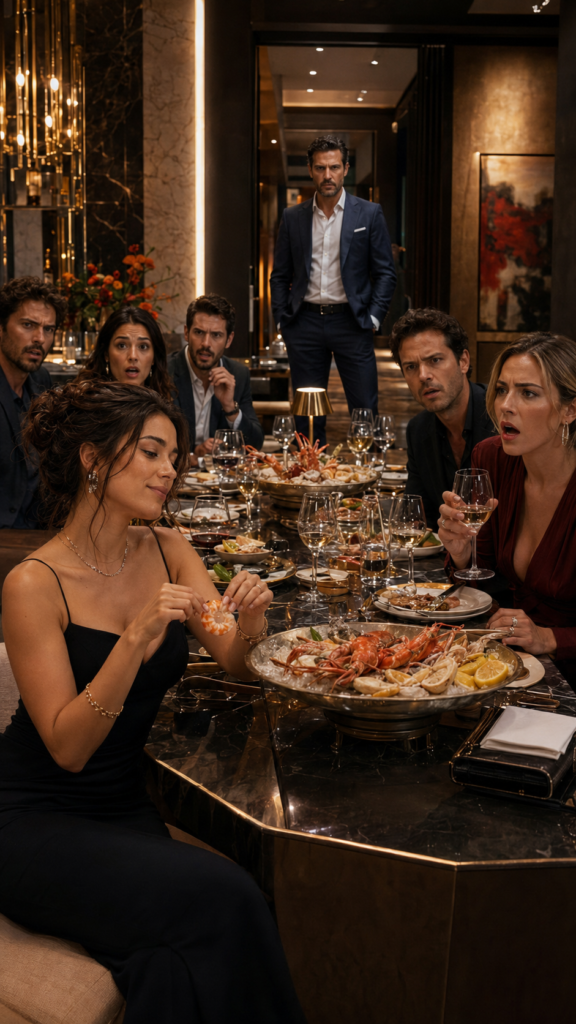
When she entered the private room, she was met with a mix of laughter, expensive perfumes, and voices trying to sound important. Eight years had passed since college, but many still acted as if they were competing to be the best in class.
There were more than twenty people at the table.
And in the center, as if the place belonged to her, was Beatriz Montes.
Beatriz wore a fitted black dress, sky-high heels, a sparkling watch, and a purse she placed on the chair as if it were another guest. In college, she had always been the one to correct everyone, the one who flaunted her grades, the one who smiled when someone failed.
That night, she hadn’t changed.
She just wore more makeup and carried more venom.
—Mariana! —she said upon seeing her—. What a miracle. I thought you weren’t coming.
Her gaze fell to Mariana’s sneakers.
—You look very… comfortable.
A few smiled.
Mariana didn’t respond to the venom. She sat beside Tomás, the group’s former jokester, who now sold insurance and still had a good-natured face.
—Hang in there —Tomás whispered—. Beatriz has been talking about her bonus, her SUV, and her boss for 40 minutes.
—Are there shrimp? —Mariana asked.
—Yes.
—Then I’ll survive.
The dinner progressed with toasts, photos, and bragging. Beatriz recounted that she worked at Grupo Altavista, one of the most powerful tech companies in Mexico, with offices in Mexico City, Monterrey, and Guadalajara.
—This year my department handled contracts worth over 160,000,000 pesos —she said, waving her wrist to let her watch gleam—. The CEO is already considering me for a vice presidency.
Mariana lowered her gaze to her plate.
Grupo Altavista.
How curious.
It was her husband’s company.
Well, more precisely, the company he had founded.
But Mariana said nothing.
After the second course, Beatriz suggested everyone share what they did for a living. One person spoke about his startup. Another about private banking. Yet another about consulting. Each person tossed out their title as if selling their life on LinkedIn.
When it was Mariana’s turn, Beatriz smiled maliciously.
—You were brilliant, Mariana. I’m sure you’re the director of something huge. Tell us.
All eyes were on her.
Mariana picked up a shrimp, peeled it slowly, and said:
—I don’t work.
Silence lasted barely two seconds.
—What do you mean you don’t work? —someone asked.
—I’m at home —she replied—. I live off my husband.
The table exploded in laughter.
Tomás stopped smiling.
Rubén nearly spat out his wine.
—Mariana Ríos turned into a kept woman? No way, I didn’t see that coming.
Beatriz raised her glass and said with a sweet voice, the kind that cuts more than a knife:
—Oh, Mariana… A woman should learn to depend on herself. Honestly, love is nice, but living off a man…
She didn’t finish the sentence.
It wasn’t necessary.
Mariana wiped her fingers with the napkin.
—You’re right.
Beatriz smiled, satisfied.
—I’m glad you understand.
—Though eating shrimp without having to deal with bosses also has its charm.
Tomás burst into laughter.
Beatriz stopped smiling.
Then she asked:
—And what does your husband do?
Mariana thought for a moment.
—He has businesses.
Laughter returned.
—Of course —Rubén said—. He probably sells phone cases online.
Beatriz leaned toward her.
—And what car does your husband drive?
—I’m not sure.
—You don’t know what car he has?
—He has several. I don’t pay attention.
The mockery grew worse.
Someone murmured, “What a joke.” Another said, “She’s already made up the millionaire.” Beatriz lifted her glass as if she had just won something.
But at that moment, her phone vibrated.
On the screen appeared: General Management — Grupo Altavista.
At the same time, outside the window, a black Maybach stopped in front of the restaurant.
The driver got out first.
Then he opened the back door.
A tall man in a dark suit stepped out of the car.
Beatriz froze.
The door to the private room opened.
The man entered, surveyed the table, and asked calmly:
—Excuse the interruption. I’m looking for my wife.
His eyes landed on Mariana.
—Mariana, darling, are you done with dinner?
PART 2
No one breathed.
Not even Rubén laughed.
Not even Tomás made a joke.
Not even Beatriz could hold her glass steady without her hand trembling.
Mariana calmly lifted the napkin and looked at her husband, Alejandro Altavista, founder and president of Grupo Altavista.
—Almost done —she said—. I was thinking about ordering dessert.
Alejandro smiled.
Not with a businessman’s smile for the cameras.
He smiled like a tired man who left an incredibly long meeting just because his wife had texted him: “Come for me when you can. This got interesting.”
Beatriz stood up so quickly she nearly knocked over her chair.
—Mr. Altavista…
The whole table turned to her.
—Do you know him? —Laura asked.
Beatriz swallowed hard.
—He’s… he’s the president of Grupo Altavista.
Silence fell heavily.
All the jokes about the made-up husband, the fake cars, and the “kept woman” began to bounce around the table like broken dishes.
Alejandro looked at Beatriz politely.
—Beatriz Montes, right? Financial Innovation Director.
She straightened her back.
—Yes, sir. It’s an honor you remember me.
—I remember you from the Monterrey project.
Beatriz tried to regain her smile.
—Yes, it was a very important project. I was just telling my colleagues that my department received great recognition.
Alejandro barely inclined his head.
—How strange. That project is still confidential.
Beatriz’s smile vanished.
Mariana drank some water.
Tomás looked at her as if he had just discovered he was sitting next to the owner of the biggest taco place in the country without knowing it.
—Confidential? —murmured Rubén.
Alejandro didn’t raise his voice.
He didn’t need to.
—It includes client data, internal strategies, and a financial line that hasn’t been presented to the board yet. I’m surprised to hear it’s being discussed at a private dinner.
Beatriz placed her glass on the table.
—No, sir. I was only speaking in general terms. Nothing sensitive.
—I hope so.
Then Alejandro turned to Mariana.
—Did they treat you well?
The question sounded soft.
But everyone understood the edge.
Mariana smiled slightly.
—They gave me a lesson on female independence.
Beatriz’s face turned red.
Rubén looked at the tablecloth.
Alejandro nodded.
—Good topic.
Beatriz breathed a sigh of relief.
Until he added:
—Though Mariana has never depended on me.
The table fell silent again.
Beatriz furrowed her brow.
—But she said she doesn’t work.
—She doesn’t work for anyone —Alejandro corrected—. It’s different.
All eyes fell on Mariana.
She hated that moment.
That’s why she didn’t go to these gatherings.
Because people didn’t want to know the truth. They wanted to slap a quick label on your forehead: successful, unsuccessful, rich, poor, lazy, kept woman.
And if you didn’t fit the label, they got annoyed.
Alejandro continued:
—Mariana designed the first risk analysis system with which Grupo Altavista secured its initial investors. Before having offices, she coded with me in a tiny apartment in Narvarte, eating instant soup at 2 in the morning.
Someone let out a “What?”.
Beatriz seemed not to understand.
—But in college…
—In college —Mariana said— I received several offers. I accepted one in New York. I lasted 11 months.
Tomás’s eyes widened.
—You never said anything.
—It wasn’t a pretty story.
And it wasn’t.
Mariana had worked 16 hours a day, traveled without sleeping, and learned that in some offices ambition blurred with mistreatment. She earned well, but was losing her life.
One day, she fainted before a presentation.
When she woke up in the hospital, the first thing she asked for was her laptop.
There she understood that proving her worth to people who would never have enough would destroy her.
She returned to Mexico.
Alejandro wasn’t yet “Mr. Alejandro Altavista.” He was just Alex, her college boyfriend, with two old computers, many debts, and an idea everyone called impossible.
Mariana didn’t want to go back to a giant company.
She wanted to build something of her own.
—For three years —Alejandro said—, Mariana laid out the architecture of the system, negotiated with the first funds, and wrote much of the base code. When the company grew, she decided to step back from daily operations.
—Step back? —Laura asked.
—Yes —Mariana replied—. I got tired.
The word fell heavy.
She was tired of chasing titles.
Tired of turning her life into a competition.
Tired of a woman having to be exhausted, impeccable, and billing millions to earn someone’s respect.
She wanted to care for her mother when she fell ill.
She wanted to read in the morning.
She wanted peace.
She wanted to stay home without that meaning disappearing.
Alejandro looked at the table.
—Mariana holds 35% of Grupo Altavista.
Rubén choked.
Tomás gave him a pat on the back.
—35%? —Beatriz whispered.
—More than enough not to depend on my salary —Alejandro said.
Mariana sighed.
—Alex, you didn’t have to say the percentage.
—Sorry —he replied—. But when someone tries to humiliate you, I find it hard to stay silent.
The phrase hit right where it should.
Beatriz pressed her lips together.
—I wasn’t trying to humiliate anyone.
—No —Mariana said—. You just used a pretty phrase to make me feel less because my life doesn’t look like yours.
Beatriz opened her mouth, but nothing came out.
For years, she had wanted to outdo Mariana.
In college, if Mariana got the best grade, Beatriz would ask how many tenths of a difference it was. If Mariana won a scholarship, Beatriz hinted that a professor favored her.
Eight years later, she thought she had finally beaten her.
She saw simple sneakers, a no-brand blouse, and a humble phrase.
And decided Mariana had failed.
—I didn’t know any of that —Beatriz murmured.
—You didn’t need to know —Mariana replied—. The problem is that you believed you had the right to judge without knowing.
The waiter appeared at the door.
—Would you like dessert?
Tomás raised his hand.
—Yes, please. And something strong for me because I just discovered I’ve been sitting next to a millionaire for two hours eating shrimp like it was nothing.
Some laughed.
But Beatriz didn’t.
Her phone vibrated again.
This time it was a message.
She read it and paled.
Alejandro also noticed her reaction.
—I imagine HR has already contacted you.
Beatriz looked up.
—Mr. Altavista…
—Not because of this dinner —he clarified—. This just confirms something that was already being investigated. Three weeks ago, we detected a leak of internal documents. Legal is reviewing unauthorized access.
The table stopped pretending not to listen.
—I didn’t leak anything —Beatriz said.
—That will be determined by the audit.
—But my promotion…
—Your promotion depended on results —Alejandro said—, but also on integrity.
The phrase was clean.
And devastating.
For the first time all night, Beatriz looked small.
Not poor.
Not ridiculous.
Small inside.
Like someone who had built a perfect image and didn’t know where to hide when the crack appeared.
Mariana didn’t feel joy.
That surprised her.
She had imagined that seeing Beatriz lose her confidence would bring her satisfaction. But seeing her with moist eyes, tense hands, and intact makeup only made her feel tired.
The comparison had damaged everyone.
It had made Beatriz cruel.
It had made others insecure.
It had nearly made Mariana forget she didn’t have to justify her peace.
After dessert, the dinner changed.
No one boasted about cars anymore.
No one talked about bonuses.
Laura confessed she hated pretending to be happy at the bank.
Iván admitted his startup was in debt.
Tomás shared that his daughter said his used car was “the prettiest in the world” because it had a unicorn sticker.
For the first time, the table stopped feeling like a competition.
It felt like a gathering of real people.
Around midnight, Beatriz approached Mariana.
—I was wrong —she said softly.
Mariana looked at her.
It didn’t sound theatrical.
It sounded broken.
—Yes —she replied—. You were wrong.
Beatriz swallowed hard.
—I thought that if I earned more, if I drove a better car, if I reached a big position… I would finally stop feeling like I was behind you.
Mariana fell silent.
Because she understood that feeling.
All too well.
—The problem —she finally said— is that there will always be someone ahead if you only look outward.
Beatriz looked down.
—I’m sorry.
—I hope you feel it too when there’s no audience.
They didn’t hug.
There was no need to turn everything into a perfect scene.
Some apologies don’t fix the past.
They just prevent the future from smelling the same.
When they left the restaurant, the Maybach was waiting at the entrance. Some former classmates looked at it, but no longer with mockery or admiration. More like the discomfort of those who had just discovered they judged too quickly.
Alejandro opened the door.
—Are you getting in or do you prefer to call a taxi to keep up the act?
Mariana playfully punched his arm.
—Don’t mock. My act was excellent.
—Too much. I almost felt guilty for keeping you.
—You relax —she said, getting into the car—. Tomorrow I’ll continue living off you.
Alejandro leaned in and smiled.
—And I’ll keep living off your smart decisions.
As the car moved down Masaryk, Mariana watched the lights reflected in the glass.
She thought of all the women who had ever been judged for working too much, for working too little, for marrying, for not marrying, for having children, for not having them, for earning more or for earning less.
There’s always someone ready to pass judgment on a life they haven’t lived.
That night, Mariana didn’t win any competition.
Because she didn’t come to compete.
She just remembered something she had taken years to learn:
True independence doesn’t always come with a glass desk, a shiny title, or a luxury SUV waiting outside.
Sometimes it means being able to choose your life without asking for permission.
And, above all, never humiliating another person just because their happiness doesn’t look like yours.