PART 1
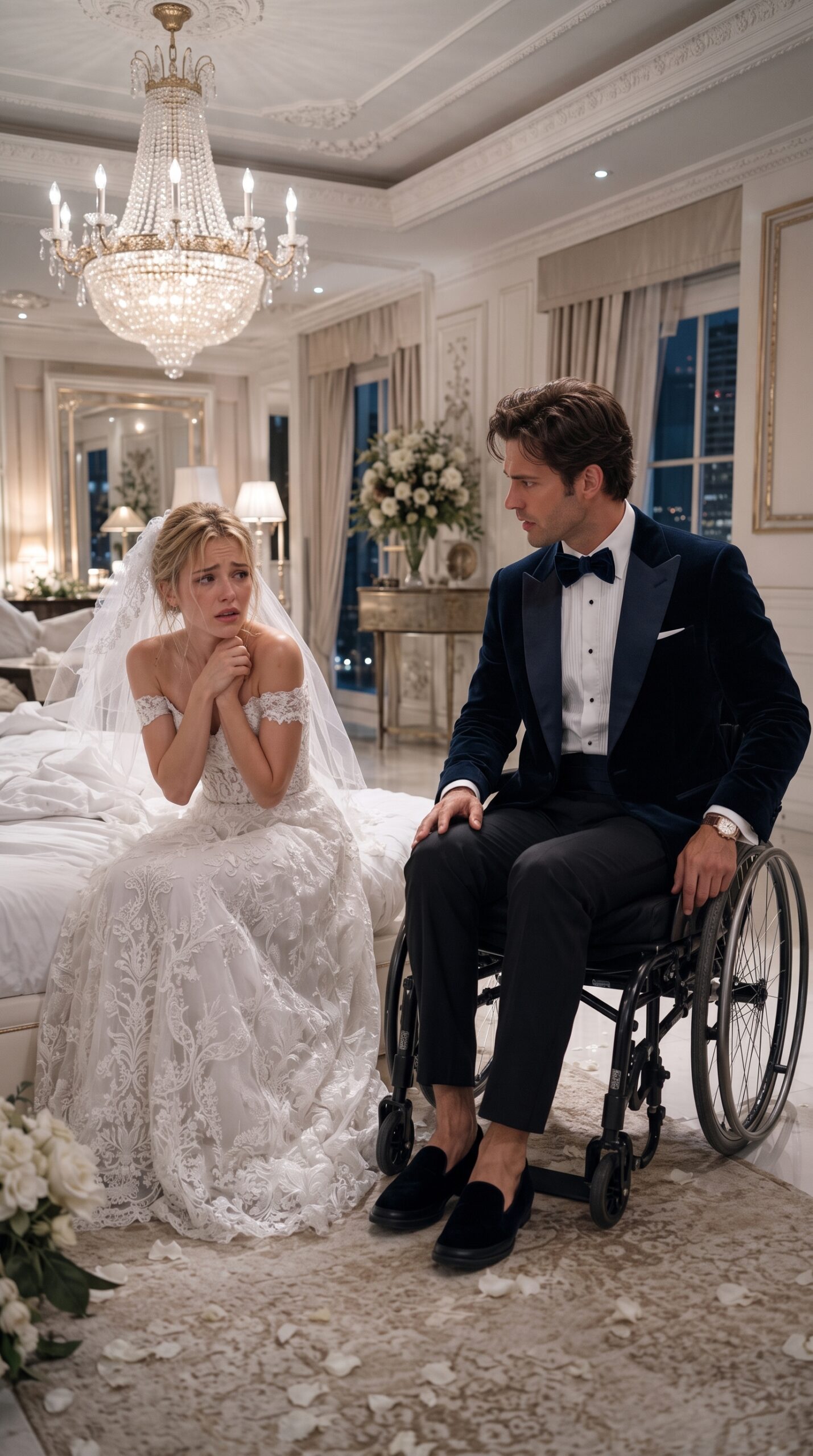
Valeria Montero's wedding night had no music, no toasts, no nervous laughter that’s supposed to fill the air when two strangers start a life together.
It had silence.
From the penthouse window in Polanco, Mexico City sparkled as if nothing bad could happen down there. But inside that vast room, Valeria stood clutching her crumpled white dress, breathing as if every second weighed her down.
In front of her, seated in an elegant black wheelchair, was Santiago Arriaga, one of the richest tech entrepreneurs in the country.
The man to whom her father had practically surrendered her life to save the family business.
Santiago didn’t move toward her.
He didn’t touch her.
He didn’t demand anything.
He just looked at her with a calmness that Valeria found more dangerous than a scream.
“You can sleep in the room next door,” he said. “No one here will force you to do anything.”
Valeria lowered her gaze.
That simple phrase shattered something inside her.
For months, she had heard another version of men. Men who bought, who demanded, who decided, who laughed when a woman said no.
So, when Santiago turned his chair to leave her alone, Valeria spoke almost in a whisper.
“I can’t.”
He stopped.
“Can’t what?”
Valeria clenched the dried bouquet still in her hand. Her fingers trembled so much that some flowers fell to the wooden floor.
“I can’t be your wife for real.”
Santiago didn’t respond immediately.
She swallowed hard and released the phrase as if pulling out a thorn buried long ago.
“It’s just that you are too big for me.”
Santiago’s expression changed.
Not from wounded pride.
Not from desire.
From fear.
Because he understood she was not talking about his body, nor his wheelchair, nor the wedding night.
She was talking about something else.
About another shadow.
About someone who had made her feel so small she almost disappeared.
“Valeria,” he said slowly, “look at me.”
She shook her head.
“Sorry. My dad said I had to behave. That you saved the factory. That I shouldn’t make a scene.”
“Your dad isn’t here.”
“But his debt is.”
Santiago took a deep breath.
Three years ago, a car accident had left him unable to move his legs. Since then, half the world thought they knew what he could or could not be. Poor thing, brave, incomplete, an example of life.
He was tired of all that.
But that night, he didn’t care about his pride.
He only cared about the woman trembling in front of him.
“I bought shares in your father's company,” he said. “I didn’t buy you.”
Valeria finally looked at him.
Her eyes were swollen, as if she had been crying inside for years without permission.
“Nobody believes me when I say I didn’t want to get married.”
Santiago felt a cold punch to the chest.
“I do.”
She let out a dry, broken laugh.
“You don’t know anything about me.”
“Then tell me.”
Valeria opened her mouth, but her phone vibrated on the bed.
One call.
Then another.
Then another.
The name on the screen drained the color from her face.
RAÚL.
Santiago caught a glimpse before she flipped the phone over.
“Who is it?”
Valeria froze.
The phone rang again.
And then a message arrived.
“Don’t think a wheelchair can hide you from me, little doll. I’m downstairs.”
Santiago glanced at the door.
Valeria took a step back, breathless.
Because at that instant, the intercom of the penthouse buzzed.
PART 2
Santiago didn’t ask twice.
He grabbed his phone, activated the security screen, and saw the lobby camera.
A tall man in an expensive suit, impeccably styled hair, and a possessive smile stood by the counter. He held a bouquet of white calla lilies, as if he had come to congratulate the newlyweds.
Valeria began shaking her head.
“No. No, please.”
“Is it Raúl?” Santiago asked.
She pressed her lips together, but fear had already answered for her.
Raúl Santamaría was the son of a former official, owner of a construction company in Santa Fe, and the kind of man who always spoke softly because he knew others would shout for him.
He had been Valeria’s boyfriend for two years.
He had also been the reason she stopped painting, stopped wearing red dresses, stopped going out alone, and stopped believing her voice mattered.
“He said if I married someone else, he would come for me,” she whispered.
Santiago felt rage bubbling up, but he didn’t let it ignite like fire. He turned it to ice.
“Did he hit you?”
Valeria closed her eyes.
That silence was worse than any answer.
Santiago called his legal chief, Miriam Cárdenas. Then Bruno Ortiz, former commander of the capital police and head of private security for Grupo Arriaga.
Then he called reception.
“Don’t let him up. And record everything.”
Downstairs, Raúl smiled for the cameras.
“I just want to greet the bride,” he said, lifting the bouquet. “She’s confused. Her family knows me.”
The guard hesitated.
That second was enough for Raúl to unleash a phrase that would later be crucial.
“Look, buddy, don’t get involved in rich people’s troubles. That woman has been mine since before the cripple bought her.”
In the penthouse, Valeria listened to the live recording and covered her mouth.
Santiago didn’t take his eyes off the screen.
“You’re nobody’s.”
She looked at him as if that idea was too new to believe.
Raúl didn’t manage to come up that night. Bruno arrived with three men and dragged him out of the building while he threatened with calls, surnames, and favors.
But the damage was already done.
The next morning, Valeria found 14 messages.
Photos of her old gallery.
Of the church where her mother went on Sundays.
Of the entrance to her father’s factory in Naucalpan.
And one more photo.
Santiago’s car parked in front of Grupo Arriaga.
“I can touch everything he touches.”
Valeria vomited in the bathroom.
Santiago found her sitting on the floor, curled up with her knees to her chest.
He didn’t force her up.
He sat beside her in his chair and waited.
“My dad knew,” she finally said.
Santiago froze.
“What did he know?”
“That Raúl was stalking me. That he came into my apartment. That he waited for me outside my painting classes. That once he locked me in his house for six hours because I told him I wanted to break up.”
Her voice cracked.
“My dad said not to make a scene. That Raúl had connections. That if I reported him, the company would sink faster. Then your offer came… and he thought marrying you would be an elegant way out.”
Santiago closed his fingers around the rim of his chair.
“He used you to settle a debt and hide a crime?”
Valeria didn’t answer.
She cried.
That same day, Miriam filed an urgent protection request. Bruno gathered recordings, witnesses, old reports, and two archived complaints from women who had also passed through Raúl’s life.
One was a teacher from Puebla.
The other, a chef who had fled to Mérida.
Both had accepted money to stay silent.
But when they found out Valeria was going to testify, they asked to speak.
For two weeks, the Polanco house stopped feeling like a prison and began to feel like a headquarters.
There were lawyers coming in, therapists calling, security checking cameras, and Valeria trying to remember how to breathe without apologizing.
Santiago made coffee at seven.
She barely ate.
He cooked eggs, fruit, toast, simple things, as if normalcy could also be trained.
“You don’t have to be strong all the time,” he told her one morning.
“I don’t know how to be anything else.”
“That’s not strength. That’s survival.”
Valeria looked at him.
“And what do you know about surviving?”
The question came out harsher than she intended.
Santiago didn’t take offense.
He just looked at his immobile legs.
“I know what it’s like to wake up one day, and everyone thinks your story is over. I know what it’s like to be looked at with pity and then with doubt. I know what it’s like for a real event to become the only thing people see about you.”
Valeria lowered her gaze.
“Sorry.”
“That word again.”
She almost smiled.
Almost.
Then the protection order arrived.
Raúl couldn’t approach Valeria, the penthouse, the factory, Grupo Arriaga, or any place he knew she would be.
Santiago wanted to believe a piece of paper could be a wall.
Valeria knew it couldn’t.
The test arrived on a Thursday at 8:21 PM.
Santiago was at a dinner with investors in Lomas de Chapultepec. Valeria stayed home reviewing sketches to reopen her small art studio.
The intercom buzzed.
“Delivery for Mrs. Arriaga,” said a delivery man wearing a cap.
“I didn’t order anything.”
“It’s paid for, ma’am.”
Valeria hung up.
Five minutes later, it buzzed again.
Now it was a bouquet of white calla lilies.
Her heart dropped.
She called Santiago.
He didn’t answer.
She called Bruno.
Neither did he.
Then she heard the sound that froze her blood.
A key turning in the lock.
The door opened.
Raúl entered, bouquet in hand.
“Enough of playing the decent wife,” he said.
Valeria couldn’t move.
He calmly shut the door.
“How did you get in?”
“People are easy. A uniform, a lie, 5,000 pesos. The new guard thought I was your brother.”
Valeria looked at her phone on the table.
Raúl saw it too.
“Don’t even think about it.”
She breathed as the therapist had taught her.
Four seconds in.
Six out.
“You’re violating a court order.”
Raúl laughed.
“Look at you. Now you talk like the cripple.”
The word didn’t break her.
It ignited her.
“Don’t call him that.”
Raúl stopped smiling.
“Are you defending him? Seriously, Valeria, how low did you fall? He’s not your husband. He’s your hiding place.”
“My husband was the first man who didn’t touch me when he could have.”
Raúl’s face changed.
That phrase hurt him more than an insult.
He advanced and grabbed her arm tightly, in the same place where he used to leave marks she covered with long sleeves.
For one second, Valeria was back to being the woman trapped in someone else’s house, begging for dawn.
Then she saw her reflection in the window.
She saw herself.
And she no longer saw herself alone.
She turned her wrist downward, broke the grip as Bruno had taught her, and backed away to the coffee table.
She grabbed a heavy vase with both hands.
“Get out.”
Raúl let out a laugh.
“You’re not going to hit me.”
“Take another step and we’ll find out.”
He advanced.
Valeria didn’t think.
She threw the vase to the floor in front of his feet. The glass shattered like a gunshot. Raúl covered his face, and she ran for the door.
Before she could reach it, the door burst open.
Santiago came in first, propelling his chair with fierce speed. Behind him were Bruno, two police officers, and Miriam with her phone recording.
Raúl froze.
Santiago saw everything in one glance.
Valeria’s red arm.
The flowers.
The glass.
Raúl’s face.
“Arrest him,” he said.
Raúl tried to recover his mask.
“She invited me.”
Valeria lifted her head.
Her lip trembled, but her voice was clear.
“I begged him to leave me alone. I begged him not to follow me. I begged my own fear to let me live. But I never begged him to come back.”
No one spoke.
Not Raúl.
The police reviewed the order, the cameras, the access logs, and the recording of the guard accepting money.
When they put the handcuffs on Raúl, he looked at Santiago with contempt.
“Does that make you a man? Sending others to fight for you?”
Santiago didn’t blink.
“No. Listening when a woman says no, that does.”
Raúl was taken away in handcuffs while he shouted that his father would fix everything.
But this time, there was no fixing.
The old complaints resurfaced. The teacher from Puebla testified. The chef from Mérida did too. The guard confessed the bribe. The lobby recording showed his threats. The penthouse recording captured the invasion.
And Valeria’s father, when summoned, tried to deny everything.
Until Miriam presented messages where he asked Raúl to “give the girl time” and “not make a scene until after the wedding.”
Valeria heard that in the hearing and felt something die inside her.
Not for Raúl.
For her father.
The man who was supposed to protect her had negotiated her silence as if she were just another debt.
When the hearing ended, he approached her in tears.
“Daughter, I wanted to save the family.”
Valeria looked at him with a hard sadness.
“I was the family.”
He had no answer.
Raúl received preventive detention and later a sentence for invasion, violence, threats, violation of a court order, and bribery. It wasn’t enough to erase what he did because nothing can completely erase those years.
But when Valeria left the courthouse holding Santiago's hand, she felt something new.
Not happiness.
Freedom.
Months later, she reopened her studio in Roma Norte.
She named it “Open House.”
It was a small, bright gallery, with wide ramps, tables at various heights, and walls full of works by women who had survived something nobody wanted to see.
Santiago financed the accessibility but didn’t decide on a single painting.
“Your name, your rules,” he told her.
On the opening night, Valeria wore a red dress.
Not to provoke.
Not to prove.
Just because she liked it.
Santiago watched her from the back, surrounded by businesspeople he was ignoring.
Miriam leaned toward him.
“You look ridiculous.”
“Why?”
“Happy.”
Santiago smiled.
“Too bad.”
When everyone left, Valeria sat on a bench beside him.
“Do you remember our wedding night?”
“Every day.”
She dropped her gaze.
“When I said you were too big for me, I thought I was talking about you. But I was talking about him. About his shadow. About his ego. About how he filled every room until I couldn’t breathe.”
Santiago took her hand.
“And now?”
Valeria looked at the open door of the gallery, the vibrant street, the city lights, and the walls that were finally hers.
“Now I have rooms where he will never enter.”
Santiago closed his eyes for a moment.
She leaned in and kissed his forehead.
“And you were never little, Santiago. Not because of the chair, not because of the accident, not because of anything. You were the first man who didn’t need to be big to make me feel safe.”
Outside, Mexico City continued to roar.
Inside, Valeria stopped apologizing for having survived.
And for the first time in many years, when someone asked her if she was okay, she didn’t lie.
She smiled.
And said she was just getting started.