PART 1
On the night when no one dared to dance with Valeria, Don Aurelio ordered the lights near her table turned off, not to shield her from embarrassment, but to hide her away.
The patron saint festival of San Miguel del Río in Jalisco was alive with music, papel picado, embroidered dresses, and men in fresh sombreros. The band played loudly in front of the plaza, while couples twirled as if the world was simple for everyone.
But beside the dance floor, Valeria sat in her wheelchair, wearing an emerald green dress her father had commissioned in Guadalajara.
At 24 years old, her hair was gathered with white flowers and a smile fought to hold on, even as her eyes weighed heavy with sadness.
Don Aurelio Montes, owner of the largest hacienda in the region, greeted politicians, ranchers, and close friends as if that night was perfect. He laughed heartily, raised his glass, and boasted that his daughter had finally come out again after the accident that had taken her ability to walk three years prior.
But every time someone looked too long at Valeria, he changed the subject.
"Come on, invite her to dance," a woman told her son.
The boy took two steps, saw the wheelchair, and headed straight for the tequila table.
Another young man approached with a rose. Valeria lifted her gaze, hope sparking for a brief moment. But he passed by and handed it to a girl who could walk.
The laughter began softly.
"Poor thing," a woman murmured, fanning herself. "Not even with all her father's money can she find a partner."
"Who’s going to dance with her? No way."
Valeria heard enough to feel something shatter within her. She clenched her hands in her lap and stared at the dance floor where the other girls twirled in their flowing skirts, linked arm in arm with men unafraid to be seen with them.
Don Aurelio clenched his jaw. He leaned toward a worker.
"Turn down those lights in front."
"But, boss, the young lady is there."
"I said turn them down."
When the lights dimmed over Valeria's table, she understood everything.
Her father didn’t want to protect her from the townsfolk. He wanted the townsfolk to stop looking at her.
A few meters away, Tomás was carrying empty boxes behind the food stalls. He was a worker at the hacienda, son of laborers, with rough hands and a shirt that was clean but worn. He wasn’t invited. He was just working.
But he saw what everyone pretended not to see.
He saw Valeria left alone. He saw the mockery. He saw Don Aurelio’s shame. And when the light went out on her, he set the box down on the ground.
He wiped his hands on his pants, took off his hat, and walked toward the dance floor.
The murmurs ignited like dry tinder.
"Where’s that guy going?"
"It’s Tomás, the laborer."
"What a disgrace."
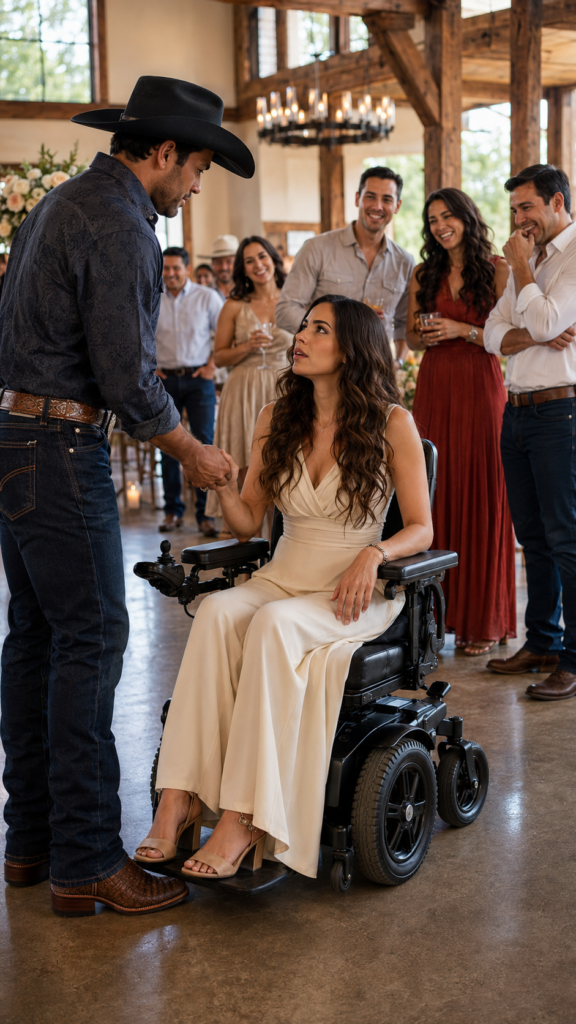
Tomás didn’t stop. He reached Valeria, lowered his head with respect, and extended his hand.
"Good evening, miss. May I have the honor of accompanying you in this dance?"
Valeria looked at him, breathless.
"You want to dance with me?"
"If you want to dance with me, yes."
The entire plaza fell silent.
Don Aurelio slammed his cup down on the table.
Valeria glanced at her father, then at the dance floor, then back at Tomás. For the first time in years, she didn’t ask for permission.
"Yes," she said, extending her hand. "I thought no one would dare."
Tomás carefully pushed the wheelchair toward the center. He didn’t treat her like a sick person or a burden. He twirled around her, following the rhythm of the band, marking the steps with such dignity that even the jeers began to fade.
Valeria laughed. First softly. Then with her whole soul.
And just as the song came to an end, Don Aurelio stood up, walked toward Tomás, and placed a heavy hand on his shoulder.
"Come with me for a moment."
He took him behind the stage, where the music drowned out the words.
"Listen to me carefully," he said, his eyes cold. "You’ve had your little show. Now stay away from my daughter."
Tomás held his hat against his chest.
"It wasn’t a show, boss. It was a dance."
Don Aurelio moved closer.
"Tomorrow you’ll understand what happens when a laborer forgets his place."
And Tomás knew, in that instant, that that night had only just begun.
PART 2
At dawn, Tomás arrived at the hacienda like every day, tools over his shoulder and his boots still stained with dust.
But the foreman wouldn’t let him through the gate.
"There’s no more work for you," he said, not looking him in the eye.
"Why?"
"Orders from above. Don’t ask, Tomás. It’s better if you leave quietly."
Tomás stared at the fields where he had worked since he was fifteen. He had cut cane under the sun, repaired fences in pouring rain, and carried sacks until his arms felt weak.
He didn’t beg. He didn’t shout. He simply understood that Don Aurelio’s threat hadn’t been a moment of anger.
It was a sentence.
That same week, he sought work at four nearby ranches. At each one, they closed the door in his face.
One of the foremen spoke to him quietly, almost with pity.
"You’ve been burned, buddy. Don Aurelio said no one should hire you."
Tomás returned home with 120 pesos in his pocket and a worry tightening his chest. His mother needed medicine for her blood pressure. His two younger siblings were still in high school. Losing his job wasn’t just a blow to his pride.
It was food less on the table.
Meanwhile, at the hacienda, Valeria asked about him.
First, they told her he was sick. Then that he had gone to Colima. After that, that he was problematic and had disrespected someone.
Nothing added up.
One afternoon, while crossing the stable yard, she overheard two workers speaking behind a fence.
"Don Aurelio fired him for dancing with the young lady."
"The boy didn’t do anything wrong."
"What’s wrong here is making someone feel alive when the boss wants to keep her hidden."
Valeria felt the words pierce her chest.
That night, she entered her father’s office without knocking. Don Aurelio was reviewing papers under an antique lamp, a glass of tequila beside him.
"Did you make them fire Tomás?"
He didn’t look up.
"I did what was necessary."
"For inviting me to dance?"
"For getting close to you as if there were no boundaries."
Valeria pushed her wheelchair closer to the desk.
"You invent the boundaries."
Don Aurelio slammed the folder shut.
"You don’t understand how people talk. I’ve protected this name my whole life. I won’t allow my daughter to become the town gossip."
Valeria let out a bitter laugh.
"You’re not afraid of them talking about me. You’re afraid of them seeing me."
He fell silent.
"You’re afraid they’ll remember I’m still a woman. That I can laugh, decide, attract someone, dance even if my legs don’t move. To you, I’m not your daughter, Dad. I’m a disgrace you learned to dress nicely."
Don Aurelio raised his hand as if to respond, but he found no words.
Valeria left the office with tears in her eyes but with her back straight.
The next day, she sent for Tomás with Martina, an employee who had cared for her for years. They found him in a humble house on the edge of town, fixing an old door for a few coins.
When Tomás saw her arrive, he immediately removed his hat.
"Miss Valeria, you shouldn’t be here."
"I should have come sooner."
She apologized to him. Not with words of wealth, not with pity. She spoke directly, her voice trembling.
Tomás didn’t want to blame her but couldn’t hide his exhaustion either.
"My mother isn’t to blame for me dancing," he said. "Neither are my siblings."
Valeria lowered her gaze.
"You gave me a night when I didn’t feel invisible. And my father paid for it as if I had committed a crime."
Tomás shook his head slowly.
"I only did what anyone with a little decency would have done."
"No," she replied. "That’s the sad part. Almost no one did."
The visit didn’t remain a secret.
Someone saw them from a distance, and the rumor reached the hacienda before night fell.
Don Aurelio exploded.
He ordered that Valeria not leave without permission. He fired Martina for accompanying her. He changed the driver. He had the main gate locked with a new chain.
The hacienda, which once seemed like a palace, became an elegant prison.
Valeria spent three days without speaking to her father.
On the fourth day, the sky dawned heavy, that gray that announces tragedy in the countryside. By nightfall, a fierce storm hit San Miguel del Río.
The wind ripped sheets from the stables. The rain turned the paths into rivers of mud. A lightning strike split an old mesquite tree by the large corral. The horses panicked and broke through the fences. Several cows were trapped near the creek.
The laborers ran chaotically. Some went to protect their families. The foreman shouted, but no one knew what to do.
Don Aurelio stepped out in a raincoat and flashlight, giving orders that the wind swallowed.
Valeria watched from the window, her heart racing.
Then she saw him.
Tomás appeared in the rain, soaked to the bone, with a rope over his shoulder. He didn’t come seeking revenge. He didn’t come to ask for forgiveness. He ran straight to the corral where a colt was sinking in the mud.
Don Aurelio saw him too.
The man he had wanted to destroy was the only one entering the disaster without asking for permission.
"Get out of there!" the landowner shouted. "That ground could give way!"
Tomás didn’t respond.
He moved through the mud up to his knees, speaking to the colt to calm it down. He slipped the rope over the harness, made a firm knot, and raised his hand asking for help.
For a few seconds, no one moved.
Then Valeria appeared in the corridor, pushing her chair with difficulty over the wet tiles. Her hair was loose, her face pale, and a blanket over her shoulders.
"Help him!" she shouted. "That animal is dying while you wait for permission!"
Her voice shattered the fear.
Two workers ran toward Tomás. Then three more. Together they pulled the rope until the colt managed to free its legs from the mud. The animal fell to its side, trembling, but alive.
The storm continued.
For hours, Tomás guided the workers through the pastures. He shut a gate near the creek. He pulled a pregnant mare from a ditch. He found eleven lost cattle near the old road. He organized the men better than the foreman, without humiliating anyone, without asking for applause.
Don Aurelio followed him in silence.
For the first time, he saw something his arrogance had never allowed him to accept: Tomás knew that land better than he did. He knew where the mud would give way, how the animals would escape, which corral would hold, and which would fall.
He was not "just a laborer."
He was the man saving the hacienda.
Near dawn, the rain subsided. The fields lay in ruins: broken fences, fallen trees, open roofs, wet grain sacks.
But the losses were not total.
Tomás had saved much of the livestock and, with that, the sustenance of many families in the town.
Valeria waited for him by the main stable. Her hands were cold, but her eyes sparkled.
"You could have stayed home," she said.
Tomás took off his wet hat.
"The storm doesn’t ask who took your job, miss. It just arrives."
Don Aurelio heard the words from behind.
And for the first time in many years, he didn’t know how to feel superior.
His fine boots were covered in the same mud as everyone else's. His name hadn’t stopped the rain. His money hadn’t calmed the animals. His orders hadn’t worked when fear paralyzed the men.
Days later, the town gathered in the plaza to organize the repair of roads, houses, and corrals.
Don Aurelio arrived with Valeria by his side.
Not behind.
Not in a corner.
Not under a dim light.
He placed her in front of the stage, where everyone could see her.
Tomás was among the workers, wearing a clean, simple shirt, trying to remain unnoticed.
Don Aurelio asked for the floor.
The murmurs faded.
Many thought he would speak of money, damages, or new rules. No one expected him to look at Tomás and say:
"Tomás, please come closer."
The laborer took a second to react. He walked to the front under the same gazes that days before had judged him for inviting Valeria to dance.
Don Aurelio took a deep breath.
"In front of this town, I want to acknowledge that I was unjust to you. I took your job, closed doors, and used my name to punish you for something that wasn’t a fault. It was an act of respect towards my daughter."
The plaza fell silent.
Valeria felt her eyes welling with tears.
"For years, I believed that protecting Valeria was deciding for her, hiding her from gazes, and shielding her from comments. But the truth is that I locked her in my own fear. That night you saw her as we all should have seen her: as a complete woman, dignified and capable of choosing."
Tomás clenched his jaw. He didn’t know what to do with an apology spoken before everyone.
Don Aurelio stepped down from the stage and extended his hand.
"I’m giving you your job back, if you want it. Not as a favor. As justice."
Tomás looked at that hand. Then he looked at Valeria.
She didn’t decide for him. She just accompanied him with her gaze.
Tomás accepted the handshake.
"I accept to work," he said, "but I won’t accept anyone believing that dignity is borrowed."
A timid applause began in one corner. Then it grew. The women who had mocked him lowered their eyes. The young men who hadn’t dared to dance that night clapped with shame.
Then the band began to play the same tune from the festival.
Tomás approached Valeria, took off his hat, and smiled just slightly.
"Miss Valeria, may I have the honor of accompanying you in this dance?"
She extended her hand.
"Only if this time they don’t turn off the lights."
Don Aurelio closed his eyes for a moment, wounded by the truth. Then he raised his hand to the staff.
"Turn them all on."
The lights clicked on one by one over the plaza.
Tomás led Valeria to the center of the dance floor. This time, no one laughed. No one pretended not to look. No one treated her like pity or him like audacity.
They watched her twirl under the music with a smile that no longer asked for permission.
And from that night on, in San Miguel del Río, it was said that the most important dance was not the one a laborer asked of the landowner's daughter, but the one that forced a whole town to stop looking with pity and start looking with respect.