PART 1
The gray uniform hung exactly where the wedding dress should have been.
Not in a bag. Not on a chair. Not hidden by accident.
Hanging, pressed, with a stiff collar and a note pinned with a golden pin:
"Put it on. Learn your place."
Lucía Santillán read the phrase twice without blinking.
There were 38 minutes left until her wedding at Hotel Palacio Reforma, in the heart of Mexico City. Below, 200 guests awaited her, live music, white flowers, cameras, businessmen, politicians, group employees, and half her family feigning excitement.
Her wedding dress, crafted in Puebla with hand-embroidered lace, had disappeared.
In its place was a maid’s uniform bearing the logo of Grupo Santillán Hoteles.
Lucía felt no shame.
What squeezed her chest was the cruelty.
Her grandmother Consuelo had worn a uniform like this for 22 years in a hotel in Acapulco. With those hands, she cleaned rooms, folded sheets, and gathered tips so her son Roberto, Lucía’s father, could study and build the family’s first hotel.
That uniform was not humiliation.
It was history.
But someone had chosen to turn it into punishment.
The door opened without anyone knocking.
Doña Blanca Varela, Diego’s mother, walked in, dressed in ivory, with a pearl necklace and that thin smile of a lady who believes she owns even the air.
“Good to see you noticed,” she said, adjusting her bracelet. “I didn’t want any last-minute drama.”
Lucía’s bridesmaids froze.
“Where’s my dress?” Lucía asked slowly.
Blanca lifted her chin.
“Put away in a safe place. Diego and I thought this would be more appropriate.”
Diego Armenta appeared behind her, immaculate, smelling of expensive cologne, adjusting his watch as if it were any Sunday in Polanco.
Lucía looked at him, waiting for a sign of surprise.
None came.
“Don’t make a scene, love,” he said. “My mom just wants to help you come down a little from that cloud.”
Lucía felt something crack, but it wasn’t her voice.
“Come down from what cloud?”
Blanca let out a dry laugh.
“From thinking you're the boss. A wife can’t go around giving orders in her husband’s business.”
“Grupo Santillán is not Diego’s business.”
“Not yet,” Diego replied.
There it was, the bold truth.
Diego stepped closer and lowered his voice.
“After the ceremony, you’ll sign the trust. Your voting shares will pass to family management. You relieve stress, I take the reins, and we stop fighting. It’s for our future.”
Lucía looked at him as if she were finally seeing the stranger who had always lived behind the perfect boyfriend.
That man had accompanied her to the hospital when her mother died.
That man had listened to her grandmother’s story as a maid.
That man had used that story to plan a public humiliation.
Then Roberto Santillán, her father, entered.
He saw the uniform. He saw the note. Then he saw his daughter.
“Say a word, sweetheart, and I’ll go cancel everything.”
Lucía touched the silver brooch she wore on her wrist.
It looked like a family heirloom.
In reality, it concealed a tiny recorder.
She also recalled the encrypted folder her father had ready on the tablet: three months of audits, inflated accounts, fake suppliers, and emails sent in the early morning.
Lucía breathed.
“No, Dad. The wedding goes on.”
Blanca smiled as if she had won.
Lucía put on the uniform in front of the mirror.
She buttoned the collar. She smoothed the fabric. She pinned her grandmother Consuelo’s brooch over her chest.
Then she tucked a sealed envelope into her pocket.
The salon doors opened.
The murmur died instantly.
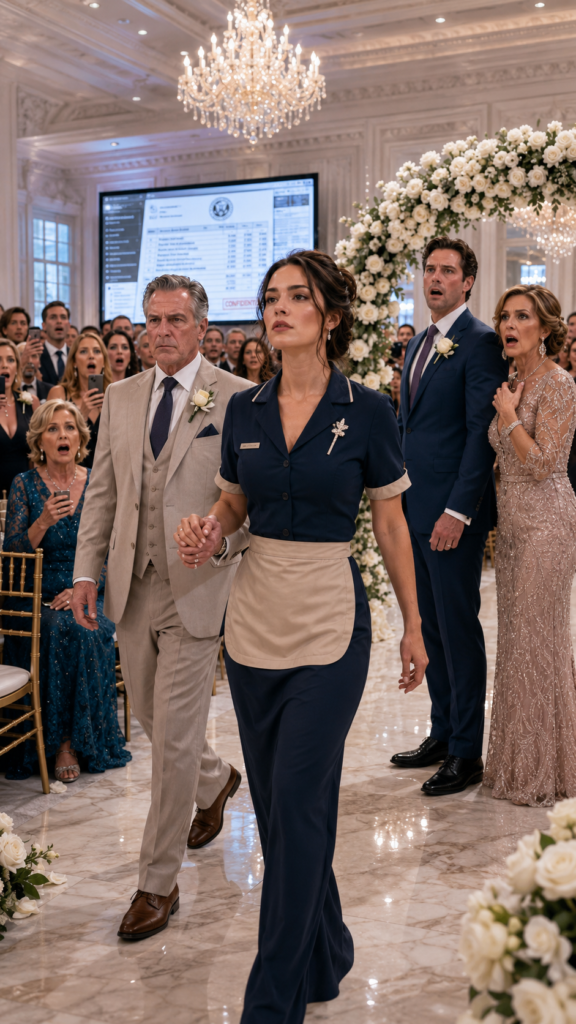
Lucía walked arm-in-arm with her father, dressed as a maid, in front of 200 guests who didn’t know whether to look, record, or bow their heads.
Diego, from the altar, smiled.
He thought she had given up.
In the middle of the aisle, Lucía stopped.
She took the microphone from the floral podium and said:
“This uniform was worn by my grandmother to build what some here tried to steal with fine suits and hyphenated last names.”
Diego stopped smiling.
Blanca stood up.
“Lucía, don’t be tacky!”
Roberto turned on the tablet.
The giant screens in the hall went dark.
And when the first image appeared, Diego’s smile vanished like he’d just seen his own sentence.
PART 2
No romantic video appeared on the screens.
No engagement photos in San Miguel de Allende, no cheesy quotes with violin music, no false story of a perfect love.
A timeline appeared.
February. March. April.
Transfers. Duplicated invoices. Contracts with suspicious signatures. Ghost companies registered in Querétaro, Mérida, and Guadalajara.
Then a huge figure appeared:
DETECTED DIVERSION: 126 MILLION PESOS.
The entire hall filled with murmurs.
One of Diego’s aunts covered her mouth. A supplier tried to sneak out through the side door. Several hotel employees, seated at the back, stood up, unsure if this was a wedding or a public hearing.
Diego walked towards Lucía.
“Turn that off, now.”
“No.”
“You’re going to regret this.”
“I would have regretted marrying you.”
Blanca tried to advance toward the sound booth.
“Get that crap off! This is a private event!”
But two hotel security personnel crossed in front of her.
They weren’t guards hired by the Armentas.
They were trusted personnel of Roberto Santillán.
Blanca looked at them as if they were disobedient furniture.
“Do you know who I am?”
One of them replied without moving:
“Yes, ma’am. That’s why you can’t pass.”
Roberto took the microphone.
His voice sounded deep, tired, but firm.
“This morning, the board of Grupo Santillán voted for the immediate separation of Diego Armenta from any operational position and authorized civil and criminal actions against those responsible.”
The act appeared on the screen.
Diego swallowed hard.
“That doesn’t count. I wasn’t notified.”
Lucía pulled the envelope from her pocket.
“Yes, you were. At 8:15 this morning. Only you were busy hiding my dress.”
Some guests gasped in surprise.
Blanca feigned indignation.
“What vulgarity! A bride talking about business at the altar!”
Lucía turned to her.
“No, Doña Blanca. Vulgar was using my grandmother’s memory to try to humiliate me.”
Then she pressed the brooch on her wrist.
The speakers emitted a clear audio.
First, Blanca’s voice:
“Have her come down dressed as a maid. That way everyone understands that the Santilláns are not of our class.”
Then Diego’s voice:
“As long as she signs the trust today, it doesn’t matter if she cries. Once we’re married, her shares will be under my control. We'll see how to get her out of the board later.”
A heavy silence fell over the hall.
Even the waiters stopped moving.
Diego looked at the brooch as if it were a snake.
“You recorded me.”
“I heard you lie for three months,” Lucía replied. “Recording you was the least.”
“That’s illegal.”
“More illegal was using my digital signature to authorize payments to your cousin’s companies.”
A signature appeared on the screen.
Lucía’s signature.
Forged.
Next to it, emails sent from an internal account, contracts approved without a board meeting, and invoices for renovations that were never completed.
A hotel in Oaxaca charged for new elevators.
They never arrived.
An industrial kitchen in Cancún appeared invoiced twice.
It was never installed.
A pool in Valle de Bravo cost 14 million.
It existed only in renders.
The murmurs turned to rage.
Doña Toña, the cleaning supervisor with over 20 years at the hotel, stood up from the last row.
Her eyes were filled with tears.
“Lucía was the only one who defended our wages when they wanted to cut staff,” she said. “And now they come to say she doesn’t know how to lead. Seriously, how low can you get?”
Several employees applauded.
Then other guests.
Then almost half the hall.
Blanca lost her mask.
“Silence! You have no right to speak!”
Lucía took a step towards the altar.
“They have more right than you. This company was built with their hands, not with their last names.”
Diego lowered his voice, desperate.
“Lucía, love, we can still fix this. This is going to look terrible for everyone. Think about your dad. Think about the press.”
“I thought about everyone when I asked you for explanations.”
“I love you.”
Lucía almost smiled, but not out of joy.
“You loved my signature, my shares, and my position on the board.”
Diego gritted his teeth.
“Don’t be dramatic.”
That phrase, so simple, hurt more than the audios.
Because Lucía remembered all the times he had called her intense for asking questions. Exaggerated for checking contracts. Bossy for not allowing Blanca to comment on payroll, suppliers, and decisions that weren’t her domain.
He never wanted a partner.
He wanted a door.
And when the door didn’t open by itself, he tried to break it.
Suddenly, the main doors of the hall swung open.
The choir didn’t enter.
No children with petals entered.
Three agents from the Mexico City Prosecutor’s Office entered.
Behind them walked an older man, pale, in a gray suit, holding a black folder.
It was Arturo Armenta, Diego’s father.
Diego froze.
“Dad… what are you doing here?”
Arturo didn’t look at him.
He approached Roberto and handed him the folder.
“Here are the original emails, the access keys, and the accounts where they moved the money.”
Blanca let out a scream.
“Arturo, you fool! You’re sinking your own son!”
The man closed his eyes for a second.
“No. I’m stopping covering for him.”
Diego lunged at him.
“Coward old man!”
An agent intervened.
Arturo, with a broken voice, said something that changed the entire atmosphere:
“Your mother asked me to sign as a guarantor for three companies I didn’t know. When I asked, she told me it was to help you enter ‘big time’ into the Santillán family. Then I found the account statements. I could no longer pretend.”
Blanca trembled with rage.
“All this was to secure your future, Diego.”
Lucía looked at her incredulously.
“Stealing a family business was securing his future?”
“You all despised us from the start.”
“You called me a maid before you even met me.”
Blanca didn’t deny it.
That silence was another confession.
One of the agents read the order.
Diego Armenta was to be detained for fraud, forgery of documents, misuse of identity, and operations with illicit funds.
Blanca Varela was implicated for conspiracy, obstruction, and participation in concealing documents.
But when the agent approached Diego, he shouted:
“She signed last night! Lucía signed! She can’t play the victim!”
The hall froze again.
Blanca, although pale, smiled with poison.
“That’s true. The bride signed. And she signed happily.”
Roberto turned to his daughter.
Lucía didn’t lower her gaze.
“Yes,” she said. “I signed.”
The murmurs returned like a wave.
Diego regained a little breath.
“See? It was all voluntary.”
Lucía raised her hand.
“Only I didn’t sign the trust they think.”
Roberto opened the last file.
On the screens appeared the document signed during the rehearsal dinner, the night before.
Diego had signed first.
Blanca, as a witness.
Lucía, at the end.
But it wasn’t a transfer of shares.
It wasn’t a marriage agreement.
It was an acknowledgment of involvement in investigated supplier companies, with authorization for the board to review accounts, contracts, and final beneficiaries.
Diego had signed it without reading.
So had Blanca.
The night before, during dinner on the hotel terrace, Diego was so sure of his victory that he didn’t even review the folder.
“They’re legal adjustments to get everything ready,” Lucía had told him.
He laughed.
“You and your papers, love. Tomorrow you won’t have to worry about those things.”
He signed where she pointed.
Blanca signed next, annoyed.
“A wedding shouldn’t feel like an office,” she said.
None read the appendix.
None suspected that the document didn’t open the door for Lucía.
It closed theirs.
Diego turned red.
“That was a trap!”
Lucía looked at him calmly.
“No. It was a trust test. You only demonstrated that you trusted your lie too much.”
The supposed priest, who had remained silent next to the altar, closed his folder.
Diego looked at him confused.
“Father Joaquín…”
The man pulled out an ID.
“I’m not a priest. I’m an external auditor for the group’s corporate insurer.”
A muffled scream swept through the hall.
Lucía took off the engagement ring.
The stone sparkled under the chandeliers like a rotten promise.
“There was never a legal wedding,” she said. “There was no act ready. There was no authorized minister. There was no civil ceremony. You prepared a humiliation. We prepared an audit.”
Diego glared at her with hatred.
“You destroyed me.”
“No, Diego. You destroyed yourself when you thought loving a woman meant taking away her power until she was silent.”
The agents placed the handcuffs on him.
Blanca tried to maintain her dignity, but when they took her by the arm, she exploded:
“Ungrateful! We were going to turn you into a real lady!”
Lucía looked at the uniform.
She touched the logo of Grupo Santillán.
Then her grandmother’s brooch.
“I was already a lady. What you wanted was to make me obedient.”
Blanca had no reply.
Only insults.
They dragged her out of the hall amidst cold stares. No one defended her. Not even the friends who moments earlier were taking selfies with her next to the floral arrangement.
Diego, before crossing the door, turned one last time.
“You’ll end up alone.”
Lucía felt the blow, but didn’t let it show.
“Better alone than married to someone who mistook love for control.”
When the doors closed, the hall fell into a strange silence.
The flowers were still there.
The food was ready.
The music awaited.
The employees looked at Lucía with shiny eyes.
Roberto approached his daughter.
“Do you want to leave?”
Lucía took a deep breath.
“No.”
She went up to the suite escorted by security.
They found her dress locked inside Blanca’s private closet, wrapped in a black cover. It was intact.
Lucía changed alone.
She didn’t cry for Diego.
She cried for the woman who almost believed she had to shrink to be loved.
She remembered her mother, who before dying told her:
“Sweetheart, don’t marry a man who needs to dim your light to feel important.”
Lucía hadn’t listened in time.
But she heard her before signing her life away.
She descended to the hall in the white dress with her grandmother’s brooch on her chest.
The wedding march didn’t play.
Applause sounded.
First from the employees.
Then from the guests.
Then from almost the entire hall.
Roberto took the microphone.
“My mother started cleaning rooms. I carried bags. My daughter studied law while watching this company grow from the ground up. If anyone thought that origin embarrassed us, they understood nothing.”
Doña Toña cried in the last row.
Lucía approached her and hugged her.
That image went viral before midnight.
The bride in a white dress hugging a maid while her canceled wedding turned into the business scandal of the year.
But the night didn’t end in tragedy.
Roberto announced that the reception would continue, not as a wedding, but as a dinner for the creation of the Consuelo Santillán Fund, intended to pay for university studies for children of maids, cooks, gardeners, receptionists, bellboys, and cleaning staff from all the group’s hotels.
The guests, still shaken, began to donate.
A businessman from Monterrey covered eight scholarships.
An actress promised to promote the fund.
A supplier voluntarily returned an inflated contract to avoid getting dirty.
The first scholarship was for Doña Toña’s granddaughter, a student of accounting at UNAM.
That was the true ceremony.
There was no husband.
There was no kiss under the flowers.
There was no newlywed waltz.
But there was justice.
There was memory.
There was an entire room understanding that the uniform used to humiliate had become a banner.
Months later, Diego pleaded guilty.
The evidence was overwhelming: audios, emails, forged signatures, bank accesses, false invoices, and the testimony of his own father.
Blanca fell too.
They seized jewelry, accounts, cars, and a house in Valle de Bravo bought with diverted money.
Grupo Santillán survived.
Lucía joined the permanent board and assumed the general legal direction.
A year later, they inaugurated the renovation of the family’s first hotel in Acapulco.
In the lobby, they placed a photograph from that day.
Lucía was walking down the aisle in a gray uniform, arm in arm with her father, while 200 people looked at her, unaware they were witnessing not a humiliation, but the beginning of a downfall.
Under the photo, they put a small display case.
Inside was Consuelo’s brooch.
And a simple plaque:
Consuelo Santillán. Maid. Mother. Root of all we are.
Many asked Lucía if that was the worst day of her life.
She always answered no.
It was painful.
It was brutal.
It was a betrayal wrapped in flowers, music, and champagne.
But it was also the day she understood that dignity does not depend on the clothes someone puts on you, but on what you do when they try to use it to lower your head.
Blanca thought a uniform could reduce her.
Diego thought her silence was weakness.
Both were wrong.
Because Lucía came from women who cleaned rooms before dawn, counted coins to pay for studies, and never let themselves be erased.
That day, she didn’t lose a wedding.
She saved herself from a whole life next to a man who wanted a quiet wife, an obedient signature, and a domesticated heiress.
And when years later someone repeated the phrase from that note, “learn your place,” Lucía only smiled.
Because yes.
That day she learned her place.
It was not behind Diego.
It was not beneath Blanca.
It was not locked away crying in a suite.
Her place was at the front, with the truth in hand, honoring all the women who worked before her so that no one would ever tell them where they had to be.