PART 1
The day Arturo Salgado gave his daughter away in marriage, Valeria stood next to a man who hadn’t spoken, moved, or opened his eyes for nine months.
Everyone said Emiliano Alcázar couldn’t hear a thing.
The doctors claimed he would never wake up.
But that night, when Valeria was alone with her husband, she cried as she confessed why she had agreed to the marriage. Then, one of Emiliano’s fingers twitched.
The private chapel of the Alcázar family in San Pedro Garza García smelled of lilies and expensive perfume.
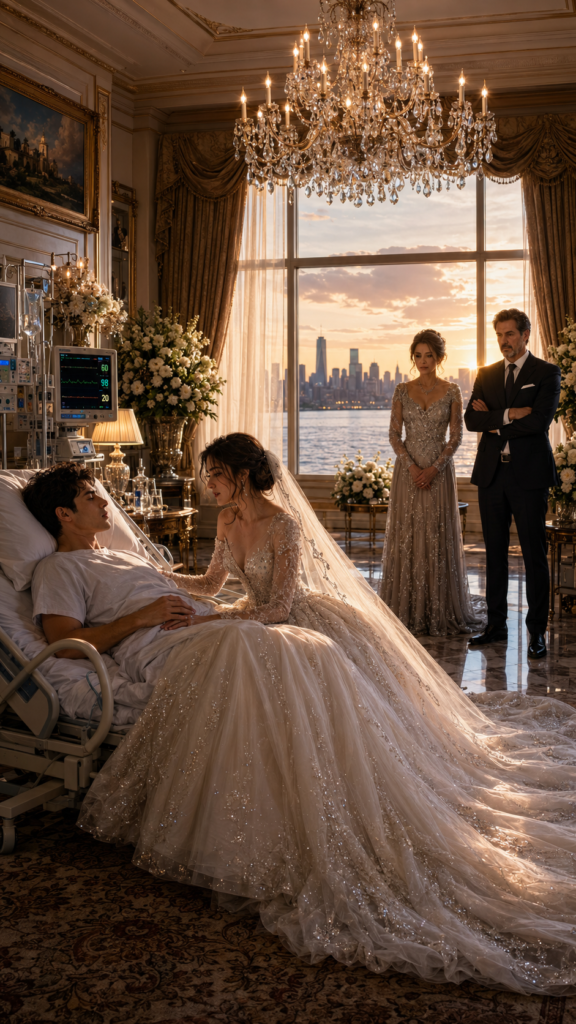
Valeria wore a borrowed dress. Emiliano sat in a wheelchair, immaculate, motionless, with a nurse behind him and a portable monitor marking every heartbeat.
“Say it,” Arturo murmured, squeezing her arm.
“I accept.”
The word didn’t sound like a promise, but like a sentence.
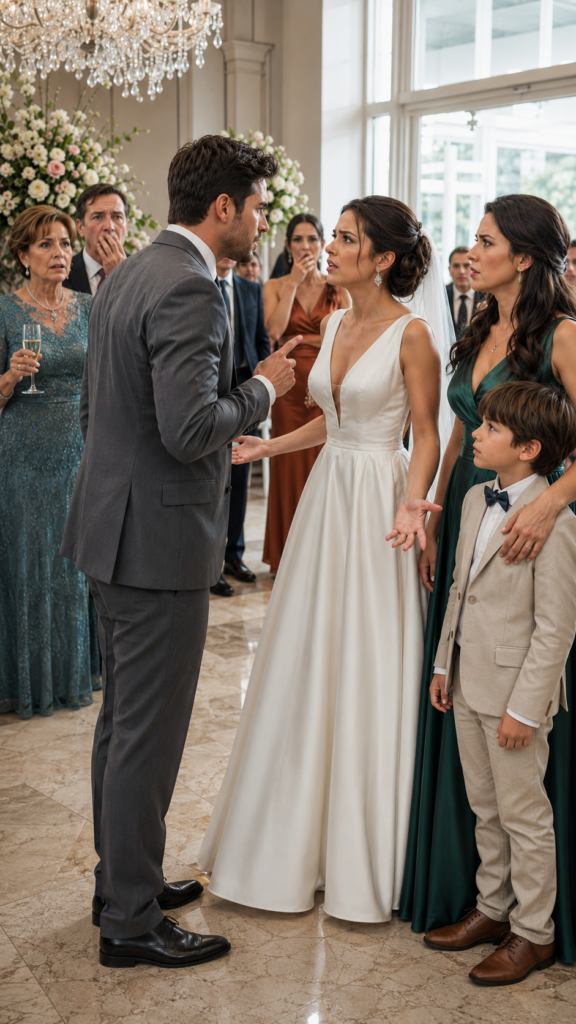
The priest finished the ceremony. The guests clapped with that cold courtesy of the wealthy, and no one asked the newlyweds to kiss.
Emiliano couldn’t even give his consent.
As they exited, Arturo breathed a sigh of relief.
“You did the right thing, daughter.”
“Marrying a stranger in a coma is the right thing?”
“This saves us.”
“Us.” Arturo always used that word when he needed Valeria to pay for his mistakes.
Three weeks earlier, he had explained the deal. The Alcázar trust required Emiliano to be married before turning thirty; otherwise, control of the business group would pass to his cousin, Santiago.
If Valeria agreed, the mortgage, the credit cards, the loans, and the debt from the clinic where her mother had died two years prior would vanish.
Arturo swore he was doing it to stop seeing her suffer.
Valeria wanted to believe him.
But as she stepped into the Alcázar residence, a stone mansion facing the Sierra Madre, she knew she hadn’t arrived at a family, but at a cage.
Santiago waited by a marble staircase.
“So, you’re the wife,” he said, eyeing her up and down. “My cousin was always lucky, even asleep.”
Before Valeria could respond, doña Beatriz Alcázar, Emiliano’s grandmother, appeared.
Elegant, rigid, with a silver cane and eyes capable of freezing a room.
“Stop looking at her like a fairground animal, Santiago.”
Then she examined Valeria from head to toe.
“She’ll do.”
She took Valeria to Emiliano’s bedroom. It wasn’t dark or sad: there were windows, fresh flowers, and soft music. Only he seemed absent from that world.
When they were alone, Valeria sat by the bed.
“I don’t know if you can hear me,” she whispered. “I didn’t want this marriage. My father gave me away because he caused the debts… and I was afraid of losing what little we had left.”
Tears overwhelmed her.
“Forgive me. You didn’t choose this either.”
The monitor maintained its rhythm.
Then Emiliano’s index finger moved.
Valeria stopped breathing.
His eyelids trembled, and after nine months, his eyes slowly opened.
She leaned in, ready to ask for help.
But Emiliano gathered the little strength he had and murmured:
“Don’t trust Santiago.”
At that very moment, the door began to open from the outside.
PART 2
Valeria barely had time to pull away from the bed before Santiago entered with a bouquet of white roses and a smile that was too perfect.
Emiliano had already closed his eyes.
“What a tender scene,” Santiago said. “The faithful wife taking care of the husband who can’t see her.”
Valeria hid the tremor in her hands.
“I was talking to him.”
“Do whatever you want. The doctors say he understands nothing.”
He watched her for several seconds, as if waiting for her to contradict him.
“Though sometimes a reflex can confuse people,” he added. “A finger, a blink, a sound… Don’t turn anything into a miracle, okay?”
Valeria understood he hadn’t entered by chance.
That night, she was assigned a room next to Emiliano’s. When she opened a drawer, she found a folded sheet hidden under the lining.
The handwriting was firm but hurried.
“If you’re reading this, it means I failed.”
Valeria kept reading.
“Don’t trust Santiago. Don’t trust Dr. Robles. Don’t trust the portrait of my mother. Her eyes aren’t painted.”
She felt a chill.
On the wall hung a portrait of a woman in a blue dress, officially dead for eight years.
Valeria pressed one of the eyes of the painting.
The frame opened, revealing a narrow passage behind the wall.
Before entering, she heard a key turning in the door to her room.
She tucked the letter inside her pants.
Santiago appeared without knocking.
“I saw light,” he said. “I thought you needed something.”
His eyes scanned the open drawer, the bed, and the portrait.
“I was just organizing my things.”
“Sure.”
He got so close that Valeria could smell his cologne.
“Emiliano can make involuntary movements. Even sounds. Don’t let your imagination get you in trouble.”
“He said my name,” she lied.
For a moment, Santiago’s smile vanished.
“How nice,” he finally replied. “Good night, sister-in-law.”
When he left, Valeria returned to the letter.
“The passages connect almost the entire house. If I’m still alive, get me out of here. If I’m awake and can’t speak, look for the silver recorder in the music room. It contains evidence.”
The next morning, Valeria personally brought the medications. She had studied nursing before dropping out to care for her mother, and she knew how to read a clinical order.
Emiliano opened his eyes when he heard her.
“I found your letter,” she whispered.
He looked at the tray.
Valeria lifted three vials. He didn’t react to the first two. When she showed him the third, his fingers tensed.
“Does this keep you sedated?”
Emiliano blinked once.
Yes.
The vial was signed by Dr. Robles.
The door opened. Santiago and the doctor entered, a thin man with metal-rimmed glasses.
“He must receive the full dose,” Robles ordered.
Valeria loaded the syringe and connected it to the IV port. While pretending to inject, she discreetly pinched the tube so the liquid wouldn’t flow.
“All set.”
Robles checked the equipment while Santiago leaned in close to Emiliano.
“Rest, cousin. You were always more useful silent.”
When they left, Valeria removed the substance. Over the following hours, Emiliano regained a bit of strength.
In the afternoon, she entered the music room. She searched through scores, display cases, and furniture until she discovered a piano key that wouldn’t return to its place.
When she pressed it, a secret compartment opened.
Inside was a silver recorder.
“You shouldn’t have found that.”
Valeria turned around.
It was Eulalia, the housekeeper, a woman who had worked for the Alcázar for thirty-two years.
“Do you know what they’re doing to Emiliano?”
Eulalia looked down.
“I know he woke up three days after the accident. I know he recognized who ordered the brakes of his truck cut. I also know the doctor started sedating him to make it look like brain damage.”
“Santiago?”
“He participated. But he doesn’t call the shots.”
Eulalia recounted how Emiliano had discovered multimillion-dollar embezzlements through fake foundations. He wanted to deliver documents to the prosecutor’s office and expel several relatives from the board.
The night before the accident, he recorded a conversation with those responsible.
A slow clap echoed from the hallway.
Santiago stood in the doorway.
“What a disappointment, Eulalia.”
The woman stepped in front of her.
“Run, girl.”
Valeria shoved a bench against Santiago and bolted with the recorder. She ran toward the west wing, opened the device, and discovered it had no battery.
However, beneath the cover was a memory card.
Santiago caught up with her in front of a dead-end corridor.
“Give it to me.”
“Come get it, jerk.”
Valeria smashed a lamp with a candlestick. The hallway plunged into darkness. Santiago grabbed her arm, but she drove her heel into his foot and found a hidden latch in the wall.
She entered the passageway.
She moved blindly, hearing Santiago behind her. Through a crack, she saw Dr. Robles interrogating Eulalia, whose face was bruised.
Further ahead, she found an exit behind Emiliano’s bedroom bookcase.
He was awake.
“I have the card,” Valeria said.
Emiliano shook his head weakly.
“No… only Santiago.”
“I know. Robles too.”
“No.”
With great effort, he took a pen and wrote a shaky word:
“MOTHER.”
Valeria looked at him in confusion.
“Your mother is dead.”
The door opened.
Santiago, Robles, and the woman from the portrait entered.
Dressed in blue. Her dark hair streaked with gray, but her face was unmistakable.
Regina Alcázar, Emiliano’s mother, was alive.
Santiago bowed his head before her.
In that moment, Valeria understood everything: he wasn’t the master of the house, but the dog guarding the door.
“She’s supposed to be dead,” Valeria said.
“Also, my son is supposed to be in a coma,” Regina replied. “Appearances are quite useful.”
She approached Emiliano and stroked his forehead. He turned his face away with a tear.
Regina had faked her death to manage the businesses from foreign accounts without facing audits. Emiliano discovered her and decided to report her.
Then she ordered the accident.
As he survived, Robles kept him sedated, and Santiago waited to take over the group when Emiliano turned thirty.
The marriage had ruined that plan.
“Your father received 15 million pesos for handing you over,” Regina revealed. “The debts were just part of it. The rest is in an account in his name.”
Valeria felt something break inside her.
Arturo hadn’t sacrificed her to save the family.
He had sold her to get rich.
Regina extended her hand.
“Give me the card. I’ll pay you another 15 million, and you can leave.”
“And Emiliano?”
“He’ll continue resting.”
“You mean prisoner.”
“I mean alive.”
Valeria clenched her fist around the card.
Then she noticed Emiliano staring at a bronze clock on the mantel. Behind it blinked a red light.
There was a hidden transmitter.
Valeria ran, ripped the clock off, and found the active device.
Regina paled.
“Who did you call?”
Emiliano smiled faintly.
“Everyone.”
Footsteps echoed in the hallway.
Four suited men entered. Regina regained her composure upon recognizing them.
“The signal was blocked, ma’am,” one informed. “No one outside received anything.”
Santiago burst out laughing.
Valeria thought it was all over.
But Emiliano squeezed her hand and left a silver key with the word “CRYPT” in her palm.
Regina saw it and, for the first time, showed true fear.
From the basement came a metallic thud.
Then another.
And another.
Valeria dashed to the passageway before they could stop her. Eulalia, who had managed to break free, closed a gate behind her and blocked Santiago.
The key opened a door beneath the family chapel.
Inside the crypt, there was no corpse.
There was a server connected to cameras, microphones, and automatic copies of every conversation inside the mansion.
Emiliano had installed the system months before the accident.
The transmitter in the bedroom was indeed a decoy, but when activated, it sent an order to the server to publish the files from an independently buried antenna in the garden.
The thuds everyone heard were the generator starting up.
On a screen appeared a countdown:
10.
11.
Regina rushed down, followed by Santiago and Robles.
“Disconnect it!” she shouted.
Valeria held the key next to the panel.
“Seriously, all this for money?”
“For power,” Regina corrected. “Money just obeys.”
Santiago lunged at Valeria, but Eulalia activated an old iron gate. He was trapped on the other side.
Robles tried to cut the wires. Emiliano, pushed in a wheelchair by a nurse who had heard the commotion, appeared at the entrance.
“Don’t… touch it,” he ordered weakly.
Robles froze.
3.
4.
5.
The screens displayed the complete transmission.
Recordings, transfers, false medical orders, videos of Regina alive, and the audio where she ordered the truck sabotage were sent to journalists, partners, authorities, and board members.
The suited men fled.
Regina did not.
She looked at her son with an hatred she could no longer disguise as love.
“You destroyed your family.”
Emiliano struggled to breathe.
“No. You destroyed it when you confused family with impunity.”
Hours later, federal agents entered the residence.
Regina, Santiago, and Dr. Robles were arrested. Eulalia provided her testimony and the adulterated vials. The nurse confirmed the clandestine doses.
Arturo was also arrested for fraud and for participating in the illegal contract. When he asked to speak with Valeria, she refused.
She didn’t want another explanation dressed as sacrifice.
Months later, Emiliano was still in rehabilitation. He had regained his voice and could walk short distances with assistance.
The marriage was annulled because neither had freely chosen that agreement.
Still, Valeria continued visiting him.
Not out of debt.
Not out of obligation.
One afternoon, Emiliano asked her if she regretted entering that house.
Valeria thought about her father’s betrayal, the terror of the passages, and everything she had almost lost.
“I regret that they tried to buy us,” she replied. “But not discovering how much we were worth without them.”
Emiliano took her hand.
This time there was no priest, no contract, no fortune at stake.
Just two people who had been used by their own families, deciding, for the first time, to stay because they wanted to.
The story divided all of Mexico: some claimed Valeria should leave the Alcázars forever; others believed love could bloom even after a lie.
But almost everyone agreed on one thing:
The family that demands your silence to protect its name isn’t caring for you.
It’s burying you alive.