PART 1
—When the judge grants me custody, I’ll sell the house, close her accounts... and then the doctor will sign the disconnection.
Lucía Aranda heard those words without being able to open her eyes.
She lay in a room at the Puerta de Hierro Hospital in Guadalajara, surrounded by tubes, monitors, and machines that breathed for her. To the doctors, her body was still alive, but her mind had vanished after the accident on the road to Chapala.
But that wasn’t true.
Lucía could hear everything.
She heard the footsteps of the nurses, the medication cart, the rain beating against the windows, and above all, the voice of Diego, her 9-year-old son, who arrived every afternoon with his green backpack and sat by her bedside.
—Mom, I got a 10 in reading today —he would say softly—. Dad didn’t come for me again, but the neighbor Chayo bought me a sandwich. Don’t worry, I’m okay.
Lucía wanted to cry.
She wanted to lift her hand, stroke his hair, and tell him that no 9-year-old should have to learn to console himself. But her body wouldn’t obey. It was like living trapped behind a glass wall: she saw life from the inside, but no one could hear her.
Her husband, Roberto Castañeda, only appeared when important visitors were around. He came with a pressed shirt, expensive flowers, and a face of an early widower that fooled everyone.
—My wife is my life —he said in front of the nurses—. I would do anything to see her wake up.
Lucía, trapped in silence, knew he was lying.
Before the accident, she had discovered suspicious movements in the accounts of her law firm. 7,800,000 pesos were missing. There were contracts signed in her name, but she had never authorized them. When she asked Roberto about it, he smiled as he always did.
—Oh, Lucía, you really see enemies everywhere.
Three days later, her brakes failed on the highway.
That night, the room was almost dark. Diego slept in a chair, his little hand resting on his mother’s sheet. The door opened carefully.
Roberto and Marisol, his assistant, entered.
—What if she wakes up? —she asked.
Roberto let out a dry laugh.
—She’s not going to wake up. Dr. Yáñez already said she’s practically gone.
—But she’s still alive.
He approached the bed.
—That’s why we need to hurry. First, I sell the house in Providencia, then the firm. After that, Yáñez will do his part.
Marisol lowered her voice.
—And the accident?
Roberto replied without fear:
—I already cut the brakes once, and no one suspected.
Diego opened his eyes.
Lucía felt his small hand tremble over hers.
—Mom... —the boy whispered—. If you can hear me, move.
And then, with all the pain in the world, Lucía barely brushed her palm with a finger.
PART 2
Diego didn’t scream.
That was what saved his mother.
He was 9 years old, but in that second, he understood something many adults would not: if Roberto realized Lucía could respond, he would kill her before anyone believed her.
The boy stayed still, his eyes filled with tears, pretending to be asleep.
Roberto didn’t notice anything. He was too busy celebrating his own evil.
—In a week, everything will be in my name —he said—. The house, the firm, the investments. And the boy... well, the boy will get used to it.
Marisol asked:
—And if he speaks?
—Who would believe a scared kid? Besides, Diego is afraid of me.
Lucía felt something breaking inside her.
Not for herself. For her son.
Roberto not only wanted to erase his wife. He also wanted to turn Diego into a quiet, obedient child, guilty of having seen too much.
When they left, Diego leaned close to Lucía’s ear.
—Mom, don’t fall asleep. I’m going to help.
The next day he arrived with a false smile and a dinosaur lunchbox. He greeted the nurses as always, left his backpack on the chair, and sat next to Lucía.
But this time he didn’t come alone.
Behind him walked Doña Socorro, Lucía’s godmother. She was a retired notary from Tlaquepaque, one of those women who speak little, look fiercely, and are not intimidated even by a governor.
Roberto appeared almost immediately.
—What are you doing here?
Doña Socorro settled her bag on her arm.
—I came to see my goddaughter.
—Lucía needs peace.
—Lucía needs you to stop deciding for her as if she were already dead.
Roberto clenched his jaw.
—You’re not direct family.
—No —Doña Socorro replied—. I am the executor of her will.
For the first time, Roberto was left speechless.
Lucía trembled inside.
The will.
She had signed it a year earlier when she began to suspect the false contracts. In that document, she left a special clause: if she became incapacitated under suspicious circumstances, Doña Socorro would manage her assets, not Roberto.
Roberto hadn’t attacked a defenseless woman.
He had attacked a lawyer who had already prepared her defense before falling.
When Roberto stormed out into the hallway, Doña Socorro leaned over the bed.
—Daughter, if you’re listening, hang in there. Diego told me about the finger. And I found your safe.
Lucía’s darkness filled with hope.
In that safe were copies of transfers, emails, altered contracts, audio from meetings, and a private investigation Lucía had paid for weeks before the accident.
Roberto had been stealing from her for months.
Marisol was not just his assistant.
She was his lover.
And Dr. Yáñez had a huge debt with a private clinic that Roberto had covered in exchange for medical favors.
Doña Socorro didn’t call the police immediately.
First, they needed fresh evidence.
Diego brought a small digital recorder hidden inside a colorful case. He placed it under the sheet, near his mother’s pillow. Each time Roberto entered, Diego pretended to play on the tablet.
And Roberto, believing himself untouchable, talked too much.
—Yáñez will sign irreversible deterioration on Friday.
—Marisol, move the money before the old lady Socorro sticks her nose in.
—The mechanic already went to Colima. No one will find him.
—Diego is weak. He’ll break on his own.
Each phrase was another stone in the tomb Roberto was digging for himself.
But Friday came sooner than expected.
That morning, at 2:16, Roberto entered the room with Dr. Yáñez. Marisol followed behind, pale and trembling.
Lucía recognized their footsteps.
She also recognized the silence of danger.
—Do it quickly —Roberto ordered—. A respiratory complication. No one will ask anything.
The doctor took a deep breath.
—This is no longer altering papers. This is killing a patient.
—Don’t get moralistic with me, man. You’ve already been paid.
Marisol murmured:
—Roberto, Diego might say something.
—Diego doesn’t know anything. And if he does, no one will believe him. He’s a traumatized kid.
Lucía wanted to move.
She couldn’t.
The doctor picked up a syringe. The sound of the plastic against the tray pierced her soul.
Then a small voice cut through the room.
—If you touch my mom, everyone is going to hear it.
Roberto turned around.
—What are you doing here?
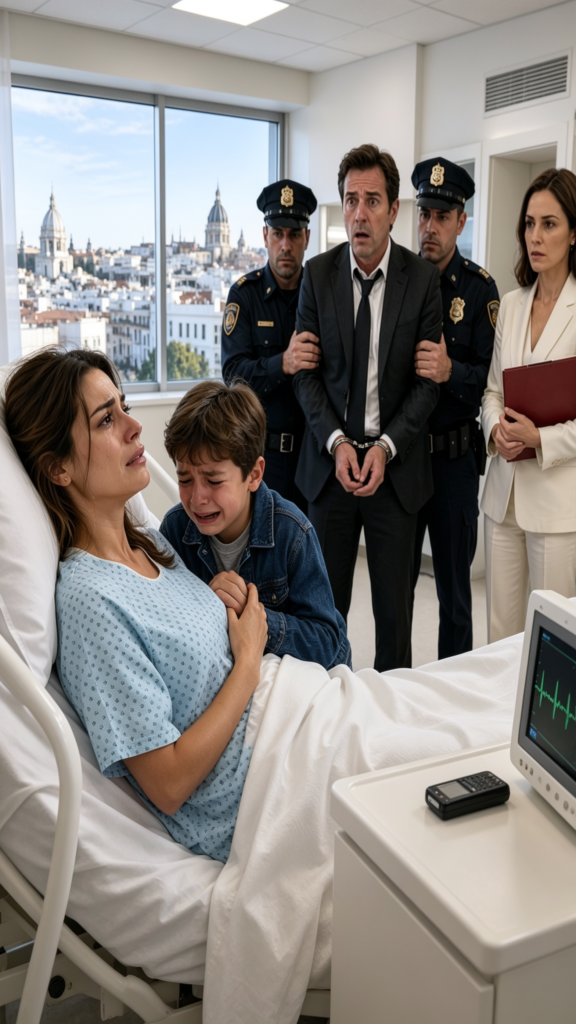
Diego stood at the door, with his backpack on his chest and his face soaked with tears.
—I heard you, Dad.
—Go to the hallway.
—No.
Roberto walked toward him.
—Don’t make me angry.
Diego swallowed hard.
—I’ve already heard you angry. You said you cut the brakes on my mom’s car.
Marisol let out a choked cry.
And then another voice appeared from the hallway.
—Let the boy keep talking.
The door opened wide.
Two agents from the Prosecutor’s Office entered, a public prosecutor, Doña Socorro with her cane, and a nurse who had been suspicious of Dr. Yáñez for weeks.
Roberto recoiled.
—What is this nonsense?
The public prosecutor raised a folder.
—Roberto Castañeda, you are under arrest for attempted feminicide, fraud, forgery of documents, and whatever else results.
—My wife is unconscious —he shouted—. They’re using my son.
Doña Socorro didn’t raise her voice.
—For eight days, you spoke next to a recorder. You also spoke with your mechanic from the parking lot. And Marisol sent emails from the firm’s account. It wasn’t hard, Roberto. You weren’t smart. You were just arrogant.
Dr. Yáñez dropped the syringe.
—I didn’t want it to come to this.
—But you did want to get paid —the public prosecutor replied.
One of the agents searched Marisol’s bag. He found a USB drive, sheets with Lucía’s forged signature, and a guardianship request with altered dates.
Roberto lost all color.
—That doesn’t prove anything.
Doña Socorro signaled.
The nurse turned on a small speaker.
Roberto’s voice filled the room:
—I already cut the brakes once, and no one suspected.
No one spoke.
Not even the monitors seemed to beep the same.
Then another recording came.
—Yáñez will sign irreversible deterioration on Friday.
Then another.
—Diego is weak. He’ll break on his own.
The boy approached the bed. He searched for Lucía’s hand beneath the sheet.
—Mom, don’t be afraid anymore.
Something ignited within her.
It wasn’t a pretty miracle. It was rage. It was love. It was a mother hearing her son defend her when the whole world had given her up for dead.
Lucía concentrated all her body into a single point.
Her eyelids.
Open them.
The light hurt like glass.
At first, she saw white. Then shadows. Then the blurry face of Diego, wet with tears.
The boy stopped breathing.
—Mom?
Lucía moved her lips. The voice came out broken, almost without strength.
—I... heard you.
Diego crumbled.
He cried like the boy who could finally stop being brave.
Roberto looked at her as if a dead woman had returned only to accuse him.
—Lucía, my love...
She barely turned her eyes toward him.
—Don’t... call me... love.
The agents cuffed him.
Roberto tried to regain his mask.
—She’s confused. She just woke up. She doesn’t know what she’s saying.
The public prosecutor approached Lucía.
—You don’t have to testify now.
Lucía breathed with difficulty.
Each word hurt.
But she had waited too long to be silent.
—I heard... everything.
That phrase destroyed what remained of Roberto.
Dr. Yáñez confessed before dawn. He handed over messages, payments, and the name of the workshop where they altered Lucía’s brakes. Marisol tried to play the victim, but the emails, transfers, and audios proved she had participated from the beginning.
The house in Providencia was protected.
The accounts were frozen.
The firm returned to Lucía and her honest partners.
And Diego, for the first time in months, slept in a real bed, not in a hospital chair.
Lucía’s recovery was slow.
The news reported that “the lawyer woke up to accuse her husband.” Social media went viral with her story. Many debated whether Roberto was a monster or if ambition could rot anyone.
But no one saw the hardest part.
Lucía had to learn to swallow again. To hold a spoon. To walk four steps with help. To talk without getting tired. There were nights when she woke up crying, thinking she was still trapped in the darkness.
Doña Socorro would turn on the light and say:
—Here you are, daughter. You’re still here.
Five months later, Lucía formally testified before the judge.
She didn’t shout. She didn’t insult. She didn’t put on a show.
She just told.
She told how she heard the confession. How she recognized Roberto’s footsteps. How Diego asked her to move a finger. How the doctor talked about disconnecting her. How her husband planned to sell her house, steal her firm, and leave her son without a mother.
When they played the main audio, Roberto lowered his gaze.
—I already cut the brakes once, and no one suspected.
Seven seconds were enough to destroy years of a perfect image.
On the day of the verdict, Lucía entered the courtroom with a cane. Diego walked alongside her, holding her hand.
Roberto was convicted. Yáñez lost his professional license. Marisol also received a sentence for complicity, fraud, and forgery.
As they exited, a reporter asked:
—Licensed, do you feel like you won?
Lucía looked at Diego.
She thought of the hospital bed. Of the darkness. Of the finger that barely moved. Of the small hand that never let go of hers.
—I didn’t win —she said—. I survived. And sometimes surviving costs more than winning.
That phrase went viral throughout Mexico.
But for Lucía, it wasn’t just a phrase.
It was her truth.
One year later, she opened a small office in the Americana neighborhood, with bougainvilleas at the entrance and a warm room for women who arrived scared. Diego did his homework by the window while she handled cases of property and family violence.
One afternoon, he found the digital recorder in a box.
—Should we throw it away? —Lucía asked.
Diego shook his head.
—No. I want to keep it to remember that I did hear you.
Lucía hugged him slowly.
—I heard you too.
Diego buried his face in her chest.
—I thought I was going to be left alone.
That phrase hurt Lucía more than any therapy.
—You will never be alone because of the secrets of an adult.
That night, as the rain fell over Guadalajara, Lucía heard her son laughing from his room.
And she understood that justice hadn’t been seeing Roberto handcuffed.
Justice was that laughter.
It was waking up without asking for permission to live.
It was speaking again.
Roberto tried to turn her into a voiceless body.
But he forgot something.
A mother can be motionless, broken, almost extinguished...
And even so, when it comes to saving her child, she finds a way to return.