PART 1
—If you’ve already decided to break your home, don’t come bringing your problems to mine.
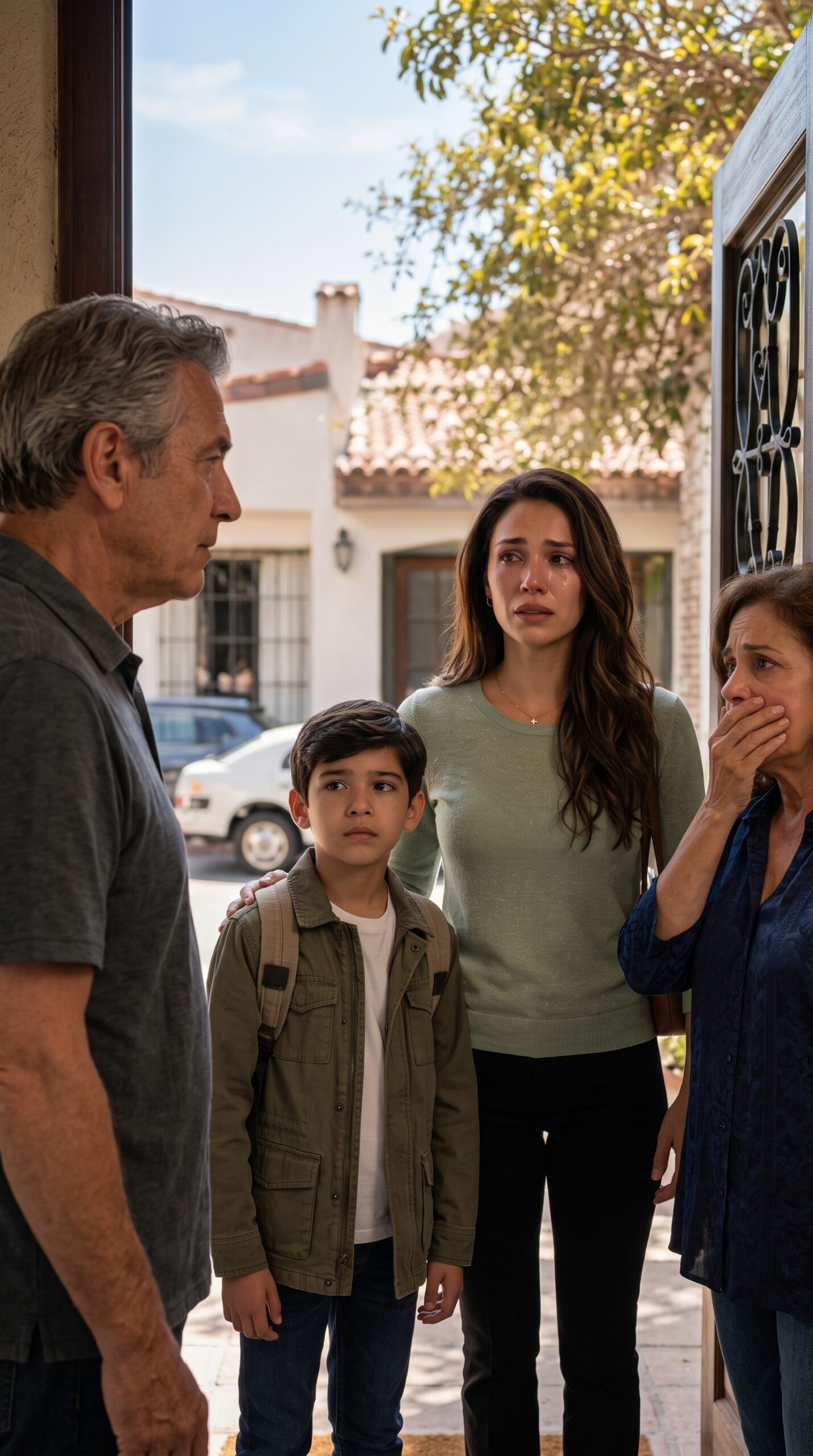
Doña Hortensia said that without fully opening the gate.
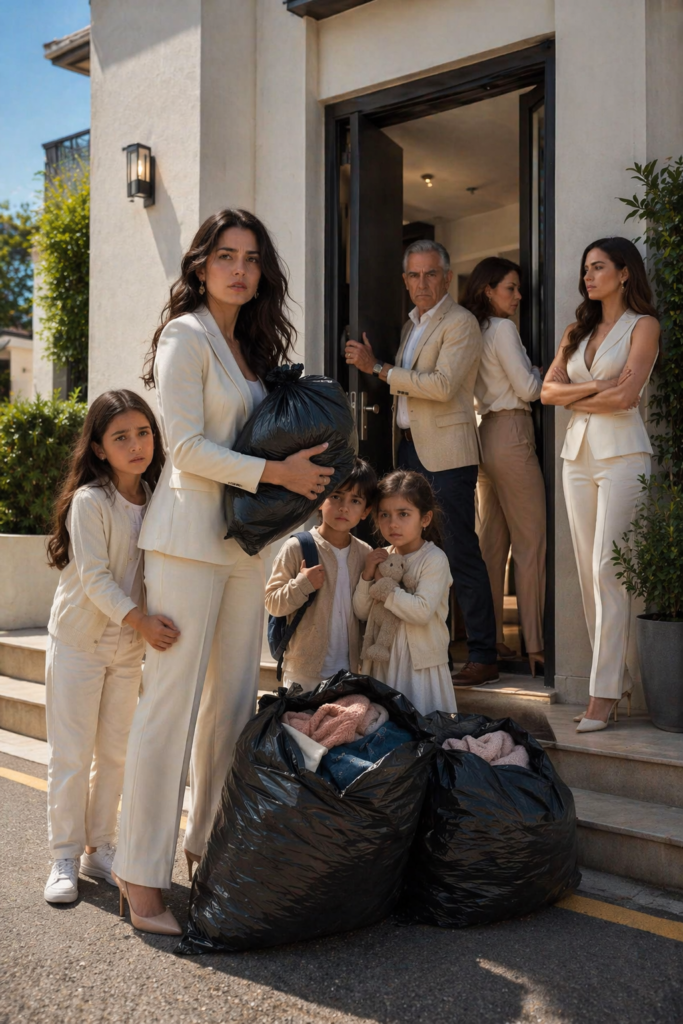
On the other side stood her daughter Valeria, soaked from the drizzle, with an old backpack on her back, a trash bag full of clothes, and her youngest son sleeping against her chest.
It was almost 11 PM in the Portales neighborhood of CDMX.
Regina, 9 years old, hugged Lucía, 6, to keep her from shivering too much. Mateo, 4, breathed through his open mouth, exhausted from crying.
Valeria hadn’t come to ask for money.
She didn’t demand inheritance, big favors, or a solved life.
She only asked to be allowed to sleep a few nights in the house where she had grown up.
The same house where her mother flaunted Facebook photos of family meals with phrases like: “Family is always there when you need it most.”
That night, that phrase didn’t even serve to open a door.
—Mom, please —Valeria said, trying not to break—. The kids have nowhere to spend the night.
Don Ramiro, her father, appeared behind Doña Hortensia. He wore his usual gray sweater and had his gaze fixed on the floor.
—Your mom and I think it’s best if you go back to Gabriel —he murmured—. He’s your children’s father.
Valeria felt the cold pierce her chest.
Gabriel wasn’t the kind of man who made scenes in public.
On the contrary.
At gatherings, he smiled, carried bags, said “excuse me,” and even served soda to his mother-in-law.
But at home, he made her doubt everything.
If he forgot to pick up the kids, it was Valeria’s fault for not reminding him.
If he came home late smelling of another woman’s perfume, she was toxic.
If Valeria cried, he said she was crazy.
And when she found three messages from another woman on his phone, Gabriel just sighed:
—Don’t exaggerate, it was a trivial thing.
But for Valeria, it wasn’t trivial.
It was ten years crumbling on a screen.
She tried to forgive for two months. She swallowed rage, went to therapy, listened to empty apologies.
Until one night, Regina asked:
—Mom, why do you always apologize even though you didn’t do anything?
That’s when Valeria understood that staying also educated.
And she asked for a divorce.
Then the real punishment began.
Her brother Aarón came out with a cup of coffee, barefoot, as if his sister’s tragedy were a boring series.
—Oh, Valeria, come on. Every marriage has problems. Gabriel does work, he does provide. Don’t act so dignified.
Then Camila, her younger sister, newly married, appeared in a satin robe with a perfect woman’s face.
—Think of your children. Stability comes first. You can’t destroy a family out of pride.
Regina lifted her face.
Valeria squeezed Mateo tighter.
—It’s not pride —she replied—. It’s self-respect.
Doña Hortensia let out a heavy sigh.
—Self-respect doesn’t pay rent, daughter. With three kids, you won’t manage alone. Better hold on for a bit. Gabriel made a mistake, but he’s not a monster.
Valeria looked inside the house.
There were four bedrooms.
Aarón occupied one even though he was 34, paid nothing, and spent the day betting online.
Another was filled with old boxes.
The guest room was empty.
There was space.
What there wasn’t was will.
Regina took a step toward the gate.
—Grandma, did we do something wrong too?
No one answered.
Not her grandmother.
Not her grandfather.
Not her uncle.
Not her aunt.
Valeria understood that if she stayed one second longer, she would fall to her knees.
And her children had seen enough.
She walked down the steps, opened the car door, and got the three of them in.
Before starting, she took out her phone and saved the location, the messages, the missed calls, and a photo of the closed gate.
She drove to a cheap hotel on Calzada de Tlalpan, unaware that 18 months later that night would unravel her family’s best-kept lie.
PART 2
The hotel smelled of bleach, dampness, and burnt coffee.
The room was small, with two hard beds, an old TV, and a curtain that wouldn’t close properly. Outside, cars, dogs, and a couple arguing echoed in the hallway.
For Valeria, it was an embarrassment.
For her children, she tried to turn it into an adventure.
—Tonight we’re going to sleep like urban explorers —she said, taking off Lucía’s wet sneakers.
Mateo asked if there were monsters.
—No, my love. There’s only mommy here.
Regina didn’t smile.
She placed the black bag on a chair, lined up her siblings’ shoes, and checked that the door was locked.
She was 9, but that night she seemed 30.
When the three fell asleep, Valeria entered the bathroom.
She sat on the toilet lid and cried, covering her mouth with a towel.
She didn’t cry only for Gabriel.
She cried for the gate.
For her mother talking about family while leaving three children on the street.
For her father with no courage to contradict her.
For Aarón mocking her.
For Camila calling self-respect what was really survival.
The next morning, Valeria took her children to school as if nothing had happened.
She bought three juices, three tortas, and styled their hair in the car using the rearview mirror.
—Are we going back home today? —Lucía asked.
Valeria swallowed hard.
—We’re going back to a safe place. I promise you that.
Then she went to work.
Valeria was a receptionist at a clinical lab in the Roma neighborhood. She earned little but always arrived on time and never lost files.
Her boss, Teresa Luján, was a serious woman, one of those who don’t hug but observe everything.
Seeing Valeria enter with swollen eyes, she closed the door to her office.
—Valeria, did your husband kick you out?
Valeria shook her head.
—I left.
Teresa fell silent for a few seconds.
—Then don’t look back.
She opened a drawer and took out a folder.
—There’s a full-time vacancy in administration. Guaranteed, benefits, and meal vouchers. I hadn’t offered it to anyone because I need someone who won’t let me down. You don’t let me down. Do you want it?
Valeria said yes before knowing how much it paid.
That same day, a coworker gave her the contact of a family lawyer. Her name was Patricia Salgado, she wore thick glasses, had a calm voice, and a sharp gaze.
—From today on, you’re going to keep everything —she said—. Messages, deposits, receipts, chats, medical appointments, festival photos, whatever.
Valeria already had half a file without knowing it.
She had receipts for tuition.
Vaccination records.
Emails from the school where she was the only one responding.
Messages where Gabriel asked:
“Is Mateo still taking syrup?”
“Is Lucía in 1st or 2nd grade?”
“What time does Regina get out?”
Questions that a present father shouldn’t be asking.
She also had audios of Gabriel saying:
“Think about the kids.”
“You’re destroying the family.”
“I failed you, not them.”
But when he understood Valeria wasn’t coming back, he changed his tone.
He requested joint custody almost 50/50.
He said Valeria was unstable.
He said she manipulated the kids.
He said he had always been a provider, an attentive husband, and a responsible father.
And in the meantime, he started talking more with her family than with his own children.
Doña Hortensia sent long audio messages:
“Daughter, don’t be bitter.”
“Gabriel supports you, don’t be ungrateful.”
“The children need a complete family.”
Valeria listened to them on the Metrobús, clutching a grocery bag against her chest.
She didn’t respond.
She just kept it all.
For three months, they lived between the hotel, a friend’s room, and finally a small apartment in Iztapalapa.
It had old tiles, a leak in the kitchen, and a window facing a wall.
But it had something that was worth more to Valeria than an elegant living room.
It had a door she could close from the inside.
Lucía chose a yellow blanket because she said yellow scared away sadness.
Mateo stuck toy cars to the wall.
Regina kept her notebooks in a box and wrote with a black marker:
“Important things. Do not throw away.”
One night, while Valeria assembled a used nightstand she bought on Marketplace, she received a message from an unknown number.
“Valeria, I’m Brenda, Camila’s cousin. I don’t know if I’m getting into trouble, but I think you have the right to know the truth.”
Then came the screenshots.
It was a family chat where Valeria wasn’t included.
The first date was a week before she found Gabriel’s messages.
Doña Hortensia had written:
“We know Gabriel is being a player, but Valeria shouldn’t separate. Alone with three kids, she’ll sink.”
Don Ramiro responded:
“If she comes asking for help, we won’t receive her. If we let her in, she won’t go back to him.”
Aarón wrote:
“Let her suffer a little. That’ll cool her off.”
Camila added:
“Exactly. Sometimes a woman needs to understand that not everything gets fixed by acting dignified.”
Valeria felt the air leaving her.
They hadn’t closed the door on her by surprise.
It wasn’t a lack of space.
It wasn’t fear.
It was a strategy.
A trap designed to force her back to the man who was destroying her from the inside.
She kept reading with trembling hands.
Then appeared the message that changed everything.
Gabriel had written in that same group:
“Thank you for supporting me. If Valeria sees she has nowhere to fall, she’ll come back on her own. Don’t give her wings.”
Valeria dropped her phone on the table.
For several minutes, she didn’t cry.
She didn’t scream.
She just looked at her children sleeping on separate mattresses, under cheap blankets, and felt shame turn into rage.
Not a scandalous rage.
A clean rage.
One that doesn’t break dishes.
It breaks lies.
The next day, Patricia read the screenshots in silence.
—This is serious —she said at the end.
—Does it help?
—It helps a lot. It not only shows family abandonment. It also demonstrates coordinated pressure with Gabriel to force you back into an emotionally harmful environment.
Valeria went pale.
—So he knew my children were on the street.
Patricia pointed to the message.
—Not only did he know. He was using it.
The first hearing came two months later.
Gabriel appeared in a white shirt, an expensive watch, and a face of unjustly hurt man.
He greeted everyone in a soft voice.
He even asked Valeria if the kids were okay, as if he hadn’t spent weeks making late deposits and questioning every expense.
His lawyer spoke of stability.
He spoke of reconciliation.
He spoke of “parental alienation.”
He said Valeria acted impulsively.
He said she prevented visitation.
He said Gabriel was a loving father who just wanted to get his children back.
Patricia didn’t interrupt.
She waited her turn.
Then she placed the evidence on the table.
Messages where Gabriel canceled visits for “urgent meetings.”
Audios where he said he couldn’t deposit child support because he also had expenses.
Screenshots where he asked basic information about his children.
Photos from school festivals where he didn’t appear.
Emails where Valeria was the only responsible party.
And then she showed the family chat.
The room grew cold.
There were the phrases, one by one.
“Let her suffer a little.”
“We won’t receive her.”
“If she sees she has nowhere to fall, she’ll come back on her own.”
“Thank you for supporting me.”
Gabriel lost color.
Doña Hortensia, who had come for moral support, lowered her gaze.
Camila turned red to her ears.
Aarón stopped smiling.
Don Ramiro covered his face with one hand, as if he had just understood too late what he had allowed.
The judge called for silence.
Valeria didn’t smile.
This wasn’t a victory.
It was witnessing in writing the night her children trembled in front of a gate while the adults calculated their pain.
After that hearing, something changed in Regina.
She no longer asked for things.
If Valeria said they were going to buy shoes, she replied:
—Mine are still good.
If she was invited to a party, she asked:
—Isn’t it too expensive for you?
If she saw her mom counting coins, she quietly went to her room.
Valeria understood that poverty can be overcome, but a child’s fear remains hidden if no one names it.
She took her to therapy.
One afternoon, as they were leaving, Regina asked from the back seat:
—Mom, did my grandma know that Dad cheated on you?
Valeria took a deep breath.
—Yes, my love.
—And that’s why she didn’t let us in?
Valeria could have lied.
She could have said adults make mistakes.
She could have protected the image of a grandmother who protected no one.
But there are lies that only serve to shield the guilty.
—She didn’t let us in because she thought that way I would return to your dad.
Regina looked out the window.
—So, we did fit.
Valeria gripped the steering wheel.
—Yes, my girl. Yes, we fit.
The provisional sentence arrived eight months later.
Valeria obtained primary physical custody.
Gabriel received alternate weekends, divided vacations, and backdated support payments.
The judge ordered all communication to be conducted through a family app, with complete records and no manipulation.
Gabriel left furious.
In the hallway, he approached Valeria and whispered:
—You took my children from me.
Valeria looked at him for the first time without fear.
—No, Gabriel. You lost the right to use the word family as a hiding place.
The news spread quickly.
In Mexico, a family can live scattered across the city, but when there’s a trial, divorce, and screenshots,
Doña Hortensia called 14 times.
Valeria didn’t answer.
Then she sent a message:
“We are happy that everything is clarified. We have always been worried about you.”
Valeria read it while standing in line at the supermarket, with rice, eggs, and two yogurts on sale.
“We have always been worried.”
She didn’t respond.
Because worrying isn’t closing a gate.
Worrying isn’t leaving three children to sleep in a cheap hotel to save the reputation of a rotten marriage.
Weeks later, Don Ramiro asked to meet her at a café near the lab.
Valeria agreed, not because she wanted to reconcile, but because she needed to know if at least one of them could tell the truth without embellishing it.
He arrived thinner, with sunken eyes and a poorly ironed blue shirt.
—Your mom doesn’t know I came —he said.
—Of course, she doesn’t.
He ordered coffee.
Valeria ordered water.
They talked about the kids. About Mateo’s loose teeth, Lucía’s drawings, Regina’s books.
Then Don Ramiro lowered his head.
—I was wrong.
Valeria didn’t feel relief.
She felt an old sadness awakening.
—Yes.
—That night, I should have opened the door.
—Yes.
He tightened his grip on the cup.
—Your mom said that if we took you in, we would destroy your family.
Valeria looked at him fixedly.
—My family was already broken, Dad. Gabriel broke it. You all just made sure I bled outside.
Don Ramiro closed his eyes.
—Can I do something?
Valeria thought of Mateo sleeping with his jacket on.
Of Lucía asking if yellow scared away sadness.
Of Regina saying: “So, we did fit.”
—I don’t know —she replied—. But repairing isn’t coming to feel less guilty. Repairing is accepting that my children also remember.
He nodded.
He didn’t cry.
But he aged before her.
With Doña Hortensia, it wasn’t the same.
She didn’t want to repair.
She wanted to erase.
She wanted Valeria to come one Sunday with the children to eat pozole and for everyone to pretend the gate was never closed.
She sent an audio on Mother’s Day.
“I’m a mother too, Valeria. Someday you’ll understand what it hurts for a daughter to close the door on you.”
Valeria listened to it once.
Then she deleted it.
Because she perfectly understood what a closed door hurt.
The difference was that she didn’t close it on a desperate woman with three children in the rain.
She closed it on adults who chose to abandon her and then wanted to come in when there was already light, beds, and stability.
Life didn’t suddenly become easy.
Valeria kept counting pesos, taking the Metro, cooking soup when there wasn’t enough for more, and folding uniforms at midnight.
But she no longer walked asking for permission.
Teresa recommended her for administrative coordinator.
The salary increased.
It wasn’t wealth, but it was hers.
With that raise, Valeria moved to a small three-bedroom apartment.
The walls needed paint.
The kitchen was narrow.
The building made noise when trucks passed.
But each child had their own bed.
Regina put a lamp on her desk.
Lucía stuck paper flowers on the wall.
Mateo said his room was a castle with windows.
One night, while Valeria prepared noodle soup, Regina quietly approached.
—Mom, I think we’re okay now.
Valeria set the spoon down on the pot.
—Yes, my love. I believe so too.
She didn’t want to cry in front of her.
But she cried a little with her back turned.
Because sometimes a mother cries when fear finally begins to release the house.
Eighteen months after that night, Regina’s school organized a family exhibition.
Each child had to choose an important word.
There were posters on friendship, respect, and honesty.
Regina chose resilience.
She wrote about plants that grow back after a storm, about people who lose their homes and still learn to rise.
At the bottom, she put a phrase that didn’t come from any book:
“A closed door hurts, but it also teaches who deserves to enter when you build your own house.”
Valeria read the poster three times.
—Is it okay? —Regina asked.
Valeria hugged her tightly.
—It’s more than okay.
That night she understood that she wasn’t raising a broken girl.
She was raising a girl who saw the truth, named it, and still chose to grow.
Gabriel ended up separating from the woman for whom he destroyed his marriage. They didn’t last a year.
Valeria didn’t celebrate.
By then, she didn’t care.
Her family continued living in the same house in Portales, with the same bedrooms, the same furniture, and the same excuses.
Aarón never apologized.
Camila sent messages talking about “good intentions.”
Doña Hortensia kept saying Valeria was bitter.
But Valeria no longer needed to convince them.
She had a job, a roof, a small savings account, three children who laughed loudly on Sundays, and a peace that no one gave her.
She built it from a cheap hotel, a black bag, and a question that still burned in her chest:
“Did we also do something wrong?”
Sometimes blood doesn’t open doors.
Sometimes it closes them so you learn to stop knocking.
And when someone tells you there’s no space for you, maybe it’s not because you don’t fit.
Maybe it’s because they know that as soon as you find your own place, you’ll never live on your knees again.