PART 1
When Doña Elvira called, crying to say that César had crashed on López Mateos Avenue, Mariela rushed out of her house without properly closing the door.
She drove toward the Civil Hospital of Guadalajara, her hands rigid on the steering wheel. At every traffic light, she imagined her husband dead, hooked to a machine, or asking to see her before he left.
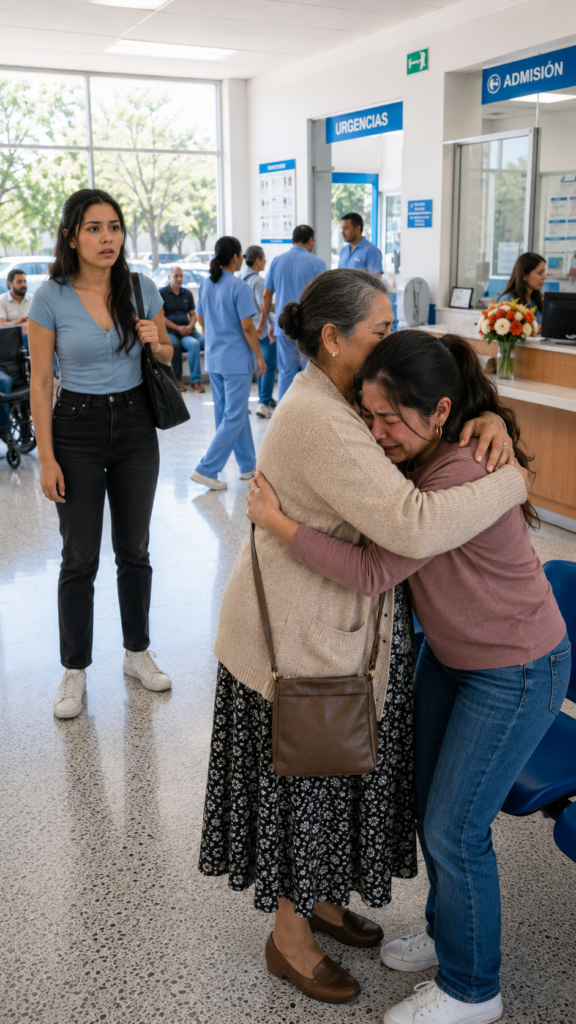
Upon arriving at the emergency room, she found Doña Elvira sitting next to the coffee machines. The woman had her purse on her lap and an expression far too calm for someone who had just announced a tragedy.
Mariela barely took two steps toward her when another woman burst in, running.
Disheveled, makeup smeared, she desperately asked for César Ramírez.
Mariela waited for her mother-in-law to stand up and demand to know who that stranger was.
But Doña Elvira walked toward her and hugged her first.
“Paola, calm down. He’s alive,” she murmured.
Mariela felt her arms turn to ice.
Paola lifted her face, saw her, and asked who she was. When Doña Elvira replied that she was César's wife, the woman covered her mouth and began to cry harder.
“He swore to me he was already separated,” she said. “We’ve been together for a year and a half.”
Mariela felt something inside her shatter.
During that same time, she had cared for César after surgery, paid part of his debts, and endured his silences, thinking the problem was the pain of not being able to have children.
They had been married for eight years.
Doña Elvira had always called her “daughter.” She saved food for her, defended her when César got heavy-handed, and never asked when the baby that doctors couldn’t promise her would arrive.
Every Thursday, the lady crossed the city to visit “a sick friend.”
Mariela had never suspected a thing.
Then a boy of about three appeared behind Paola.
He had a small bandage on his forehead and a plastic dinosaur clutched against his chest.
The boy looked around, recognized Doña Elvira, and ran toward her.
“Grandma!”
Doña Elvira picked him up with a naturalness that felt rehearsed. She reached into her bag, pulled out an apple juice, and opened it without even looking.
She had it all prepared.
Mariela felt the hallway tilt.
The boy had César's eyebrows and the same dark eyes as Doña Elvira.
“Since when do you know about him?” Mariela asked.
Her mother-in-law didn’t lower her gaze.
“Since he was born, Mariela.”
She no longer called her “mija.”
She called her Mariela.
“Did you lie to me for three years?”
“Yes.”
“Why did you call me today?”
Doña Elvira tightened the boy against her chest. She wiped away tears that seemed to have run dry before Mariela arrived and answered with brutal calm:
“Because Mateo was in the car. He got three stitches. He’s fine, but I can’t take care of him anymore.”
Then she put him in front of Mariela, as if handing over a long-overdue debt.
“Take him. He needs a mother, and I’m already 68.”
In that moment, Mariela understood that the call had never been to inform her of her husband's accident.
She had been summoned for something much worse.
While Mateo drank his juice, confused, Mariela realized that the accident had merely opened the door to a far deeper betrayal.
PART 2
Mariela had to sit down because her knees stopped responding.
Paola remained by the wall, stroking Mateo's head every time the boy leaned toward her. He called her “ma” with the trust of someone who had learned that word in her arms.
This didn’t add up.
Mateo was three years old, but Paola had only been with César for a year and a half.
“She’s not his mother,” Doña Elvira clarified. “His mother was named Lucía.”
The truth came out in pieces.
César had met Lucía during a work trip to León. According to him, it was just one night. Months later, he learned of the pregnancy, but he blocked her number and continued living with Mariela as if nothing had happened.
Lucía died of a stroke when Mateo was four months old.
The hospital located César because he was registered as the father. He refused to pick up the baby, claiming he didn’t know how to care for him and that confessing would destroy his marriage.
Doña Elvira traveled to the funeral, held her grandson, and decided he wouldn’t end up in a group home.
Since then, every Thursday, she went to see him at a cousin’s house who helped care for him.
The Thursdays of “the sick friend” had never existed.
“And why didn’t you tell me?” Mariela asked. “I could have helped.”
Doña Elvira let out a sigh, as if she were the offended one.
“Because you would have left César. And if you left, this family would fall apart.”
Mariela looked at her, not recognizing her.
“Did you hide a child to protect your last name?”
“To protect everyone. You were better off not knowing.”
There died the last kind image Mariela had of her mother-in-law.
Doña Elvira hadn’t kept the secret to spare her pain. She had done it to keep her within the marriage, maintain the household, and ensure that, as she aged, there was another woman willing to raise Mateo.
For three years, she had watched her.
Every time Mariela cried over another failed treatment, she consoled her. Every time she talked about adoption, she asked if she could love a child who wasn’t her own. Every sweet phrase had also been a test.
She wasn’t caring for her.
She was selecting her.
Mariela stepped outside to the parking lot and vomited next to a planter. Then she stood staring at the cars under the sun, trying to hate them all equally.
But what she felt at the thought of Mateo was not just compassion.
It was desire.
A dark, immediate, almost shameful desire.
For eight years, she had bought pregnancy tests, visited specialists, endured injections, and listened to family say, “For some reason, God didn’t send children.” Now, just a few meters away, there was a boy without a biological mother, bearing her husband’s last name and a grandmother unable to care for him anymore.
Mariela wanted to hug him.
She wanted to hear him call her mom.
And she knew, with a clarity that frightened her, that she didn’t want him solely for what he needed.
She also wanted him to fill what was missing in her.
When she returned, she found Paola crouched in front of Mateo, promising him everything would be okay.
Mariela asked if she knew César was married.
Paola swore she hadn’t known at first. He had shown her false messages, told her he lived with Mariela only while selling the house, and even took off his ring before seeing her.
“And when did you discover the truth?”
Paola took too long to respond.
“Eight months ago.”
“So you stayed eight months with a married man.”
“I stayed for Mateo,” she replied. “By then, he was already sleeping with me when he had nightmares. I took him to kindergarten, gave him his medicine, and knew which dinosaur he wanted next to his bed. César was hardly ever around.”
Paola wasn’t innocent either.
She had accepted a lie when she already knew the truth. However, she was the only person in that hallway who had cared for the boy every day without owing him anything by blood.
“Mateo is my son,” she said, her voice cracking. “Not by blood, but by everything that matters.”
Mariela responded with something she would remember many nights later:
“Not by blood. And not on paper, either.”
Paola recoiled as if she had been slapped.
At that moment, a doctor came out to inform them that César had a broken leg and several broken ribs but was out of danger.
When she saw him in the room, Mariela didn’t scream.
She let him speak.
César cried, blamed his mother, blamed Lucía, blamed fear, and claimed he intended to tell her “when the right moment came.”
Then he asked her not to file for divorce.
The house was mortgaged. The small mechanic shop was in both their names. If Mariela revealed his debts and fought for every penny, he could lose his business.
Then she understood how much power she had.
She didn’t make the decision that day. For two weeks, she consulted lawyers, reviewed documents, and found out who was legally responsible for Mateo.
César was the recognized father.
Doña Elvira had a temporary authorization to care for him.
Paola had nothing.
No custody, no guardianship, not a signature to prove a year and a half of sleepless nights.
Mariela filed for divorce and presented her condition.
She would renounce claiming part of the shop. She wouldn’t report César’s financial irregularities. She would agree to sell the house without sinking him and keep the scandal out of the family.
In exchange, César would have to grant her provisional custody of Mateo, cooperate with the legal process for her to adopt him, and keep Paola away.
Her lawyer asked her three times if she was sure.
Mariela answered yes.
César accepted before the week was over.
Not because he thought she would be a good mother.
He accepted because he preferred to lose a son he had never really wanted than to lose his business.
That was the cruelest twist: Doña Elvira had lied to keep the family together, but her own son sold that family the moment they put a price on it.
Paola found out when she received a message from César ordering her to deliver the child’s clothes and documents.
She went to the shop, yelled at him in front of employees, and called him a coward. Then she sought out Mariela and begged her not to erase her from Mateo’s life.
“You can hate me,” she said. “You can sue me for staying with him. But don’t make that child believe his mother disappeared again.”
Mariela knew she was right.
She also knew that as long as Paola was near, Mateo would take longer to see her as a mother.
She chose what was most convenient for her.
The day she went to pick him up, Mateo was at Paola’s house with a blue backpack. When he saw Mariela, he ran to hide behind the woman’s legs.
“I don’t want to go,” he sobbed. “I want my ma.”
Paola knelt down, embraced him, and tried to explain that Mariela would take care of him. But the boy clung to her shirt until it stretched.
Mariela could have stopped.
She could have asked for a transition, therapy, or frequent visits.
She didn’t.
She picked him up while Mateo kicked and screamed “ma!” so loudly he lost his voice.
Paola fell to her knees on the sidewalk.
Doña Elvira watched from her car without intervening. César didn’t even show up.
During the drive, Mateo cried until he fell asleep. Mariela opened an apple juice with one hand and drove with the other, just like she had driven to the hospital.
Only this time, the accident wasn’t waiting for her.
The accident was her.
Eight months passed.
Mateo began calling her “Mom Mari.” He entered a kindergarten near their home, learned to sleep without the light on, and laughed heartily again. Mariela knew his allergies, his tantrums, and the exact way to cut his quesadillas.
She loved him.
That wasn’t a lie either.
Doña Elvira visited him on Sundays, although between them, there were no longer hugs or affectionate words. Mariela stopped calling her mother-in-law, and Doña Elvira never called her daughter again.
César saw Mateo whenever he remembered, which was almost never.
He kept the shop, avoided scandal, and began dating another woman a few months later.
Paola got one Saturday a month in a public park. Mariela granted her that because she wanted to, not because she was obligated.
On each visit, Mateo ran to Paola and called her “ma.” When they said goodbye, he cried less than before, but still asked why he couldn’t sleep at her house.
Mariela listened to the answer from a bench.
She knew exactly what she was doing.
Sometimes she thought she had rescued a child abandoned by his father and raised in secrecy.
Other nights, she watched him sleep and remembered his hands gripping Paola’s clothes. Then she understood that she had used the divorce as currency and the law as a hiding place.
Doña Elvira had called “family protection” a three-year lie.
César had called “fear” his cowardice.
Paola had called “love for Mateo” staying with a married man.
And Mariela called “giving him a mother” taking the child she desired.
Everyone had a pretty explanation.
The only one who had never chosen anything was Mateo.
Mariela ended up being an attentive mother, but that truth didn’t erase how she obtained him. Loving someone well after tearing them from another’s arms didn’t make the beginning just.
Her sister said she had saved the boy.
Her ex-sister-in-law said she had stolen him from the only woman who truly raised him.
Perhaps both were right.
Because Mariela did give him a home, stability, and the love César had never wanted to give.
But she also separated Mateo from Paola to fill a void that belonged solely to her.
And that is the question that hung over the entire family:
Did Mariela give a child a mother who had none, or did she take away the only one he had left to heal her own wound?