PART 1
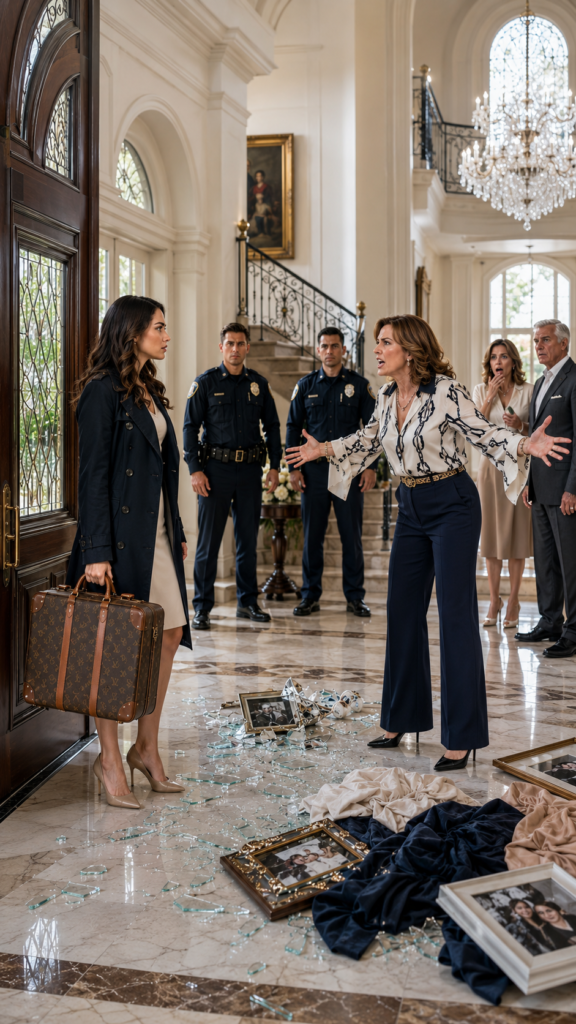
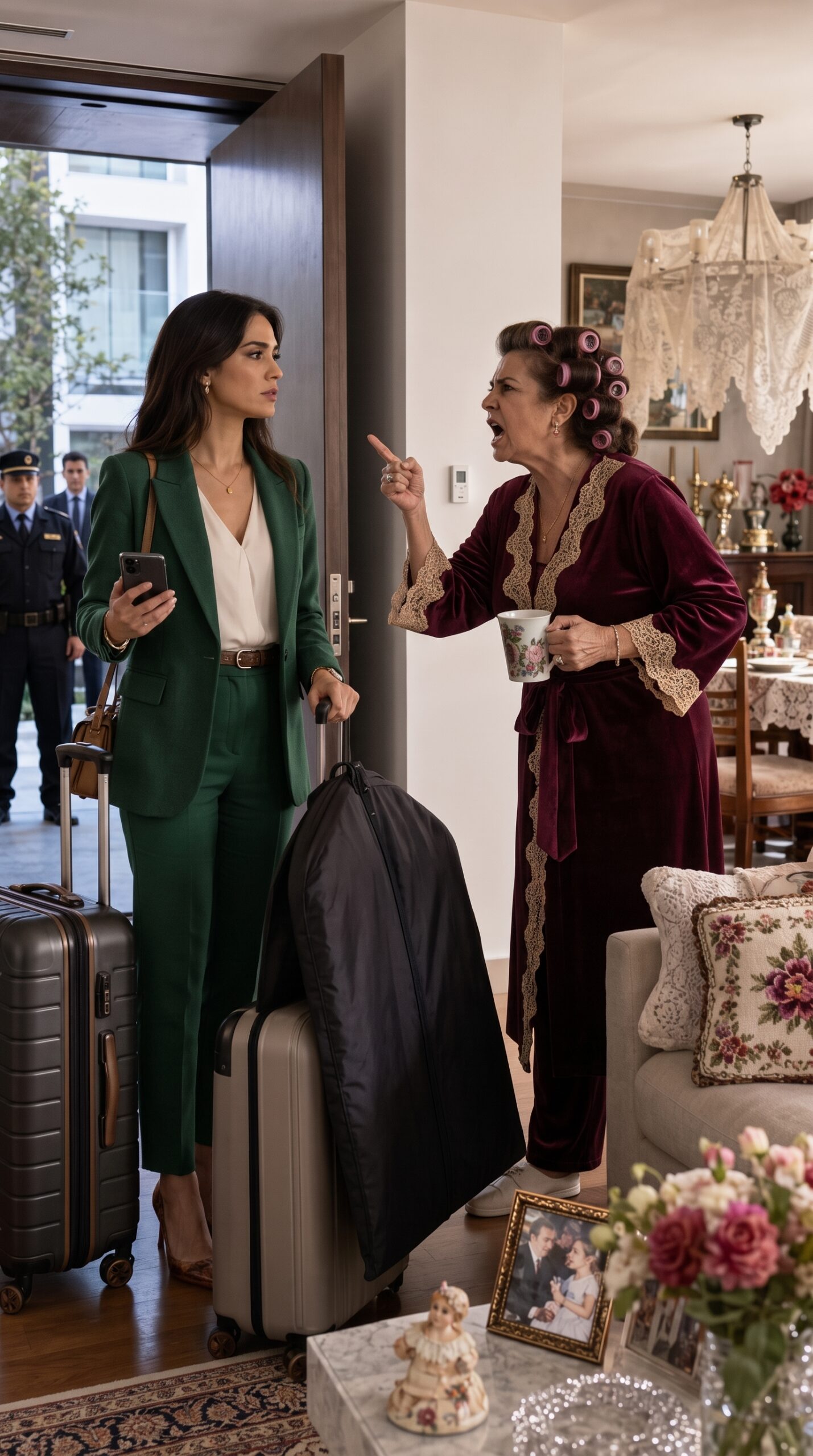
—Not one more step, little girl! This apartment is no longer yours. My son paid for it, my son is in charge here, and you better leave before I call the cops.
Graciela Muñoz's voice thundered down the 10th-floor hallway as if she owned the entire building.
Valeria Ríos had just stepped off the elevator with two suitcases, a backpack stuffed with dirty clothes, and her body aching after six weeks of caring for her recently operated sister in Querétaro.
She hadn't expected flowers.
She hadn't expected a hot dinner.
But she certainly hadn’t anticipated finding her mother-in-law planted at the entrance of her apartment, wearing her gray robe, fuzzy slippers, and sipping coffee from the blue cup that had belonged to her mother.
The 10-B no longer smelled like Valeria.
It smelled of cheap candles, lavender spray, and reheated broth.
The living room no longer held photographs from her travels, nor the painting of San Miguel de Allende that she had bought with her first big project.
Instead, there was a huge cross on the wall, golden cushions that read “Blessed Home,” and a woven blanket draped over the white sofa that Valeria had paid off in twelve months.
Valeria dropped her suitcases on the floor.
At 32 years old, she was an interior designer, and she had bought that apartment in Del Valle four years before marrying Andrés Muñoz.
She had bought it with her credit, with her savings, and with many nights of eating canned tuna to afford the down payment.
Andrés had never contributed a single peso.
But in front of their friends, he would say “our place” with a confidence that had always made Valeria uncomfortable.
—Mrs. Graciela, what are you doing inside my house? —Valeria asked, steady, without raising her voice.
Graciela let out a dry laugh.
—Your house? Oh, come on. My son finally opened his eyes. You went off playing nurse with your sister, and he decided to bring his mother back, as he should.
Valeria glanced toward the bedroom.
The door was ajar.
Her dresses no longer hung in order.
On the nightstand where her father’s photo used to be, there was an image of Saint Jude, an expensive perfume, and Graciela’s makeup bag.
—You need to leave right now —Valeria said.
—The one who’s leaving is you —Graciela shot back—. Women like you think that just because you bring a laptop and pay the bills, you’re worth more than a family. Andrés put up with you for too long.
The elevator guard lowered his gaze, uncomfortable.
Valeria took a deep breath.
She didn’t cry.
She didn’t respond to the insult.
She pulled out her cell phone and called management.
—Good afternoon, this is Valeria Ríos from apartment 10-B. There’s an unauthorized person inside my property. She is threatening me and refusing to leave. I need security and the manager right now.
Graciela’s face barely changed.
It was a blink.
But Valeria noticed.
Her mother-in-law wasn’t sure she had the right.
She was only sure that she could intimidate Valeria.
—You have two minutes to grab your bag and walk out —Valeria said.
—Now you’re going to kick me out? Damn, you arrogant old hag.
Valeria glanced at the black bags next to the service room.
Then she turned her gaze to her mother-in-law.
—Then let’s start cleaning up.
When the guards arrived, Graciela screamed that it was abuse, that her son was the real owner, that Valeria was a nobody, and that the whole building would regret it.
She called Andrés seven times.
Four minutes later, he was in the hallway, disheveled, without the stolen cup, and with half of his clothes stuffed in a bag.
But Valeria didn’t get to feel relief.
Because upon closing the door, she found Andrés’s desk drawer ajar.
And inside was a thick folder with her name written in black marker.
PART 2
Valeria stood frozen in front of the desk.
Outside, Graciela continued banging on the door with her palm.
—Open up, you ungrateful! My son is going to put you in your place!
Valeria didn’t open.
She locked the door, left the suitcases by the dining room, and walked toward the desk Andrés used when he claimed to have Zoom meetings until dawn.
That drawer was always closed.
Andrés said he kept invoices, contracts for his business, and “very boring” documents that had nothing to do with her.
But that night it was open.
As if someone had run from a lie and had forgotten to hide the knife.
The folder was cream-colored.
On the tab it read:
VALERIA RÍOS / APARTMENT 10-B.
Valeria opened it with cold hands.
The first page was a copy of her title deed.
The second was a copy of her ID.
The third, her CURP.
She felt a hollow feeling in her stomach.
She had lost that ID almost a year earlier.
Andrés had helped her look for it all over the house.
He searched drawers, bags, the car, even the kitchen trash.
Then he hugged her and said: —It probably fell at the supermarket, love. Don’t stress over it.
And she believed him.
Beneath it was a loan application form.
Name of the holder: Valeria Ríos.
Property in guarantee: apartment 10-B, Del Valle neighborhood, Mexico City.
Amount requested: 3,200,000 pesos.
At the bottom of the page appeared a signature.
Her signature.
Or a crooked copy of her signature.
Valeria had to sit down.
It wasn’t a meddling mother-in-law.
It wasn’t a marital dispute.
It wasn’t the typical family scene where everyone voiced opinions and no one respected boundaries.
It was a trap.
She kept looking.
There were printed emails between Andrés and a financial advisor named Mónica Luján.
In one, Andrés asked if they could move forward without the owner present because “she was out of town dealing with a family matter.”
In another, Mónica replied that without biometric validation and a physical signature, they couldn’t release the loan.
The last email was dated two days earlier.
Andrés wrote:
“My wife returns on Sunday. If it gets tough, I need another alternative. The debt can’t wait any longer.”
Valeria read that phrase three times.
The debt.
Andrés had never mentioned a debt.
On the contrary, he flaunted watches, dinners in Polanco, weekends in Valle de Bravo, and a supposed import business that, according to him, was “going strong, dude.”
Valeria opened another black folder beneath it.
There she found a lease contract ready to be signed.
The apartment was described as “furnished, remodeled, prime location, monthly rent of 42,000 pesos.”
Landlord: Andrés Muñoz.
Not Valeria Ríos.
Andrés Muñoz.
There were also recent photos of her living room, her kitchen, her closet, and her bedroom.
In one image, her green dress hung next to Andrés’s suits.
In another, her computer sat on the desk.
In another, her mother’s blue cup rested on the table.
Her entire life had been photographed as if it were an elegant Airbnb.
As if she were an object that could be removed from the picture.
At the bottom of the folder was a sheet written in big, round handwriting.
It was from Graciela.
“If Valeria takes longer in Querétaro, we need to say the apartment is empty. If she returns making a scene, Andrés will remind her that he paid many expenses. An exaggerated wife isn’t believed as much as her husband.”
Valeria crumpled the paper into a ball.
She didn’t cry.
Her chest burned, yes.
But it wasn’t sadness.
It was a cold, clean rage, one that didn’t seek to scream but to put everything in order.
Her phone vibrated.
Andrés: My mom just called me. What did you do, Valeria? Don’t put on a show. I’m on my way.
Then another message came in.
Andrés: Don’t touch my papers.
Valeria let out a short, bitter laugh.
Then she took photos of everything.
The application.
The emails.
The forged signature.
The contract.
Graciela’s note.
Then she recorded a video showing the open drawer, the dates on the documents, and every page where Andrés used her name as if it were his own.
She called Renata.
Renata was her friend from college.
She was also a criminal lawyer.
And, above all, she had never told Valeria that lukewarm phrase “It’s probably a misunderstanding.”
—Where are you? —Renata asked as soon as she heard her voice.
—In my apartment.
—Is Andrés there?
—Not yet.
—Perfect. Don’t be alone with him. Send me photos now. And don’t tell him what you found.
Valeria obeyed.
On the other end, there was silence for almost a minute.
That silence scared her more than Graciela’s screams.
—Vale —Renata finally said—, this isn’t a family dispute. There’s possible forgery here, misuse of personal documents, attempted fraud, and unauthorized occupancy of your property.
—What do I do?
—Back everything up in the cloud. Ask the building to keep footage from the last eight weeks. Cancel access cards for Andrés and his mom. And when he arrives, have witnesses present.
Valeria hung up and called management.
—I need to block the access cards for Andrés Muñoz and Graciela Muñoz —she said—. I also need copies of all the videos related to my apartment.
The manager didn’t ask too many questions.
After the scandal, he seemed to understand enough.
—Of course, Mrs. Ríos. In fact, we have a record that Mrs. Graciela entered with bags five days ago. A man also went up with a camera three days ago.
Valeria closed her eyes.
Five days sleeping in her bed.
Three days displaying her home.
—I want copies of everything.
Then she took three black bags.
She didn’t put anything of hers in.
She packed Graciela’s robe.
The slippers.
The “Blessed Home” cushions.
The candles.
The gossip magazines.
The golden figurines she had placed on the console.
She also packed Andrés’s shirts, shoes, chargers, a leather jacket, and a box of perfumes he took better care of than his promises.
This wasn’t revenge.
It was reclaiming territory.
At 9:26 p.m., the intercom buzzed.
—Mrs. Ríos, Mr. Andrés is in reception. He says he lives with you.
—Let him come up —Valeria replied—. But with security.
Andrés entered with the face of an offended husband.
He didn’t look guilty.
He looked annoyed for being discovered ahead of time.
—Really, Valeria? —he said upon seeing the two guards—. Are you going to make a scene with strangers?
—They’re not strangers. They’re witnesses.
Andrés glanced at the black bags.
Then at the desk.
Then at her.
—Where’s my mom?
—Out of my property.
—She’s my mother.
—And this is my apartment.
He let out a humorless laugh.
—Back to this again. You’ve always loved rubbing it in my face that you bought this.
—I wasn’t rubbing it in. I was reminding you when you wanted to change reality.
Andrés took one step toward her.
A guard moved at the same time.
Andrés stopped.
—My mom got upset. You know her. But you exaggerate too. She had nowhere to stay.
—She has a house in Satélite.
—They’re remodeling it.
—Then let her rent a room. Not my bed.
Andrés clenched his jaw.
—Don’t be cruel.
—Cruel was bringing her here while I was tending to my sister’s wound and sleeping in a hospital chair.
—I’ve got problems too.
—I know. 3,200,000 pesos worth of problems.
Andrés’s face lost color.
The confidence, the arrogance, the condescending tone of “calm down” fell away in one second.
—What did you say?
Valeria placed the loan application on the table.
—I found your alternative.
Andrés lowered his gaze.
He didn’t touch the paper.
That detail betrayed him more than any confession.
—That doesn’t mean anything —he murmured.
—It means you had my ID stolen, my title deed, and a forged signature.
—I didn’t steal anything.
—Then explain to me why my ID appeared in your drawer almost a year later.
Andrés ran his hand through his hair.
—I was desperate.
—Why?
He fell silent.
Valeria didn’t fill the void.
She would have done it before.
Before, she would have made excuses for him.
That his mom pressured him.
That the business was going badly.
That he was tired.
That nobody was perfect.
That night, she left him alone in front of his own lie.
—My partner left me hanging —he finally said—. I put money where I shouldn’t have. I took out loans. If I didn’t pay this week, they were going to sue me.
—And you thought of using my house?
—Our house.
—Mine.
Andrés slammed his palm on the table.
—I lived here too! I paid for groceries, gas, dinners, repairs!
—Paying for groceries doesn’t make you the owner.
—I was going to fix it before you found out.
Valeria looked at him with a sadness that no longer held love.
—That’s the sickest thing you’ve said today.
At that moment, Renata walked into the apartment with a folder under her arm and a serious expression.
—Good evening. I’m Valeria Ríos’s attorney.
Andrés let out a nervous chuckle.
—Attorney? No way. This is a couple’s issue.
—No —Renata replied—. This involves personal documents, possible forgery, attempted credit with foreign collateral, and a contract where you present yourself as the landlord of a property that is not in your name.
Andrés looked at Valeria.
For the first time, he didn’t seem angry.
He seemed scared.
—Vale, please. We can talk.
—We’ve been talking for years. You talked. I ceded.
Her phone began to ring.
It was Graciela.
Andrés didn’t answer.
It rang again.
On the third ring, he picked up with a broken voice.
—What’s wrong, Mom?
Graciela’s voice was loud enough for everyone to hear.
—Tell them to let me up! That woman threw me out like trash! My things are in black bags!
Valeria picked up one bag and set it by the door.
—Mrs. Graciela —she said toward the phone—, you called me trash in my own house. So I did the logical thing: I took out the trash.
There was a thick silence.
Then Graciela yelled something, but Andrés hung up the phone.
Not because he wanted to defend Valeria.
But because he understood that every word from his mother was sinking him further.
Renata opened her folder.
—The financial institution has already been notified to mark any transaction related to 10-B as suspicious due to possible impersonation. We also requested to preserve emails, digital records, and communications.
Andrés went pale.
—They couldn’t do that.
—Yes, they could —Renata said—. And it’s already done.
—Valeria, you’re going to destroy me.
She watched him for a long moment.
That man wasn’t asking for forgiveness.
He was asking for impunity.
—No, Andrés. You destroyed yourself when you thought my trust was a blank signature.
That night, Andrés left escorted by security.
There were no broken dishes.
There were no melodramatic screams.
Only inventory.
Six shirts.
Two pairs of shoes.
One laptop.
Four chargers.
One watch.
One box of documents.
Andrés signed each page with the same hand that had tried to forge Valeria’s signature.
Before leaving, he paused at the door.
—Are you really going to throw away a marriage over papers?
Valeria felt a small pain.
Not for losing him.
But for confirming that he had never understood anything.
—It wasn’t about the papers —she responded—. It was my name. It was my home. It was me.
And she closed the door.
The following weeks were heavy.
Valeria testified, delivered videos, messages, copies, and emails.
The building provided recordings where Graciela entered with bags, Andrés checked Valeria’s mailbox, and a man took pictures of the apartment as if it were a property for sale.
Then the twist that finally sank him appeared.
Andrés had not only attempted to rent the apartment.
He had already received two deposits from people who believed they were dealing with the legitimate owner.
It was no longer a desperate idea.
There was already money involved.
Graciela tried to present herself as a victim.
She claimed her son had assured her that “everything was sorted out.”
She said she knew nothing about loans, signatures, or contracts.
But the messages she wrote contradicted her.
“If she comes back, stand firm. That apartment serves the family more than it does her alone,” she had sent.
The family.
That’s what they called the theft when it suited them.
Andrés first blamed his partner.
Then his mother.
Then the pressure.
Finally, when he understood that Valeria would no longer answer his midnight calls, he sent a simple message:
“Sorry. I was afraid of losing everything.”
Valeria read it on the balcony.
She didn’t respond.
Because some apologies don’t come from remorse.
They come from no longer being able to keep lying.
Two months later, her sister arrived from Querétaro with sweet bread, yellow flowers, and new covers for the cushions.
—I promise they don’t say “Blessed Home” —she joked.
Valeria smiled.
—So what do they say?
Her sister pulled out a white cover with small letters:
“No one enters here without permission.”
They laughed until their stomachs hurt.
That afternoon they hung up the photographs again.
They watered the jade plant that Graciela had left to wither.
They bought a blue cup similar to her mother’s and placed it on the table.
Not to forget the broken one.
But to remember that something broken doesn’t always mean defeat.
Sometimes it means finally seeing who broke it.
Months later, when the sun set over the Del Valle buildings, Valeria understood something no one had taught her.
A home is not where a woman has to ask for permission to exist.
It’s not where things are moved, photos are erased, and her name is used as if it belonged to the family.
A home is where her voice matters.
Where closing a door doesn’t mean being alone.
It means finding peace.
And that night, as she turned off the living room light, Valeria didn’t think about Andrés.
She didn’t think about Graciela.
She thought about the woman who returned with two suitcases and found her life invaded.
About the woman they called trash.
About the woman who took out the trash.
And who not only reclaimed her apartment.
She reclaimed herself.