PART 1
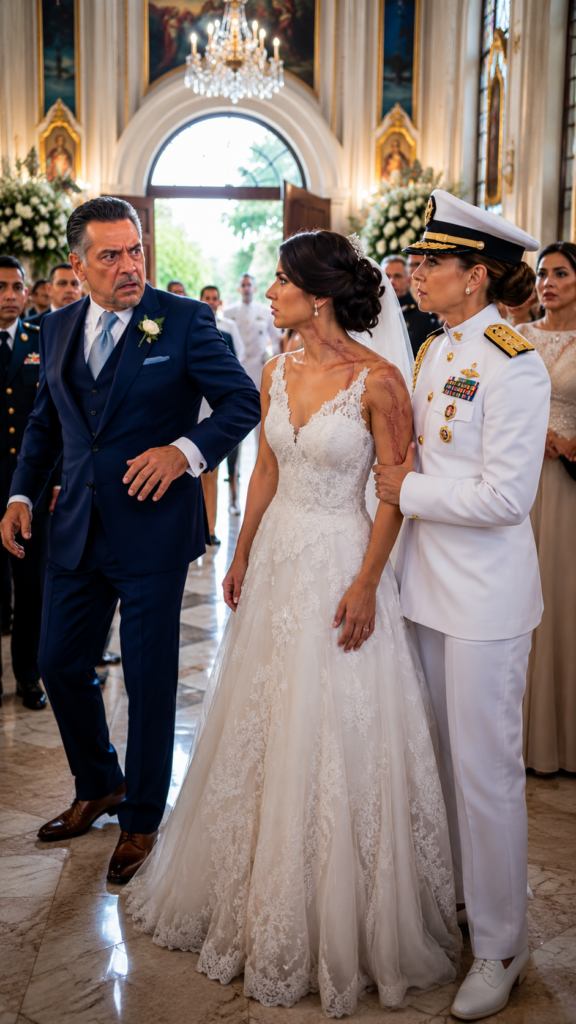
Three minutes before the wedding march played, Ricardo Landa stared at the scars crisscrossing his daughter's neck and shoulder, took a step back, and whispered as if she were a shame:
—I will not hand over a marked woman at the altar.
In the small chapel of San Ángel, everything was ready.
White flowers hung from the arches, guests filled the pews, and outside waited photographers, businessmen from Monterrey, politicians from Mexico City, and several high-ranking Navy officers.
But for Ricardo, none of it mattered as much as one thing: the perfect photo.
Mariana Landa, Lieutenant Commander, took a deep breath.
The white dress exposed part of her left shoulder. There lay the scar, thick and jagged, born of the fire that nearly killed her during a naval mission off the coast of Baja California.
Her father watched her with barely concealed disgust.
—I told you to wear the high-neck dress —he murmured—. Was it so hard to think of the family?
Mariana didn’t lower her gaze.
For years, she had sent money from her military salary to save her father’s construction company when it was drowning in debt.
She had spent months in rehabilitation to regain movement in her arm.
She had dragged three injured comrades from a burning engine room while the smoke seared her lungs.
But in that moment, to her father, she was not a survivor.
She was a stain on the family image.
Behind Ricardo stood his other daughter, Renata, in a golden dress with an awkward smile.
—Mariana, Dad just wants to avoid comments —she said softly—. People can be cruel, you know how they are.
—People can say whatever they want.
—Seriously, don’t make this harder.
From the side entrance, Santiago Robles, the groom, approached with a tense face.
—Mr. Landa, if you don’t want to walk with her, I…
Mariana took his hand.
—No, Santiago. Don’t beg.
Ricardo let out a dry laugh.
—Look at this. She’s still proud.
Then he leaned toward her and said something that froze her blood:
—If you walk alone, everyone will remember my daughter returned from the Navy looking like a warning sign.
Mariana felt the wound burn, but she didn’t cover it.
She had survived the fire.
She could survive the cruelty of her own father.
Then the main doors of the chapel opened.
A heavy silence fell over everyone.
The attending officers stood up immediately.
Under the light of the stained glass, Admiral Teresa Villaseñor, Secretary of the Navy, appeared.
Her white uniform shone with an authority that no one dared to interrupt.
Ricardo paled.
He had spent two years trying to get close to her because his company was seeking million-dollar contracts for port infrastructure.
The admiral walked straight to Mariana.
She looked at her scars.
Then she looked at Ricardo as if she had just measured his soul.
—You may be ashamed of your daughter’s marks, Mr. Landa —she said firmly—. But I know exactly how she got them.
She offered her arm to Mariana.
—Allow me the honor, Lieutenant.
The entire chapel held its breath.
Santiago had tears in his eyes.
Ricardo stood frozen by the door, jaw clenched, pride shattered.
Mariana took the admiral’s arm.
The officers began to applaud.
Then the others joined in.
And as they moved toward the altar, Teresa Villaseñor leaned slightly toward her and whispered:
—The dossier arrived complete this morning.
Mariana smiled like a bride, but her heart thudded like a drum.
—Is everything confirmed?
—Everything. And there’s enough to sink more than one.
In the back, Ricardo understood too late that the admiral had not come just to accompany his daughter.
She had come for him.
PART 2
The ceremony continued as if nothing had changed, but the air inside the chapel was no longer the same.
Mariana smiled, responded to the priest, and held Santiago's hand, even though inside every word from the admiral echoed like an emergency siren.
She had waited eight months for this moment.
Eight months pretending her father was just a vain, classist man obsessed with appearances.
But Mariana knew the truth.
Ricardo Landa was not just cruel.
He was corrupt.
And her scars were not a tragedy of fate.
They were a direct consequence of his ambition.
It all began three weeks after Mariana returned injured to Mexico.
The explosion on the ship ARM Centinela left her with deep burns, two fractured ribs, and nights spent waking up drenched in sweat.
Since she couldn’t live alone yet, she spent her recovery at the family home in Las Lomas.
One morning, she went down to the kitchen for water and heard her father’s voice in the library.
—The Navy isn’t going to review those plates —Ricardo was saying on the phone—. The certificates are already signed. By the time they fail, we’ll have already cashed in.
Mariana froze.
—And if there are deaths? —someone asked on the other end.
Ricardo let out a low laugh.
—Then let them blame the commander. That’s what they sign for.
That phrase ripped open her chest.
Because Grupo Landa Industrial, her father’s company, sold thermal coatings and metal parts for military vessels.
And Mariana knew what a defective plate meant.
Fire.
Explosions.
Sailors trapped.
Families receiving midnight calls.
For weeks, she investigated without saying a word.
She copied contracts.
Photographed invoices.
Saved emails.
She found ghost companies, payments to retired officials, and altered evidence.
But the worst appeared in a folder marked "Centinela."
The ship where she nearly died.
The thermal plates installed in the engine room came from a subsidiary of Grupo Landa.
The resistance tests had been falsified.
And the final authorization had a clear signature.
Ricardo Landa.
Her father.
The man who had just called her a "marked woman" was responsible for the very marks he despised.
—You may kiss the bride.
The priest’s voice brought Mariana back to the present.
Santiago kissed her tenderly.
The guests applauded.
She smiled for the photos, hugged her mother, greeted the uncles, thanked for blessings.
But her eyes kept on Ricardo.
He was sweating.
Looking at his cell phone.
Trying to smile.
Desperately searching for the admiral, as if he could still fix it with an expensive meal or a campaign promise.
The reception was at an elegant estate near Tepotzotlán.
There was music, huge centerpieces, and waiters serving champagne as if it were a normal wedding.
But it wasn’t.
Ricardo approached Admiral Teresa Villaseñor with a smile of a man used to buying silence.
—Admiral, what a pleasure to have you here.
She didn’t even pretend to be warm.
—I came for Lieutenant Landa.
—Of course, of course. Mariana has always been intense, but she’s a good girl.
The admiral raised an eyebrow.
—Intense?
Ricardo swallowed hard.
—Well, you know, young people sometimes exaggerate.
—Does a woman who entered a burning zone twice to rescue three comrades exaggerate?
Silence began to grow around them.
Renata stopped laughing with her friends.
Mariana’s mother, Graciela, gripped her glass with trembling hands.
Ricardo tried to regain control.
—I didn’t mean to say that.
—Or does she exaggerate because she reported corruption within naval contracts?
The music seemed to fade away.
Santiago took Mariana's hand.
The admiral pulled out a thick manila envelope and placed it on a table.
—Here are the original technical reports, the transfers, the altered invoices, and the falsified laboratory tests.
Ricardo looked at the envelope as if it were a bomb.
—That has no validity.
—Yes, it does.
—They’re copies.
—We have the originals.
—That’s impossible.
The admiral looked at him unblinking.
—The impossible was that your daughter survived what you sold.
Everyone turned to Mariana.
So did Ricardo.
His face no longer showed shame.
It showed fury.
—Was it you?
Mariana held his gaze.
—Yes.
—You’re my father!
—And I was your daughter.
The phrase fell harder than any scream.
Ricardo clenched his fists.
—I gave you a home, an education, a last name.
—I was afraid to be imperfect.
Mariana took a step toward him.
The scar on her neck was visible under the bright light of the hall.
—You taught me that a woman was worth less if she didn’t look pretty in a photo. You taught me to stay quiet when you humiliated Mom. You taught me that money washed everything clean.
Her voice trembled, but it didn’t break.
—The Navy taught me something else. Honor isn’t flaunted at dinners. It’s demonstrated when no one is watching.
Ricardo looked toward the guests.
He searched for support among his partners, among the politicians, among the businessmen who had once patted his back.
No one moved.
Everyone took a step back.
Exactly how he had done with Mariana.
Then Renata began to cry.
—I knew something.
Ricardo turned abruptly.
—Shut up.
—No, Dad. Not anymore.
Renata breathed as if she were lifting a stone off her chest.
—Months ago, you asked me to destroy boxes of documents. You said they were tax issues. I believed you because I wanted you to love me more than Mariana.
Mariana looked at her, surprised.
Renata wiped her tears.
—I criticized her for her scars. I told her to wear high necks. I made her feel ugly because you taught me that competing for your approval was normal.
Graciela let out a sob.
—Renata…
—Mom, we were never a family to him. We were decoration.
Ricardo looked like he was running out of air.
—I did everything for you.
—No —Mariana said—. You did it for your reflection.
At that moment, two federal agents entered the hall.
One showed identification.
—Mr. Ricardo Landa, you must come with us.
Ricardo stepped back.
—This is a wedding. You can't do this here.
The admiral responded with brutal calm:
—Yes, it’s a wedding. Your daughter’s. You’re just a guest who just ran out of exits.
Murmurs filled the estate.
Cell phones recorded.
Some guests cried.
Others looked down, uncomfortable having admired for years a man built on lies.
Ricardo looked at Mariana.
For the first time, he didn’t seem powerful.
He seemed old.
He was 63, had deep bags under his eyes, and a loneliness so vast that not even his expensive suit could hide it.
The agents approached, but he raised a hand.
—Mariana…
She didn’t respond.
—Did it hurt a lot?
Everyone fell silent.
He awkwardly pointed at the scar on her neck.
—That.
Mariana felt a knot in her throat.
—Yes.
—Were you scared?
—A lot.
—Did you cry?
She swallowed hard.
—Every night for four months.
Ricardo lowered his head.
His eyes filled with tears, but it was too late to use them as defense.
—I should have gone to the hospital more often.
Mariana said nothing.
—I should have hugged you when you came back.
Renata was crying silently.
Graciela covered her mouth with a napkin.
—I should have told you that you were beautiful —he murmured—. I should have walked you down the aisle.
Santiago tightened his grip on Mariana’s hand.
She looked at her father, and for a second, she didn’t see the corrupt businessman or the cruel man.
She saw an empty man who had confused respect with fear and family with a showcase.
Ricardo took a tiny step toward her.
—It’s too late, isn’t it?
Mariana took a deep breath.
Then she stepped closer.
She hugged him.
It wasn’t a long hug.
Nor was it complete forgiveness.
It was a brief, painful, human gesture.
—It’s too late to change what you did —she said—. But not to accept the truth.
Ricardo broke down.
He cried without caring who saw him.
For the first time in his life, he stopped acting like he owned the world.
He was just a father handcuffed by his own decisions.
Before leaving, he turned one last time.
—Thank you for being better than me.
Mariana didn’t smile.
She only touched the scar on her neck.
The agents took him away amid flashes, murmurs, and glances that no longer admired him.
The admiral raised her glass.
—To Lieutenant Mariana Landa.
Santiago hugged her at the waist.
Renata approached her sister and, without saying a word, took her hand.
Graciela cried as if she finally understood how many years she had lived with her head down.
Mariana looked at everyone.
The wedding had changed.
It was no longer a perfect party.
It was something stronger.
It was the day a woman stopped hiding her wounds and forced an entire family to look at theirs.
Because there are scars that do not destroy beauty.
They unmask it.
And sometimes, what a family calls shame is precisely the only thing that can still save it.