PART 1
Diego Salvatierra returned to Mexico City two days earlier than planned, a suitcase in one hand and a bouquet of white tulips in the other.
He had come back from a work trip in Monterrey that was supposed to last three days, but the meetings wrapped up early. Instead of calling, he booked the first flight home.
He wanted to surprise Clara.
Throughout the flight, he imagined her face as she opened the door to their apartment in Del Valle. He pictured her hands flying to her chest, a soft laugh escaping her lips, and him kneeling before her eight-month pregnant belly to speak to their baby.
Clara was in the final stretch of her pregnancy.
Her back ached, sleep was elusive, and even walking from the kitchen to the living room left her exhausted, but she never complained. Each night, she would caress her belly and whisper to the baby:
—Almost there, my love. Soon we’ll meet.
Diego loved her for that.
He loved her more than he did on their wedding day.
So when he inserted the key into the lock, he wore a foolish grin, thinking that tonight would be one of those beautiful stories told years later.
But as soon as he opened the door, something clutched at his chest.
The apartment was too quiet.
No television blared, no music played. The slow footsteps of Clara were absent, nor was there the sound of the kettle she used at night.
Only a dim light seeped from the bedroom.
Diego set the suitcase down by the entrance and moved slowly, still believing that perhaps Clara had fallen asleep.
But upon reaching the door, he froze.
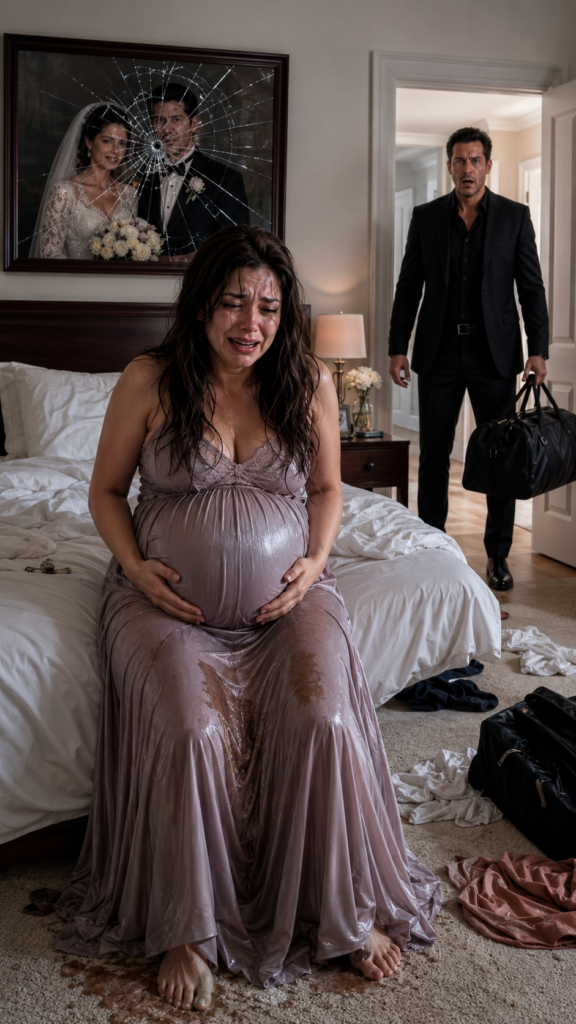
Clara lay on her side, at the edge of the bed, motionless.
She wore the pearl silk nightgown he had gifted her on their anniversary. Only something was wrong.
She had it on inside out.
The seams were exposed. The neckline hung crookedly over her back. The fabric looked strained, as if she had thrown it on in a rush, in the dark, with no strength left.
Diego swallowed hard.
Then he looked down.
The wedding portrait lay shattered on the white rug. The silver frame, bent. The glass, shattered. And on one corner of the crystal, a fresh stain of blood.
Red.
Bright.
Impossible to ignore.
The bouquet fell from his hands.
For a few seconds, Diego understood nothing.
Then, like poison, a phrase returned to his mind.
His mother, Doña Rebeca, had said it weeks earlier, in that soft voice she used to sow doubt:
—Son, don’t think you know everything about the woman you married.
Diego had brushed it off.
But now, seeing the nightgown inside out, the broken portrait, and the blood on the floor, his mind began to weave a horrible story.
Had someone been here?
Was there a fight?
Had a man run out before he arrived?
And then came the thought that made him feel the most disgust for himself:
What if the baby wasn’t his?
Diego clenched his fists.
For almost sixty seconds, he didn’t move.
He didn’t ask.
He didn’t run.
He didn’t touch Clara.
He just stood there, silently judging her.
Until she trembled.
Not as someone waking up.
But as someone fighting against unbearable pain.
Clara brought both hands to her belly and let out a weak moan that shattered his soul.
—Clara?
She barely turned her face.
She was pale, drenched in cold sweat. Her lips were dry, and her eyes were filled with terror, not guilt.
With the little strength she had left, she whispered:
—Diego… I called… so many times…
And in that instant, he understood that while he suspected her, his wife was fading before his eyes.
PART 2
Diego rushed across the bedroom, as if those sixty seconds of paralysis were burning his skin.
He knelt beside Clara and took her hand. That’s when he saw the cut.
Her palm was open from a shard of glass from the portrait. Blood ran between her fingers, but that wasn’t what scared him most.
What left him breathless was the way Clara clutched her belly.
Her fingers dug into the fabric of the nightgown, her breath came in gasps, and her eyes seemed to lose focus with each passing moment.
—My love, what happened? —Diego asked, trying to sound calm, though inside he was shattered.
Clara swallowed hard.
—I felt a really strong pain… I thought it was normal… then I tried to get up for water and got dizzy.
She looked down.
—I dropped the glass… cut myself on the frame… I tried to change because I was wet, but I couldn’t see well… that’s why I put the nightgown on like this.
Diego felt something inside him break.
The nightgown inside out wasn’t a sign of betrayal.
It was a sign of desperation.
The portrait hadn’t broken in a fight.
It had shattered because Clara had fallen while trying to get help.
And the blood wasn’t proof of infidelity.
It was proof that she had been alone.
Diego searched for Clara’s phone among the sheets. He found it on the floor, the screen cracked but lit up.
There were 18 missed calls from him.
2 failed attempts to dial 911.
And one answered call lasting 3 minutes with his mother.
Diego felt a chill in the back of his neck.
—Did you talk to my mom?
Clara closed her eyes.
A tear rolled down her temple.
—I asked her to send an ambulance… I told her I couldn’t move.
Diego tightened his grip on the phone.
—And what did she say?
Clara took her time answering.
As if even sick, she wanted to protect him from the truth.
—That I should stop being dramatic… that pregnant women of old didn’t whine over anything.
Diego fell silent.
—She also said… that I probably just wanted to get your attention so you’d come back early.
Diego’s jaw trembled.
For the first time in his life, he felt no respect for his mother.
He felt fear of what that woman was capable of provoking with her prejudices disguised as advice.
Clara doubled over in pain again.
That snapped him out of his shock.
Diego didn’t waste another second. He wrapped her in his jacket, placed a clean towel over her wounded hand, and called 911 from his phone.
But when he heard that the ambulance could take time due to traffic on Viaducto, he made a decision.
—We’re leaving now.
He carefully carried her to the car.
Each step down the building felt like an eternity. Clara moaned softly, apologizing as if her pain were an inconvenience.
—Don’t apologize, please —Diego told her, his voice breaking—. Just hang in there, my love. We’re almost there.
The drive to Angeles Hospital was a nightmare.
Red lights. Horns blaring. A truck blocking the way. People yelling as Diego drove like a man possessed.
But he only looked in the rearview mirror at Clara, lying in the back seat, struggling to breathe.
Halfway there, she murmured:
—Diego…
—I’m here.
—If something happens… don’t let your mom decide for me.
That phrase hit him like a punch.
Because Clara didn’t just fear for their baby.
She feared that even on a stretcher, someone would erase her.
Upon arriving at the hospital, the doctors attended to her immediately.
Diego tried to follow her, but a nurse stopped him.
—Sir, you need to wait here.
—She’s my wife.
—And that’s why we need you to let us work.
The doors closed.
Diego remained in the waiting room, his shirt stained with blood, hands trembling, and guilt gnawing at his chest.
There, sitting under a cold, white light, he recalled those sixty seconds.
The way he had looked at Clara.
The ease with which he had let doubt creep in.
The speed at which he believed a dirty story before asking if she was okay.
He hadn’t said anything out loud, but his silence had already condemned her.
Almost two hours later, a doctor emerged with a serious expression.
—Family of Clara Mendoza?
Diego shot up.
—I’m her husband.
The doctor took a deep breath.
—You arrived in time. Your wife had a serious complication and was entering fetal distress. We are stabilizing her now. The baby is responding, but we will keep her under observation.
Diego brought his hands to his face.
—Are they going to be okay?
—For now, yes. But I’ll be clear: another delay could have changed everything.
Another delay.
Diego closed his eyes.
He didn’t think first of his mother.
He thought of himself.
Of his pause.
Of his doubt.
Of those miserable sixty seconds that he could never erase.
When he sat back down, he saw Doña Rebeca walk in.
She was impeccable, with a designer bag, perfect hair, and that expression of a woman who believes every hospital owes her explanations.
—Where’s Clara? —she asked without greeting—. I’ve come to speak with the doctors. You’re too agitated, Diego. I can make decisions.
Diego looked at her as if he could finally see her fully.
Not as the mother who raised him.
But as the woman who had sown poison in his marriage and who, when Clara asked for help, called her dramatic.
—You’re not going to decide anything —he said.
Doña Rebeca blinked, offended.
—Excuse me, what did you say?
—You’re not going in. You’re not going to see her. You’re not going to speak with the doctors. And you’re not going to get near my son until Clara wants it.
The woman let out a dry laugh.
—Oh, Diego, please. She’s manipulating you even from a hospital bed. Can’t you see how she is?
Diego took a step toward her.
He didn’t shout.
That was what threw her off the most.
—I saw the calls. I saw that she asked you for an ambulance. I saw that you left her alone.
Doña Rebeca's expression faded.
—I thought she was exaggerating.
—No. You decided she was exaggerating because you never loved her.
A nurse approached upon hearing the tension, but Diego raised a hand, calm.
—I want to indicate that my mother is not authorized to enter my wife’s room or receive any medical information.
Doña Rebeca opened her mouth, indignant.
—I’m your mother.
—And she is my family.
The blow was silent, but brutal.
For the first time, Doña Rebeca had no response.
Hours later, Clara awakened.
Her face was weary, her hand bandaged, and her belly covered with monitors. Diego sat by her side, his eyes red from lack of sleep.
When she saw him, she tried to smile.
—Is the baby?
Diego kissed her forehead.
—He’s fine. So are you. The doctors say we arrived in time.
Clara closed her eyes with relief.
But when she looked at him again, something changed.
—How long were you at the door?
Diego felt the question pierce his chest.
He couldn’t lie to her.
Not after everything.
—Almost a minute.
Clara said nothing.
She just looked at him.
And that silence hurt more than any accusation.
Diego bowed his head.
—I thought horrible things. I saw the nightgown, the frame, the blood… and I let my mom’s voice speak louder than yours. I have no excuse.
Clara turned her face toward the window.
Outside, dawn broke over the city, with that gray sky that sometimes seems to promise nothing.
—I called you 18 times —she said—. I didn’t need you to be perfect. I needed you to trust.
Diego pressed his lips together.
—I know.
—And when I saw you standing there… I thought you no longer believed me.
That phrase destroyed him.
Because the truth wasn’t that Clara had betrayed their marriage.
The truth was that he, for sixty seconds, had betrayed the trust he vowed to protect.
Three days passed in the hospital.
The baby was born prematurely but strong. A small, squawking boy from the first cry, whom they named Mateo.
When Diego held him for the first time, he cried without shame.
Not just from happiness.
But from fear.
Because he had almost lost everything by listening to the one who fed his doubts.
Doña Rebeca tried to appear two more times. She sent flowers, messages, audio recordings crying, saying that no one understood "a mother’s concern."
Clara didn’t respond.
Neither did Diego.
Weeks later, when Clara returned to the apartment with Mateo in her arms, the first thing she saw was the wall of the bedroom.
The wedding portrait was gone.
In its place, Diego had put a new photo: Clara in the hospital, disheveled, exhausted, holding Mateo against her chest.
Below it was a simple phrase:
"Family is defended by believing in it."
Clara stared at it for a long time.
—It doesn’t erase what happened —she said.
—No —Diego replied—. But I want to build something you truly deserve.
Clara didn’t forgive him overnight.
It doesn’t happen that way, even though novels make it seem easy.
There was therapy. There were uncomfortable conversations. There were nights when she cried, not knowing if the fear stemmed from childbirth or from feeling judged by the man she loved the most.
Diego learned to listen without defending himself.
He learned that saying sorry means nothing if one doesn’t change.
And he learned that a mother can raise a child, but she has no right to govern her marriage.
Time later, when someone in the family asked why Doña Rebeca no longer saw the child, Diego replied with a single thing:
—Because love isn’t enough when mixed with poison.
Many criticized him.
Others said he was exaggerating.
But Clara, with Mateo sleeping in her arms, understood that finally her husband had chosen.
He didn’t choose between his mother and his wife.
He chose between doubt and truth.
And sometimes that’s the decision that saves a family… even if it breaks another forever.