PART 1
—Sorry for being born, Leo.
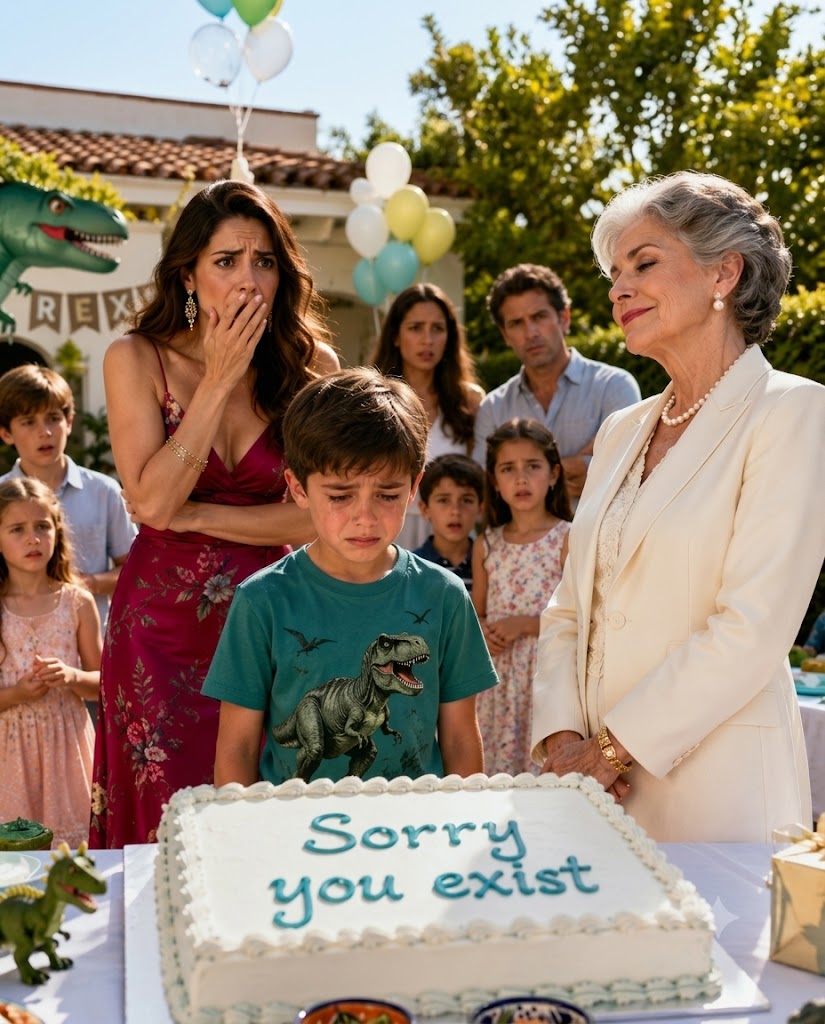
The letters were formed with blue icing, twisted but perfectly visible, on a white cake that was meant to be a birthday treat.
For a few seconds, no one spoke.
The backyard of the house, in a quiet neighborhood of Puebla, froze in the midst of yellow balloons, dinosaur plates, and children with cheeks stuffed with sweets. Eight-year-old Leo stared at the cake, as if he didn't quite understand if those words were meant for him.
Then he looked up at his grandmother.
Doña Graciela smiled.
Not a nervous smile. Not a smile from someone who had made a mistake. She smiled like someone who had finally said something she had held onto for years.
Camila felt the blood drain to her feet.
She had prepared this party for two weeks. It wasn't an extravagant party, but it overflowed with love: a T-Rex piñata, a sweet table, sandwiches, hibiscus water, and simple decorations Leo had chosen with excitement.
Leo wasn’t an exuberant child. He was sensitive, quiet, one of those kids who preferred to draw fossils rather than play soccer in the street. He struggled to make friends, but this year he had finally invited ten classmates from school.
For Camila, this birthday was important.
She wanted her son to feel celebrated, not tolerated.
But in her husband Adrián’s family, there always loomed a shadow: Doña Graciela.
Graciela Salvatierra was 68 years old, went to mass every Sunday, coordinated collections for needy families, and posted quotes on Facebook about love, values, and family unity. In the neighborhood, everyone knew her as a decent lady.
Within the family, however, she was poison wrapped in a rosary.
Since Camila married Adrián, Graciela treated her like an intruder. She called her “mijita” with fake sweetness, but every word came with thorns.
—Adrián has always been too much man for someone so simple —she once commented, in front of everyone, during a meal.
Camila remained silent.
She did it for peace. For respect. For not making Adrián uncomfortable. For that oh-so-Mexican idea that “family must be endured.”
When Leo was born, Graciela barely held him.
—He’s a bit weird, isn’t he? Very whiny —she said.
Adrián, as always, clenched his jaw and murmured:
—Ignore her, love. That’s just how my mom talks.
That’s how she talked when she gave Leo’s cousins new toys while giving him used books. That’s how she talked when she said Leo seemed like a “little girl” for crying. That’s how she talked when she sent him to sit far away because “that boy always makes things uncomfortable.”
Camila swallowed too many things.
Until that Saturday.
The week before, Adrián told her that his mom wanted to bring a cake.
Camila tensed.
—I already ordered one. The dinosaur one that Leo chose.
—Yeah, but she wants to feel included.
—Your mom never wants to feel included with Leo, Adrián. She wants to control.
He sighed, tired.
—Please. Let’s not start. Maybe this time she really wants to do something nice.
Camila agreed with one condition: the cake could only say “Happy birthday, Leo.”
Adrián promised to talk to Graciela.
But Graciela arrived late, wearing a cream-colored dress, painted lips, and a rectangular box in her hands. She entered the yard as if the party belonged to her.
—Kids, come here. I brought a special cake for the birthday boy.
Leo ran excitedly, his hands dirty from playing excavator. His friends approached, as did several parents.
Graciela opened the box.
“Sorry for being born, Leo.”
Leo read silently. His little mouth moved slowly. Then he looked at his friends, at his grandmother, and finally at his mom.
He didn’t scream. Didn’t protest.
His face just went blank.
Then he ran toward the house.
The door to his room slammed shut.
Camila wanted to follow him, but first, she looked at Graciela.
—What did you do?
The old woman lifted her chin.
—What you never dared to do. That boy needs character. You’re raising him as if the world owes him applause.
By 3 PM, the party was empty.
The piñata hung idle. The dinosaur cake remained untouched. The chairs were in disarray. And Leo was locked in his room, quietly crying.
That night, while Camila sat in front of her son’s door, Adrián said in the living room:
—My mom went too far, yes, but let’s not make this bigger.
Camila slowly stood up.
She looked at him as if she didn’t recognize the man she had been married to for ten years.
And in that moment, she understood that what was coming would not only break Graciela.
It would also show Adrián who he had really been all this time.
PART 2
Leo didn’t leave his room for two days.
Camila left him food on a tray: soup, toast, fruit, cereal, jello. Everything returned almost untouched. He only drank water and responded in a voice so soft it felt like it didn’t belong to him.
—I’m not hungry, Mom.
The boy who had counted the days until his party now didn't want to see photos, talk to his friends, or return to school. He asked Camila to put away his dinosaur shirt because he didn’t want to wear it anymore.
That broke something inside her.
Graciela didn’t apologize.
Not a call. Not a message. Nothing.
Adrián did talk to her, but Camila listened from the kitchen. There were no shouts. No boundaries. Just that warm voice he used when he wanted to please everyone.
—Mom, honestly, that was wrong. You shouldn’t have done it in front of the kids.
Camila closed her eyes.
In front of the kids.
As if the problem were the audience, not the cruelty.
On the other side, Graciela responded so loudly that it could be heard in the hallway:
—Your wife is exaggerating, Adrián. That boy needs to become a little man. If he crumbles over a phrase, imagine when life hits him for real.
Camila waited.
She waited for her husband to say: “Don’t ever come near my son again.”
She waited for him to finally choose Leo.
But Adrián only replied:
—We’ll talk later.
That dawn, Camila called her aunt Rosalba, the woman who had raised her after her mother died.
—I can’t do this anymore, aunt —she said, her voice breaking.
Rosalba listened without interruption. The cake, the phrase, Leo’s isolation, Adrián’s cowardice, Graciela’s smile.
In the end, she simply said:
—Honey, that woman doesn’t fear the damage she does. She fears being seen for who she really is.
Camila stood still.
Because it was true.
Graciela lived off her image. In the parish, they called her “an example.” She organized charity breakfasts, gathered food supplies, and flaunted pictures with poor children as if charity could erase what she did at home.
For ten years, Camila had protected her reputation.
Not anymore.
The next day, she wrote to Rebeca, Adrián’s sister.
They weren’t friends. Rebeca always avoided problems with her mother. But Camila knew she had seen things too.
“Your mom humiliated Leo in front of 10 kids with a cake that said ‘Sorry for being born.’ I’m going to tell the truth. If you have something to say, tell me now.”
The response came 20 minutes later.
“I thought you’d never dare. She’s done things to my kids too. I have recordings.”
Camila stared at the screen.
It wasn’t just Leo.
Rebeca sent her screenshots, dates, and messages. She told her how Graciela called her daughter Paulina “fat” when she was 9. How she told her grandson Bruno he was useless because he didn’t win a competition. How she used expensive gifts to manipulate and emotional punishments to control.
Then three moms from the party wrote.
One said: “My son asked me why Leo’s grandmother hates him.”
Another sent a photo of the cake.
The third wrote: “Sorry for not saying anything there. It was abuse.”
Camila gathered everything in a folder: screenshots, recordings, testimonies, exact dates. She didn’t want to shout without evidence. She wanted Graciela to be unable to hide behind her favorite word: exaggerated.
On Wednesday night, Adrián found her printing pages.
—What is that?
—The truth.
He paled.
—Camila, please. Don’t make a scene.
She looked at him with a calmness that even scared her.
—Your mom made our son believe that asking for forgiveness for existing was normal. And you’re worried about a scene.
—She’s still my mother.
—And Leo is still your son. Honestly, Adrián, how sad that I have to remind you of that.
He didn’t respond.
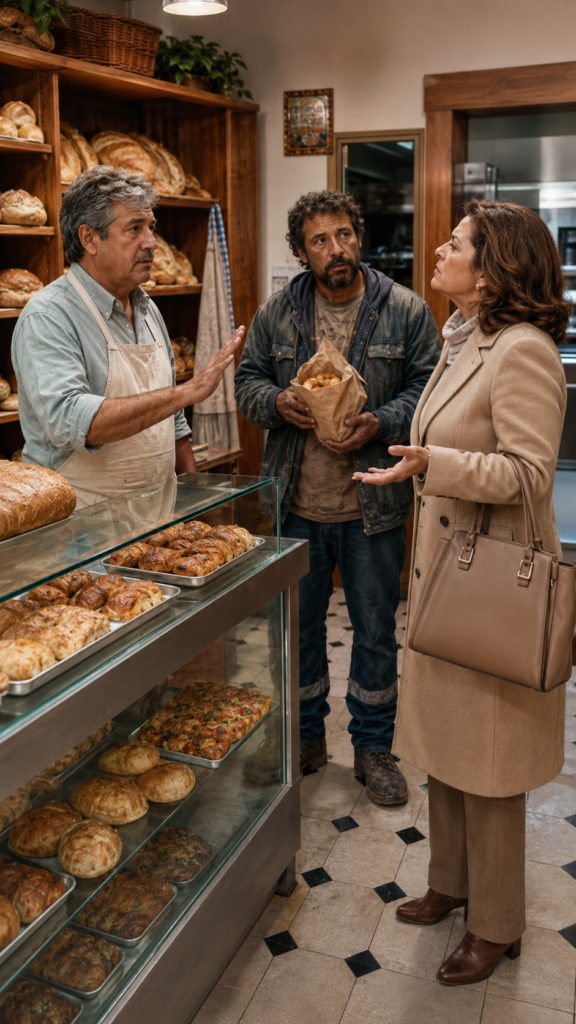
On Thursday morning, Camila went to a bakery. She ordered a white cake with blue letters.
The girl at the counter asked:
—What message do we put?
Camila took a deep breath.
—Write: “Sorry for being born, Graciela.”
At 10:30, she arrived at her mother-in-law’s house.
There were several cars parked. It was the day for the parish group meeting.
Camila entered without knocking.
The living room smelled of coffee, sweet bread, and expensive perfume. Eleven women sat with porcelain cups, notebooks, and rosaries on their wrists. Graciela was at the center, talking about a collection for vulnerable children.
When she saw Camila, she stiffened.
—What are you doing here?
Camila walked to the table.
—I’ve come to return something to you.
She placed the box in front of her and lifted the lid.
“Sorry for being born, Graciela.”
A murmur swept through the room.
—What a horror! —said one lady.
Graciela jumped up.
—Are you crazy? How dare you?
Camila didn’t blink.
—with the same ease you brought one like it to my son’s birthday. The difference is he’s 8. You’re old enough to understand shame.
The women exchanged confused glances.
Graciela let out a dry laugh.
—Don’t listen to her. My daughter-in-law has always been contentious.
—Not today —Camila said—. Today you’re not going to hide behind that.
She opened the folder and began distributing copies.
The sheets had dates, phrases, photos, and testimonies. They were not rumors. It was a story of abuse disguised as “character.”
“Christmas 2023: Graciela told Leo that his parents didn't have more children because they didn’t want another weird kid.”
“Family meal, April 2024: Graciela said in front of everyone that Leo cried like a girl.”
“Leo’s 8th birthday: she brought a cake with the phrase ‘Sorry for being born’ and said someone had to educate him.”
An older woman, named Carmen, stopped reading and looked at Graciela.
—Is this true?
—It’s manipulated —she replied—. Camila has always wanted to separate me from my son.
Camila took out her cell phone.
—Then listen to your voice.
She played an audio that Rebeca had sent her.
Graciela’s voice was heard clearly saying:
—Those kids need to have their pride broken from a young age. If not, they become weak like Leo, who seems to have been born to be a nuisance.
The audio ended.
No one spoke.
Not even Graciela.
Camila put away her phone.
—For years, you called me exaggerated. You told me I didn’t know how to endure jokes. You told me a good daughter-in-law stays quiet. And I kept quiet too much. But my son wasn’t born to endure your cruelty.
Graciela pressed her lips together.
—You made him weak.
—No. You confused love with domination.
Carmen slowly stood up. She had been friends with Graciela for over 20 years.
—Graciela, look at me and tell me you didn’t have that cake made.
Graciela didn’t answer.
—Tell me.
The mask cracked for the first time.
She looked at the women, searching for support, but no one defended her.
—It was a lesson —she finally said—. A necessary lesson. That boy can’t grow up thinking everyone has to applaud him.
A woman placed her hand on her chest.
—It was his birthday.
—And life isn’t always going to celebrate his existence —Graciela spat.
Camila felt pain, but also a cold clarity.
—Thank you.
Graciela furrowed her brow.
—Thank you for what?
—For saying it in front of them. I brought evidence, but you just showed them your soul.
Carmen grabbed her bag.
—I can’t stay seated here any longer.
Another woman stood up. Then another. The chairs began to move. Half-full cups were left behind. Open notebooks. Forgotten rosaries.
Graciela tried to stop them.
—Are you going to believe this woman?
Carmen replied from the door:
—We don’t believe her. We heard you.
When the room was almost empty, Camila placed the cake in front of Graciela.
—This is yours.
—Adrián will find out.
—He already knows I came.
—He’s going to leave you.
Camila thought of Leo locked away for two days without eating. She thought of his eyes reading that phrase. She thought of all the times she had swallowed her anger to avoid breaking the family.
Then she understood something.
The family was already broken.
It was just that everyone walked slowly among the pieces to avoid making noise.
—If Adrián leaves me for protecting our son, then I will also know who he is.
Graciela trembled with rage.
—You can’t take my grandson from me.
—I’m not taking him. You lost him when you decided to humiliate him to feel powerful.
Camila spoke louder:
—You will never see him again. Not on birthdays, not on Christmas, not at school, not through calls, not through gifts. If you try to approach, this folder will be received by the whole family, the parish, and everyone who still believes you’re a saint.
Graciela whispered:
—You’re cruel.
Camila shook her head.
—Cruel was smiling while an eight-year-old boy read “Sorry for being born.” This is called consequence.
She left without running.
In the car, she cried. Not out of triumph. She cried for having taken so long.
When she got home, she found Leo in the kitchen. He had a plate of cereal in front of him and swollen eyes.
—Did you go to my grandmother’s? —he asked.
Camila sat beside him.
—Yes.
—Did she get mad?
—Yes.
—Is it my fault?
Camila took his hand.
—No, love. None of this is your fault. I went because no adult has the right to make you feel like you’re a nuisance in this world.
Leo lowered his gaze.
—Do I not have to see her anymore?
—No. Not if you don’t want to. And I won’t force you.
The boy breathed as if he could finally rest.
That afternoon, they made a chocolate cake. It came out crooked, with runny icing and ugly letters, but it said: “Happy birthday, Leo.”
When Camila lit eight candles, Leo smiled a little.
Not like before.
But he smiled.
Adrián arrived after 7, pale, with his cell phone in hand.
—My mom called me 12 times.
Camila continued washing the dishes.
—I imagine.
—She says you humiliated her in front of her friends.
—No. I just stopped covering for her.
Adrián looked toward the living room, where Leo was eating cake and watching cartoons. Something in his face cracked.
—She asked me to demand an apology from you.
Camila turned off the tap.
—And are you going to do it?
He sat down, his eyes filled with shame.
—No.
For the first time, he didn’t defend his mother.
—When Leo ran to his room, I knew she had done it to hurt him. But I did the usual thing. I downplayed it because confronting my mom scares me.
His voice broke.
—I’m sorry. I failed him.
Camila felt love and rage at the same time.
—Yes, you failed him. And it’s not enough to cry. You’re going to have to show him that you really are his dad now.
Adrián nodded.
That week they sought family therapy. Adrián began to set boundaries. He didn’t answer Graciela’s calls. He didn’t accept gifts. He didn’t allow manipulation.
Graciela posted phrases about ungrateful children and manipulative daughters-in-law. She claimed she was sick from the pressure. She called relatives to play the victim.
But something had changed.
Rebeca stopped taking her children to her. Carmen resigned from the charity committee. Several women from the parish asked that Graciela stay away for a while.
Her façade didn’t entirely fall apart, but it cracked enough for everyone to see what lay behind.
Leo took time to heal. He asked many times if his friends still liked him. The school supported him. Some kids made him drawings. His best friend gave him a sheet with a dinosaur and a phrase written with spelling mistakes:
“Sensitive dinosaurs are strong too.”
Leo taped it in his room.
Months later, he asked for a small party for his 9th birthday. Just five friends, pizza, and chocolate cake.
Before blowing out the candles, he looked at Camila.
—Now no one is going to write something mean?
Camila stroked his hair.
—Now no one will.
And no one did.
Because sometimes setting boundaries doesn’t destroy a family.
Sometimes it only reveals that the family was already destroyed by those who confused silence with respect.
Camila learned late that being good wasn’t letting others trample on you.
Being good was also standing up, closing a door, and saying:
—This far.
And Leo learned something that no cruel cake could take away from him.
That his existence didn’t need to apologize.
Those who owed an apology were those who thought they had the right to make him feel less.