PART 1
Doña Irene arrived at her son’s house with two grocery bags hanging from her arm and the banquet receipt folded inside one of the bags.
She didn’t ring the doorbell.
She never did.
This was Logan’s house, her only son living in Mexico City, and since he married Emilia, Irene had entered through the side door as if it were her own. Not out of friendly confidence, but because everyone assumed she was always available.
On that December afternoon, the Del Valle neighborhood was filled with Christmas lights, the scent of punch, and children shouting on the sidewalks. Irene had picked up fruits, napkins, chocolate for the grandkids, and a few bags of candy “just in case something was missing.”
Something was always missing.
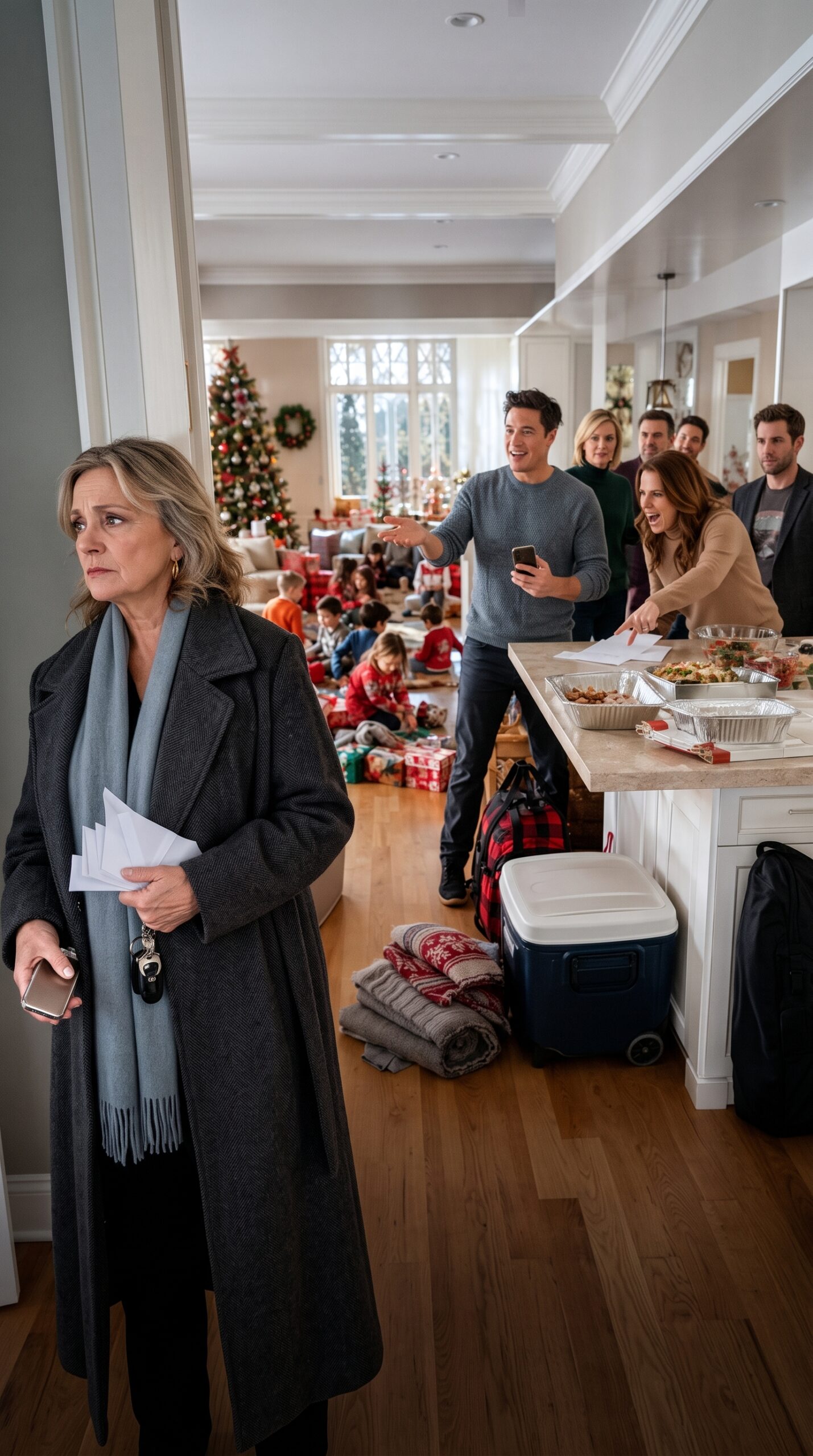
As she approached the kitchen, she heard Logan’s voice.
“Just leave the 9 kids with my mom,” he said, as if he were talking about putting a pot on the stove. “She doesn’t do anything anyway.”
Irene froze.
The grocery bag dug into her wrist. The banquet receipt, totaling 38,740 pesos, crinkled in her hand.
Then came Emilia’s laughter.
It wasn’t a nervous chuckle. It was a comfortable, conspiratorial laugh, the kind that stings because it confirms that the mockery had been brewing long before.
“Yeah, besides, she already paid for the food,” Emilia added. “The least we can do is have her take the kids upstairs and watch them while we eat in peace.”
Irene blinked slowly.
Upstairs would be Logan and Emilia’s four kids, Emilia’s three sister’s kids, and two cousins who “were just coming for a bit.” In total, nine kids running, crying, fighting over toys, asking for water, spilling food, staining couches.
And downstairs, the adults would toast with wine, laughing as if Grandma were part of the included service.
“My mom always says yes,” Logan finished. “Honestly, if she gets tired, she can rest later. Christmas is for family.”
Irene felt something sink in her chest.
She didn’t scream. She didn’t confront them. She didn’t make a scene.
She simply stepped back carefully, as if any noise could shatter what little dignity she had left.
She left through the same side door.
The cold air hit her face. She sat in her car and looked at her son’s house, lit up with a huge Christmas wreath at the entrance and an inflatable Santa moving in the yard.
For years, Irene had cared for sick kids, paid for cakes, brought medicine, washed other people’s dishes, and cooked for birthdays where no one saved her even a chair.
When the first grandchild was born, she slept eight nights on a couch so Emilia could rest. When the second was born, she cared for the first. Then more kids came, more favors, more “Mom, can you?” more “it’ll just be for two little hours.”
It was never just two little hours.
That night, upon arriving at her apartment in Narvarte, she placed the bags on the table and pulled out the banquet receipt.
38,740 pesos.
She had paid it without saying anything, thinking it would be her gift for everyone to enjoy. She had also bought toys, ordered desserts, and set aside two trays of romeritos because Logan had loved them since he was a child.
She sat in front of an old notebook and wrote two columns.
“What I’ve given.”
“What I’ve received.”
In the first, the words flowed like water bursting a dam: guards, meals, loans, school pickups, medicine, parties, piñatas, shopping, sleepless nights, emergency favors, laundry, washed dishes, swallowed tears.
In the second column, she didn’t write anything.
Not a single line.
At 3:16 AM, Irene opened her phone. She had a message from Logan:
“Mom, remember to arrive early on the 24th. Emilia says better by 2 to set everything up.”
Irene stared at the screen for a long time.
Then she opened the contact for the banquet company.
And when the operator answered, Irene said calmly:
“Good evening. I want to cancel all Christmas service.”
PART 2
The woman from the company asked her twice if she was sure.
Irene replied that she was.
She would lose part of her deposit, but they would refund 21,000 pesos. When she hung up, she didn’t feel guilt. She felt something stranger, something she hadn’t felt in years.
Relief.
Then she called her friend Nati, a 67-year-old woman who lived in Valle de Bravo and had been telling her for months:
“Come with me for Christmas, Irene. Here, no one makes you take care of kids. Here, you sit, eat, and laugh.”
Irene always replied the same:
“I can’t, Nati. Family comes first.”
But that morning, she understood something that broke her soul.
For her family, she was never first. Not second. Not third.
She was the backup plan.
Nati answered, half-asleep, but upon hearing her, she woke up completely.
“Do you still have room for me?” Irene asked.
“Oh, old friend, my house always has room for you,” Nati replied. “What happened?”
Irene didn’t tell everything. She just said:
“I’m tired of buying my place at the table.”
On December 23, Irene packed three changes of clothes, a jacket, her medicine, a book she had wanted to finish for months, and a red scarf she had knitted for herself.
She didn’t notify anyone.
Not because she wanted to punish anyone, but because she knew that if she did, Logan would speak to her in that concerned son voice that actually hid pressure. Emilia would say she was exaggerating. Emilia’s sister would make faces. And in the end, everyone would try to turn her pain into guilt.
Irene turned off her phone before leaving the city.
The road to Valle de Bravo was filled with families, trucks, coffee vendors, and cars with gift bows on the back seat. Irene drove slowly, tears in her eyes, remembering Logan as a child.
At seven, he had brought her a poorly made coffee to bed on Mother’s Day. He had put in so much sugar that it tasted like syrup, but Irene drank it as if it were the best coffee in the world.
That child existed.
The man who said “leave her with the 9 kids” also existed.
And that was the most painful part.
In Valle de Bravo, Nati welcomed her with a strong hug, one of those that don’t ask questions until you’re done breathing.
Her house smelled of firewood, cinnamon, and freshly made tamales. There were five more friends, all retired, each with stories of busy children, difficult daughters-in-law, demanding families, and years of silence to avoid discomfort.
Irene was given a cup of punch and a chair next to the fireplace.
“Sit down,” Nati said. “You’re not here to serve. You’re here to be.”
That phrase nearly made her cry.
On the night of the 24th, while at Logan’s house they must have been waiting for trays, desserts, gifts, and Grandma to arrive on time, Irene was eating bacalao with friends, listening to boleros, and laughing for the first time without worrying that a child would break something.
At 8:47, she turned on her phone.
She had 36 missed calls.
12 from Logan.
9 from Emilia.
6 from Emilia’s sister.
The rest were from numbers she didn’t even have saved.
There were also messages.
“Mom, where are you?”
“People have arrived.”
“The banquet hasn’t shown up.”
“What did you do?”
“The kids are unbearable.”
“Please answer.”
Logan’s last message said:
“This isn’t right. You left us alone.”
Irene looked at it and smiled sadly.
For the first time, they were experiencing what she always carried.
The phone rang again.
Logan.
Nati watched her from the couch, without intervening. She just squeezed her hand.
Irene answered.
“Mom, where are you?” Logan said, his voice tense. “We’re all here. The food didn’t arrive. Emilia is crying. The kids are going crazy. What’s wrong with you?”
Irene took a deep breath.
“I’m in Valle de Bravo.”
On the other side, there was silence.
“What? You went on vacation for Christmas?”
“Yes.”
“And you didn’t think to let us know?”
“Just like you didn’t think to ask me if I wanted to take care of 9 kids.”
Logan’s breathing changed.
“What are you talking about?”
“I was in your hallway,” Irene said. “I heard you say to leave all the kids with me because I ‘don’t do anything anyway.’”
Logan didn’t respond.
And that silence was a confession.
“Mom, that was a foolish comment. Don’t take it that way.”
“I’m taking it exactly as it was,” she replied. “Because it wasn’t a joke. It was a truth that slipped out.”
Emilia appeared at the back, shouting something.
“Tell her that because of her tantrum, she ruined Christmas!”
Irene closed her eyes.
“I didn’t ruin anything, Emilia,” she said calmly. “I just stopped financing a party where I was going to be hidden upstairs with the kids.”
“You’re the grandmother!” Emilia yelled. “That’s what grandmothers do!”
Irene felt her voice crack, but she didn’t yield.
“Grandmothers love. Grandmothers help if they want to. But they are not free employees. They are not waitresses. They are not automatic babysitters. And they are certainly not furniture to be used and ignored.”
Logan spoke more quietly.
“Mom, there are people here. You made us look bad.”
“No, son. You all looked bad when you planned to use me without asking. The difference is that this time I didn’t go to save you.”
There was a noise of dishes, children crying, someone saying, “So what are we going to have for dinner?” Logan seemed to breathe with contained rage.
“And the gifts?” he asked finally.
Irene looked at the bag where she had stored the toys. She hadn’t brought them.
“They’re with me.”
“Come on, Mom.”
“They’re not punishment. They’re consequence. I bought gifts because I wanted to celebrate with my family, not because I was obligated to pay for peace in a house where I’m not respected.”
Logan took time to respond.
When he did, his voice was no longer angry but lost.
“So… you’re not coming?”
“Not tonight.”
“And afterward?”
Irene looked at the fireplace, her friends quietly laughing to give her privacy, the warm cup between her fingers.
“Later we’ll talk. But not to convince me. We’ll talk when you’re ready to listen.”
She hung up.
This time, she didn’t turn off her phone. She just left it on the table, face down, like someone leaving a burden they no longer plan to lift.
On December 29, Logan and Emilia arrived at Irene’s apartment.
They didn’t notify her.
They knocked hard, as if the door had an obligation to open.
Irene opened it calmly. Logan looked exhausted. Emilia had her arms crossed and a hardened face that tried to hide embarrassment.
“You humiliated us,” Emilia said as soon as she entered.
“No,” Irene replied. “You humiliated yourselves by not knowing how to organize a dinner without using me.”
Logan clenched his jaw.
“Mom, you could have said something earlier.”
“I could have. But you all could have asked me beforehand. No one did.”
Emilia let out a dry laugh.
“Oh, please. You’ve always helped. We thought you liked it.”
Irene looked at her intently.
“I liked feeling loved. Not exploited. There’s a difference.”
The phrase left Emilia speechless.
Logan lowered his gaze.
“I didn’t know you felt that way.”
“Because you never asked.”
That blow was more powerful than any scream.
Irene walked to the table and pulled out the notebook. She opened it to the two columns and placed it in front of Logan.
He read “What I’ve given.” He turned a page. Then another. Birthdays. Guards. Money. Sleepless nights. Shopping. Emergencies. Meals. School. Illnesses.
Then he reached the empty column.
“What I’ve received.”
Logan turned pale.
“Mom…”
“I didn’t make that list to charge you,” Irene said. “I made it to realize that I was disappearing.”
Emilia sat down without asking. For the first time, she didn’t seem angry, but uncomfortable with herself.
“My mom always did everything,” she murmured. “I thought that’s how it was.”
Irene nodded.
“So did I. Until I heard myself become a useful burden.”
Logan covered his face with one hand.
“I’m sorry,” he finally said. “I’m sorry for saying that. I’m sorry for thinking you’d always be there even if we treated you like this.”
Irene didn’t rush to hug him.
She would have done that before. She would have calmed his guilt, would have said, “It’s okay,” would have returned to the same place.
This time, she didn’t.
“I forgive you when your actions change,” she said. “Not when your words sound nice.”
Emilia took a deep breath.
“What do you need?”
Irene took the notebook and wrote in front of them.
“1. If you want help, you ask for it in advance.”
“2. If I say no, it should be respected.”
“3. At family gatherings, I’m invited, not assigned.”
“4. I won’t pay for food, gifts, or emergencies to buy love.”
“5. If I go to a dinner, I sit at the table.”
Logan read each point as if they were rules of a new country.
“Okay,” he said softly.
“It’s not going to be easy,” Irene warned. “You’re used to me carrying the load. And I’m used to carrying the load. We all have to learn.”
Emilia cried silently.
It wasn’t a perfect scene. There was no music, no dramatic hug, no complete forgiveness. Just three adults facing an uncomfortable truth: a family can also hurt when it confuses love with availability.
The following year, Christmas was different.
Not perfect.
Different.
Logan invited Irene with three weeks' notice. Emilia organized a potluck: everyone brought something. The kids had chores. Emilia’s sister complained, as always, but this time no one played along.
When Irene arrived, she found a reserved chair for her at the table.
On the plate was a card written by one of her grandkids:
“Grandma Irene, you’re not here to work. You’re here to have dinner with us.”
Irene read the phrase twice.
Logan, from the kitchen, looked at her with teary eyes.
“Merry Christmas, Mom,” he said. “Sit down. We’ll serve.”
Irene sat down.
And while she listened to the noise of the kids, the dishes, the laughter, and the adults finally getting up to resolve what they used to throw at her, she felt something that couldn’t fit into any family photo.
It wasn’t revenge.
It was dignity.
Because sometimes family doesn’t learn when one keeps giving.
Sometimes they learn when one finally stops being available to keep being broken.