PART 1
—God knew those babies needed a better mother.
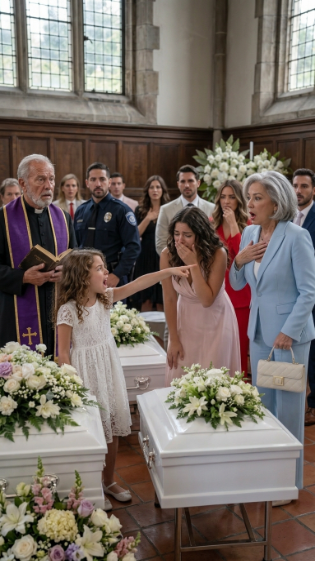
Ofelia Barragán's voice cut through the Guadalajara funeral home as all eyes turned to the two white coffins draped in roses.
Daniela Montes felt the floor vanish beneath her feet.
Inside those tiny boxes lay Gael and Bruno, her three-month-old twins, the children she had waited six long years for, now being laid to rest without understanding why they had stopped breathing that very morning.
Ofelia stood by the coffins, rosary in hand, her makeup untouched.
She was not crying.
She only raised her chin, as if the funeral were a trial and she had already delivered her verdict.
—I tried to help her—she continued—. But there are women who confuse love with chaos. She carried them all the time, didn’t respect schedules, and was always tired.
Several aunts from the family nodded in agreement.
Someone murmured that three children were too much for Daniela.
Another suggested that maybe the twins had died due to negligence.
Daniela wanted to scream that she had never left them alone, that she noted every feeding and had taken the babies to the pediatrician when she noticed they slept too much.
But her throat betrayed her.
Beside her, her husband, Mauricio Barragán, stared at his shoes.
Not even when Ofelia attacked her again did he lift his head.
—God doesn’t make mistakes—said the woman—. Sometimes He protects children by taking them from places where they are not safe.
Daniela turned to Mauricio.
She waited for a defense, a single phrase, any sign that their eleven years together still meant something.
He barely whispered:
—Mom, that’s enough.
Ofelia smiled with disdain.
—No, son. The truth must also be spoken at funerals.
Daniela’s parents suppressed their rage while Mauricio’s family watched her as if she bore the guilt written across her forehead.
Then a small hand sought hers.
It was Renata, her seven-year-old daughter.
She wore a black dress, her hair in two messy braids, and a purple bag slung across her chest. She squeezed her mother’s fingers three times, her secret signal to say “I love you.”
—Mommy—she whispered—I know why my little brothers didn’t wake up.
Daniela looked at her, confused.
Before she could ask, Renata released her hand and walked to the front.
Her shoes echoed on the marble.
Ofelia paled.
—Come here, child—she ordered.
Renata did not obey.
She stood next to the priest, opened her bag, and pulled out an old cell phone with a cracked screen.
—Grandma—she said with a clarity that froze everyone—, you said no one would believe me because I’m a girl.
Mauricio lifted his head for the first time.
Renata turned on the phone.
—But I took pictures of what you put in their bottles… and I also recorded what Dad did when I told him.
Ofelia’s rosary fell from her hands.
Daniela felt the air leave the room.
And when the first image appeared on the screen, she realized that the death of her children concealed an even more monstrous betrayal.
PART 2
Three months earlier, Daniela’s house seemed full of life.
They lived in a private neighborhood in Tlajomulco, in a home adorned with bougainvillea and a patio where Renata rode her pink bicycle.
The twins’ room had sky-blue walls and two cribs that Mauricio had assembled, swearing he would be the best father in the world.
Gael and Bruno had arrived after costly treatments, injections, and two losses that Daniela seldom mentioned.
When they were born, Mauricio cried.
Ofelia pretended to be emotional as well.
She brought blessed medals and embroidered blankets, but before leaving the hospital, she unleashed her first criticism:
—I hope you don’t make them delicate children. Babies need discipline from the start.
Daniela chose not to argue.
During the first weeks, she worked from home designing for restaurants. She slept little and sometimes forgot to eat, but she never stopped caring for her children.
Renata was her most enthusiastic helper. She sang to them, arranged their socks, and alerted her mom when one of them breathed oddly.
The trouble began every Tuesday and Thursday.
Those days, Mauricio traveled as a representative for a pharmaceutical lab, and Ofelia came over “to lend a hand.”
She had a copy of the key because her son insisted.
—Don’t be paranoid, Dani—Mauricio would say—. My mom raised four kids. She knows more than we do.
Ofelia walked in without knocking, rearranging furniture, changing the formula’s location, and correcting everything.
—You fold the clothes wrong.
—You carry them too much.
—A good mother doesn’t need to consult the pediatrician about every little thing.
Daniela began to feel like a guest in her own home.
One night, Renata asked her why her grandma treated her like she was useless.
Daniela replied that it was just adult differences.
The girl shook her head.
—No, Mommy. She wants you to think you’re doing everything wrong.
Daniela hugged her and told her not to worry.
But Renata was already worried.
One Thursday, she pretended to have a stomach ache to stay home. While Daniela managed a video call in the bedroom, the girl went to the kitchen for water.
There she saw Ofelia with two open bottles.
On the table sat Mauricio’s black briefcase.
The grandmother pulled out a sample jar, crushed some pills with a spoon, and let the powder fall into the milk.
Renata froze.
Ofelia caught her in the doorway.
For a moment, they both stood in silence.
Then Ofelia smiled.
—Those are vitamins to help them sleep well. Your mom makes them nervous and then plays the victim.
—That doesn’t look like a vitamin—retorted Renata.
The smile vanished.
Ofelia crouched down to be at eye level with her.
—Children who invent things destroy families. And no one believes a lying girl.
That day, the twins slept for almost seven straight hours.
Daniela tried to wake them to feed them, but they barely reacted.
—Finally, they’re getting into a rhythm—Ofelia assured—. See how they rest with me?
Renata started jotting everything down in a school notebook.
Dates, times, phrases, and the way the babies became too still after drinking the bottles prepared by their grandmother.
She even rescued an old cell phone that Daniela had given her to play with.
From the hallway, she took several photos.
In one, the jar was visible; in another, the spoon over the milk; and in another, Ofelia shaking both bottles.
But Renata wanted to do something more.
One night, when Mauricio returned from León, he entered his study and showed him one of the images.
—Dad, Grandma is putting medicine in the babies’ milk.
Mauricio glanced at the screen for just a few seconds.
His face changed.
He recognized the jar: it was a controlled sedative he had brought as a sample for specialist doctors.
—Where did you get this?—he asked.
—from your briefcase.
Mauricio snatched the phone from her.
Renata, scared, accidentally activated the recorder.
—Don’t tell your mom—he ordered—. Grandma must’ve just confused things. I’ll talk to her.
—But the babies don’t wake up right.
—Renata, enough. Don’t make a scene.
The girl left in tears.
From the hallway, she heard her father calling Ofelia.
—Mom, did you take a jar from my briefcase?
There was a pause.
—You can’t use that with the kids—said Mauricio in a low voice—. It’s dangerous.
Renata waited for him to shout, to call Daniela, to rush and check on her brothers.
But Mauricio only added:
—Get rid of the jar and don’t ever do that again. Daniela already thinks you’re crossing lines. I don’t want another fight.
That phrase etched itself in her mind.
Mauricio didn’t know the phone was still on.
Nor did he know Ofelia wouldn’t obey.
The night before the twins' death, she returned to the house. She said Mauricio had asked her to help because Daniela looked exhausted.
She prepared the last two bottles while Renata watched from her hiding spot on the stairs.
This time, she used more powder.
—Now they’ll sleep like angels—she murmured.
At 4:38 in the morning, Daniela woke up to silence.
Gael was cold.
Bruno wasn’t breathing either.
The ambulance arrived too late.
During the initial investigation, Mauricio stated he had never noticed missing medications and that his mother never touched his briefcase.
Daniela, shattered, questioned nothing.
Ofelia took advantage of the chaos to spread rumors: that Daniela fell asleep, that she didn’t keep schedules, that she might have mixed the formula wrong.
That’s why she felt so secure in the funeral home.
Until Renata turned on the cell phone.
The first photo showed Ofelia leaning a spoon over a bottle.
The second allowed them to read the label on the sedative.
The third displayed Mauricio's briefcase open on the table.
A murmur swept through the room.
—That doesn’t prove I gave them anything—Ofelia said, trembling—. The girl is confused.
Renata opened the audio.
Mauricio’s voice filled the funeral home:
“Don’t tell your mom… I’ll talk to her.”
Then they heard the call.
“You can’t use that with the kids… Get rid of the jar and don’t ever do that again.”
Daniela slowly turned to her husband.
—You knew.
Mauricio lost color.
—I didn’t know she would keep doing it.
—But you knew she had already done it.
He began to cry.
—I thought it was just once. I thought I could control her.
Daniela slapped him.
It was the blow of a mother who had just discovered that her children could have been saved.
—You preferred to protect her instead.
Ofelia tried to snatch the cell phone from Renata, but Daniela's father intervened.
—You don’t touch my granddaughter.
The woman lost control.
—I just wanted them to sleep! That girl couldn’t handle them! Always tired, always crying, always making my son feel guilty.
Daniela stepped toward her.
—You drugged three-month-old babies to prove I was a bad mother?
—They were small doses.
—My children are in two coffins.
The priest called the police.
Renata also pulled out the notebook where she had recorded six occasions. The last entry said Ofelia had promised that “nothing would wake them.”
When the officers arrived, the funeral home was chaos.
Ofelia kept shouting that she had done it all for the good of the family.
Mauricio sat on the floor, repeating that he never imagined his mother could go so far.
Daniela hugged Renata: her daughter had asked for help and the adult who was supposed to protect her chose silence.
The prosecutor reopened the case.
Toxicology tests confirmed lethal levels of the sedative in Gael and Bruno’s bodies.
At Ofelia’s house, they found searches about doses, deep sleep, and respiratory depression in infants.
They also discovered messages where she claimed Mauricio would depend on her again when Daniela failed.
The crime hadn’t stemmed from impulse.
It had been born of control.
Ofelia wanted to prove Daniela was incapable, reclaim authority over her son, and become the only indispensable woman in the family.
Mauricio was investigated for withholding information and lying during the first statement.
He hadn’t administered the medication, but his silence had allowed his mother to return.
Months later, during the trial, Ofelia presented herself as a sacrificial grandmother who had made “a mistake.”
Her lawyer blamed fatigue and insisted she never intended to kill the children.
Then they played Renata’s audio.
Next, they showed the photos and read the notebook.
The girl testified accompanied by a psychologist.
—My grandma said nobody would believe me—she explained—. My dad did believe me, but preferred my mom not to find out.
Mauricio lowered his head.
That phrase condemned him in a way no sentence could match.
Ofelia received a sentence that would keep her in prison for the rest of her life for the deaths of the two babies.
Mauricio was prosecuted for concealment and falsehood, in addition to temporarily losing unsupervised visitation with Renata.
Daniela filed for divorce.
When he asked for forgiveness, she didn’t scream.
—Your mother gave them poison—she said—but you kept quiet when they were still alive.
Daniela moved with Renata to Mazatlán, near her parents.
They took two blankets, the photographs of the twins, and the purple notebook.
The girl began therapy because she dreamed she spoke and no one could hear her.
One night, she asked if her little brothers knew she had tried to save them.
Daniela hugged her tightly.
—You were a child. Protecting them was the adults’ responsibility. The guilt was never yours.
A year later, both visited Gael and Bruno’s grave.
Renata left a letter next to the flowers.
She wrote that she was no longer afraid to tell the truth, even if the adults got angry.
Daniela cried as she read it.
Her children would not return, but Ofelia’s mask had fallen, and Mauricio would have to live with the price of his cowardice.
Because evil does not always enter a home by breaking down the door.
Sometimes it enters with a borrowed key, a rosary in hand, and the phrase “I just want to help.”
And sometimes an entire family is destroyed not just by who harms, but by who sees the signs, knows the truth, and chooses silence to avoid discomforting the wrong person.